
Game Plan
Way back in the earliest days, before we had met Zooniverse, Ali, I, and several undergraduates were brainstorming a website. Ali had already put together an interface to enable her assistants to help identify images, and it was successful enough that we knew that a website would work. But her existing interface was not scalable to large numbers of people, and we wanted to get the general public involved. So what to do?
Since we wanted people to stick around on our website for a while, we decided that we ought to embed the animal identification process in a game. We thought about several different game types, including adventure games, ones in which players “collect” the animals they identify, and even puzzle games. Here is a mock screenshot of one adventure game we imagined:

In this one, the idea was that you played as if you were an animal. Here you’re a lion with giraffe and porcupine sidekicks. You’d get a series of challenges based on the life of your character. For example, as a young lion, you’d learn to hunt for food. To do so, you’d identify animals in images and add them to a temporary collection (at bottom right). If enough people agreed with you about the identification, the image would become available to satisfy the challenge. So if the identified animal was a Thomson’s gazelle for instance, you’d be able to cash it in to satisfy the “learn to hunt” challenge. Once you’d accumulated enough prey items, you’d get a new challenge or you could switch to a different character. We envisioned various score metrics – a percent of images identified “correctly”, a count of images identified, and some sort of score that took into account how many challenges you had completed. We also thought about a social component where users could showcase their finds, trade collected animals, and chat with one another.
Of course, there were drawbacks to this sort of game. You’ll notice that there’s no way to indicate the number or behavior of animals in the images, and we hadn’t yet come up with a way to deal with the sets of three images that usually get taken during the daytime. We also worried about perverse incentives: we imagined someone so intent on winning, that they mis-identified images so as to more quickly accomplish the challenges.
It was François Boucher-Genesse who first suggested to us that a game concept might not be necessary. François consults for the Center for Game Science at the University of Washington, which is known for its acclaimed science game Foldit. I had contacted him to understand more about how to design a good science game. But he pointed out that in our case, a game hid the scientific side of the endeavor and played down the usefulness of identifying the images. He pointed out that the images were compelling enough that a game might not be necessary.
Soon afterwards, we were contacted by Jonathan Brier, a social computing researcher who had come across Ali’s original small-scale interface. He introduced us to the Zooniverse. And the rest, as they say, is history.
No post today!
Hi all – sorry, no post today — on two days holiday for the “Royal Bush Wedding” as we’ve dubbed it.

Felix and Laura are cornerstones of our small Serengeti Community. Congratulations to a wonderful couple, wonderful friends, and two people I couldn’t imagine Serengeti life without.
SuPer Qt, the Super Cute Lion
#### Today’s guest post is from Daniel Rosengren, one of the full-time field researchers on the Serengeti Lion Project. ####
The prettiest lion born in our study area lately got the code name “SPQ”. “SP” because she was born in the Spurs pride and “Q” because that’s the order she was born, starting from A. Fittingly, her more personal name thus became SuPer Qt (Super Cute). One might think that lions all look alike. But SuPer Qt definitely stands out with her striking looks.
The other day I found the still young SuPer Qt together with her mother and another adult female. They were resting in the tall grass, at least the old females were. SuPer Qt sat up scanning the plains around her for anything to eat. Suddenly lightning struck really near. Close enough not to give a thundering sound but a very loud bang. SuPer Qt jumped while the adults didn’t even react.
After the rain passed SuPer Qt spotted two warthogs in the distance and started stalking. She’s young but not too young to participate in hunts. The other females lifted their heads, saw the pigs and followed suit. I drove around in a big semi-circle to get closer without disturbing. The lions were lucky, the hogs walked straight towards them. Then their luck vanished, just like the warthogs down a burrow. At first, the lions seemed confused and looked around widely as they slowly pushed forward. I don’t know what gave the hiding place away but once the lions came within about 15 meters of the burrow they instantly knew the hogs were there.
All lions took turns digging. The two older and more experienced lions dug with more force and determination. SuPer Qt seemed to dig more randomly. Her inexperience showed in more comical ways too. Twice she managed to place herself in a position behind a digging lion, getting her face full of dirt. Another time she circled the burrow and instead of walking around the oldest female she decided to walk under it. Something got SuPer Qt’s attention down the hole and she stood up while still under the old female who got her hind legs air borne. The old female was too busy looking down the burrow to seem to notice. They stood like this for a good while until the old female ungracefully, one leg at the time, managed to get her hind feet on the ground again.
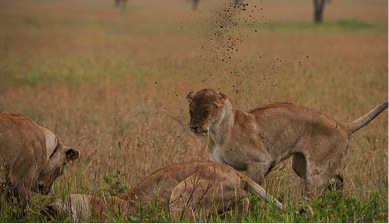
SuperQT getting a face full of dirt

Wrong place, wrong time.
After a long time of digging, the lions finally gave up. They lay down about 20 meters from the hole and rested. Half an hour or so later, the warthogs emerged. They were watched by the lions as they walked away but never had to run for it. The warthogs lived to see another day and must have had a very thrilling time.
Faulty Cameras (video-style)
Ali has written about the beatings that the cameras take, and you’ve likely seen Snapshot Serengeti images tilted at odd angles, or at the sky, or face-down in the dirt.
Every once in a rare while, a camera suddenly switches from “snapshot” mode to “video” mode and instead of taking three pictures, takes ten seconds of video. This video “feature” eats up camera memory very fast and so isn’t good for our research, as we end up running out of memory before we have a chance to re-service the camera. It also doesn’t record any sound.
But the resulting video can be amusing. Here is a series of ten-second clips taken on May 6, 2012. I think I know how the camera got flipped to video mode! Do you?
Running in place
The Red Queen Hypothesis in evolutionary biology describes an arms race between predators and prey that leaves each party running as fast as they can just to stay in place. Sometimes I feel a little bit like I am caught in this race with my cameras and the various creatures that maul, munch, or invade them. Granted, the animals aren’t evolving or learning new tricks to overcome each new defense, but it seems that as soon as I conquer one source of damage, something new appears. I thought you might be interested to see the “evolution” of my camera trap weaponry over the last few years.
June 2010
Perhaps I should have known better. But the naked cameras that I set up during my 2009 pilot season alongside Panthera’s indefatigable Philipp Henschel didn’t get destroyed en masse. So I was completely unprepared for the destruction that followed. 90 cameras lost in 6 months to hyenas, ele(phant)s, and fire.

naked camera.

Just some of the many casualties. Photo taken by Daniel Rosengren.
Feb 2011
I returned to Serengeti armed with 200 pounds of steel cases. This made my luggage rather unpleasant.
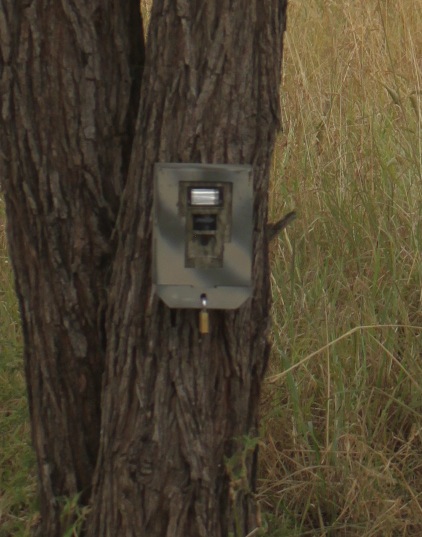
steel cases. camo color means you can’t see them, right?
Unfortunately, the straps we used to attach the cameras to trees were crap, and still broke with a quick tug from hyena or elle.
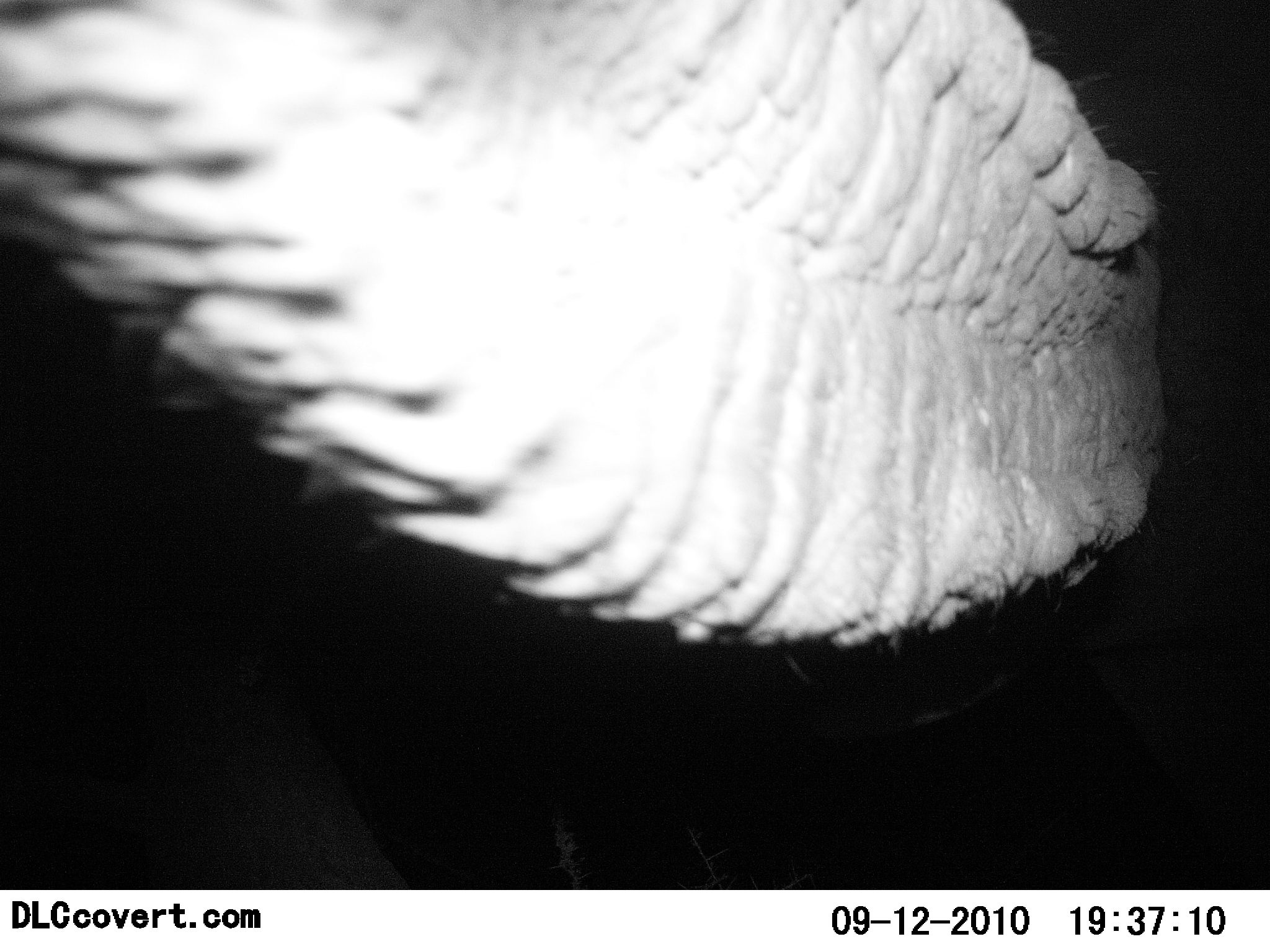
ele trunk, up close!
April 2011
Power tools! Rich Howell at Trail Cam Pro sent me out a super fancy Bosch impact driver and hundreds of steel lagbolts. I spent the next 3 months playing with power tools.
Unfortunately, the 3” lagbolts still broke if tugged on solidly by an ele. Cameras were wrestled from their cases by baboons and really determined hyenas. They were stolen by poachers and Masaai who herded their cattle across the border from NCA. They got waterlogged in the heavy rains. Cases were not quite the panacea I had hoped for.
January 2012
I arrived in Serengeti with 5” lagbolts of the best grade steel I could find. And padlocks. And dessicant sacks to keep the cameras dry. Now the cameras were staying on the trees, but getting punctured by teeth, invaded by ants, and waterlogged by the rains. “Water resistant” apparently doesn’t mean a whole lot in the world of ScoutGuard…nor does “manufacturer warranty.” And I still don’t understand how bugs get inside a “water resistant” camera that has no obvious damage.
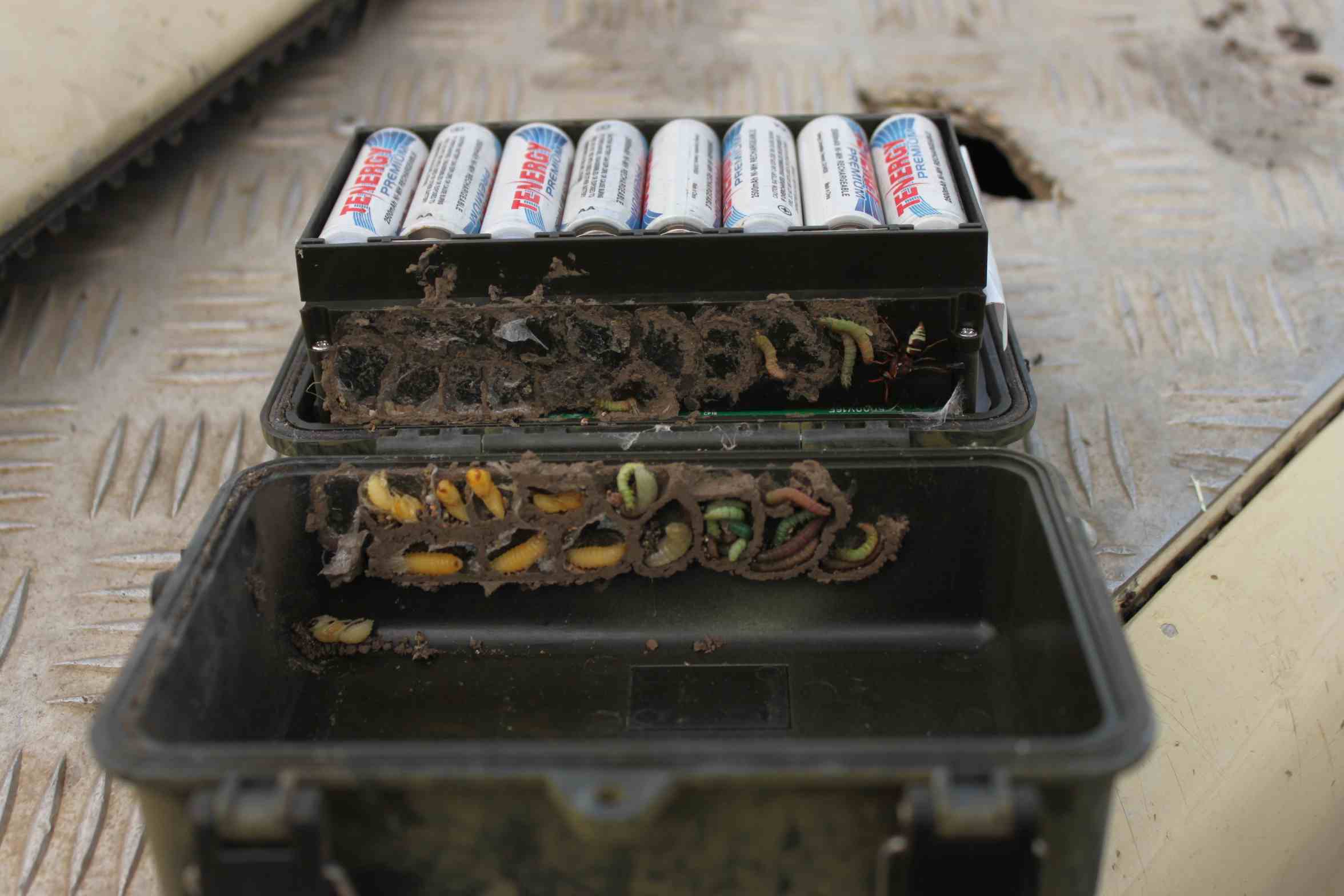
Not entirely sure what happened here…
January 2013
I armed myself with more padlocks, more lagbolts, and 6 tubes of silicone sealant. My luggage was filled with new cameras, grimly awaiting their doom. I can replace punctured flash covers with clear plastic. Sensor covers are another story, and apparently it is impossible to buy replacements. We’ll see how well the silicone works to fend off ants and raindrops.
Next up? Spikes! I’m going to weld bits of steel to the camera case so that hyenas can’t get their maws around them. Take that, you big, ugly puppies!
Friday Favorites
In case you’re not aware of it, Snapshot Serengeti is still live. (Or I should say, live again, as it was down for a few days following the completion of Season 4.) The pictures up now are all from Season 4, but the ones of nothing but grass have been removed. So every picture should have something to see in it. We are still recording all the classifications that are made, so your classifications still count.
However, we think we have enough classifications for Season 4 to be able to get science out of it. So if you’re looking to really make an impact science-wise, try out one of the other Zooniverse projects. My personal favorites are Seafloor Explorer and Old Weather. (But if you’re really just loving the fuzzy animal pix, we understand if you want to hang out on Snapshot.)
Ali tells me that Season 5 is in transit! A hard drive with hundreds of thousands of images is somewhere between Arusha, Tanzania, and Saint Paul, Minnesota. We’ll be working on it soon to get it ready for you to classify.
Meanwhile, here are some lovely snapshots to tide you over:


Sequestration, Science, and Snapshot Serengeti
Even if you live outside the U.S., it’s been hard to miss the arrival of the dreaded sequester. However, the impact of sequestration on science research doesn’t get a lot of attention in the general din. The U.S. government funds almost all of the nation’s basic science research, which means science research that doesn’t have an immediate application like creating a new medicine or figuring out how to grow crops to withstand drought.
Much of ecology research is basic. In Snapshot Serengeti, we’re interested in learning how a large assemblage of animals coexist and use the landscape. The results will not have an immediate impact on how the Serengeti is managed, but we hope it will help inform conservation management decisions down the line.

Worth funding?
Most of the nation’s basic research – and much applied research – is being cut by approximately 8%. Now, science funding hasn’t been doing all that well over the past couple decades anyway. And now things are getting worse. Snapshot Serengeti and its parent organization, the Lion Research Center, are mainly funded by the National Science Foundation (NSF), which announced recently that it will award 1,000 fewer grants this year than anticipated.
You may remember that in January, we were working hard on a grant proposal to keep our cameras rolling past the end of 2012. The way the process works is that each proposal gets evaluated on whether it is good, well-planned, and worthwhile science and either gets recommended for funding or rejected. To give you an idea, in our division of the NSF, 16% of proposals got recommended for funding last year.
But it doesn’t end there. Each year the NSF gets many more good, well-planned, and worthwhile proposals than it can fund. So it ranks them. And then it starts funding them, starting at the top and moving down the list, until it runs out of money. Of the recommended proposals, NSF expected to be able to fund just the top 22% of them this year.
And with sequestration, that pot of available money just got even smaller.
What that means for our proposal isn’t clear yet. If the sequester sticks, then we will be competing for a smaller pot of next year’s NSF money. And even if it doesn’t, we’ll be in tighter competition with all those really good proposals from this year that just missed out on getting funded. In either case, the sequester is bad news for Snapshot Serengeti.
Trees
The rain is crazy. Not as windy as yesterday, when it blew our furniture off the veranda, but crazy nonetheless. I could see it coming, not just your typical clouds stretching to the earth in the distance – I could see the waves of water hitting the ground between the scattered trees, moving closer with every second. It was a race – I wanted to reach the valley, with its low profile and scattered trees, before the storm reached me. I know that in a lightening storm, you’re not supposed to seek shelter beneath a tree. But in my giant Landrover, with its 4.5 foot antennae beckoning to the sky, I don’t like being the only blip on the plains. Logical or not. (Comments from lightning experts welcome.)
And so here I am. Somewhere between cameras L05 and L06, hunkered down as the torrents of water wash over Arnold & me. The endless tubes of silicone sealant have done their job – most of me, and most of my equipment, is dry – there are only two leaks in the roof.
The sky is gray for miles – I am done for the day. It’s only 5pm! In wet season, I can normally work until 7pm, and still prep my car for camping before it’s too dark to see. Today feels like one of those cherished half-days from elementary school – not as magical as a snow day, mind you, but exciting nonetheless. Except I am trapped in my car…
So, with that, I open a beer, shake out the ants and grass clippings from my shirt, and hunker down in the front seat to wait out the rain. And to think. I’ve been thinking a lot about trees lately. Mostly what they mean for the how the carnivores are using their landscape.
See, from the radio-collaring data, we know that lions are densest in the woodlands. Living at high densities that is, not stupid. But the cameras in the woodlands don’t “see” lions very well. Out on the plains, a lone tree is a huge attractant. It’s the only shade for miles, the only blip on the horizon. All the carnivores, but expecially the musclebound, heat-stressed lions, will seek it out. In contrast, in the woodlands, even though there are more lions, the odds of them walking in front of the one of 10,000 trees that has my camera on it are…slim.
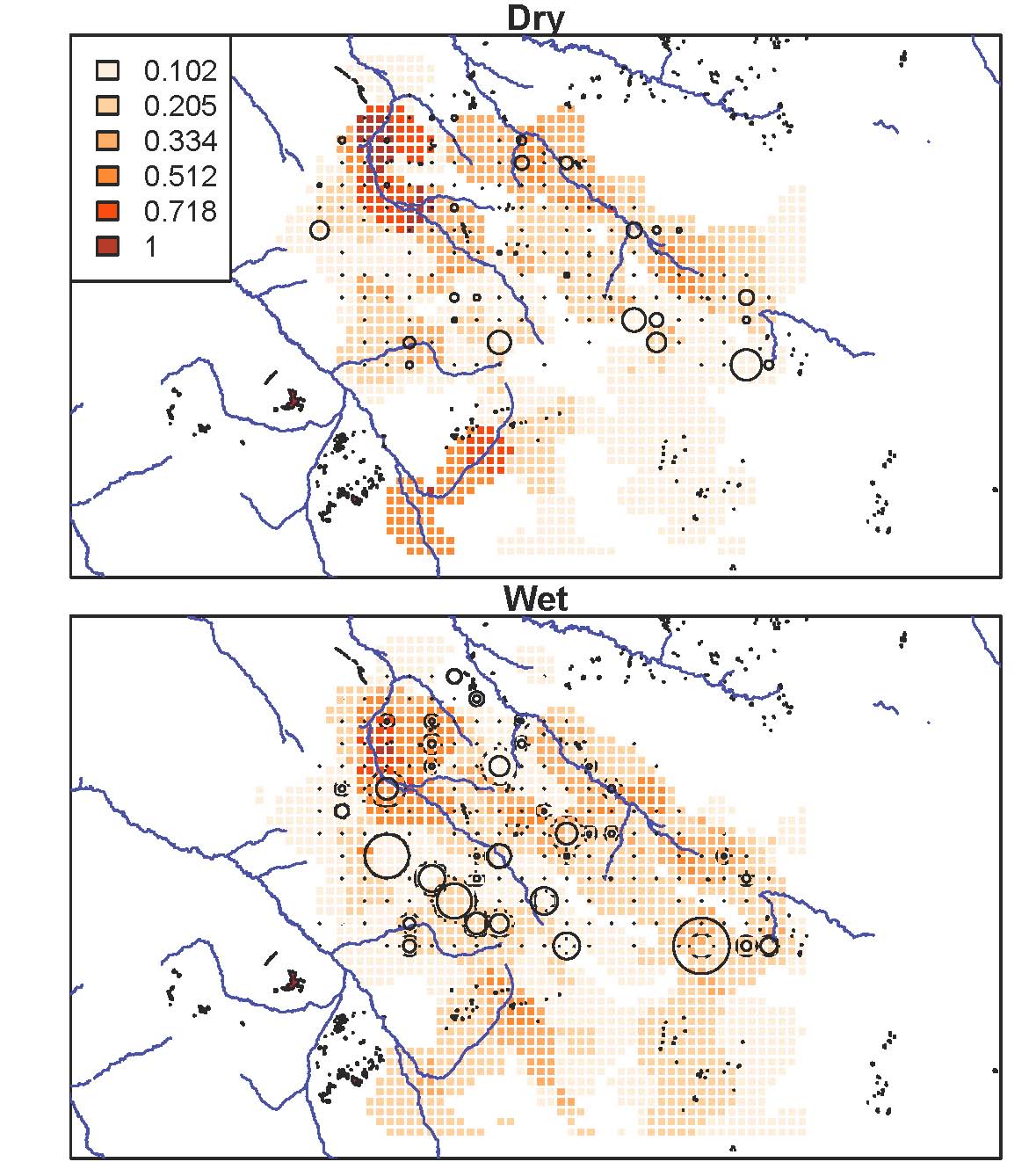
This map is one of many I’ve been making the last week or so. Here, lion densities, as calculated from radiocollar data, are the red background cells; camera traps are in circles, sized proportionally to the number of lions captured there. As you can see, the sheer number of lions captured in each camera trap doesn’t line up especially well with known lion densities. Disappointing, but perhaps unsurprising. One camera really only captures a very tiny window in front of it – not the whole 5km2 grid cell whose center it sits in. One of my goals, therefore, is to use what we know about the habitat to align the camera data with what we know about lion ranging patterns. I think the answer lies in characterizing the habitat at multiple different spatial scales – spatial scales that matter to the decision-making of a heat-stressed carnivore who sees blips on the horizon as oases of shade. And so I’m counting trees. Trees within 20 meters, 50 meters, 200 meters of the camera. One tree in a thick clump is still pretty attractive if that clump is the only thing for miles. Once I can interpret the landscape for lions, once I can match camera data with what we know to be true for lion ranging, I can be comfortable interpreting patterns for the other species. I hope.
The rain is letting up now, and it’s getting dark. Time to pack the car for camping – equipment on the roof and in the front seat. Bed in the back. And a sunset to watch with beer in hand.
Caracal
Today’s post is a guest post from Lora Orme, an undergraduate conducting directed research with us at the University of Minnesota.
Hailing from regions of Africa as well as India, the Middle East, and southwest Asia, the caracal prefers a dry habitat such as savanna or woodlands. This preference distinguishes the caracal from its feline cousin, the serval, which primarily lives in wetter climates. The difference encourages the caracal’s more open eating habits; the carnivorous caracal will hunt and consume almost any source of meat that is available, from rodents scurrying across the plains, to monkeys or birds overhead. In fact, the caracal is an expert bird hunter, using its powerful hind legs to leap up to ten feet in the air. That is twice as high as the height of the average human!

The caracal looks like a slightly overgrown housecat, around three feet long when full-grown. It has red-brown hair and very distinct facial markings. But the most distinguishing feature of the caracal is the ear tuft. These tassels of long black hair play an important role in pinpointing prey, working with 20 muscles within the ears themselves. The tufts may also act like little flags that help the caracal communicate with others of its kind. Visually, the tufts make a caracal resemble a lynx. For this and other similarities, the caracal has been nicknamed the “African lynx” or the “desert lynx.” It is important to discriminate, however, that the caracal has no spots or stripes, longer legs, and a slimmer body than the lynx. These characteristics allow the streamlined caracal to be among the fastest small cats.
Because of the caracal’s impressive agility, it was once bred in India as a status symbol and for the sport of bird hunting. Present day caracals are generally known to be elusive and secretive, camouflaging into tall grasses and quickly escaping from sight. However, if wild prey is scarce, caracals have been known to attack livestock and other domesticated animals. Due to the caracal’s natural tendency to hunt, they are sometimes considered pests and shot by ranchers.
Predatory instincts drive the caracal to live a solitary life when not mating. The majority of communication occurs in mews, hisses, and purrs with mates and kin. Even when a pair joins together to mate, the male does not stay to help raise the young. Thus, the female is left to watch over the litter of up to six kittens. She keeps them hidden in a burrow that has been borrowed from the den of an aardvark or porcupine. They stay hidden until they are one to two months of age and begin eating meat alongside their mother. Finally, when they reach about one year of age, they leave her side to begin lives and possibly families of their own.
The Refrigerator
About a year ago, we received a very generous donation from James Brundidge at the TV Channel Nova that allowed to a) upgrade our solar power to support a refrigerator, and b) buy a refrigerator! Granted, it took several months (6?) to actually get the fridge, get the power, and get everything working – but by the time I left Serengeti last year, we had a fridge!! And a freezer. We made ice cubes! Ice cubes!!!
[These are the things that are exciting in the field. Sorry.]
See, before the fridge (and, more importantly, the freezer), our food was kind of limited. With someone traveling to “town” (Arusha – 6-12 hours away depending on the number of breakdowns and punctures) only once every 8 weeks or so, meat and fresh veggies and other delicacies (crackers, milk, cheese…) were a little hard to come by. Meat is wicked expensive here, so we don’t eat it a lot anyway, but beans and ‘soya chunks’ (meat flavored soy mince) gets old. Really. Old. So every two months, when someone came back from town, our meat menus (say, twice a week) would go something like this:
First day from Arusha: Chicken! Also, all the leafy greens, as they go off in about 2 days. Cheese.
Rest of Week 1: Any other meat (pork chops) we might have gotten, all the remaining leafy greens. Peppers, tomatoes, and carrots, as they start going quick if on the shelf. More cheese.
Week 2: Minced beef. Cut off the green bits and cook for several hours in spices to hide the taste. Cut off the moldy bits on the peppers & tomatoes. Finish the cheese (not because it’s going bad, but because it is just that delicious).
Week 3: Bacon & Sausages. They seem to last longer than the fresh meat. They don’t even turn green! I’d rather not think about why. Salvage what’s possible from the peppers. Cabbage.
Weeks 4-8: It’s back to only beans & ‘soya chunks’ (flavored fake meat), rice, and potatoes, and cabbage. At this point we start looking for reasons why we desperately need to go into Arusha…
So. Needless to say, the refrigerator was life-altering. The cheese still disappears by week 1.5 because a certain Swede [Daniel!] eats little else until it’s gone, but everything else has changed. No more green meat. No more warm beer. No more powdered milk. Now when I get home after a long day, I have cold beer. Among other things. Life doesn’t get much better than that.
Epilogue: It is now week 4. Somehow, all of our vegetables, cheese and 99% of our meat have been consumed…by a week ago. I’m sure we need to go to Arusha for something…

