
Safari Phil Goes to the Serengeti
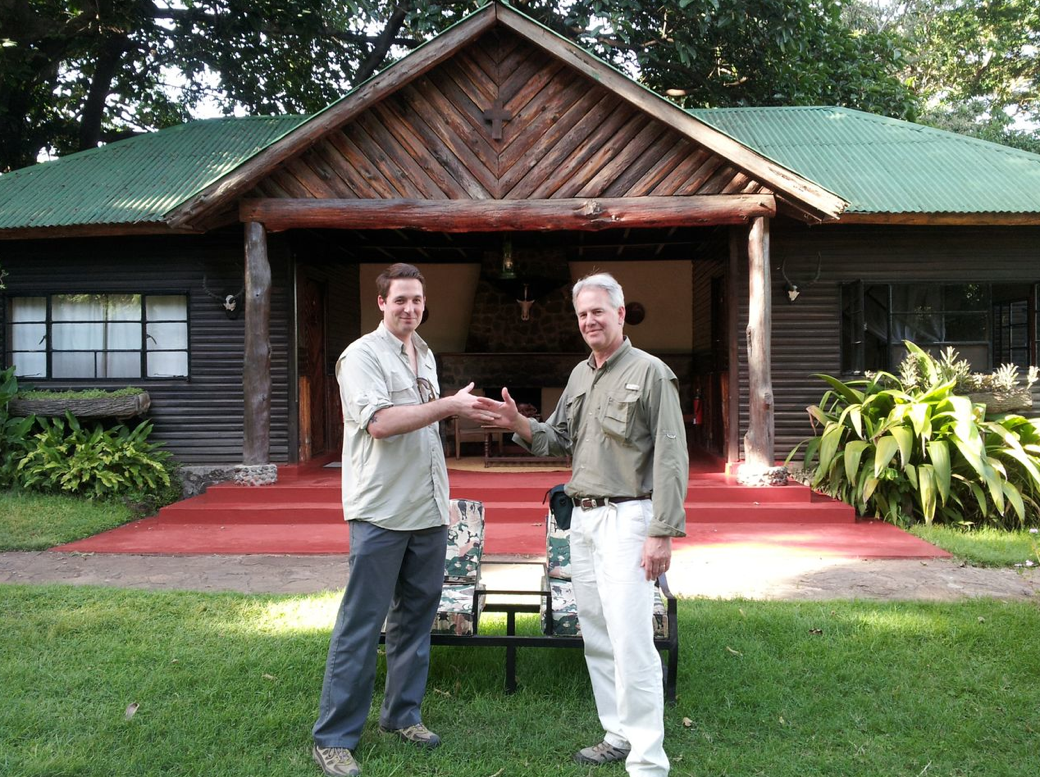
Today’s guest post is by Phil Thiesse, the KSTP video photojournalist who shot the footage for the TV report on Snapshot Serengeti and the Lion Project.
I am a television photojournalist from Minnesota currently operating under the nom de plume “Safari Phil,” at least during my visit to the Lion Research Center in The Serengeti.

My colleague Safari Chris and I traveled all the way from the Twin Cities to spotlight the Snapshot Serengeti project for KSTP TV’s 5 Eyewitness News. We just happened to be in the neighborhood, working on a series of reports in Arusha, Tanzania. We were able to sell the story to our bosses because one of the researchers, Ali Swanson, is a graduate student at the University of Minnesota and would be our tour guide amongst the lions.
The plan was to rendezvous with Ali at a restaurant in Arusha as she passed through on a supply mission. The thought was to ride with her the following day in her well traveled Land Rover to the middle of The Serengeti, about seven hours on a good day. The restaurant we were meeting at was closing early, so Ali suggested we move to the Impala Hotel, a full two blocks away. We rode there in the Land Rover, the three of us in the front seat…the only seat, Chris bravely straddling the gear shift. It was after that 5 minute ride we decided to fly to the Serengeti instead.
Daniel Rosenburg, another lion researcher, picked us up at Seronera Airport and in another well worn Land Rover, brought us to Lion House, where we would wait for Ali. She eventually arrived with all of the supplies necessary for lion research: food, cameras, batteries, a punching bag. Wait, what?? For kick boxing. An excellent workout, I’ve been told. We were treated to a satisfying dinner of pasta, bacon and tomatoes. And a sip of Scotch. Or two.
We hit it early the next day, heading out at sunrise to get video of lions and of Ali and another researcher, Stan Mguzu, tending to the hundreds of game cameras that provide images for Snapshot Serengeti. The cameras were easy to find, but the lions proved to be a little more elusive. Daniel’s expertise at tracking finally got us in the middle of two prides. In addition, we were up close to zebras, impalas, cape buffalo, dik-diks, giraffes, topi, an eagle, warthogs, gazelles, mongoose, baboons, monkeys, hippos and hyrax.

There was a dinner party to top off our last night in the Serengeti. Two people from Cheetah House joined us for sausage, fried egg plant, and some fantastic made-from-scratch mashed potatoes. Chris made a run to the outhouse as the evening wound down and the researchers made it a trip he’ll never forget. As we waited patiently for his return, I expressed my opinion that this was a really bad idea, but the others were confident in their decision. Like they had done this exact thing before. We heard the returning footstep stop dead in their tracks and even retreat a bit, but luckily, we didn’t hear Chris grab his heart. He did have a few choice words for the group, but survived yet another close encounter with a Serengeti lion.
Thanks to the expertise and hospitality of Ali, Daniel and Stan, we were able to bring the story of Snapshot Serengeti to our viewers in Minnesota. That story, along with others featuring Minnesota connections to Tanzania, can be seen on KSTP.com.
Braving the wilds of Washington D.C.
While Ali is braving the wilds of the Serengeti, I’m braving the wilds of Washington D.C. You know — the herds of tourists, the temperamental and unpredictable congressional staff, the roaring protesters. I work right downtown on the National Mall at the Smithsonian’s National Museum of Natural History; I’m doing a fellowship here. And most days, I find shelter from the D.C. wildlife up in my office in the east wing.
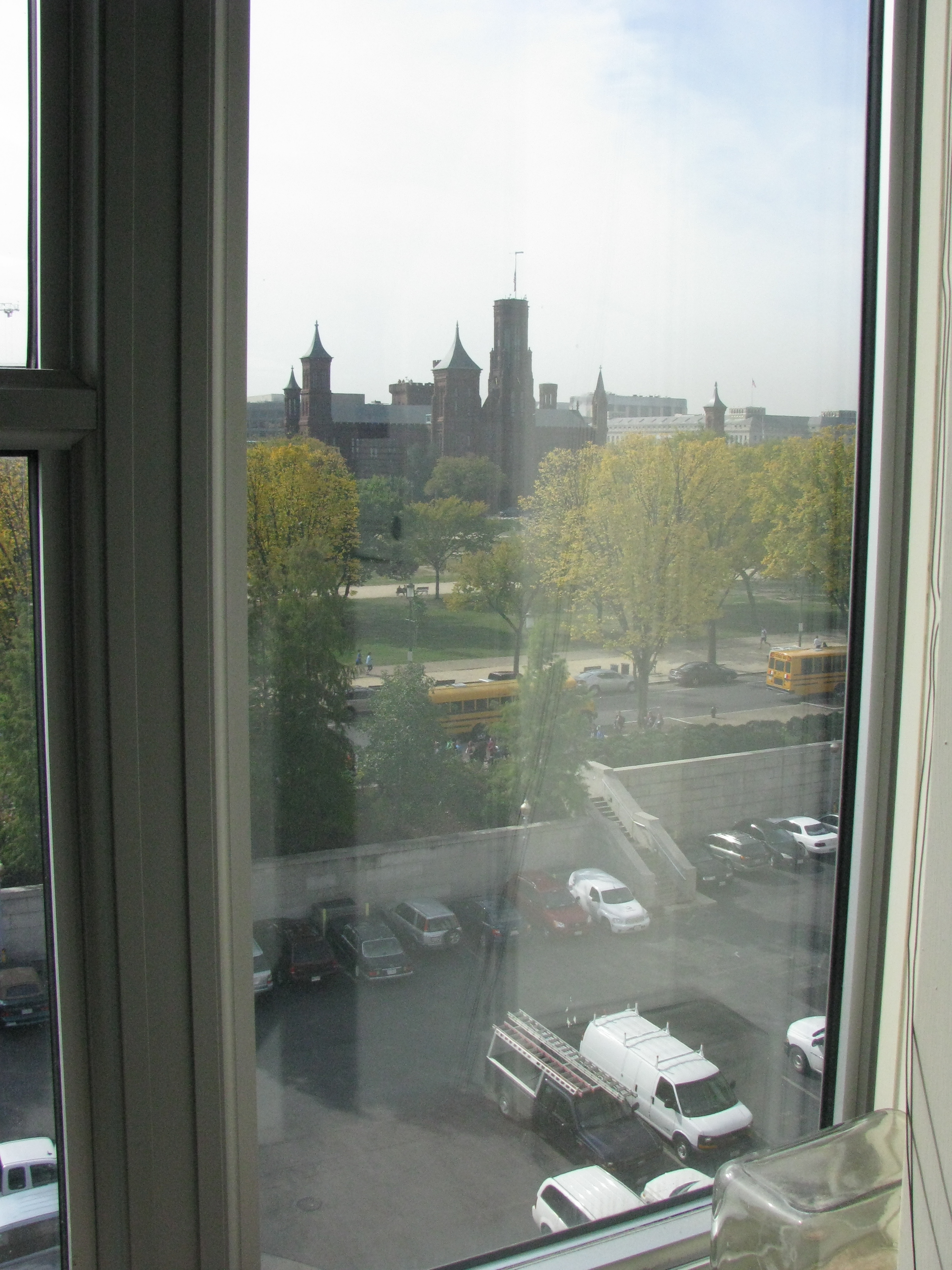
Overlooking the D.C. wildlife from the safety of the National Museum of Natural History’s east wing.
But for the next couple days, I’m donning my pith helmet business clothes, hopping into my Land Rover onto the metro, and heading over to the kopjes Capitol Hill. I’m going to be lobbying.
The Biological Ecological Sciences Coalition (BESC) holds an annual Congressional Visits Day, inviting scientists to come talk to congresspeople about the importance of federally funding biological research. Today is a training day, so that people like me can get clued-in to how the federal budget works and how to communicate with politicians. (My guess is that it’s not a good idea to spout off lots of numbers and use a lot of jargon.) Then tomorrow, we’ll be put in small groups and have meetings all day long with the staff of various senators and representatives.
I’m participating in the Congressional Visits Day in part because I’m always curious about how things work, and the opportunity to learn more about how money gets from the coffers of the Treasury into the hands of the scientist on the street savanna is a draw. But I’m also participating because federal funding for the sciences is in trouble. It has been stagnant for the past decades and is now declining thanks to the Sequester.
Over the next half-century (which I hope to experience), I see two major threats to our physical and financial well-being as a people. The first is the disruption of agriculture due to unavoidable factors like climate change and the introduction of invasive species. The second is the emergence and spread of zoonotic disease facilitated by unavoidable globalization. It is critical to understand the science surrounding these issues if we want to be able to adequately prepare for them, and the science to understand is fundamentally biological.
So I’m leaving the quiet sanctuary of my office to head out and study talk to the lions policy makers.
Owch.
Have *just* gotten back from Gombe and already back in the field frantically trying to finish camera traps before my mother comes out to visit. Stories of chimpanzees to come soon.
In the meanwhile, here’s a link to a clip that National Geographic Television did on lion-cheetah interactions. While lions kill a lot of cheetah cubs, they also occasionally kill adult cheetahs, as you’ll see in this clip. Since cheetahs don’t pose any direct threat to lions (unlike hyenas and leopards, which can kill lion cubs), and they only have minimal diet overlap, we’re not entirely sure why lions seem so intent on killing cheetahs. Watching this video clip, what do you think is going on?
Spot that leopard!
Today’s guest blogger is Lucy Hughes. Lucy lived and worked on a private nature reserve in South Africa for four years, carrying out field research that included a camera-trap study into the reserve’s leopard population and twice monthly bird surveys for Cape Town University’s Birds in Reserves Project (BIRP).
Trying to discover how many individual leopards used a reserve in South Africa was challenging work in more ways than one. Unlike the Serengeti Lion Project’s (SLP) 200-odd camera traps, I could count ours on one hand. That said the study area was much smaller at around 2,500 hectares. The technique was also very different. Whereas the SLP is trying to get a snapshot of animal interaction over a vast area I was interested in individual animals, so setting the camera traps up systematically on a grid basis was not the best option. Instead, to make best use of our limited camera traps, I selected sites that I thought a leopard was most likely to pass.
These sites fell into two categories, the survey sites and the random event sites. Based on recent tracks and scats on game trails and roads, the cameras were moved around the reserve on a regular basis in an attempt to survey the whole area. One or two cameras were reserved for the random events: a fresh kill, old carcass, or hunches about certain water holes or koppies (rocky hills).
My job was to trundle around the reserve, mostly on foot, searching for signs of leopard. Looking for tracks and scats on the network of sand roads was easy and for the most part it seemed these big cats do love a nice clear road to walk down. Wandering down a dry river bed following a set of tracks idly wondering if the leopard is asleep in one of the big Marula trees is one thing, but suddenly realizing that the pug marks seem to have doubled in size and that you are hot on the trail of two lions jolts you to a stop. Finding signs off these roads was a little harder, the substrate of the game trails was often tangled with grasses and small thorny bushes and picking up tracks was virtually impossible.
Half an eye was always on the sky watching for vultures. Their activity often led to carcasses but it was the sense of smell that served best. The smell of rotting carcasses is fairly potent and travels far and my nose became super sensitive to the whiffs. Unfortunately not having the skills of a bloodhound I would flounder around in the bush turning this way and that trying to pin down the source of the smell.

Setting up a camera trap on a dead wildebeest
Other than spending just a little too much time around dead things, camera-trapping carcasses lead to some great data. One surprise was just how often kills seemed to be ‘shared’. The following two shots from the same eland kill highlight this. You can see even without comparing spot patterns that these two leopards are different.

Female 1

Male 3
The first is a young female and the second is the reserve’s dominant male so it’s hardly surprising that he has stolen her meal. At other kills, though, we had various combinations of leopard visitors including three different adult males within two nights to the same zebra kill. The fact that the leopards stayed put in front of the cameras, munching, meant we managed to get shots from every angle, which helped a lot in putting together ID charts. At no time did we tie down any of the carcasses so clearly the leopards where not fazed by the cameras.
This following shot shows a jackal at the same eland kill. The leopards on this reserve where under very little pressure from lions, which only passed through occasionally. They hardly ever resorted to stashing kills up trees as leopards in areas of high lion density would.

Jackal at eland kill
This meant that many smaller mammals took advantage of the leftovers. Other than the obvious spotted hyena, we recorded brown hyena, side-striped and black-backed jackal, honey badger, civet, bush pig, and mongoose. This following shot looks harmonious, but the series shows that the honey badger definitely had the upper hand on the jackal.

Honey badger and jackal
The one thing that fellow researcher, Michele, and I were always aware of was that we were spending a lot of time in places that big cats also spent a lot of time. When you are setting up a camera on a fresh kill you can’t help but wonder if the killer is laying somewhere close watching you!
Check out the time stamps on this next set of pics to illustrate this point!

12:35 – Setting camera

15:58 – Leopard
Photos copyright Michele Altenkirk/Lucy Hughes, Lisssataba NR
Wildebeest Explosion
If you’ve spent time on Snapshot Serengeti, then you’ll know that wildebeest are rather abundant in the Serengeti – especially during the rainy season. But it wasn’t always this way. In the 1950’s there were fewer than a quarter of the wildebeest there are today.
Back then, there was something suppressing the wildebeest population, keeping it much lower than the land’s capacity. It wasn’t predators, though there are now more lions and hyena in the Serengeti thanks to the increase in wildebeest. It wasn’t poaching, though we know that poachers take a substantial number of wildebeest. It was disease.
In the early 1930’s rinderpest was detected in Serengeti’s wildebeest. Rinderpest is closely related to measles. In fact, it is believed that measles evolved from rinderpest some 800 to 1,600 years ago. But rinderpest doesn’t affect people; instead, it affects ungulates and most likely evolved in Eurasia. For a long time, the Sahara Desert probably acted as a sort of barrier, preventing the disease from reaching sub-Saharan Africa. But in the late nineteenth century, people transported infected cattle into the region.
Rinderpest has high mortality in wildebeest, especially in young animals. What was once known as “yearling disease” killed so many young wildebeest that the Serengeti population was only about 300,000 animals in the 1950’s. Rinderpest also causes high mortality in cattle, and so inoculation attempts started in the 1940’s. These got better over time, and in the 1960’s there was a largely successful push to vaccinate 80 million cattle across twenty-two African countries, including Tanzania.
Wildebeest themselves were not vaccinated, but as the number of rinderpest-infected cattle decreased with vaccination, so did the number of wildebeest that had rinderpest. Following the initial vaccination push, regular vaccination campaigns kept the infection rate very low in cattle. Despite a handful of small localized rinderpest outbreaks in the ensuing decades, the disease was essentially eliminated from the Serengeti wildebeest population. This pattern of infection shows us that for rinderpest, wildebeest are what is termed a spillover species, which means that the wildebeest population cannot by itself sustain the disease; wildebeest must constantly contract the disease from cattle for it to survive in the wildebeest population.
The Serengeti wildebeest population has since exploded. No longer constrained by rinderpest, it has soared to 1.2 to 1.5 million animals.
As for rinderpest, the vaccination campaigns of the mid twentieth century were only a start. The international Food and Agriculture Organization (FAO) continued to pursue the disease by vaccinating cattle and by the 1990’s had reduced it to only local outbreaks worldwide. In 2010, the FAO declared that they were confident that they had eliminated the disease from everywhere it had been known. And less than two years ago rinderpest was declared officially eradicated. It is the second of only two diseases that humanity has successfully eradicated, the first being smallpox.
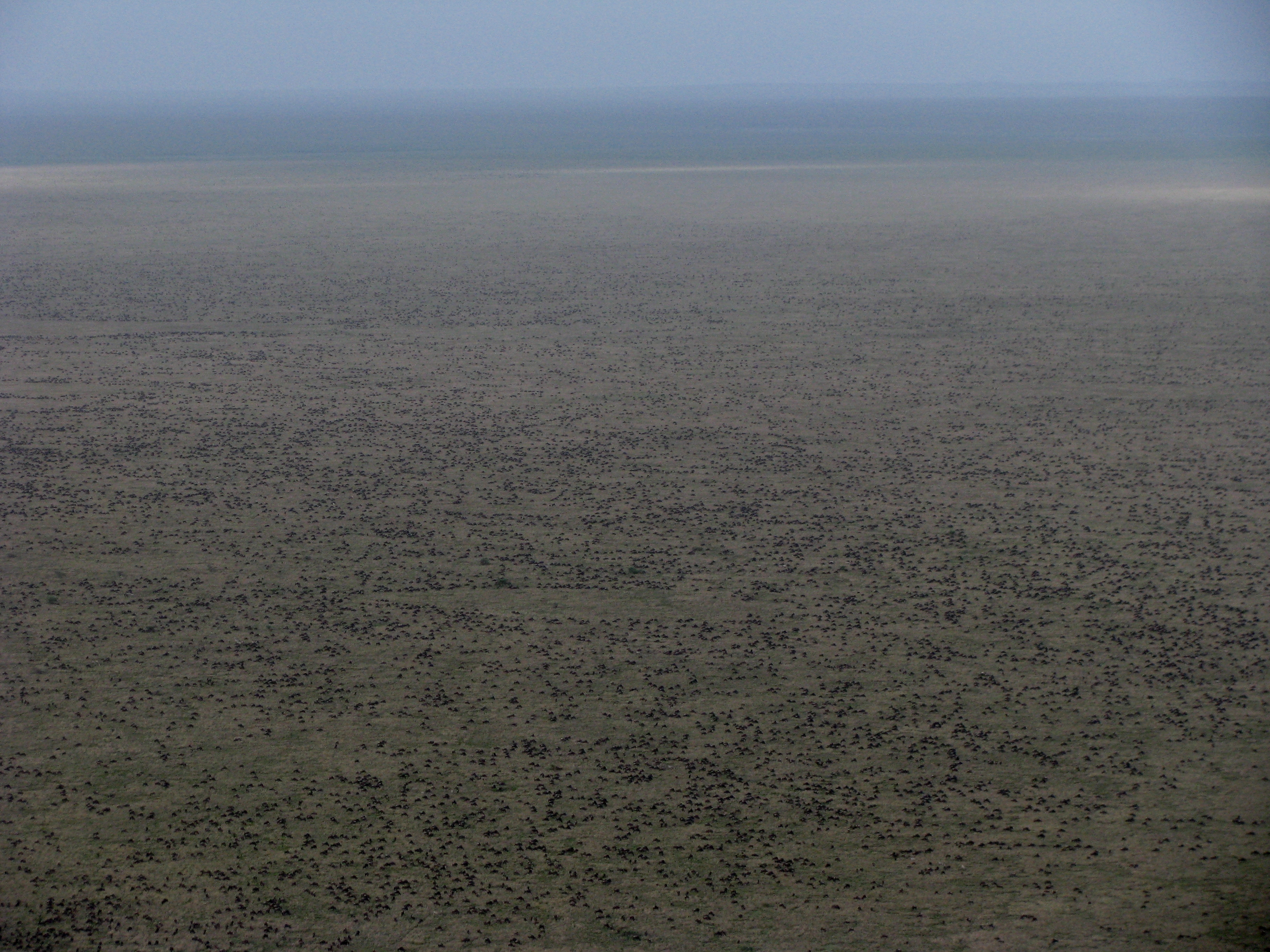
Wildebeest all the way to the horizon
Chickens have necks?
I often forget that chickens have necks. I mean, who eats neck? You buy chicken breast in the stores, barbecue some drummies, get wings at your local bar, or pick up a bucket of fried (yes, I’m originally southern and have a weak spot for fried chicken). But never eat neck. You can’t rock up to KFC and ask for a 2-piece meal with a neck.
But as it turns out, they are surprisingly tasty. I am gnawing on one right now, trying not to dance to the music.
What is love? Baby, don’t hurt me. Don’t hurt me. No more.
Yes, that’s right. I’m sitting at a hotel in Mwanza and “What is love” is blasting behind me. Apparently it is Easter, and there is a big celebration. It’s kind of amazing. And surprisingly hard to not groove along. Now Ace of Base’s “I saw the sign” comes on. I feel like I am 10 years old again.
I’m on my way to Gombe Stream National Park, home to Jane Goodall’s long term chimpanzee research center, and temporary home to my dear friend Lisa O’Bryan – a fellow UMN grad student who does the same long field stints there as I do in Serengeti. Lisa’s just received a competitive grant from National Geographic (read her blog) to study some of the ins and outs of chimpanzee communication. I’ve been meaning to visit her since we both first came out in 2009, but whenever I’m out here the months just slip away. I mean to go to places like Selous and Katavi, but before I know it I’m frantically finishing the last round of cameras, revising our data backup procedures, trying to figure out who the last 20 lions were that I saw, devise new hyena-proofing strategies, and board my plane home in a rush of papers, data entry, accounting, phone calls and goodbyes.
And so, even though I don’t have time for it any more than I ever do, even though I’m already counting the days I’ll need without rain to finish my vegetation assessments before leaving Serengeti for good, I’m taking a week and going to Gombe. For the record, by “week,” I mean four days in transit, and two at my destination. But that’s okay; it’s all part of the adventure.
For example, I caught a lift with a Tanzanian researcher – Chunde, a disease ecologist – out of Serengeti, west to Lamadi. Nearly two hours late, because the 10-minute job at the garage turned into 90 minutes, Chunde picks me up with a roll of his eyes. “Tanzanian time,” he says, and grins. We’re in Lamadi by noon, and soon I’m on a bus to Mwanza. A very, very, very full bus. I’m standing, gripping the luggage racks for dear life, chickens squawking at my feet, admiring the variety of decorative hairstyles in front of me. Several hours later, after some games of peek-a-boo with kits in the nearby seats, we’re there.
And I’m here, at the amazingly local Lenana hotel. With Ace of Base fading into horn music into the deep thumping base of Tanzanian dance music. For the first time in a long time, I’m on holiday. Chicken neck, 80’s music, and a lot of stares – and tomorrow? Kigoma, and then to Gombe. Not too shabby. Just like this chicken neck.
Lost in the Mail
I have some sad news. The hard drive carrying Season 5 never arrived in Minnesota. Ali had it sent several weeks ago by postal mail. But not all the world’s mail is quite as reliable as we might hope. The hard drive may be sitting in some office somewhere, lost among piles of boxes. Or someone may have decided that a hard drive would turn a nice personal profit. Whatever happened, we’ll probably never see the hard drive again. Or we might – I once sent a package to a friend in South Africa and gave up on it when it hadn’t arrived after a couple months. But almost a year later, my friend sent me an email thanking me for the package and curious about some rather out-of-date news that I had written her.
But fret not. Ali said she’ll scrounge up another hard drive and load it with Season 5’s photos. She knows of someone traveling to the U.S. in a couple weeks and will ask for the hard drive to be hand couriered. Meanwhile, we’ll all have to sit tight.

The angle on this image makes this kori bustard look huge! I bet this bird could carry our hard drive over the Atlantic…
Since it’s Friday and I can’t leave you with just sad news for the weekend, here are some Serengeti laughing hippos.
Gail, Garth or Gerta? Cataloguing the giraffes of the Serengeti
Today’s guest post is written by Megan Strauss, a researcher at the University of Minnesota. She runs the Serengeti Giraffe Project.
If you had visited the lion research house between 2008 and 2010, in addition to Fabio, the stuffed lion, the mantelpiece full of animal skulls, and the aquarium of incredibly hardy fish, you would have seen this photo of a male giraffe, which I taped to one of the bedroom doors:
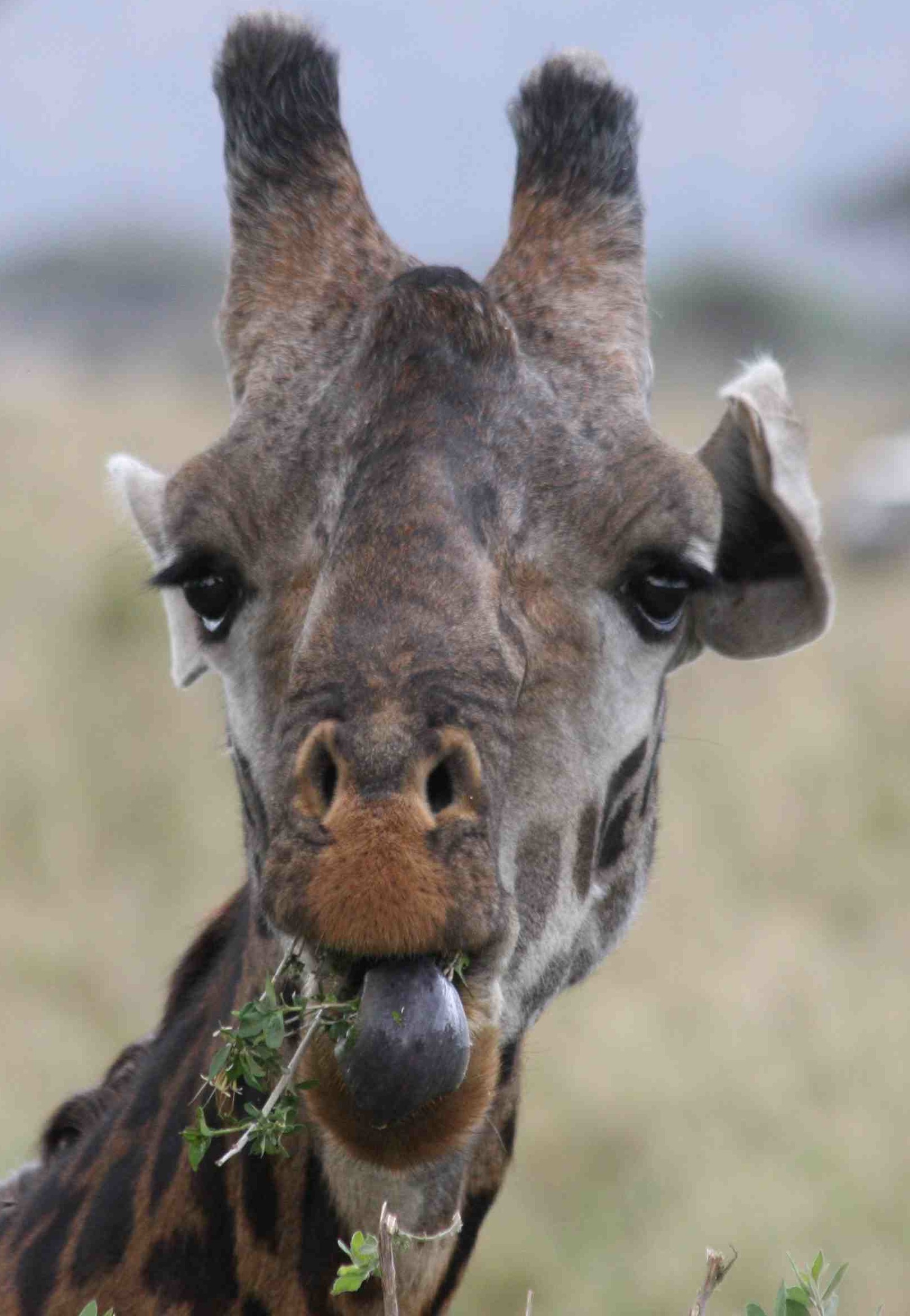
For the last few years, I’ve tracked these quiet giants of the Serengeti woodlands, studying their population dynamics, the vegetation they eat, and their interactions with lions and people.
We can learn a lot by keeping track of individual giraffes. Luckily, it turns out that each giraffe is born with a unique set of coat markings that persist throughout life, like human fingerprints or lion whisker spots. So, each field season, I arrived in Serengeti stocked with the materials necessary to catalogue the many giraffes I would encounter: several hundred 5 x 8 index cards, ink cartridges for the printer, sharp scissors, and a good supply of glue sticks. My days in the field often went as follows. Morning and afternoon: meander through the woodlands locating and photographing giraffes. Evenings: work through the day’s photographs, identifying giraffes and making ID cards for any new individuals. For fun, I assigned a different first name to each individual. The female below is named Flopsy, for her deformed right ear:


Among Serengeti giraffes, which belong to the Masai subspecies, coat markings vary from blocky to highly stellate, or star-like. While the patterns do not change, the color of the markings can grow darker as giraffes age, particularly for males. The shape, color and arrangement of the coat markings are all useful for telling apart different individuals. Other traits are useful as well, such as tail length or ossicone size, shape and hairiness. (Ossicone is the name for the bony, skin-covered horns of a giraffe.) I’ve included some giraffe photos below so you can try your hand at giraffe pattern matching. See if you can match the individual on the top row with any of the individuals in the bottom two rows:

Sexing giraffes is usually easy, especially at close range or from photograph. Aside from the obvious, adult males can be distinguished from females by their larger size, skull ossification (the ossicones of males are larger and mature males acquire additional bony skull protrusions) and their more erect posture. Sexing young calves is a bit trickier. The genitals of male calves are small and calves aren’t always willing to pose for the camera.
Here is an example of a mature male giraffe with significant skull ossification:

By the end of my 2010 field season, I’d amassed a catalogue of almost 1,000 giraffes. (Identifying giraffes by eye can be a laborious and error-prone process but Doug Bolger and colleagues at Dartmouth University have now released Wild-ID, software that assists with giraffe pattern recognition.
We are hoping that we can use the plentiful giraffe images coming in from the camera trap study to maintain this giraffe database and to monitor the population. It turns out, though, that many of the camera trap images contain only giraffe legs, which are much harder to use for identification than flanks.

Blast from the past
#### Spent all day yesterday driving from Serengeti *back* to Arusha — nine hours, two punctures and a broken hi-lift jack later, arrived in Arusha sweaty, grimy, and as excited as a human could possibly be about good food. At any rate — with last minute travel preps and a looooong travel day, this blog post got tucked away in the back of my mind until I woke up (well-fed!) this morning. I’m hoping I can appease you all with a blast-from-the-past note-from-the field from my *first ever* trip to Serengeti in 2009. Now I’m off to find a cappuccino. I did mention that 90% of my mental energy out here goes to thinking about food, right? #####
28-July-2009
Notes from my first days in Serengeti: I am so stunned I don’t even know what to write.
I am in the Serengeti.
I am smack dab in the middle of a natural phenomenon. In my first 24 hours here, I have seen a dozen things that I can barely pronounce. Impala, Topi, Hartebeest, Buffalo, gazelle. Baboons, Hyraxes, jackals, giraffes, zebra. Elephants, hyenas, lions and leopards. The baboons hang outside our house, like raccoons of Africa, but bigger and more agile…and much, much uglier.
Ingela, one of the field researchers and a spectacularly wonderful woman, reminds us to pull the front door closed lest the baboons invade (this has happened before). She also reminds us to occasionally look up in the tree in the side yard, as it seems to be a favorite rest-stop for a the neighborhood leopard. As I watch a giraffe meander past the outhouse out back, I feel vaguely like I have stepped back in time. Or landed on mars. What is this place? (Answer: AWESOME.)
Over whiskey and chocolates, Phil and Ingela and I discuss the important things in life, such as the following:
Q: What to do if you encounter a lion while on foot?
a)Run screaming
b) Make yourself look really big and menacing
c) back away slowly, maintaining eye contact with the lion, but without tripping. At a “safe distance” turn around to face the direction you are heading, and absolutely do not look back.
d) wave your pot and shout “kakakakakaka.”
Answer: Word on the street is that “c” is textbook correct, but “d” has proven to work after sunrise in the Serengeti. I do not personally know anyone that has attempted a, b, or c and lived to tell the tale. Both Craig and Ingela have survived on variations of d.
I think I’m going to like it here.

Lions and Wolves: Hunting and Conservation
Lion hunting is an active sport in Africa, with wealthy foreigners paying thousands of dollars for a chance to kill a lion and take its skin back home to taxidermy. Done right, lion hunting could benefit the species, by helping to pay for land protection and other conservation measures. However, too often it is done poorly.

For many years, Craig has been actively involved in figuring out how to do lion hunting sustainably. In 2009, he, Ali, and I, and a bunch of others wrote a paper (“Sport Hunting, Predator Control and Conservation of Large Carnivores”) about the pressures and dynamics of hunting large carnivores with a focus on lions and wolves. If you’re not a hunter yourself, you may believe that hunting and conservation are diametrically opposed to one another. But that’s not true; most hunters are also conservationists and many of the strongest wildlife protection laws in our country were championed by hunters. In our paper we explore the complexities that arise when you add the third party: not just hunters and conservationists, but also rural citizens, and particularly ranchers. While hunters want to maintain wildlife (to hunt, and often for other reasons as well), ranchers would be most happy if there were no predators around at all; predators like lions and wolves kill livestock and even threaten rural people. Wildlife managers then have the unhappy task of trying to please all three groups, and they often do so by employing hunters to maintain lower than full capacity predator populations.
Late last year, the U.S. Fish and Wildlife Service responded to a petition to list African lions as endangered species, which would prohibit the importation into the U.S. of lion trophies. This week the Tanzanian Ministry of Natural Resources and Tourism wrote an opinion piece in the New York Times about it, saying that doing so would cripple Tanzania’s ability to protect lions and other wildlife. Our intrepid safari reporter Chris Egert followed up with Craig on KSTP to get his take on the controversy. What do you think? Should the U.S. prohibit the importation of lion trophies? What do you think about hunting as a component of conservation? What can be done to reduce the conflict between large carnivores and the people who live (and tend livestock) near them? These are not questions with easy answers, and I’m curious to hear what Snapshot Serengeti fans think.

