
I hope you get paid for that…
Not that long ago, somebody asked me just what it was I was doing at the University of Minnesota. When I described my dissertation research to them, they paused in thoughtful silence, then asked slowly, “Did you ever think about doing something…useful?”
I’m pretty thick-skinned – so that just made me laugh. I love what I do and wouldn’t trade it for the world. But I also think that it really and truly is important. We live increasingly in a world where water comes from the tap, and food from the grocery store. I think it’s important for us to understand how the world works – how all of the puzzle pieces fit together to produce this amazingly vibrant, dynamic mosaic of life…and how our actions might affect it.
And so with that, this post is devoted to all the things that people say when I tell them what I do. I’m curious to hear the lines that other folks get!
The things people say:
— Huh. Did you ever think about doing something…practical?
— I hope you get paid for that…
— Um…what are you going to do with that?
— So, are you going to be able to get a job?
— You’ve been in school for HOW long?
— Really? You get to be a “doctor”?
— Oh! Kind of like the Lion King?
But my personal favorite? “You have the BEST job in the whole world!” I usually hear this from tourists while in the field. They say this from the inside of their air-conditioned cars, on the way back to their hotels with running water and fresh food (that’s been refrigerated!). I am usually dusty when they tell me this, I am covered in tsetse fly bites and Acacia thorn scratches, my nose is sunburned and my arms ache because my Land Rover has no power steering. Part of me wants to point out to them the fact that most of my day is spent playing with power tools or watching lion sleep, and that this in fact is rather boring. Part of me wants to point out that I get fresh meat only every 6 weeks, and have no refrigerator to put it in. That my shower is a bucket, and ever since the spitting cobra incident, I’m a little on edge in the ‘bathroom’. That my toilet is outside and sometimes hard to get to because buffalo like to wander through the yard at night. Yes, a part of me wants to point all of these things out to them…but I don’t. Why? Because in the end…I think they’re right.
Camera Traps are Pretty Cool…
Studying animals in the wild can be incredibly difficult. In Serengeti, for example, many of the animals we might want to know more about are really shy (like leopards), or aggressive (like buffalo and elephants) — and it’s hard to get close to them to study their behavior. Furthermore, a lot of the wildlife we study is nocturnal – meaning the animals are active at night, in the dark, when it’s virtually impossible to watch them in any meaningful way.
Enter camera traps to save the day. If you’re a researcher, a hunter, or a wildlife enthusiast, you’ve probably heard about camera traps. These are remotely triggered cameras that are transforming the way people study wildlife. Instead of taking pictures of the animals, the animals take pictures of themselves!
You might be surprised to discover that camera traps have been around for a long time. A really long time. In the 1890’s, a fellow named George Shiras developed a system so that wildlife triggered a trip wire, which triggered a flash and the camera shutter – producing the first wildlife “self portraits.” He was pretty creative in inducing the animals to trip the wire – for example, to photograph beavers he would tie the trip wire to a dislodged stick in the beaver’s dam. When the beaver went to repair the dam, it triggered the camera!
Modern technology is making camera traps better and more affordable. Cameras today are triggered by a combination of heat and motion – so the animals trigger the cameras merely by walking in front of them. In recent years, the use of camera traps in research has skyrocketed; they are now widely used to identify the presence of rare, endangered, or even presumed-extinct species; they’re used to estimate species densities, patterns of habitat use, predation, and even the relationships between competing species. Sometimes, the animals caught in cameras have unique markings that allow researchers to identify different individuals – for example, tigers have unique stripes, and leopards and cheetahs have unique spots. But even for animals where this isn’t the case, statisticians are hard at work developing methods capable of dealing with the data that camera traps are pulling in.
All of this means that we can ask really cool questions about a variety of species – but it also means you don’t need to be a scientist – or a statistician – to use camera traps to understand the world around you. Ever wondered what your backyard wildlife is doing at night? It’s never too late to find out!
Aardwolf vs. Jackal
#### Today I’m excited to bring you a guest post by UMN undergraduate Peter Williams. Peter conducted independent research in the Lion Lab through the University of Minnesota’s directed research program, helping to identify and process some of the early images from the camera trapping survey. You’ll likely see Peter on Talk from time to time. ###
One of my favorite animals of the Serengeti is the aardwolf. This little-known relative of hyenas has an extremely specialized diet—it mostly eats one genus of termite. Aardwolves, about the size of a fox, are not the toughest carnivores. Some other carnivores, such as lions, have been reported to kill aardwolves, and parent aardwolves guard their burrows to prevent jackals from eating their cubs. I wanted to know if the threat of a jackal attack affected aardwolves. Did aardwolves avoid jackals by living in different areas? Or by being active at different times?
To dive into this, I first compiled the camera trap sightings for aardwolves and jackals in a spreadsheet. Each sighting contains tons of information, such as time of day the sighting was taken, distance to the nearest river, how many trees in the area, what the grass cover was like, etc. I made graphs comparing aardwolf sighting to all of these different factors and looked to see if there were any trends. Then I did the same with jackal sightings. Most factors showed no correlation, but there were a few trends that stood out.
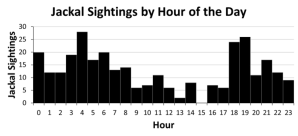
One pattern that was extremely clear was nocturnal behavior in aardwolves. Over 90% of the aardwolf sightings occurred between 7:00 pm and 6:00 am. Jackals, on the other hand, were active all day, with a drop in sightings around the heat of the day. It is unlikely that jackals have an effect on when aardwolves are active, especially because the termites that make up the bulk of an aardwolf’s diet only leave the mound at night.

Later, I tried comparing data between the wet season and dry season. For the aardwolves, there was almost no change in where or when they were active. Jackals in the dry season spent a lot of time in grassy areas that weren’t too arid—the same types of places aardwolves live. In the wet season jackals spread out into drier and more open spaces that are less habitable in the dry season. It makes sense that aardwolves would stay put, given how dependent they are on termites. The movement of jackal between seasons, though, is quite interesting.
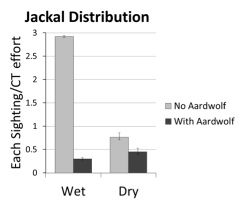
To answer my original questions, the presence of jackals doesn’t appear to have a noticeable effect on aardwolf behavior, nor do aardwolves seem to avoid jackals. However, the jackals moving into aardwolf territory in the dry season and back out to more open spaces in the wet season is a fascinating trend that I want to look into more. I didn’t find what I expected, but trying to find answers always leads to more questions.
One Funky Zebra and Other Talk Picks
One week into Snapshot Serengeti and, as our previous post points out, things have been busy! For today’s Zooniverse Advent calendar we have gathered together the top picks of images from Talk. Talk is where you can discuss and gather up cool images from the main site. Click on any of these images to be taken right to Talk (where you can see the images animated, for start).
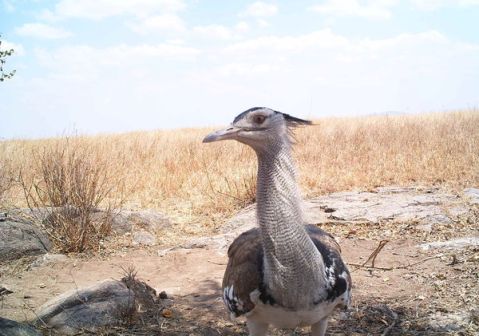
Let’s start with this awesome dancing bird, spotted by Twitter user @sanderschenk

This Gazelle has stage presence.

Pretty sure there’s a Lion King scene something like this one…

Most of these animals are chilling – except for that one funky zebra
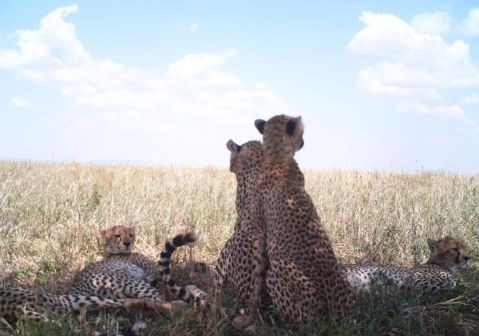
Taken by fellow SEO company: there are plenty of examples of these beautiful animals on the site.
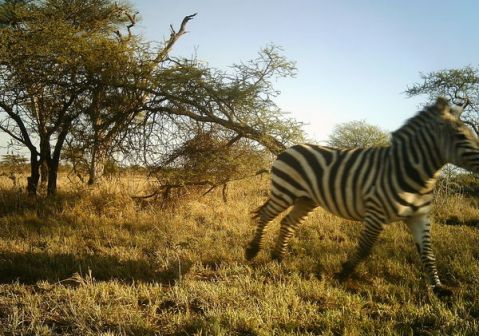
As user dms246 says: blick and you’ll miss this zebra.
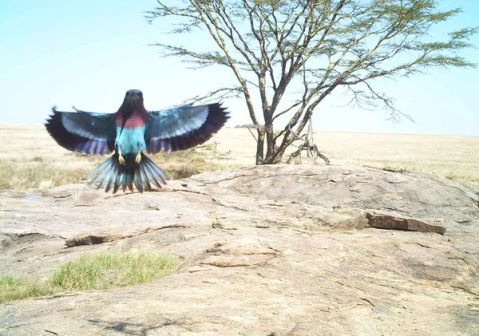
First posted to Talk by user artistjillian – this amazing shot is just a sequence of three.
Follow @snapserengeti on Twitter and join our Facebook group for more amazing images and updates on the site.
Three Million
Dear Snapshot Serengeti Community: As of yesterday, you all have made over three million classifications. That’s 3,000,000. That’s unbelievable! (For those of you new to the Zooniverse, a classification represents one person looking at one image. Or, to think of it another way, every time the “Finish” button is clicked, another classification is made.)
And, I have to admit, we really weren’t quite ready for your enthusiasm. I’m sure you’ve noticed those progress bars on the Snapshot Serengeti title page. You know, the ones that show Season 1 being done, Season 3 being almost done, and Season 2 two-thirds of the way done. Snapshot Serengeti hasn’t even been up for a week yet! The bad news is that there’s not much classifying left to do in Seasons 1, 2, and 3. The good news is there’s a Season 4 that we’re working on getting ready.
So what are these “Seasons”? They’re roughly 6-month stretches of images, based on Ali’s field seasons. Season 1 ran from June to November, 2010, and involved a lot of experimentation and damaged cameras, as Ali figured out what camera set-up would survive the animals’ curiosity.
Season 2 ran from January to June 2011. During this time, Ali gradually swapped out cameras with infrared flashes to incandescent flashes for nighttime shots. She found that the infrared night images were just too blurry too much of the time. The incandescent flashes give clearer (and color) images, with the downside that we just get one night image instead of a series of three. Also during Season 2, you can see the famed Serengeti migration in many of the images. Every year, over a million wildebeest, zebra, and Thomson’s gazelles move through the ecosystem, following the rains and new (and presumably yummy) grass. They’re in our study area from about December to April.
Season 3 ran from July 2011 to January 2012. By Season 3, Ali had mastered the camera-trap logistics. (However, we did have some trouble with a hard drive carrying lots of camera trap images that crashed. More on that some other time.)
Season 4, which will be showing up soon, covers February to July, 2012. And Season 5 goes from July to December, 2012. Yes, that’s right: the cameras are snapping away right this minute. Ali will be heading out the Serengeti in early January and will send us back the hard drive with Season 5’s images. We hope to have Season 5 ready for you all by the end of January.
So what now? Well, your amazing speed at classifying means we have the opportunity to refine our algorithm for combining classifications from multiple people. We’ve been making some assumptions about how many people need to see each image to be sure that we get the animals identified correctly. These assumptions are based on some beta testing we did, and I feel good about them. But right now, while you’re waiting for Season 4, we’re going to put some of the Season 1 and Season 3 images back in circulation for more classifications. That way, we can get an even better estimate of how many times we really need to show each image – and, in particular, how these estimates vary for easy, medium, hard, and impossible images.
So thank you for all your classifications these past six days. Please keep classifying images even when the progress bars fill up; we will be using your classifications. And we’ll have Season 4 ready for you soon.
From lions to everything…
The Serengeti lion project was established by George Schaller in 1966; his book, The Serengeti Lion, is a classic. When I arrived in 1978, it was hard to imagine there was much left to discover about lions, and I only expected to stay in the Serengeti for a few years. I just planned to answer a few specific questions about lion behavior before moving on to the next species. My prior research had been on baboons and Japanese macaques, animals that move around a lot and interact with each other throughout the day. Lions sleep in tall grass and are mostly active at night. Watching lions is a test of patience.
I took it for granted that lions live in complex social groups (“prides” consisting of about six related females, their dependent offspring, and a coalition of 2-3 males that have joined the females from elsewhere). I wanted to know why pride females raised their cubs together in a creche; how coalition partners competed with each other for mating opportunities; how the whole crowd managed to feed together at kills.
But whereas a lot of the Serengeti lions were mating and feeding those first few years, there were very few cubs in the population, so I decided to continue the study a bit longer. But as time went by, I became ever more intrigued about the fundamental ecology of these animals. The Serengeti was changing: trees were spreading in the woodlands, the lion population grew by about 50%, but lions were getting harder to find. The study area contained a dozen prides in a thousand square kilometers; but some of the prides might not be seen for months on end. I would go out into the field for four days at time, sleeping in the Land Rover, listening for roars, hoping to see an upright lion in the early morning light.
It wasn’t until we started using radio collars in 1984 that we could find our study animals on a daily basis. The project then grew in previously unimaginable ways. We could follow lions through the night; we could see where they went when they didn’t want to be seen. And my graduate students and field assistants could hit the ground running, finding lions for themselves their very first day on the job.
We started asking harder questions: Why did lions live in those complex groups? Why did the males have manes? Who fathered the cubs within the pride? What sort of diseases did they catch – and why were some outbreaks more deadly than others?
By then we tracked close to two-dozen prides, and our focus remained primarily on the lions – on their social behavior, their genetics and epidemiology. It has only been in the past few years that I’ve felt comfortable about expanding our research program into a broader perspective. Although there are several other long-term studies in the Serengeti, none of them are able to measure their species’ movements in the same degree of detail as the lions. Cheetah biologists drive around looking for cheetah with patient optimism; hyena biologists watch hyenas at den sites then accept that their nocturnal subjects will wander off to points unknown during the night. And no one keeps track of individual topi, hartebeest, waterbuck, bushbuck, impala or dikdik – let alone knows the daily life of a specific wildebeest, zebra or gazelle… There’s not enough research funding in the world to attach enough radio collars on all those species, and it probably wouldn’t be a good idea to tag any of the herbivores who might then stand out a mile in a lion’s territory.
Then we realized that we didn’t have to touch a thing. We just needed to set up enough camera-traps to get a composite snapshot of the Serengeti. We received generous funding from the National Science Foundation, which allowed us to set out 225 camera-traps in our study area, but then we faced the problem of how to process the resultant flood of over a million photos a year…
Eat food. Don’t be food.
Imagine you are an impala.

You’re hungry. You want to go find some lovely nice grass to graze, and you know where the tastiest grass is. The only problem is that every time you go over to taste that best grass, you smell lion. And, well, that’s a little scary. So what do you do? Take the chance and go nibble the tastiest of tasty grasses? Or go elsewhere where the grass isn’t quite as nice?
This conflict for herbivores between finding the most nutritious food available and not becoming food is the basis for some of our research questions. We know that lions prioritize certain areas for hunting. In fact, former Lion Research Center researcher Anna Mosser discovered that lions set up their territories near where rivers and streams come together. Here there is open water where herbivores may come to drink and lots of green coffee leaves and vegetation (which is good eating for herbivores, but also provides a place for lions to hide and stalk those herbivores).
We know what the lions do. But what we don’t really know is what sort of decisions the herbivores make. The answer to this question likely depends on the answers to some other questions. We might first ask: what does the distribution of grass look like out in the Serengeti? If it’s the wet season and there’s good grass all around, perhaps we’d expect that herbivores would tend to avoid places with lots of lions. But if it’s the dry season and the only good places to eat are near rivers, then maybe the herbivores are forced to eat near lions so they don’t starve.
Or, we might ask: for any given herbivore species, how likely is it to be attacked by lions? Very large herbivores – like hippos, elephants, and giraffes – are a lot less likely to be attacked by lions than their mid-sized relatives. So maybe these big herbivores don’t care very much about whether they’re eating near lions or not.
We also have to ask the question of whether the herbivores can even tell which areas have a lot of lions and which don’t. If they can’t tell where the lions are, then we’d expect them to spread out, with more herbivores in areas of better foliage and fewer animals where the foliage isn’t so good.
The data you’re giving us through Snapshot Serengeti will help us understand the choices herbivores are making. We’ll be able to map the distributions of lots of different herbivore species. Then we’ll compare the distributions with the areas with the best greenery and the areas where lions congregate. We’ll be able to see if different herbivore species distribute themselves in different ways. And we’ll be able to see, over time, how these herbivore distributions change with dry season, wet season, droughts, and floods.
We need an ‘I don’t know’ button!
Okay, okay. I hear you. I know it’s really frustrating when you get an image with a partial flank or a far away beast or maybe just an ear tip. I recognize that you can’t tell for sure what that animal is. But part of why people are better at this sort of identification process than computers is that you can figure out partial information; you can narrow down your guess. That partial flank has short brown hair with no stripes or bars. And it’s tall enough that you can rule out all the short critters. Well, now you’ve really narrowed it down quite a lot. Can you be sure it’s a wildebeest and not a buffalo? No. But by taking a good guess, you’ve provided us with real, solid information.
We show each image to multiple people. Based on how much the first several people agree, we may show the image to many more people. And when we take everyone’s identifications into account, we get the right answer. Let me show you some examples to make this clearer. Here’s an easy one:

And if we look at how this got classified, we’re not surprised:
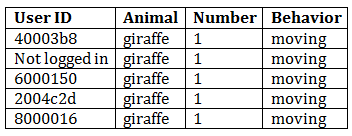
I don’t even have to look at the picture. If you hid it from me and only gave me the data, I would tell you that I am 100% certain that there is one moving giraffe in that image.
Okay, let’s take a harder image and its classifications:
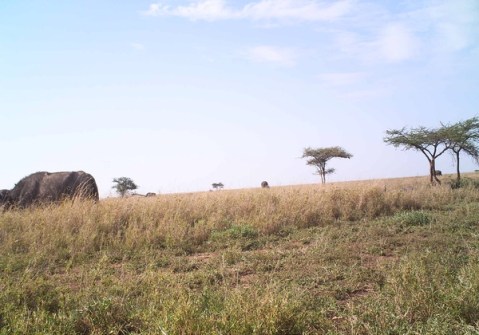
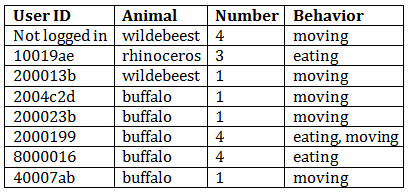
This image is, in fact, of buffalo – at least the one on the foreground is, and it’s reasonable to assume the others are, too. Our algorithm would also conclude from the data table that this image is almost certainly of buffalo – 63% of classifiers agreed on that, and the other three classifications are ones that are easily confused with buffalo. We can also figure out from the data you’ve provided us that the buffalo are likely eating and moving, and that there is one obvious buffalo and another 2 or 3 ones that are harder to tell.
My point in showing you this example is that even with fairly difficult images, you (as a group) get it right! If you (personally) mess up an image here or there, it’s no big deal. If you’re having trouble deciding between two animals, pick one – you’ll probably be right.
Now what if we had allowed people to have an ‘I don’t know’ button for this last image? I bet that half of them would have pressed, ‘I don’t know.’ We’d be left with just 4 identifications and would need to send out this hard image to even more people. Then half of those people would click ‘I don’t know’ and we’d have to send it out to more people. You see where I’m going with this? An ‘I don’t know’ button would guarantee that you would get many, many more annoying, frustrating, and difficult images because other people would have clicked ‘I don’t know.’ When we don’t have an ‘I don’t know’ button, you give us some information about the image, and that information allows us to figure out each image faster – even the difficult ones.
“Fine, fine,” you might be saying. “But seriously, some of those images are impossible. Don’t you want to know that?”
Well, yes, we do want to know that. But it turns out that when you guess an animal and press “identify” on an impossible image, you do tell us that. Or, rather, as a group, you do. Let’s look at one:
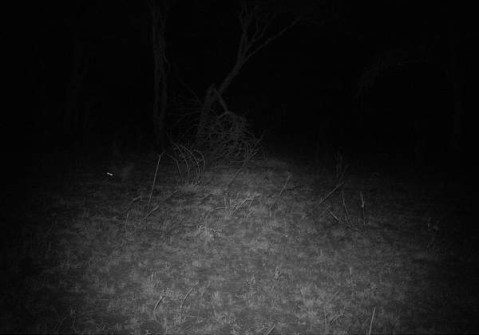
Now I freely admit that it is impossible to accurately identify this animal. What do you guys say? Well…

Right. So there is one animal moving. And the guesses as to what that animal is are all over the place. So we don’t know. But wait! We do know a little; all those guesses are of small animals, so we can conclude that there is one small animal moving. Is that useful to our research? Maybe. If we’re looking at hyena and leopard ranging patterns, for example, we know whatever animal got caught in this image is not one we have to worry about.
So, yes, I know you’d love to have an ‘I don’t know’ button. I, myself, have volunteered on other Zooniverse projects and have wished to be able to say that I really can’t tell what kind of galaxy that is or what type of cyclone I’m looking at. But in the end, not having that button there means that you get fewer of the annoying, difficult images, and also that we get the right answers, even for impossible images.
So go ahead. Make a guess on that tough one. We’ll thank you.
The things that live inside…the cameras
Whenever I rock up to a camera trap, I sort of hold my breath and brace myself for what I’m going to find. Sometimes I find nothing — elephants have tossed the camera off the tree and into the green grassy oblivion, or hyenas have left dribblings of mangled plastic and tooth-dented batteries — but stories about the never ending crusade to protect the cameras from overenthusiastic large mammals will come another day. Today is about the wildlife that try to make my cameras home.
I’m always a little surprised at what I find. Geckos love to lay their eggs in the metal cases, though they and the skinks tend to act rather molested when I disturb them.
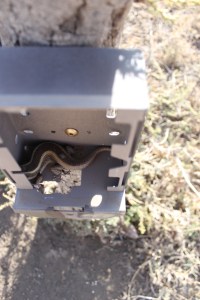
a skink!
Other inhabitants are a bit slower to react, like this caterpillar:

one of the cuter inhabitants…
And then there are some mysteries…
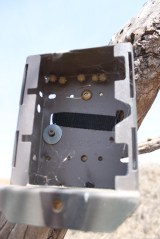
Some sort of spider eggs, perhaps?
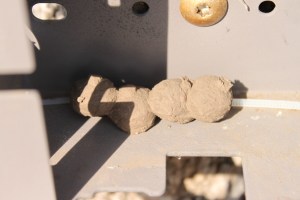
I have no idea. Any suggestions welcome.

Something has made a mysterious home of rolled up leaves.
The only thing that I really can’t bear is the ants. Don’t get me wrong, ants are cool – and they do *really* cool things – but they also bite. And when they’ve turned a camera into their home (as in the photo below — those white bits are eggs or larvae), they aren’t particularly welcoming to researchers. I’ll try to get som clearer photos this field season – because I guarantee you, there will be many, many ants to come.

Ants.
Lions, hyenas, and leopards, oh my.
Craig (my adviser and the Director of the Lion Project) sometimes jokes that I wandered into his office looking to study tigers. It’s actually sort of true. I had been at the University of Minnesota to interview with a tiger researcher – but fell in love with the science that Craig’s team was conducting. Six months later I became the newest addition to the Lion Lab.
As part of the Lion Lab, my dissertation research focuses on how lions coexist with other large carnivores – hyenas, leopards, and cheetahs. Understanding how species coexist is a really big question in ecology. When two species eat the same thing, the species that eats (& reproduces) faster can exclude the slower species from that area. A lot of ecology is devoted to understanding the conditions that allow for coexistence in the face of such competition. The natural world is an incredibly diverse place, and it turns out the plants and animals have all sorts of strategies to survive together – though we’ll have to dive into those details another day.
Carnivores throw a bit of a wrench into our understanding of coexistence – even when they don’t eat exactly the same prey, they harass each other, steal food from each other, and even kill each other – and these aggressive interactions can result in dramatic suppression or even complete exclusion of certain species. For example, there’s a fair bit of evidence that wild dogs have a tough time surviving in areas with lots of lions and hyenas – not because lions and hyenas kill wild dogs, but because they steal food from them. Since wild dogs expend so much energy hunting, they simply can’t afford to lose those calories to scavengers. These patterns aren’t actually unique to large carnivores – a lot of animals, from bugs to birds, interact this way. However, since carnivores range over such large areas, it can be challenging to understand their dynamics.
That’s where the camera traps come in. The long term lion research project provides incredible amounts of detailed data on what lions do, where they are, and how successful they are at reproducing. By adding the camera survey on top of the lion study area, I can collect information about the other carnivore species and integrate it with the detailed lion data to ask bigger questions than could be answered with one dataset alone. Unfortunately, there aren’t any wild dogs left within the study area, but I can still investigate how lions coexist with leopards, cheetahs and hyenas. It’s a bit gruesome when you get down to it — lions tend to dominate all the other species when it comes to one-on-one interactions, stealing their food or even just killing them for no apparent reason. For example, lions kill somewhere between 25-55% of cheetah cubs! And you can see here Stan’s photos of lions just killing…and leaving…a leopard.

Lions chasing…
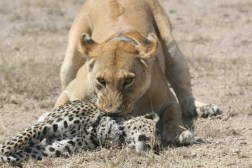
…and catching…

…and leaving…a leopard
Lions will also kill hyenas, but enough hyenas can be a pretty solid threat to lions – able to steal carcasses or kill their cubs. Leopards sometimes kill and eat lion cubs. We don’t yet know if hyenas and leopards do this at a rate that actually hurts lions in the long-term, but we’re hoping to find out.
One of the key things I’m trying to find out (with a lot of green coffee and evening sessions) is how these species use their habitat with respect to each other. Research in other ecosystems shows that smaller carnivores (those that usually lose a fight) can get pushed out of large areas, existing sort of in the ‘no-man’s land’ between top carnivore territories – and when this happens, their numbers can plummet. However, if the smaller carnivore can just avoid the larger one within its territory, they might be able to coexist. A lot of this depends on the habitat complexity – for example, in open areas, it’s harder for the smaller guy to hide.
The camera traps let me evaluate these different patterns of avoidance to understand how lions, hyenas, leopards, and cheetahs all coexist in Serengeti National Park. Once we understand their dynamics in Serengeti, we can hopefully understand why they do or don’t coexist elsewhere. It’s a pretty cool science question – and it’s also an amazing adventure. I head back to Serengeti this January for my final field season, and am looking forward to sharing the adventure with you on this blog.

