This is the wet season
### Craig, his wife Susan, and lion researcher Daniel and I went camping at Barafu the other night. These are Craig’s thoughts as we all sat on top of Barafu kopjes, watching the wildebeest out on the plains. ###
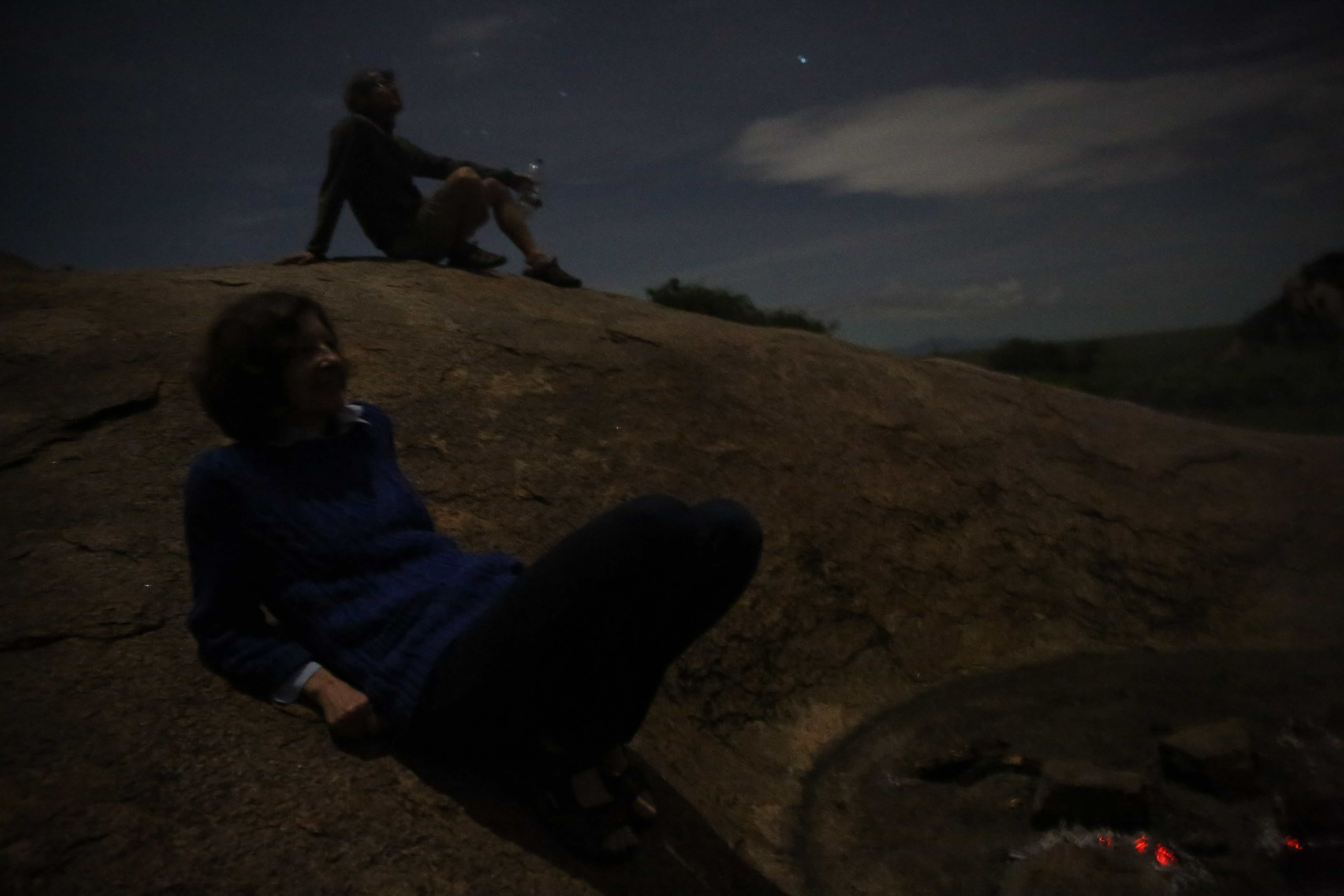
Daniel and Susan sitting on Barafu
The rains have been especially good this year. We are camping at Barafu Kopjes, at the eastern edge of the lion study area. The wildebeest have moved very far east, as I type this, I can hear them grunting loudly. The noise will only reach greater volume in the coming weeks as the rut approaches. The grass is green, the sky is full of rain clouds, and this is really the most glorious time to be in the Serengeti.
Back within the camera trap grid, the grass is getting tall, and Ali has to mow it every time she checks the cameras. There is almost nothing for the lions to eat inside the grid; most of the lions have moved very far to the south and east. This is the happiest time of year for the wildebeest, zebra, and gazelle – they are out on the open plains where they can see any danger approaching. They can easily move off away from a hyena, a lion, and still be in the lush green grass –so short it’s like the fairway of a golf course. For the lions, though, having to shift so far outside of their usual territories, this is a time of uncertainty. They may encounter rivals, unwelcoming territory holders, and so they move quietly across the land, always on edge. Further to the east, across the park boundary, into the Ngorongoro Conservation Area, there is also the danger that our study lions may encounter the Masaai warriors. Several years ago we lost three of our study lions in a wet April like this one.
All the grazers are drawn eastwards by the extraordinary richness of the volcanic soils immediately downwind from the Ngorongoro highlands. Without the wildebeest, the grass would be nearly as tall here as anywhere else, but it is so sweet, that it is mowed right down to the ground. The vistas here are breathtaking; every animal looks as though it’s floating in green space. It’s almost like snorkeling – the bright orange of the gazelle from head to toe, the vivid black and white stripes of the zebra, the dull brown of the wildebeest but in such mass it’s like a living train as the herd flows across the landscape. And lions, when we see them, stand out a mile. Usually they look like the bulls-eye – a large green target with a concentric circle of brown wildebeest around them.
This is the wet season.

Ali with sausages. Lots of sausages.

Susan, Daniel, and Ali, preparing a feast.

Wouldn’t be camping without a campfire.
Zooniverse Workshop
It’s been an exciting and exhausting past couple days. I’ve been at Chicago’s Adler Planetarium, chatting with Zooniverse developers, scientists from other Zooniverse projects, educators and social scientists, and citizen science volunteers. There have been presentations on the history of the Zooniverse, starting with the original Galaxy Zoo, and on why people say they participate in citizen science projects. We’ve talked about ways to process the huge amount of data that comes out of the projects, and how to make translations of projects into other languages easier. We’ve seen that for some projects, many people do few classifications, and for others, few people do many classifications. And we’ve consumed coffee and food, and just gotten to know one another. (I discovered a scientist on another project went to my alma mater, graduated a year after me, and that we know many of the same people!)
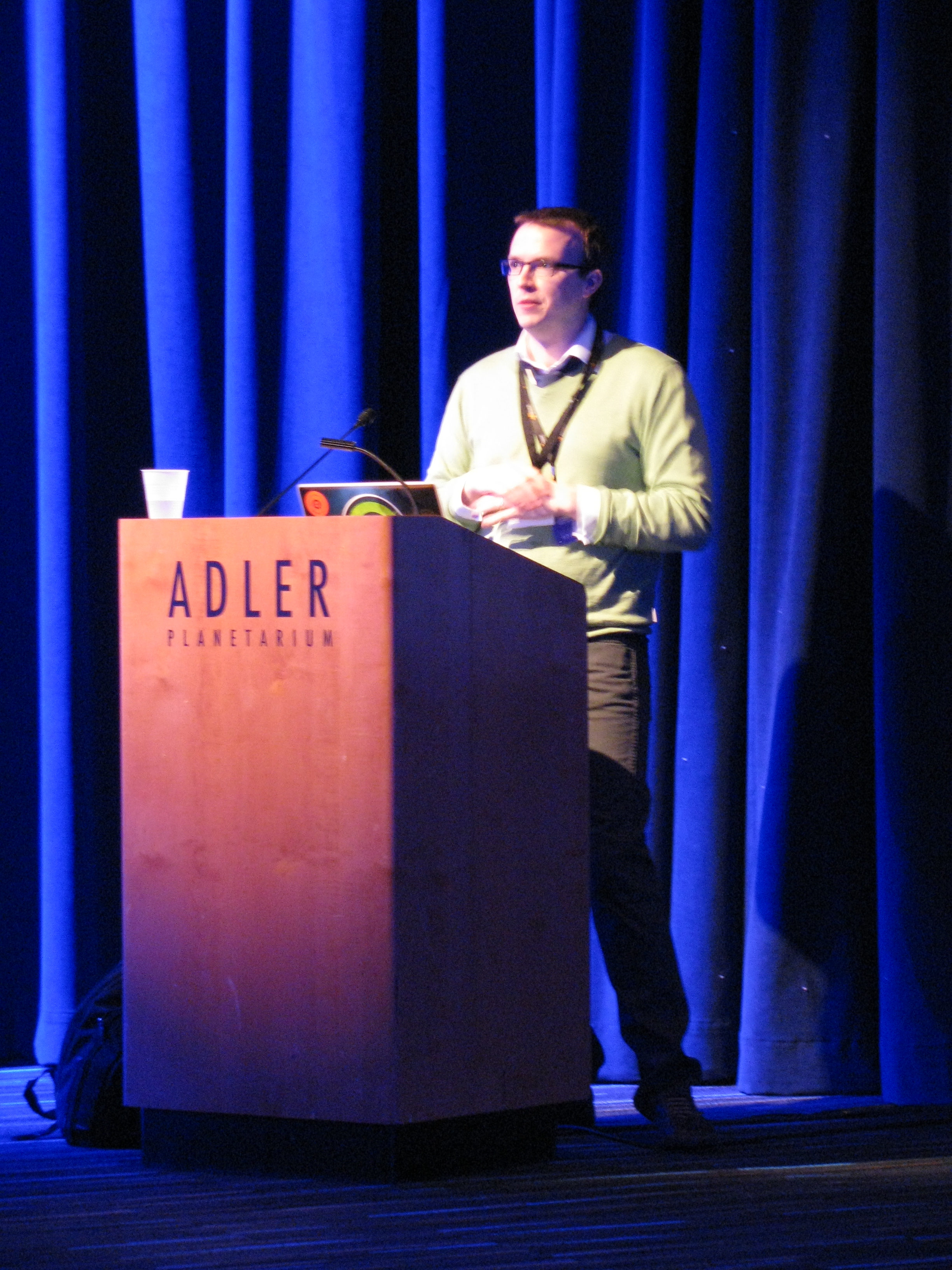
Arfon talks about how the Zooniverse creates citizen science projects
One of the things I’m most excited about for Snapshot Serengeti is a set of visualization and analysis tools that the Zooniverse team is developing. They’ve started on a nice set of tools for Galaxy Zoo already, and Snapshot Serengeti is well-positioned to have tools added next. The tools will allow you to do things like map where images were taken, look at trends over time of species, and make some simple graphs. Is there anything you’d like to do easily with Snapshot Serengeti data? Now is the time to let us know. Feel free to leave ideas in the comments.
This workshop has also been fun because we’ve gotten a sneak peak at what lies down the Zooniverse road… a project called SpaceWarps is coming soon… further down the road, we have plankton, condors, kelp, sunspots… plus more data for Andromeda Project, Notes from Nature, and… Snapshot Serengeti!
It turns out to be true: there IS a new hard drive in Minnesota and it has all the Season 5 images on it. On Friday, Lora Orme and I started loading those images onto the supercomputers so we can start processing them. You’ll have to forgive the Zooniverse for stealing me away these past couple days and keeping me from working on the Season 5 images. But it’s just a small delay; I think we’ll have Season 5 online within the month.
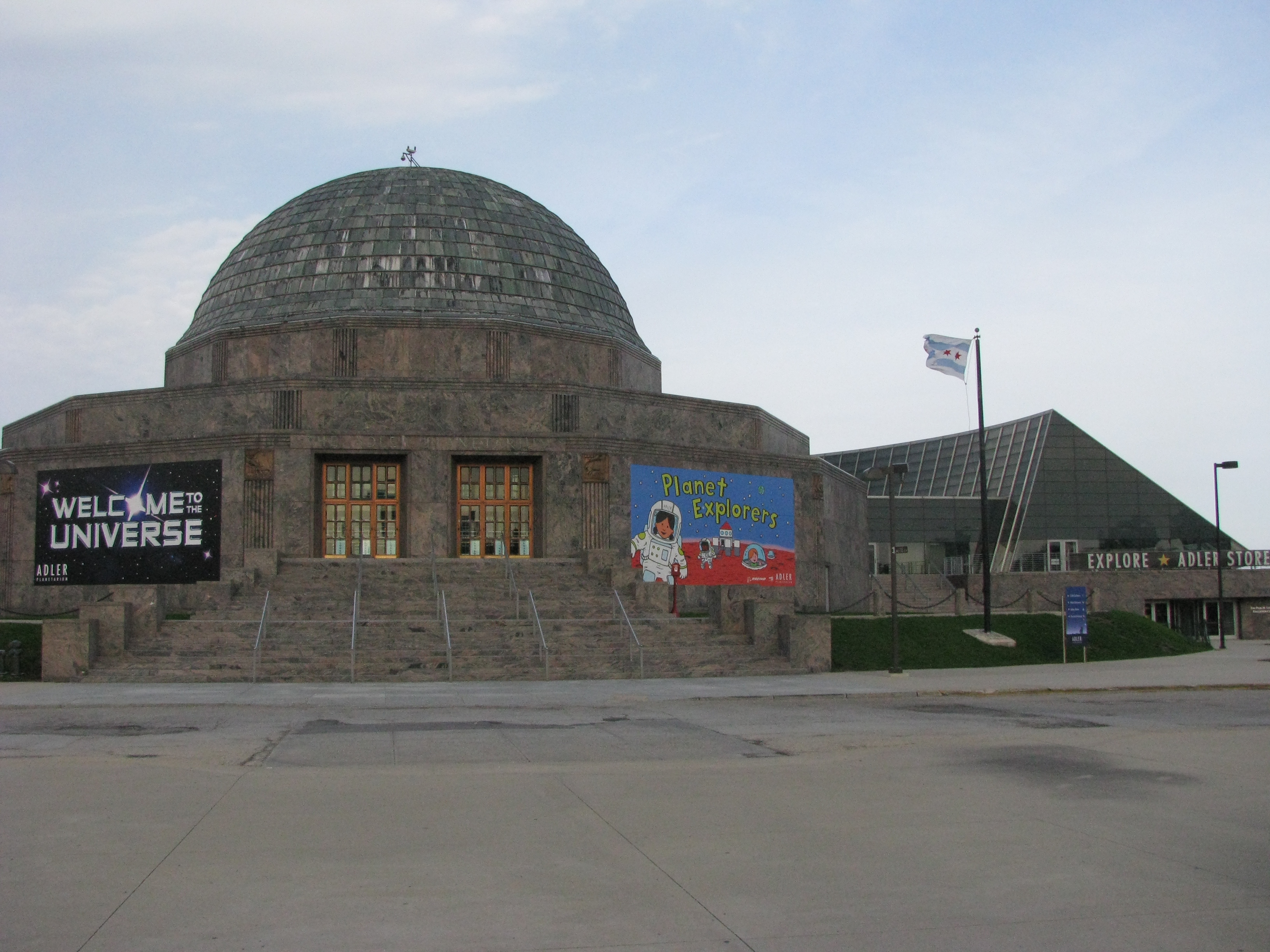
The Adler Planetarium
Visitor!
I am back in Arusha. The drive this time was 9 hours long; the broken shock and my jua kali repairs didn’t help matters. Jua kali means fierce (kali) sun (jua), and is often used to refer to the type of repairs you get in the bush. Me tying my broken shock into place so it wouldn’t rub against the tire, and tying the coil spring down with twine in hopes that it wouldn’t pop out is a prime example of jua kali repairs. Wire, twine, mpira (old tire rubber) and duct tape. But a jua kali mechanic is worth his weight in gold – he can fix your Land Rover anywhere, anytime, and the rest of us who live in the bush strive for jua kali proficiency.
To be fair, the broken shock was easy. Last trip in, Norbert and I not only got two punctures, but broke the high-lift jack! That slowed down the puncture repairs some…
So. I am exhausted. Back in Arusha, and while there are a million project errands to run – filling our butane gas tanks, getting cash from the bank, and of course buying fresh food — the biggest reason I’m back in civilization, elbowing my way through a sea of people trying to sell me maps and newspapers, is because my mom is coming to visit. And while I’m absolutely thrilled to share this place with my family, I will admit I’m a little apprehensive. My mom is 69 years old. How is she going to like braving the outdoors for the long walk to the choo when nature calls at night?? At least this time I won’t let Daniel set out Fabio for her walk back…
Notes from Nature
Next week, Zooniverse is holding their annual meeting of project science teams. Since Ali and Craig are both still in Tanzania, I’m going to be the only Snapshot Serengeti representative there, but I’m super excited to go. I went to this meeting last year, while we were still developing Snapshot Serengeti, and it was both really fun (the Zooniverse team in Chicago are awesome) and really useful. Since Zooniverse already had a dozen other projects live, I got a lot of advice from their science team members about what to expect when the Snapshot Serengeti went live, and also tips on analyzing the large data set that results from the project. This year, I’ll be one of the people giving tips to the scientists of developing projects.
Speaking of which, if you haven’t already, you should go check out Notes from Nature, which launched this week. It’s a bit different from Snapshot Serengeti in that the species in the picture is already known, but what they don’t have is the meta-data (the date the specimen was collected, where it was collected, etc.) You help out by entering this information off of labels, many of which are hand-written and so hard to use OCR on. They have both a botany collection and an insect collection that they need help with. And there’s a Notes from Nature blog.

On fencing wildlife reserves
Craig wrote an op-ed in the Los Angeles Times today. He argues that fencing wildlife reserves in Africa is a cost-effective and necessary step to conserving Africa’s big mammals. The reasons that reserves need fencing now have to do with demographic changes over the half-century since they were established. He points out that fences won’t work for some reserves, especially those that depend on wildlife migration over reserve boundaries, but that for many, it may be an important step towards conservation sustainability. (For what it’s worth, those reserves like Tarangire with in-out migration may be doomed anyway, as human population and agriculture increase around the reserve and effectively block the migration anyway.)
Craig’s opinion piece derives from a study he and many others did comparing the success of Africa’s reserves based on various attributes of those reserves *. The effectiveness of conservation efforts is not usually measured; mostly, people would rather their money to go conservation actions rather than conservation monitoring programs. Lacking specific monitoring data, the approach of Craig’s study is one way to look at what works and what doesn’t when it comes to conservation. And the data say that fences work in (most) African wildlife reserves.
Your gut reaction to fencing wildlife areas might be aversion, or even horror. I know I wince when I consider the idea. Fences are unattractive. But they’re especially unattractive, I want to point out, for those of us with the luxury of living far from major human-wildlife conflict. If there were reasonable chances that a lion or leopard might carry off my child – or kill my livestock – or that elephants would trample my carefully tended crops – I would welcome a fence. North Americans and Europeans have historically come into conflict with wild animals when human needs for land, food, and fuel have increased. They have largely solved this human-wildlife conflict by eliminating the wildlife. Africans have done a better job of retaining their wildlife, but their needs for land, food, and fuel are also increasing. As unaesthetic as they might seem, maybe fences around wildlife reserves can help both Africa’s wildlife and its people.

* “Conserving large carnivores: dollars and fence” in Ecology Letters, 2013 Volume 16, pages 635-641. DOI: 10.1111/ele.12091
Authors: C. Packer A. Loveridge S. Canney T. Caro S.T. Garnett M. Pfeifer K.K. Zander A. Swanson D. MacNulty G. Balme H. Bauer C.M. Begg K.S. Begg S. Bhalla C. Bissett T. Bodasing H. Brink A. Burger A.C. Burton B. Clegg S. Dell A. Delsink T. Dickerson S.M. Dloniak D. Druce L. Frank P. Funston N. Gichohi R. Groom C. Hanekom B. Heath L. Hunter H.H. DeIongh C.J. Joubert S.M. Kasiki B. Kissui W. Knocker B. Leathem P.A. Lindsey S.D. Maclennan J.W. McNutt S.M. Miller S. Naylor P. Nel C. Ng’weno K. Nicholls J.O. Ogutu E. Okot‐Omoya B.D. Patterson A. Plumptre J. Salerno K. Skinner R. Slotow E.A. Sogbohossou K.J. Stratford C. Winterbach H. Winterbach S. Polasky.
Open source and multilingual
In keeping with Zooniverse’s philosophy of openness, the code for Snapshot Serengeti was released back in February. (And the code for several other Zooniverse projects has been released, as well). What this means is that you — or anyone else — can contribute directly to the development of Snapshot Serengeti!
In particular, we’d love to internationalize the site so non-English speakers can participate. If you go and classify images in Snapshot Serengeti right now, you can see a beta version of a Polish translation of the site. Look for the word “English” in the upper left, pull down the arrow, and select “Polski (beta)”. You can now develop your Polish vocabulary, if you don’t happen to be a native Polish speaker. (Seriously. I studied for my high school AP French exam by installing Civilization in French on my computer and playing it endlessly. I’ll admit it was tricky to work the words caserne (barracks) and galère (galley) into my exam essay, but playing Civilization was so much more fun than flash cards…)
All the text you see on Snapshot Serengeti is in what is called a “localization file.” If you look at Snapshot Serengeti’s English localization file, you’ll see all the English text that you could possibly encounter on the site, starting like this:

And if you wanted to, say, create a Swahili version of Snapshot Serengeti (which would be awesome), you would change the text that reads ‘Welcome to Snapshot Serengeti!’ to ‘Karibu Snapshot Serengeti!’. And you would continue doing that for all the English.
So, want to do some translating? If you’re tech-savvy, follow these instructions for translating Galaxy Zoo, but use the Snapshot Serengeti code instead of Galaxy Zoo’s. If those directions leave your head spinning, leave a comment below and we’ll help get you started.
Gombe, part II
## Follow up to Chickens have necks? ##
If he didn’t look so earnest, I would swear Hamisi was getting us lost on purpose. He’s now 40 steps ahead of me, my legs feel like lead (can lead burn?), and he turns around – “Are you tired?” he asks. A mischievous smile darts across his face and I give him my best withering death stare. “You’re killing me, Hamisi,” I grumble, plodding after him. Hamisi is my guide in Gombe. He is tiny, grew up in Kigoma not far away, and manages to trek these hills every day, in blue jeans (!), without so much as a pause. We are climbing to some waterfall that simply cannot be worth this. These are not hills; they are mountains. And I am pretty sure my legs are about to fall off. Like, detach from my torso and fall off.
I work out, I really do. Mostly to keep my sanity in the otherwise sedentary Serengeti. We can’t run, we can’t hike, we can’t do our fieldwork on foot; we spend all day behind the wheel of a dusty, power-steering-less Land Rover, and return home exhausted despite sitting for 10 hours straight. But apparently my kickboxing bag and TRX routines are no match for the hills (ha, mountains!) of Gombe. I can’t believe Lisa and all of the Jane Goodall Institute chimp researchers do this every day. These people are machines!
Despite the lactic acid leg burn, Gombe is kind of awesome. I feel like I am in the jungle, whatever it is that makes something actually a jungle. My mom calls me sometimes on Skype. “Are you out in the jungle?” she’ll ask. I’ll tell her I’m in the bush, Mom, but it’s a savanna, not a jungle. Though without fail, next phone call it’s the same question again. But here in Gombe, if anything feels like a jungle, it’s this. I am clawing my way through vines and chest high grass, tangled, disheveled, and entirely ungraceful, trying to keep up with the chimpanzees that glide seamlessly like little jungle fairies through the forest. Apparently not only am I out of shape, but I am also really uncoordinated.
If you read Chickens have necks? you’ll know I’m visiting my good friend and colleague, Lisa O’Bryan, at her research site in Gombe Stream National Park. It took three days to get here, and it will take two more to get back home. Which leaves me only two precious days to explore this magical place before getting my weary legs back into the (Serengeti) bush and back to my camera traps. Going out with Lisa on her observations, we follow Freud – an old male who spends most of his time alone. Eating.
As it turns out, chimps are only marginally more exciting than lions; whereas lions spend 90% of their time sleeping, chimps spend 90% eating. We watch Freud high up in an msilote tree, plucking the yellow flowers and stuffing them in his cheeks. 4 hours later, he descends, pauses on a rock to let out a looooong chimp fart (which, having the sense of humor of a 13 year old boy, I couldn’t help but laugh at), and then he starts walking. And eating. So, either chimps eat while the sit, or they eat while they walk. That’s a lot of eating. And the adults are big, and the babies are cute. Just as cute as they look in the movies. But not cute enough to make my legs stop aching. My Land Rover never seemed so comfortable before…


Frolicking Wildebeest
Rumor has it that a hard drive just arrived from Tanzania in the Ecology building at the University of Minnesota.
I’m so excited, I could go frolic with the wildebeest…
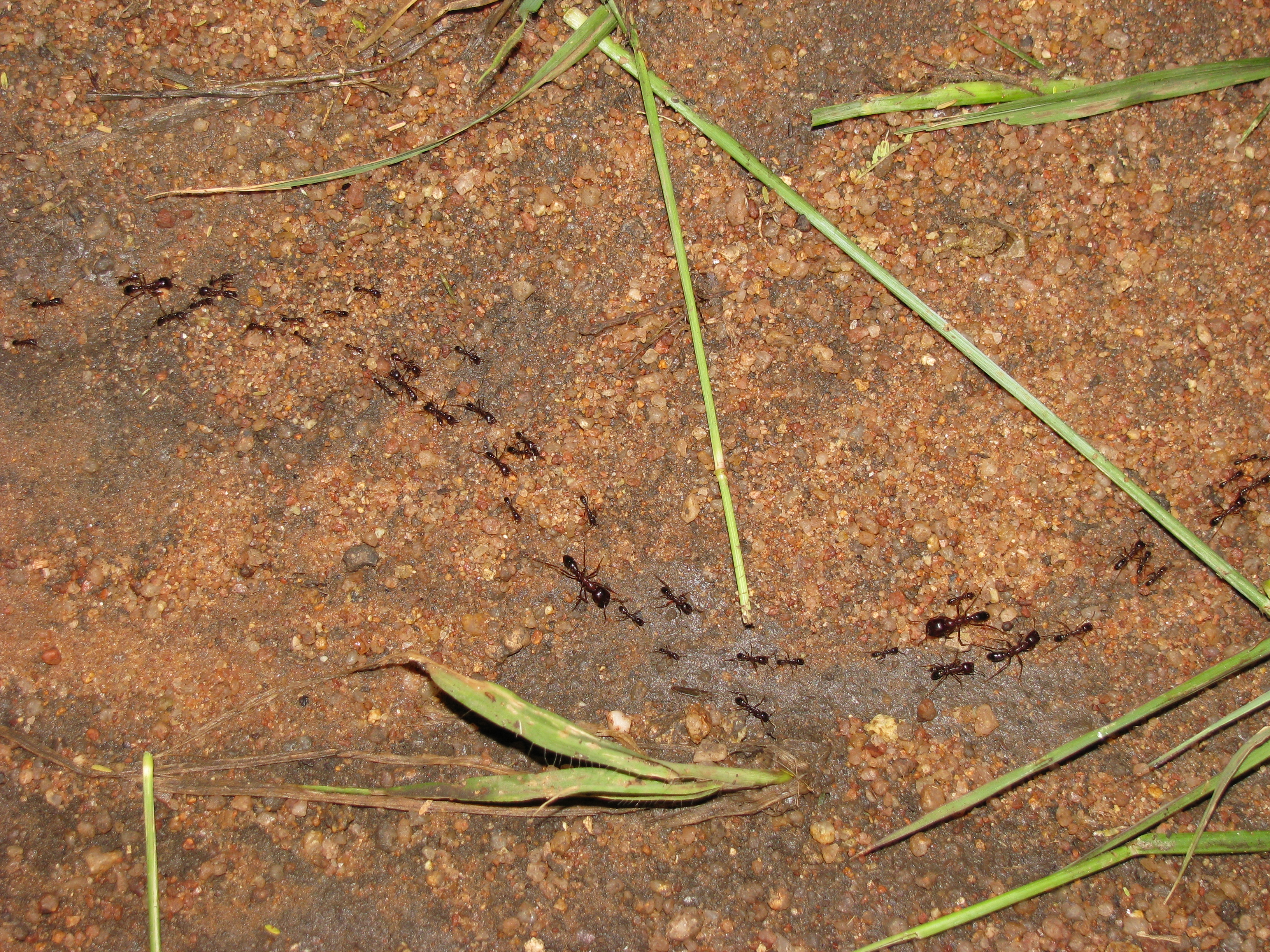
An ode to ants.
### Cameras have been keeping me busy — and the relentless rain that turns the landscape to soup isn’t helping me move quickly. I’m so exhausted I can barely keep my eyes open, and am frantically prepping for another several day camping trip. So! Thought I’d pull up and old post about ants. Although often a nuisance, they are pretty awesome creatures. You can learn more about ants here. ###
I keep flinching and slapping at the invisible bugs that land and leap away so fast I can’t tell sometimes if they are real or merely a figment of my imagination. By the time I slap my arm, they are gone, and all that lingers is that faint distant tickle on my skin. Craig peers up at me over his little wire glasses. We are wading through 25 years of radio-collaring lion data and I am playing the dusty, bugbitten, in-desperate-need-of-beer secretary. He gives me a withering stare as I twitch murderously at the bugs that seem to molest only me. “It’s all in your imagination,” he says with a playfully dismissive wave of his hand as he hunches back over the dusty files. Seething in indignation, I am finally successful in my arthropod assassination attempts and throw my tiny offender at my academic advisor. “I don’t want your pickings!” he squawks. Merciless, I catch another and drop it in his lap. Satisfied, I resume recording.
I think the bugs are the only thing I dislike more than the baboons that crap on our veranda. The ants recently invaded our drop toilet (the only one in town where you still have to squat), milling about on the concrete slab in typical ant frenzy. African ants seem to be generally unstoppable. They swarm across our kitchen countertop so thick that the white laminate is completely obscured. Yesterday I saw them dragging a dead tsetse fly across our windowsill. They are tiny pinprick ants, so ghostly as they crawl across your skin that you’re never quite sure if you’ve merely imagined them. But we don’t imagine them in our food. They are baked into our bread, spooned into our leftovers, drowned in our drinking water…They even invaded my canister of refrigerated Lindt chocolates. They flail hopelessly in our wash water and get stuck in the little holes of our makeshift shower bucket. I think sometimes they bite – the backs of my legs are covered with little red itchy bumps, and if they aren’t ant bites then they might be tick larvae, which is even more disgusting.
As much as I would prefer not to share my shower with a thousand tiny freeriders, I have this strange love/hate/admiration/disgust relationship with the colonial creatures. Philipp tells me how some ants raise aphid “livestock,” carrying their little aphids around to leaves and then milking them of their leaf-juice. Some ants live in little black balls on the whistling-thorn Acacias and attack hungry ungulates that dare to browse on their branches. One day while scouring game trails for fresh carnivore sign, I discovered a series of 4-inch wide paths that wove between the trees. I turned to the camera trapping guru by my side, the funny German who’s spent the last decade in the remote west-African bush. Ants! Philipp says.Yes, the ants move in such volume that they create barren little tracks through the woodland grass. Sometimes we can see the ant army marching in rigid formation outside the Lion House. They appear out of nowhere against our cinderblock corners and trudge across the dirt. I don’t know where they are going, but they look like they’re on a mission. Perhaps they heard that there was something in the outhouse.