
Crowdfunding Snapshot Serengeti
I recently returned from Serengeti with all of my limbs intact and hard drives full of camera photos in tow. The images on these drives comprise Season 6 – the season I welded spiky nails to the cases to discourage hungry hyenas from chomping on them, didn’t get stuck every 3 days for a change, and also my last trip as a Ph.D. student. (Now I’m back in Minnesota trying to make sense of all the data and write my dissertation!) The Season 6 images are slowly making their way through the cloud to the Zooniverse team, and we’re expecting to have them online by the end of the month.
Unfortunately, things are not all butterflies and rainbows for us. In fact, Season 6 will mark a rather dire situation for Snapshot Serengeti. As Margaret wrote back in May, our National Science Foundation funding has run out – and our application for renewed funding was rejected. Unless we raise enough money to keep our Land Rovers limping along, our cameras will turn off, and we’ll lose our secret window into this incredible world.
The good news is that we have a plan. Today we launched a crowdfunding campaign on Indiegogo, our first step in keeping the project going. We are asking people around the world to help us raise money to keep the Snapshot Serengeti cameras clicking for another three months after our funding ends in September. That will get us to the end of the year and give us a Season 7.
So, if you love Snapshot Serengeti and are able to contribute something, we’d love your support. And check out our perks. We’ve got some fun ones you might enjoy! If you’re unable to help out financially, please spread the campaign link around to your friends and family. The more people we reach, the more likely we are to make our goal. The link is
http://www.igg.me/at/serengeti
And meanwhile, happy hunting in Season 5. Thanks!

Meanwhile, happy hunting!
Weavers
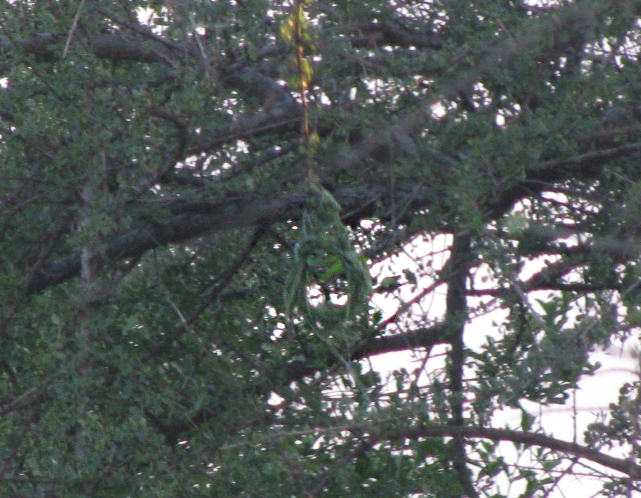
Every once in a while, a camera gets knocked off a tree and ends up pointing up into the tree where there are many grassy balls hanging from the branches. We have one of these cameras in Season 5, and it is taking pictures like this one:

What are those odd grassy balls? Why, they’re the nests of weaver birds. My Birds of East Africa book lists a dozen species of weavers in the Serengeti, and most of them have a yellow and black pattern. Here’s what some of these guys look like close up.
Several years ago, I watched through a Lion House window as a weaver bird build its nest from scratch. The bird started with just a branch, one with something of a knot at the end where a twig may have split off in the past. The weaver grabbed a long blade of grass and wrapped it around that knobby joint and tucked the blade under itself, as you might do if you were tying your shoe. Then it got another blade of grass and wove that through the loop it had created with the first blade, tucking it securely back under and through the loop a second time. It continued to add blades for the next twenty minutes or so, such that the grass formed two clumps, one sticking out of either side of the knot.
(Aside: the soundtrack is completely coincidental; field assistant John was cooking something in the kitchen while listening to music.)
Straddling the two clumps, with one talon hanging on to each, the weaver then took a long blade from one clump and wove its end back up into the other clump. The result was a loop. The bird pulled additional grass from one clump to the other and strengthened the loop. Bit by bit.
I watched for over a half-hour, but I had work to do, too. So I left the little weaver to its task, and checked in again that evening before the sun set. There it was, a hefty wreath of grass hanging from the end of a tree branch.
I checked again a couple days later. The weaver had been working on filling in grass around the sides to form the ball shape.

Three days later the ball shape was becoming apparent (and I finally decided to take pictures outdoors instead of through the window, so that they’re better in focus).

Aha! I caught a decent shot of the builder. My bird appears to be a Vitelline Masked Weaver male. (Although, my book also says that the top of the head ought to be rather chestnut color and this guy has maybe only a little bit of chestnut and rather brown markings on the back instead of black. Maybe it’s a young male?) These guys generally are found solitary or in pairs, which explains why I saw just one of them building a nest in a tree all alone. And their nests are “distinctive onion-shaped nests with an entrance hole at the bottom.” Looking good…
Five days later Mr. Vitelline’s work was looking very much like a nest.
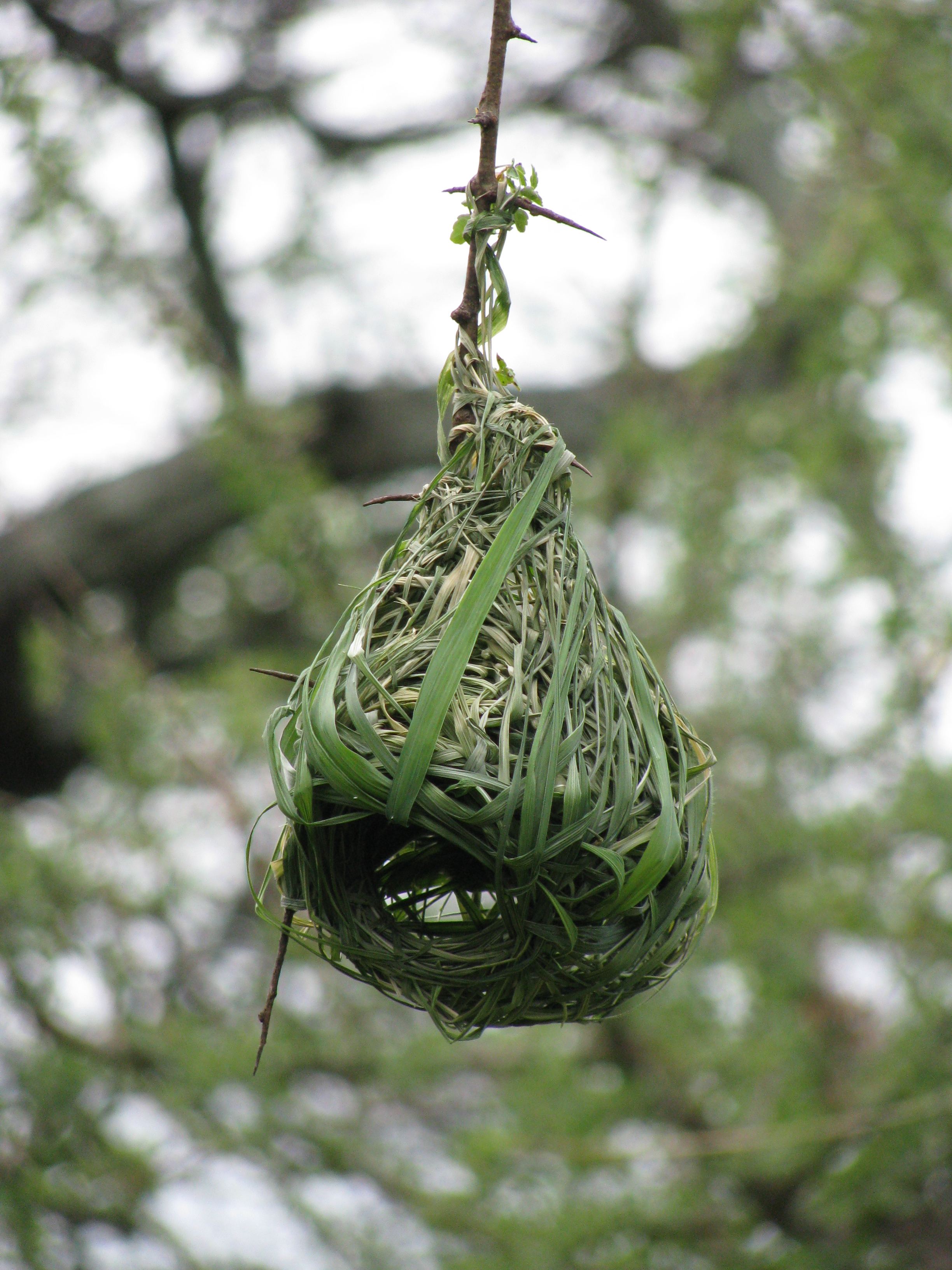

Five days later was also my last day in the Serengeti, so I didn’t see further developments of this nest. But I suspect it was completed and became a comfortable abode for its industrious builder.
Lions, cheetahs, and dogs, oh my! Part 2.
Last week, we left off with this crazy biological paradox: lions kill cheetah cubs left and right, yet as the Serengeti lion population tripled over the last 40 years, cheetah numbers remained stable.
As crazy as it sounds, it seems that that even though lions kill cheetah cubs left and right, it doesn’t really matter for cheetah populations. There are a number of reasons this could be. For example, cheetahs are able to have cubs again really quickly after they lose a litter, so it doesn’t take long to “replace” those lost cubs. It’s also possible that lions might only be killing cubs that would probably die from another source – say, cubs that would otherwise have died from starvation, or cubs that might have been killed by hyenas. Whatever the reason, what we’re seeing is that lions killing cheetah cubs doesn’t have an effect on the total number of cheetahs in the area.
I think this might hold true for other animals, not just cheetahs. It’s a bit of a weird concept to wrap your head around – that being killed, which is really bad if you’re that individual cheetah, doesn’t actually matter as much for the larger population – but it’s one that seems to be gaining traction among ecologists who study how different species live together in the natural world. Specifically, ecologists are getting excited about the role that behavior plays in driving population dynamics.
Most scientists have studied this phenomenon in predator-prey systems – say, wolves and elk, or wolf spiders and “leaf bugs”.

Wolf spider. Photo from Wikipedia.org.

“Leaf bug” from the Miridae family. Photo from Wikipedia.org.
What scientists are discovering is that predators can suppress prey populations not by eating lots of prey, but by causing the prey to change their behavior. Unlike many spiders, wolf spiders actively hunt their prey – sometimes lurking in ambush, other times chasing their prey for some distance. To avoid being eaten, leaf bugs may avoid areas where wolf spiders have lots of hiding places from which to stage an ambush, or leaf bugs may avoid entire patches of land that have lots of wolf spiders. If these areas are the same ones that have lots of mirid bug food, then they’ve effectively lost their habitat. Sound familiar?
Back to Africa – what does this mean for wild dogs and cheetahs? Interestingly enough, lions do not displace cheetahs from large areas of the Serengeti. We’ve discovered this in part from historic radio-collar data that was collected simultaneously on both species in the late 1980’s. Below is a map that shows average lion density across the study area. Green indicates areas with higher densities. The black “+” symbols show where cheetah were tracked within the same study area. They are overwhelmingly more likely to be found in areas with lots of lions. This is because that is where the food is – and cheetahs are following their prey, regardless of the risk of encountering a lion. The Snapshot Serengeti data confirm this – cheetahs are way more likely to be caught on cameras inside lion territories.
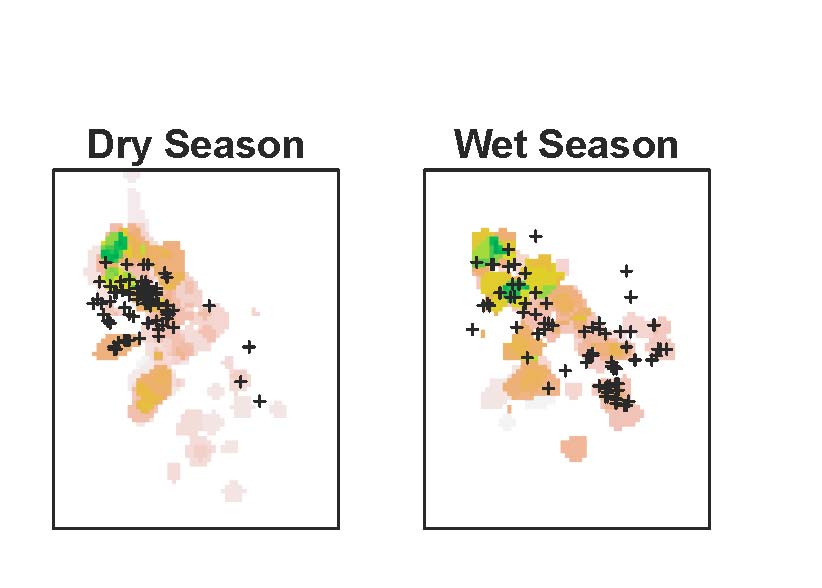
Lion density is mapped per 1km x 1km grid cell. High density areas shown in green, lower in pale orange/gray. Cheetah locations are the black +’s.
Unfortunately, we don’t have radio-collar data on the Serengeti wild dogs from the 1980’s. But we do have radio-collar data for the wild dogs that have been living in the larger Serengeti ecosystem for the past 8 years. As you can see in the map below, wild dogs regularly roam within just 30km of the lion study area. But they don’t settle there – instead, wild dogs remain in hills to the east of Serengeti – where there are local people (who kill wild dogs), but very few lions.

Other researchers in east and southern Africa are starting to pick up on the same patterns in their parks. From Tanzania, to Botswana, to South Africa, researchers are finding that wild dogs get kicked out of really large, prime areas by lions…but that cheetahs do not. What they’re finding (since they have all these animals GPS-collared) is that cheetahs are responding to lions at a very immediate scale. Instead of avoiding habitats that have lions, cheetahs maintain a “safe” distance from the lions – allowing them to use their preferred habitats, but still minimize their risk of getting attacked.
Carnivore researchers are only really just beginning to explore the role of behavior in driving population-level suppression, but I think that there’s good reason to believe that large scale displacement, or other behaviors, for that matter, have greater effects on population numbers of cheetahs and wild dogs, as well as other “subordinate” carnivores – not just in African ecosystems but in systems around the world. It’s a new way of thinking about how competing species all live together in one place, but it’s one that might change the way we approach carnivore conservation for threatened species.
Rare Romping Rhinoceros
Thanks to Snapshotters Jihang and parsfan who posted it to Talk, we can all marvel over the best ever picture of a black rhinoceros taken by a Snapshot Serengeti camera.

(And yes, it’s a set of three images, so you can animate them.)
There’s no mistaking this beast!
There are two types of rhinoceroses in Africa: the white rhino and the black rhino. Despite their names, they’re both gray, but you can tell them apart by their lips: white rhinos have broad lips, while black rhinos have a pointed and curved upper lip that is used to grasp vegetation. There are only black rhinos in the Serengeti (and in all of Tanzania), and they can grow to weigh up to 3,000 lbs (1,360 kg).
Despite their size and bulk, these animals can really move — at speeds up to 28 mph (50 kph). Several years ago, I had the chance to see the rhinoceros rehabilitation center at Kruger National Park in South Africa. This gave me a chance to get fairly close to the creatures. At one point I was on the other side of a fence from a rhino and it charged me; the fence was made of wood and very solid, so I was fine and the rhino just bounced off the fence. But I was amazed at how fast it went from standing still to ramming speed — and how quiet it was doing so.
Black rhinos are critically endangered, with fewer than 5,000 alive in the wild (as of the end of 2010, the most recent statistic). Fully 95% of all wild black rhinos live in one of four countries: South Africa, Namibia, Kenya, and Zimbabwe. Tanzania has only about 100 of them, with a quarter of those in the Serengeti.
It’s thought that about 1,000 rhinos originally inhabited the Serengeti. But in the 1970’s and early 1980’s, poaching increased severely. A park survey conducted in 1982 found only two remaining rhinos, both female. Efforts were made to actively protect these remaining two, and plans began to be made to bring in a male. But before those plans came through, a male rhino showed up on his own in 1994. It’s thought that he came from the Ngorongoro population, which contained only about a dozen animals at the time. Moreover, it was quite a hike at 70 miles (113 km). As I said, these animals can move!
It’s something of a mystery how this male rhino found the females in so vast an area — sound? smell? — but he stayed. Within a short time there were four babies, and since then, the population has steadily grown. Now there are twenty or so black rhinoceroses living around Moru Kopjes. These Kopjes are about 20 miles (32 km) south of our camera trap area, so we only rarely catch a glimpse of one (out for a walk?).
While the Moru population is growing, it still faces two major threats. The first is continued poaching. Demand for rhino horn has been rapidly escalating since 2009, with black market prices in Asia skyrocketing, and organized crime getting into the action. In May 2012, two of the Moru rhinos were found dead with their horns missing. The second threat to the Moru population is inbreeding, which over time can cause lower reproduction rates and increased genetic disease. Fortunately, there are ongoing efforts to both protect the existing rhinos and to bring more black rhino genetic diversity to the Serengeti by translocating animals from South Africa.
Perhaps in several decades these massive beasts will once again make regular appearances in central Serengeti; until then, keep your eyes peeled for their rare cameos.
Lions, Cheetahs, and Dogs, Oh My! Part 1.
By now it’s no secret that lions are kind of mean – and that if you are any other carnivore living in the Serengeti, you’d probably prefer a lion-less world. No tawny, muscle-bound foes to steal your food, kill your cubs, chase you around…life would be easy! You’d have plenty of food, your cubs would grow up strong, and your numbers would increase.
Or would they?
It certainly makes sense that all the nasty things that lions do to other carnivores should add up to limit their numbers. Lions are responsible for nearly 30% of wild dog deaths, and over 50% of cheetah deaths! On top of that, they steal food that cheetahs and wild dogs have worked hard to get – and might not have the energy to get again. Researchers are pretty sure that more lions means fewer wild dogs in two ways: 1) In reserves where there are more lions, there are fewer wild dogs, and 2) When lion numbers increase through time, wild dog populations decline.
The same has generally been believed about cheetahs, and some research from the 1990s suggested that reserves with more lions had fewer cheetahs. But as I started digging into the data from Serengeti, I saw a different, quite unexpected, story.
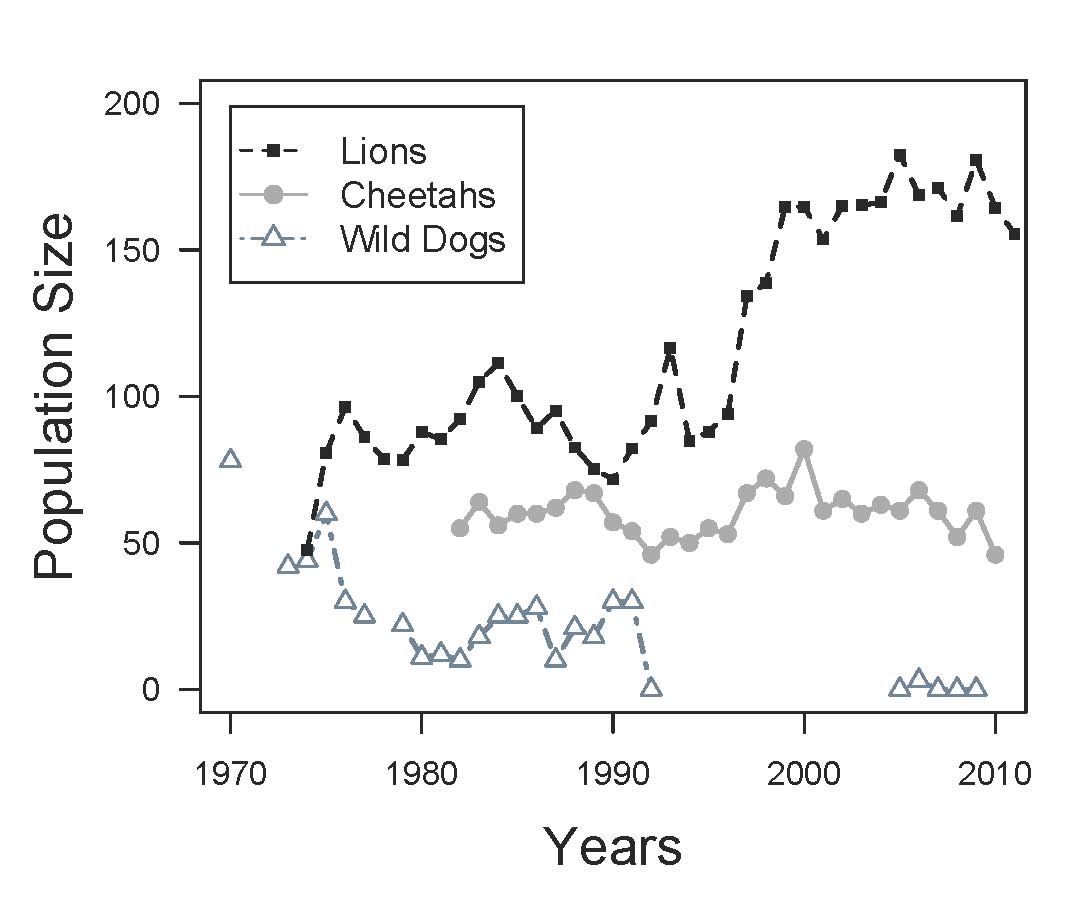
The number of lions, cheetahs, and wild dogs from 1970 onwards. Wild dogs disappeared from the ecosystem from 1992 through 2005.
Lions, cheetahs, and wild dogs were all monitored by long-term projects for a number of years. This graph shows their population sizes since the 1960s. The increase in lions is pretty clear – lions have nearly tripled in the last 40 years, largely due to increases in wildebeest. Wild dogs disappeared from the study area. Now, their final disappearance was due in large part to disease, but it’s possible that lions didn’t help matters. In sharp contrast, the cheetah population has stayed pretty much the same. Sure, there are some ups and downs, but on average, the population has been holding steady over the last 40 years.
Wait a minute, if lions are really bad for cheetahs, then why haven’t cheetah populations declined in the Serengeti? How can they possibly be holding steady when lion numbers have tripled? What is going on???
It’s a good question. Tune in next week for an answer!
Grass
You’ve undoubtedly seen it: Grass. Tall waving grass. Lots of it. From here to the horizon. If you’re itching to get images of animals to classify, the “nothing here” grass images can seem annoying. Some people find the grass images soothing. The animals themselves, well, a lot of them seem to like it.
Some animals find that tall grass is nice for concealing themselves from predators, like these guys:
Or this impala:
And some animals think the grass is nice for eating, like here:
Or here:
This post is brought to you by Faulty Cameras that switch unexpectedly to video mode when they’re not supposed to. These Season 5 videos have no sound, but capture some of the movement you don’t get with the photographs, so I thought you might like them.
Stuck. Part 2.
##### Today’s post is a continuation of last week’s adventure, written by Patrik Dousa. #####
When we left off the story from last week, all of us in the Serengeti team were out deep in the sour tern range of the Serengeti trying to free a land rover from thick mud. All we accomplished was securing the range rover even deeper in the mud. From 1/4 of the wheel being submerged to a half, with the bumper touching the ground. Good going. A beautiful sunset was going to occur in an hour or so and the last place to be at that point was in the middle of a hazardous plain with a large pride of lions waking up for their nighttime prowls.
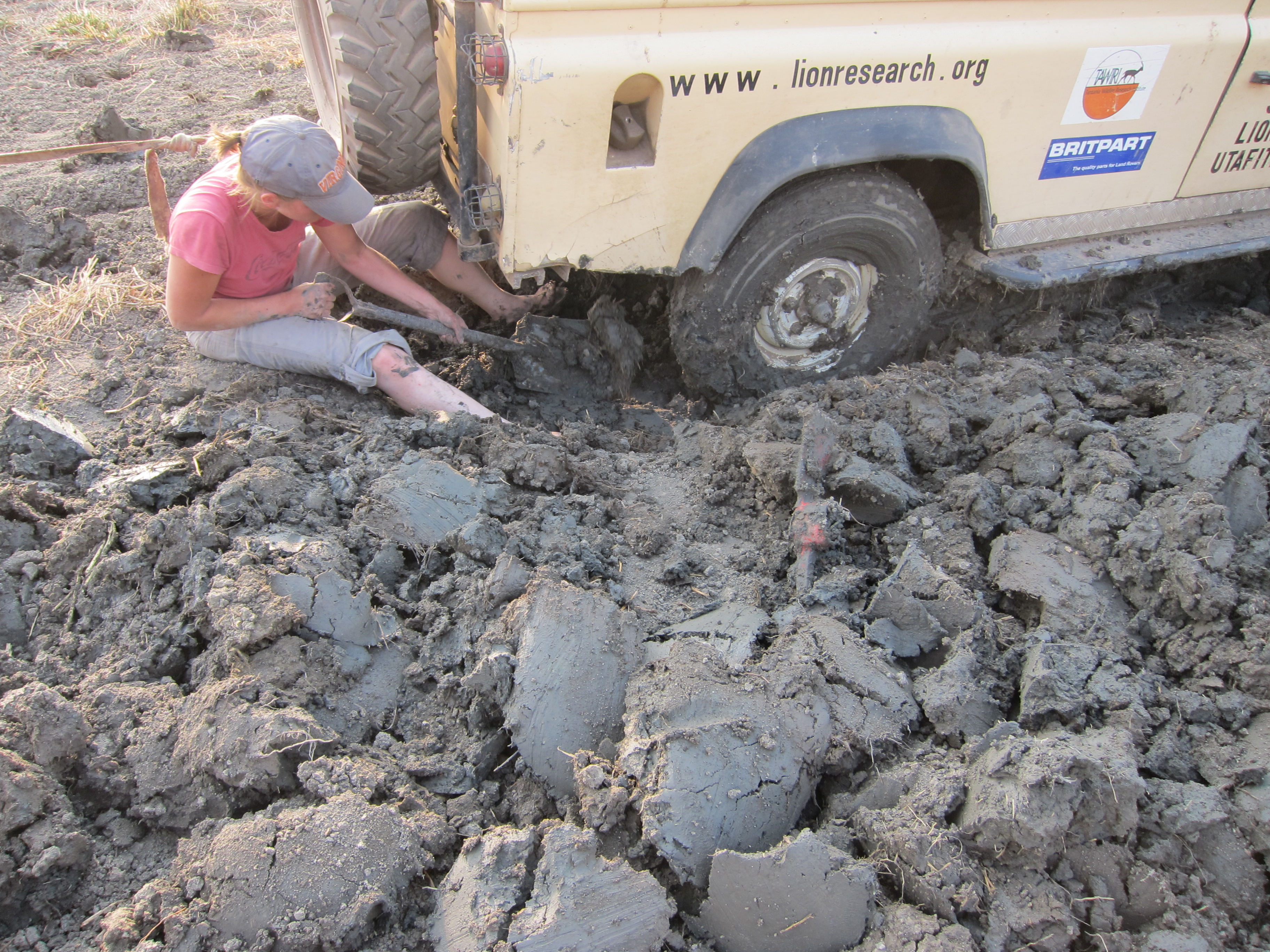
This is actually muddier than it looks…
The lions are still watching us from their mesas to the north and Ali is figuring out the next move. I thought it was a clear decision. Leave. Now. Have I described to you the fortitude and diligence of a lion researcher? A job that requires you to spend most of your time in the dry plains with the only the basic minimum requirements to sustain you doesn’t attract individuals who give up too easily. No, Ali and George see the sunken rover as a challenge that must be faced. We aren’t leaving, not without a fight.
Just then a tourist vehicle pulls up along a road about a half-mile from our area on the other side of the uncrossable mud plains. The guide is in the process taking them back home to one of the southern lodges and apparently decided to stop, having spied the magnificent example of male lion that was observing our vehicle. The new arrival attracted King Simba’s attention and the powerful elegant beast starts walking towards the tourists. I can see their excitement mount through my binoculars — this moment is going to be the highlight of their trip. George and Ali are laboring through shovelfuls of the thickest, reddest, peatiest mud you can imagine and only a short distance away, well-scrubbed observers are preparing themselves for the the apex of their Serengeti experience. Such is life.
I see a bold cub follow his master lion and play around his feet incurring his wrath for a moment. The king playfully swats back and raises his head to the heavens letting out an immense roar to the delight of the tourists. The greatest show on earth — with our little car-trouble side-show of going on right in the background. “Who are those crazy people back there?” they must have asked their guide. “Well, they’re professionals, so they must know what their doing.” the guide is certain to have responded.
The lion’s roar triggered a slow migration of the lionesses and their cubs from the low mesas to the area closer to the tourist vehicle where the male lion had settled. As the single file procession began, we felt a wave of relief since the pride was now headed away from our rover. A few more attempts to drag out the stuck vehicle failed. By now the sun is steadily growing larger and more rosy as it begins its decent. The sky eventually reaches the particular hue that Ali reads as our signal to leave.
We secured the vehicle and took all the valuables and began a slow retreat back thinking, “please don’t get stuck” on repeat until we got back on the main road. The pink sun blossomed into a deep red bloom that backlit the acacia tree line creating the beautiful silhouetted postcard image that the Serengeti is so well know for. The mood in the car was impervious to these romantic supplications. Exhausted and temporarily defeated, the crew made the long journey back toward the research house.

And all we’ve done is get ourselves in even deeper.
Being the visitor who expended the least amount of sweat that day, I suggested that we stop at the local canteen Seronera and that I’d treat everyone to a chicken and rice dinner and a Stoney Tangawizi (the extra spicy ginger ale that is everybody’s favorite drink in Tanzania). This turned out to be a very cost effective way to turn the sour mood sweet — just a few bucks per plate and brew to get everyone back to their happy place. Soon the team was back to the bantering with the locals and planning tomorrow’s adventure. That was my last night at the Serengeti, the next day I was back on the road to Arusha. Ali messaged me later and mentioned that they were able to round up a crew to go back and successfully drag out the rover the next day. This did not surprise me since I had well learned: you can’t keep a lion research team down for long.
The trouble with shade
Who knew that shade could be so problematic? A couple of weeks ago, I wrote about how shade seems to be my biggest obstacle in reconciling how the cameras see the world vs. what is actually going on. My job is to figure out how to make things right.
To start with, the camera traps are up on trees. Mostly. As you know, the cameras are on a rough grid layout – 225 grid cells, each 5km2 (2.236km on each side) — covering a total of 1,125 km2 of Serengeti’s center. This kind of design makes sure that we are covering enough of the landscape to capture the bigger picture of animal distributions and movements. Each camera is roughly at the center of each grid cell – on the closes suitable tree to that center point. Some trees are big and shady; some are small and spindly. In the woodlands, there are trees everywhere; on the plains, the camera-trap tree can be the only tree for miles. And sometimes there are no trees at all, and here the cameras get put up on metal poles.


These different habitats are important to capture. I think that animals might behave very differently in areas with lots of trees than they do in areas with very few trees. When it comes to the aggressive interactions between carnivores, for example, trees, shrubs, and tall grass provide great hiding places for the smaller species. It’s like trying to hide from someone you don’t like in an empty room vs. in a really huge, crowded shopping mall.
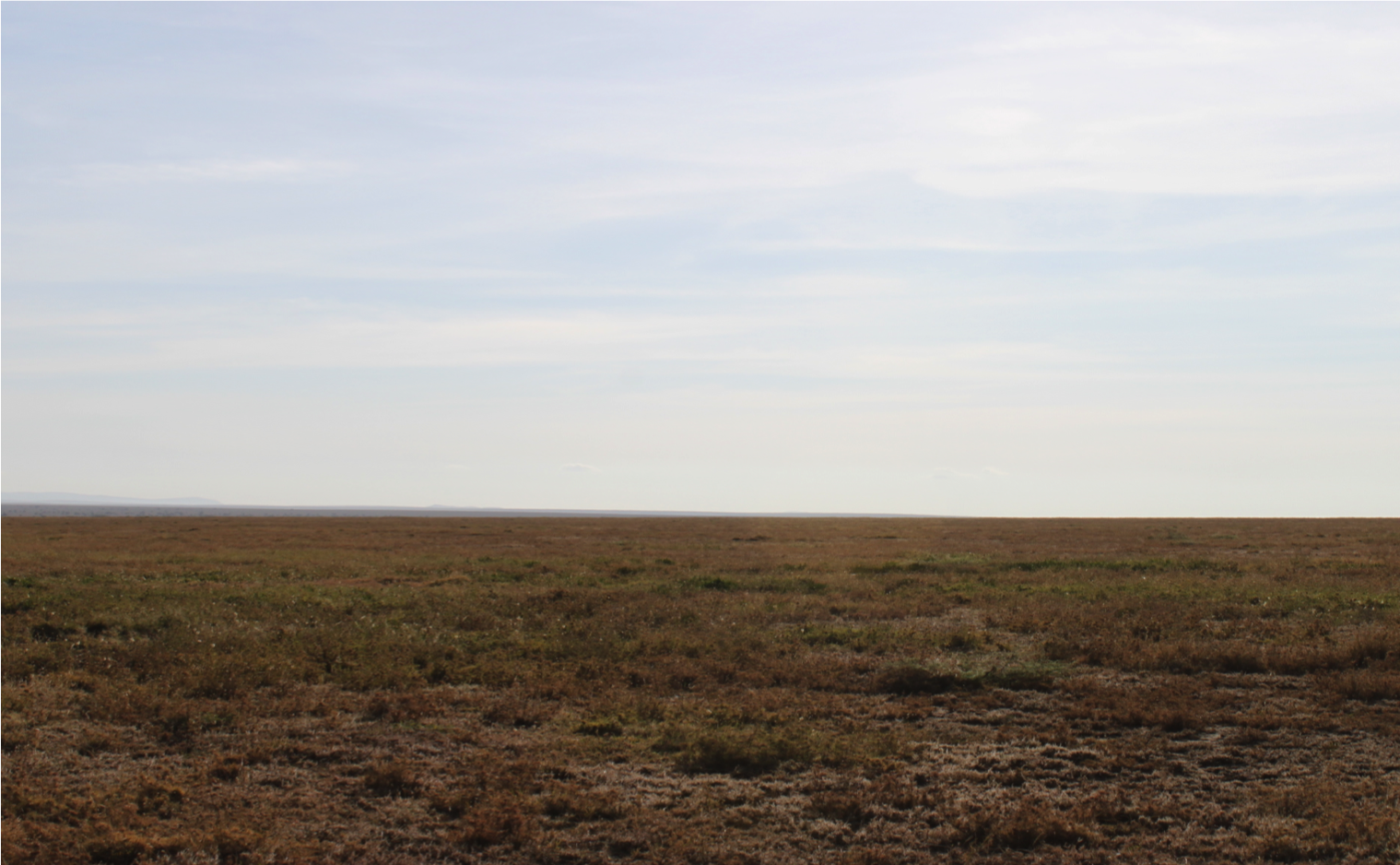
It’s a lot harder to hide from lions here
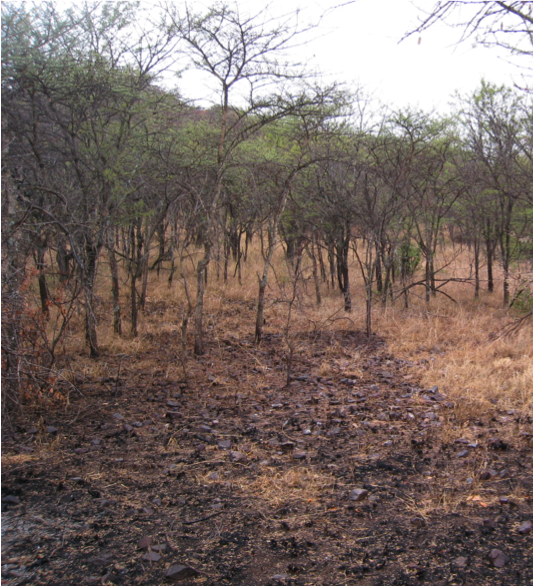
…than here
The problem is that camera traps work better in some habitats than others – at least for certain species. Say you are a huge, muscle-bound lion. Even standing is tiring in the Serengeti heat, and you spend your days breathing heavily even at rest. You like shade. A lot. If you are out in the open plains, a single shade tree will stick out for miles, and you’ll probably work your way to it. Chances are, that tree has a camera. In the woodlands, though, there are lots of trees. And the camera trap could be on any one of them. So even if you’re searching for shade, the chances of you walking past the camera trap in the woodland are far smaller – just because there are so many trees to choose from.
Here’s a map of the study area – green shows more densely wooded areas, whereas yellow marks the plains. Camera traps that have captured lions are shown with circles; the bigger the circle, the more lions were seen at that trap. I know for a fact that there are more lions in the northern half of that map than in the southern half, but the lions out on the plains seem to really like getting their picture taken!
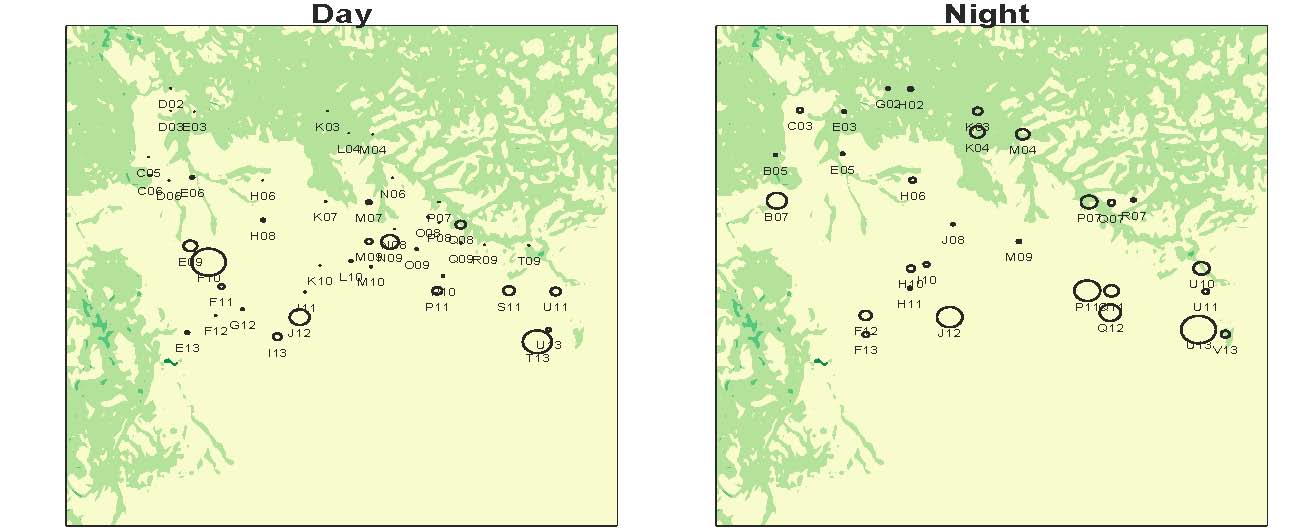
The pattern looks a little better at night than in the day, but it’s not perfect. So perhaps shade isn’t the only thing affecting how these cameras “see” lions in different habitats.
As depressing as this problem seems at first glance, I’m optimistic that we can solve it (enter Kibumbu’s new GPS collar!), but those methods are material for another day. In the meanwhile, what else do you think might be going on that attracts lions, or other animals to trees, besides shade?
Stuck. Part 1.
Stuck. Surrounded by lions. Please come.
This is not a text message that you’d necessarily expect to get on your cell phone…unless you work as a lion researcher in the Serengeti like Ali does. Receiving this text in the early afternoon, she takes the news in stride as a necessary task that needed to be finished before dark. I on the other hand, as a visitor, am charged up and nonplussed with the drama of it all. George, one of the field research assistants on a lion tracking expedition, obviously needs help and pronto, so we are on our way out within a few minutes. In the wild Serengeti, a few minutes can separate success from tragedy — the research team has an exceptional awareness of this and also the discipline to do what it needs to be done in a methodical and prompt manner as Ali is demonstrating to me at this moment.
We track George and his land rover down just like we do lions. Each rover is outfitted with the same tracking unit that is on the collar of each radio-tracked lioness. So we chase the rover’s signature signal deep into the southern range, driving on the dirt roads as fast as we can safely afford. As the day draws towards a close, the animals become restless. Elephants trumpet in the distance. A serval — a beautiful African wild cat one doesn’t see everyday– trots across the road and disappears in the brush. Normally such a sighting would warrant an immediate stop, but not today.
Finally, we go as far as the roads can take us and we must venture in the unmarked grassy plains that are a minefield of axle-breaking holes and mud-traps. Driving off road is risky business in the daytime –as George was just reminded of — and completely a fool’s errand in the nighttime. Ali looks for the tell-tale signs in grass patch coloration that indicate a possible hole as she swerves deftly through the treacherous terrain in a labored crawl.
Finally on the horizon, we sight George and his rover axle deep in a seemingly stable area. The dry cracked surface, however, masks a vast mud hole created by the recent rains. This is the worst kind of environmental trap that even a seasoned veteran like George can fall prey too. With a lighthearted smile that belies any frustration, George explains how he tracked a pride of lions into this area and was surprised by the sudden drop into the mud. Luckily, our rover remains in the solid area just short of George’s rover. We check the area and see that the lions have moved off to a series of small mesas to the north. It’s safe enough to exit the vehicles as long as one of us keeps a 360 degree lookout.
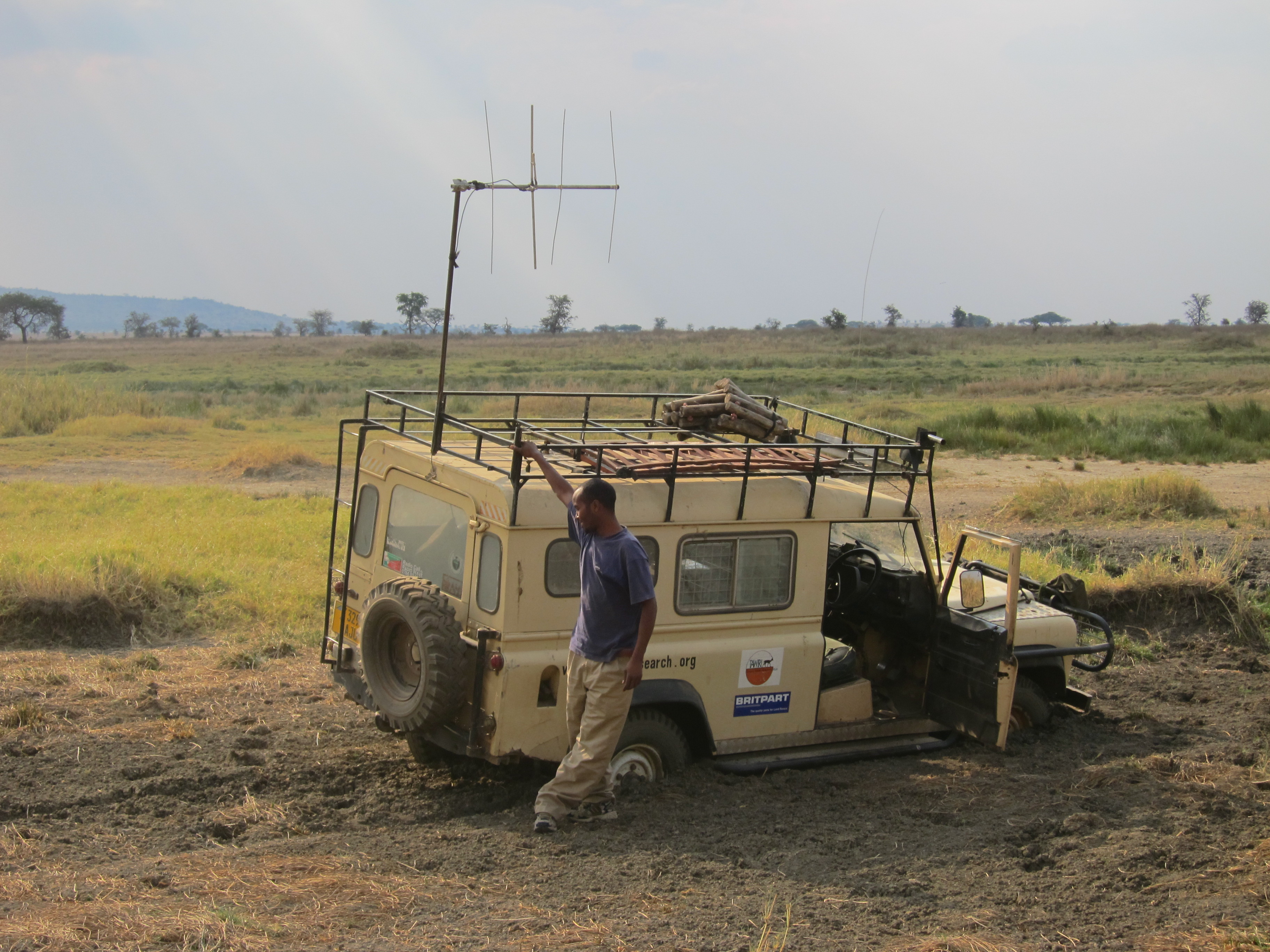
How we found George.
Our cellphones at that point record no bars, so as Ali readies a tow line, she inquires how George was able to get a message out.
The calm exterior and wry banter of every lion researcher I’ve met is always the counterpoint to the fierce passion and iron discipline at their core. George is all smiles and laughs a bit as he recounts the sinking feeling he had when he saw that he had no bars on his cellphone and lions surrounding three sides of the vehicle. A thickly maned adult male lion stood watch right outside the drivers side as if he sensed George’s desperation.
A good scientist, when faced with a problem, puts together an experiment to test its boundaries. Perhaps the cell phone could be made to transmit somehow? As George raised his hand up and out of the vehicle he noticed to a single bar flicker on and off. This observation made him hatch a plan that he reflected on as he eyed the attentive dark-maned sentinel waiting outside along with the multiple groups of lionesses and cubs surrounding him.
The day was not going to get any longer so George, did exactly what he contemplated: he composed his terse message on his phone, climbed out the window onto the roof rack, and jumped up several times pressing the send key until the signal caught and the phone indicated the message was sent. Then he waited for the animals realize that he was still out of their range and relax back down to their lazy poses and before slipping back into the car to await rescue.
By the end of the story, the tow cable is fastened and mud traction ladders are in position under the rear wheels of the rover. Ali is ready to begin the first effort to pull the car. The gears lock in, the engine strains, the wheels spin, and…Georges car slips off of the ladders and deeper into the mud.

Step 1. Let’s see if we can tow George out…
To be continued…
Conference on Science Communication
Last week I attended a conference on science communication in Cambridge, Massachusetts. It was an intense few days, but totally worthwhile and interesting. There were fifty of us grad students, seven 3-person panels of various experts, and more food than you can possibly imagine. (The sheer quantity of food rivaled that put out by Zooniverse for its workshops — and that’s saying something.) The grad students spanned all sorts of science disciplines, but the conference was arranged by astronomers, so there was, I think, a disproportionate number of people there who like to try to figure out what’s going on up in space. I really enjoy talking with researchers in other disciplines because there are rather distinct cultures across the difference sciences. It’s interesting to see what various fields value and how they do things. And frankly, I don’t want to reinvent the wheel and so prefer to borrow best practices from elsewhere rather than figure them out from scratch.
The more I talk to astronomers, the more I think ecologists can borrow stuff from them. I mean, astronomers are pretty constrained in their science. All they can do is observe stuff out there in space and then try to be super clever to figure out what’s going on. Meanwhile, here on earth, we ecologists can do all that sort of observing PLUS we can manipulate the world to do experiments. Because we can do hands-on experiments, that’s a big part of ecology, but as the tools are getting more sophisticated to collect the sort of large-scale observational data that astronomers already have, I think we may be able to learn new things about the living world that are hard to figure out from experiments alone. And we might be able to borrow ideas from astronomers on how to do so.
For example, check this out. It’s a hand-out from one of our panel speakers, Dr. Alyssa Goodman, an astronomer at Harvard, who talked with us about communicating science with other scientists in different disciplines.

So the cool thing that caught my eye was: Zooniverse! (I added the red oval and arrow; the rest is original.) But this whole Seamless Astronomy thing sounds like a neat effort to integrate large amounts of data, visualization, research, and social media into something coherent that people can use to explore and combine some large astronomy data sets. There’s nothing like this (that I am aware of) going on in ecology, but the sorts of things this project figures out in the astronomy world could be useful to us over in ecology.
Of course some things will always be different in different disciplines. One thing we did at this conference was to introduce ourselves and our research in short one-minute “pop talks.” We had to avoid using jargon, which is hard when you’re steeped in your science all day every day. To reinforce the no-jargon rule, everyone was given big, brightly colored sheets of paper — one that read JARGON and one that read AWESOME. If someone used jargon, the audience would all hold up their JARGON flags. If someone explained something well without jargon, up went the AWESOME signs. This sort of feedback worked really well and we all got good at speaking without jargon fairly quickly.
But it was easier for some of us than others. I got to stand up and talk about how I study “plants and animals and how they interact with one another,” which is pretty understandable to anyone. I felt bad for the particle physicists and molecular chemists who had to try to describe their work without using the technical terms for the things they study; but they did well: “The world is made up of little tiny particles. I study how these particles wobble, and in particular how they wobble when you shine really bright lights on them.”
Lucky for us, we get to look at savanna landscapes and amazing animals as we do our research, so I’ll appreciate the perks of ecology as I get back to work now that the conference is over.

