
The lost lions of the Transect Steady pride
### Today we’ve got a guest post by our very own Daniel Rosengren, lion tracker (& photographer) extraordinaire. ###
It started with some mysterious footprints around the Loliondo Kopjes. There were a lot of fresh paw marks in the mud following the road. I could tell it was a big pride but the only big pride with a territory nearby was the Young Transects. But I could not hear their collar. Neither could I hear any of our other prides. I drove around for a while looking for lions, especially on the rocks and under trees. I didn’t find any and guessed it could have been the Young Transect lions anyway, only without the collared female.
A couple of weeks later I was headed out east when I soon caught eye on a big group of lions. As I drove closer I realized they weren’t any lions I knew. I tried to get photos of all of them but it wasn’t easy knowing who you’d already got in a group of 17 lions. Luckily they all started walking along the track. All I had to do was park ahead of them and take photos as they passed one by one. Once I had photos of all their left sides I went home to try to figure out who they were.

I concentrated on the older females as the youngster probably never had been seen before by the Lion Project. After a while I found a couple of matches. It was TR86 and TSF from the Transect Steady pride, not seen since December 2009, almost three and a half years earlier. But the last time they were seen regularly in our study area was in 2008.
Now I contacted TANAPA and the vets to organize a collaring of one of the females. They were coming. I drove back to the place where I’d seen the lions and hoped they hadn’t walked too far. I found them in the shade of a tree. Then a long wait started for the vets to organize themselves and drive all the way from Fort Ikoma. Once they came, the collaring went smoothly, the rest of the pride watching from a distance.
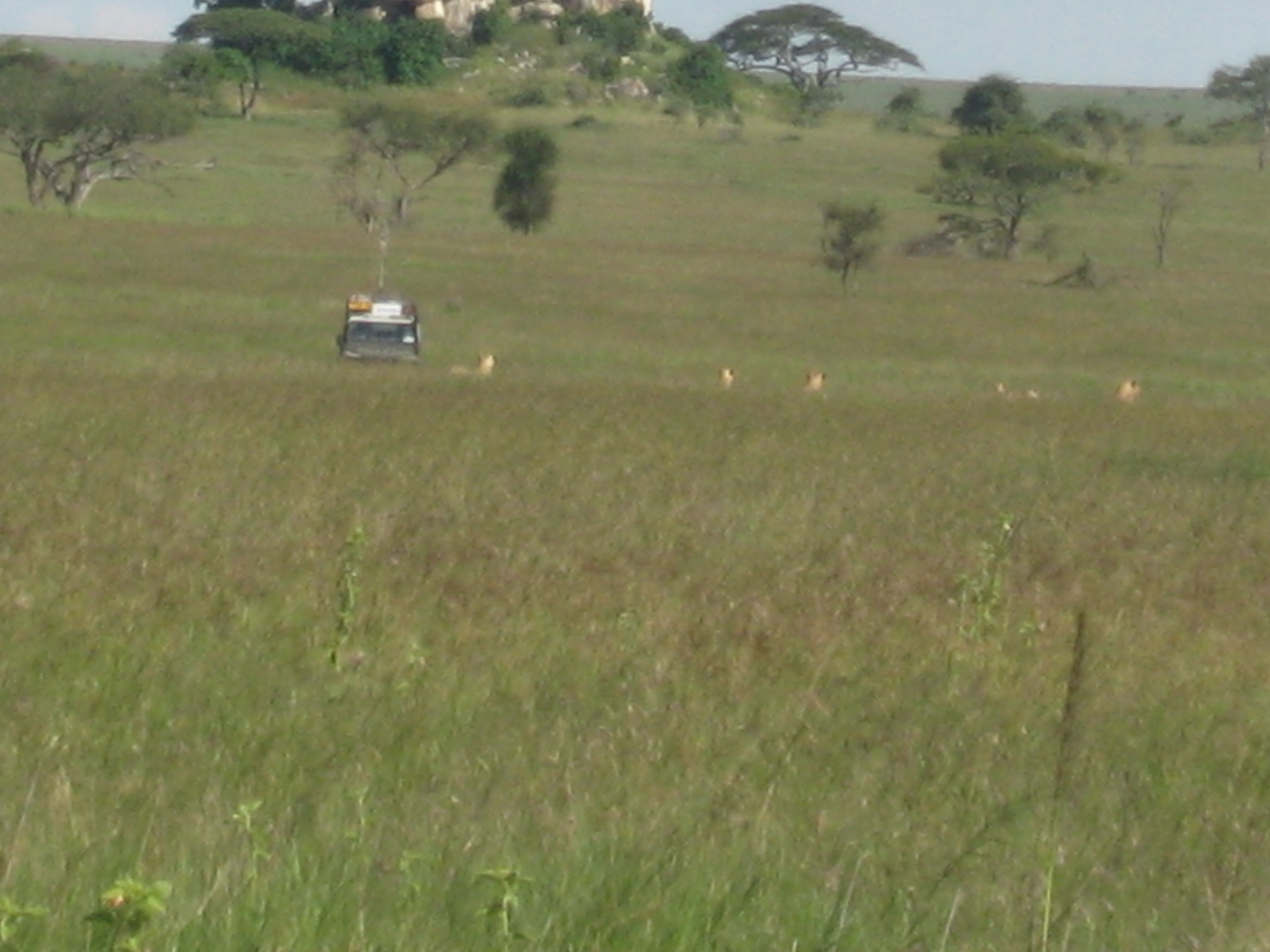
All of the lions of the TS pride, watching us warily as we try and create enough space to safely collar our lion.

Daniel fitting the collar.

TANAPA vet preparing to take samples.
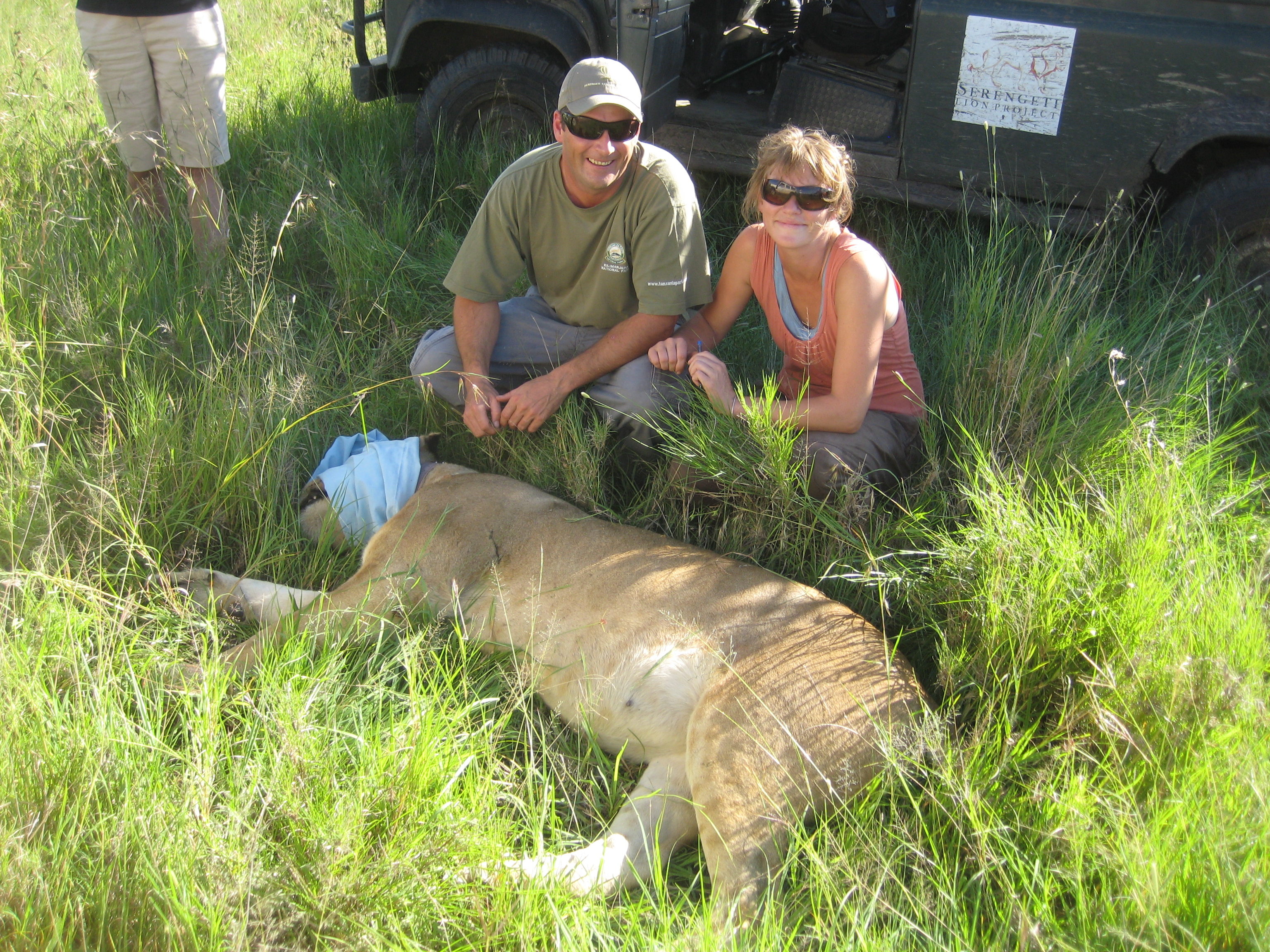
It’s pretty exciting to to be this close to a lion. Their paws are BIG.
About a week later I found the pride just outside the northern edge of our study area along the Pipeline track. Two more old females known since before had joined them, TR93 and TR106. Then they disappeared. So two weeks later I decided to search for them and drove along the Pipeline track north. But instead of driving on the actual track, which in many places was disappearing because of little use, I drove parallel to it, hitting all hilltops to be able to pick up the radio signal from a greater distance. The drive was terrible as the hills in the area are specked with large rocks and I had to drive dead slow. I held on the the steering wheel as little as possible. Having no power steering means that every time I hit a rock I risk breaking thumbs or worse.
I picked up the signal after a while but I still had to pass several hills before finally finding them, right by the track at a river confluence. That was quite far north of our study area and too far to go and see them on a weekly basis. The future will have to show where they finally settle.
Better with experience
Does experience help with identifying Snapshot Serengeti images? I’ve started an analysis to find out.
I’m using the set of about 4,000 expert-classified images for this analysis. I’ve selected all the classifications that were done by logged-in volunteers on the images that had just one species in them. (It’s easier to work with images with just one species.) And I’ve thrown out all the images that experts said were “impossible.” That leaves me with 68,535 classifications for 4,084 images done by 5,096 different logged-in volunteers.
I’ve counted the number of total classifications each volunteer has done and given them a score based on those classifications. And then I’ve averaged the scores for each group of volunteers who did the same number of classifications. And here are the results:
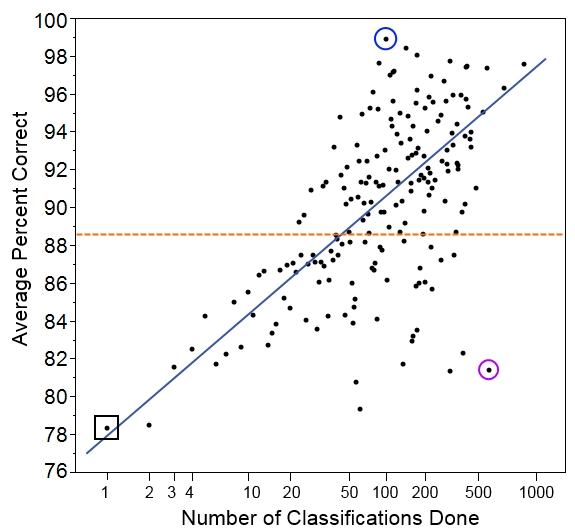
Here we have the number of classifications done on the bottom. Note that the scale is a log scale, which means that higher numbers get grouped closer together. We do this so we can more easily look at all the data on one graph. Also, we expect someone to improve more quickly with each additional classification at lower numbers of classifications.
On the left, we have the average score for each group of volunteers who did that many classifications. So, for example, the group of people who did just one classification in our set had an average score of 78.4% (black square on the graph). The group of people who did two classifications had an average score of 78.5%, and the group of people who did three classifications had an average score of 81.6%.
Overall, the five thousand volunteers got an average score of 88.6% correct (orange dotted line). Not bad, but it’s worth noting that it’s quite a bit lower than the 96.6% that we get if we pool individuals’ answers together with the plurality algorithm.
And we see that, indeed, volunteers who did more classifications tended to get a higher percentage of them correct (blue line). But there’s quite a lot of individual variation. You can see that despite doing 512 classifications in our set, one user had a score of only 81.4% (purple circle). This is a similar rate of success as you might expect for someone doing just 4 classifications! Similarly, it wasn’t the most prolific volunteer who scored the best; instead, the volunteer who did just 96 classifications got 95 correct, for a score of 99.0% (blue circle).
We have to be careful, though, because this set of images was drawn randomly from Season 4, and someone who has just one classification in our set could have already classified hundreds of images before this one. Counting the number of classifications done before the ones in this set will be my task for next time. Then I’ll be able to give a better sense of how the total number of classifications done on Snapshot Serengeti is related to how correct volunteers are. And that will give us a sense of whether people learn to identify animals better as they go along.
This is what grant applications do
I’ve been working on a federal grant application the last couple of weeks. It’s left me feeling a bit like this:
The grant was originally due this upcoming Thursday, but with the government shutdown showing no signs of ending, who knows what will happen? The National Science Foundation’s website is unavailable during the furlough, meaning that nobody can submit applications. So we’ve all been granted an unexpected extension, but we’re not sure until when.
The grant I’m applying for is called the Doctoral Dissertation Improvement Grant. It’s an opportunity for Ph.D. students to acquire funding to add on a piece to their dissertation that they wouldn’t otherwise be able to do. I’m applying for funds to go down to South Africa and work with a couple of folks from the conservation organization Panthera to collate data from two sites with long-term carnivore research projects. Their research team currently has camera surveys laid out in two reserves in Kwazulu-Natal, South Africa: Phinda Private Game Reserve and Mkhuze Game reserve. Now, the cool thing about these reserves is that they are small, fenced, and pretty much identical to each other…except that lions have been deliberately excluded from Mkhuze.
Now, one of the biggest frustrations of working with large carnivores is that I can’t experimentally isolate the processes I’m studying. If I want to know how lions affect the ranging patterns and demography of hyenas, well, I should take out all the lions from a system and see what happens to the hyenas. For obvious reasons, this is never going to happen. But the set-up in Phinda and Mkhuze is the next best thing: by holding everything else constant – habitat, prey – I can actually assess the effect of lions on the ranging and dynamics of hyenas, cheetahs, and leopards by comparing the two reserves.

Camera surveys (yellow dot = camera) in Serengeti (left) and Phinda/Mkhuze (right).
So, that’s what I’m working on non-stop until whenever it turns out to be due. Because this would be a really cool grant to get. I’m currently working on analyzing some of the camera trap data from Seasons 1-4 and hope to share some of the results with you next week. Until then, I’m going to continue to be a bit of a zombie.
Science Shutdown
It’s Day 2 of the U.S. government shutdown. While the media blares about congressional politics and occasionally offers a run-down of what the shutdown may or may not mean for the average Joe, the impacts of the shutdown on science are not generally noted. Notice that I said ‘science’ and not ‘U.S. science’ because this shutdown affects scientists around the globe.
For starters, all the federal grant-making agencies are shut. This means no processing of grants, no review of proposals. Everything grinds to a halt. At best, it causes delays. But at worst, it means important science that depends on continuity gets interrupted, forcing some scientists to start their experiments over from scratch; for expensive experiments, it could mean a death knell. Other research that depends on getting funding before a field season may be delayed a year even if the government is shut down for only a few days.
Much of U.S. science is actually done by government employees. One agency, the United States Geological Survey, employs (oh, I can’t look up the number; the website is shut down; let’s just say “many thousands of”) scientists who work on topics like climate, ecosystems, earthquakes, and water quality. While some of these employees — like those who monitor for earthquakes, for example — will keep working as “essential” employees, most are furloughed. They get sent home with no pay and are forbidden by law to do any science. Forbidden. It’s a felony to work when furloughed. This hits home for me, as my husband is a post-doctoral geologist with the the U.S. Geological Survey and we are going without three-quarters of our household income for the length of the shutdown.
In addition to the direct impacts of the shutdown on government funding agencies and on government scientists, many more scientists are indirectly affected by issues of access. I am a fellow at the Smithsonian Institution’s National Museum of Natural History in Washington D.C., but I am employed by the University of Minnesota. The Smithsonian, being a quasi-governmental organization, is shut down. Most of the Smithsonian’s scientists are furloughed. (The folks in the entomology department, where I spend my time, are many of the ones that describe new species of insects previously unknown to science. No new species for a while, everyone. Sorry.) And on top of that, even people who aren’t employees of the Smithsonian (like me) cannot do their work, because they can’t get into the building. I know of visitors from other countries who came to visit the Museum for a few weeks to do research. But they can’t get in.
There are many, many scientists all over the world who collaborate with U.S. government scientists, who depend on U.S. government funding, and who use U.S. federal facilities. All these people are feeling the negative effects of the shutdown and aren’t able to get their science done.

The sound of silence?
## Today’s guest post is from our moderator and regular contributor Lucy Hughes. ##

What does silence mean to you? Maybe it’s that moment at the end of the day when the telephones stop ringing and the office hubbub finally stops and you can hear yourself think. Maybe sitting in your garden listening to the insects and aeroplanes pass overhead. Or maybe it’s that first 5 minutes of waking before the baby starts howling. Whatever it means to you the point is silence isn’t really silent. Something is always making a sound even if it’s a leaf rustling in the wind or a cricket singing.
In the African bush night time silence is deafening. Just before sunset there is a rush of activity. The day shift starts looking for a place to spend the night whilst frantically searching out that last mouthful of food. Young banded mongoose are scolded into their burrows by older siblings. Antelope take a drink before heading to thicker cover. Francolins are calling out their staccato calls whilst sandgrouse flock to drink. As the sun sets and darkness looms everything quietens down, the last to make a noise are the guinea fowl who wait till it is just dark to, one by one, barrel up to adorn their favourite roosting trees like giant Christmas baubles. They finally settle down, and the nearby baboons stop squabbling and there is a moment’s peace before the night shift takes over.
The Scops owl is first with its ‘poop poop poop’ call sounding almost like an insect. Then the night-jars join in. A distant rasping bark and the jackal are off calling ownership of their territory. They stop suddenly and a moment later there it is, the slow wo-oop! Woo-ooop! and the hyena clan are declaring they are up for business.
There has been no respite to the constant noise of the African bush during this transition between day and night; a seamless mix between the two sound tracks. As the evening wears on and the night shift are out hunting in earnest it gets quieter. If you are lucky enough to experience this it is unforgettable. The silence is thick, it hurts your ears and you want to shake your head to clear it. You are straining to hear anything out there in the blackness and your senses have you on high alert, never mind that you are in a vehicle your primal instinct knows this is Africa and beasts roam that want to eat you.
The only sound is a cacophony of insects and it is this that gets in your head, it is a relief when a spotted eagle owl calls breaking the pitch and giving you perspective again. Staring into the blackness you see a shape move , you can’t make out what it is, then comes a noise that goes right through you, a guttural, low sawing sound, a leopard is calling broadcasting its presence using the ground as a sounding board. He walks out in front of you, pauses for a moment, then strides off purposefully into the night.
The silence of the African night is palpable. You could slice it with a knife. It is so full of promises of wonderful animal encounters that I never want to sleep. It’s my favourite sound of silence; what’s yours?

The short and happy life of a Serengeti lion
### Last week Craig spoke for Cafe Scientifique about lions and shared the research that Lion Project has been conducting for the last 45 years. Check out the video here. Peter and Faith, UMN undergrads conducting research in the Lion Lab, attended the talk and share their experiences as well. ####
Peter and Faith here! Last week we had the opportunity to attend the Bell Museum’s Cafe Scientifique. Cafe Scientifique allows scientists from all disciplines and specialties to share their research directly with the public in the form of a casual presentation given at the Bryant Lake Bowl in Minneapolis, MN. This past month’s talk was given by Snapshot Serengeti’s own Professor Craig Packer, giving a historic rundown of some of the highlights of the lion research conducted by the University of Minnesota’s Lion Research Center.
As prospective lion researchers ourselves, it was both interesting and valuable to hear the conclusions of past research from the perspective of the researcher. Not to mention having it be told in a casual and humorous way, which is a refreshing break from the stack of scientific papers we are usually reading! The audience, which was made up of local community members, was also engaged in the talk. Even though Dr. Packer presented complex graphs and maps, he explained the research in a way that was accessible to everyone. The studies that were discussed during the talk included the lion’s mane study, why lions form prides, and even a bit about lion conservation and the potential use of fences to protect vulnerable populations. In addition to reviewing past research, Dr. Packer also talked about the lion project’s current research–Snapshot Serengeti. The audience was amazed by how fast volunteers sorted through the millions of images on Snapshot Serengeti. (To all of you that have contributed to the success of “Snapshot”, cheers to you!) By the end of the talk, the entire audience, (including us!) had loads of insightful questions, and left with a piqued interest in the world of lion research.
A Young Grad Student’s Project…
Three weeks into graduate school and I’d have to say that it’s been an overwhelming and exciting time thus far. The coursework is intense, the lectures intriguing, and it’s certainly been interesting getting to know the diverse array of people who populate the Ecology, Evolution, and Behavior department. Accomplishment of the week, however, would have to be rounding up some IT guys to fix the lab printer so that I can finally make copies of all the papers I need to be reading! Score.
Even though I’ve just begun at UMN, I had been developing potential research project to do in the Lion Lab over the last several months. While Ali focuses on interactions between different predator species, I will be diving into the interspecies interactions that compose the Serengeti’s predator-prey dynamics. Specifically, I want to look into how physical predation along with the fear of potential predation influence how and where herbivores move throughout the day. Snapshot Serengeti is essential to my research because the camera traps are collecting data on where herbivores are congregating 24/7. Most other studies have been limited to looking at large-scale distributions during the day, whereas we can pick apart fine-scale distribution patterns even during the hours of darkness.
Now the Serengeti and the creatures in it are not static, but move around and prioritize different activities throughout the day. Herbivores are active during the day (diurnal), whereas the major savanna predators are most active in the twilights (crepuscular) and evenings (nocturnal). To avoid predators and maximize resource intake, herbivores could be strategizing about what they do and when they do it. I want to look at where the prey herbivores are during different times of the day and see if and how this changes throughout the 24-hour cycle in. If it does, we can then move into examining different hypotheses and motivating factors for these particular movement patterns.
One thing I would like to do is use lion behavioral data from the Serengeti Lion Project to construct a map of predator “attack risk” – a diagram showing the areas which include landscape features that are known to increase predator attack success. Another kind of map I can construct is one highlighting areas of prime resources based off of information on different herbivore species’ primary diets. This would reveal where herbivores should be going if they were focused solely on resource acquisition. The camera traps provide yet another layer by showing us where the herbivores ARE actually spending their time, and we can compare this (actual) distribution to those predicted by the two mentioned models.
Studies like this would not be possible without the novel type of information being generated by the camera traps. Being able to pull information from the pictures and add in additional data from the lion behavior projects, I have a good chance of being able to reveal something interesting about the dynamic interactions being hashed out in the Serengeti.
A cheetah made from galaxies
This is what happens when astronomers haven’t gotten enough sleep. From Kyle Willett: a cheetah made out of many, many small galaxy images from Galaxy Zoo. Click it for the awesome full-sized image.

Why does the zebra have stripes?
While procrastinating on this lovely Sunday afternoon, I stumbled across this incredible video of a octopus camouflage in action:
Now, we don’t have anything quite that camouflaged in the Serengeti, but in watching that video my thoughts turned to one of our more strikingly colored species: the zebra. Their starkly contrasting black and white stripes have puzzled researchers and naturalists for a long time.
For starters, the stripes seem like they would be terrible camouflage. I mean, how much more could you stand out from the open plains of waving gold grass? But at dawn and dusk, especially from a distance, the stripes seem to bleed into gray, making them look a surprising lot like elephants (no joke), or rocks, or even nothing at all. Still, up close they still look like bright black-on-white zebras, and it’s hard to imagine that any lion lurking in the thickets nearby would be fooled.
Some researchers have mused that the bold patterns disrupt the perception of predators, and that when the zebras run en masse from an attacking lion, they become a confusing jumble of stripes into which the initial target disappears. Others have pointed out that every zebra has a unique set of stripes, and that these stocky equids might use these patterns to identify herd members, mates, or even mothers (if you’re a hungry foal).
One of the my favorite explanations has always been that the stripes protect against the savanna’s most fearsome creature: the tsetse fly. These blood-sucking insects are not only vectors for some nasty diseases (such as sleeping sickness), but also hurt. A lot. (Having spent more time than I care to remember in the woodlands where these terrible, terrible creatures thrive, just the thought of tsetses makes me shudder. I have spent many hours hurling expletives (fruitlessly) at the tiny terrors.) Tsetse flies suck. A lot. And if wearing stripes were a way to fend them off, I’d have gone out in a zebra suit every day. There are in fact stories of one intrepid researcher back in the day dressing up in a stripey suit and attempting to test whether zebra stripes deter tsetses. But there’s only so much that one man in a zebra outfit can do, and field experiments are notoriously difficult…and so this remained a buried rumor until last year.
Last year, Swedish researchers discovered that horseflies (a close cousin to the terrible tsetse) don’t like stripes. And they tested this on an experiment useing number of fake, plastic zebras painted solid black, solid white, and various things in between. Turns out that the flies really like dark colors over light colors, but still like solid light colors over stripes. And while in the real world, there are things (such as smells) that may attract tsetses to stripey animals despite their off-putting pattern, this study is pretty exciting. And next time I have to venture into the savannah woodlands? You can bet I’m wearing that zebra-striped shirt.
Human, 1, dancing
Seriously, this was too good not to share!

 Snapshot Serengeti