
Meeting of the minds
You’ll have to forgive me if I am less eloquent than I’d like to be. It’s late Sunday night, and my brain is still reeling from one of the most intellectually exciting and intense weeks I think my Ph.D. career has seen.
Right. So. Craig, Meredith, and I spent the last week at the first ever Gordon Research Conference on Predator-Prey Interactions. It was quite the meeting-of-the-minds for ecologists, and I spent much of the week rather star-struck. See, while much of our scientific careers are spent collecting, cleaning, and analyzing data (not to mention trying to convince funding agencies that they should give us money), a significant portion of our time also goes towards pouring over the thoughts, insights, and experiences of other researchers as they are articulated in scientific journal articles. We are impressed and sometimes awed by their insight. Our own scientific aspirations are shaped by their creativity and vision.
At the GRC last week, I had a chance to meet the movers and shakers who fundamentally shape the way that we ecologists see the world around us…and it was awesome.
Dr. Jim Estes, a professor at UC Santa Cruz, was one of these movers and shakers. Dr. Estes is perhaps best known for his work on sea otters that provided one of the first and most spectacular examples of how a keystone predator could shape an entire ecosystem. A keystone predator is one that plays a crucial role in the larger community, and whose disappearance has disproportionate and dramatic consequences that cascade throughout the ecosystem in what we call a trophic cascade. (“Trophic” refers to different levels within the food web.)

A pacific northwest ecosystem with and without sea otters. From the recently published Ripple et al. (2014) Science article.
When sea otters disappear from pockets of oceans in the Pacific northwest, the number of sea urchins (which otters love to eat) increases. And sea urchins increase a lot. Without the otters to keep sea urchins in check, the urchins eat up all of the kelp that many fish, crabs, and other underwater sea creatures call home. No otters means no kelp, and no kelp means that a vast array of other underwater sea creatures also disappear.
Otters were recognized as keystone predators back in the 1970’s. But they aren’t the only carnivore that can change the face of an ecosystem. In fact, Dr. Estes presented a “sneak peak” at results from a review paper that he and colleagues were just about to publish in one of the world’s leading scientific journals.
Their article documents that at least seven of the world’s 31 large carnivores have been found to trigger trophic cascades. Some of these effects derive from the fact that big predators reduce herbivores by eating them. But some of these effects are mediated through “fear” — in which prey animals change their behavior to avoid predation. And some of these changes are because top predators suppress smaller predators, which in turn suppress their prey.
There are many, many ways in which top predators shape the face of ecosystems around the world. Furthermore, as Dr. Estes and his colleagues (all “biocelebrities” and many of whom were also at the GRC!) point out in this new paper, these top predator populations are declining. They are declining quickly and globally, and they are declining as a result of human disturbance. What’s worse is that even though we know that these top predators can have enormous influence over the structure and function of natural systems, we don’t really understand the general patterns that underlie their influence. So as they disappear, it’s anyone’s guess as to how our natural places will change.
It’s abundantly and urgently clear from the recent scientific literature and from the thoughts and interests of ecology’s biggest names at last weeks’ conference that we need to understand how top predators shape the natural world. I’m hopeful that our research here at Snapshot Serengeti will continue to provide tiny pieces of the puzzle towards this scientific understanding. Thank you guys for helping us understand how this amazing world works.
No blog posts!
Sorry for the silence, everyone. Craig, Meredith, and I are currently neck deep in the first ever Gordon Research Conference on Predator Prey Interactions.
We are busy trying to sound intelligent and trying not to be too “star struck.” Yes, believe it or not, there are “bio-celebrities.”
Today I’m hosting a break-out session on the role of “fear” in predator-predator coexistence — wish me luck and I’ll tell you all about it next week!
Happy 2014, Snapshot Serengeti!
It’s a new year. Of course, I am in blatant denial about this, since this means time is passing and I haven’t finished all of the things I planned to do in 2013, but the calendar has turned despite my protests.
So happy 2014 everyone! Here’s a few of the awesome photos we’ve collected over the last year. I’m looking forward to collecting newer and better ones in the year to come!

these guys will always be my favorite animals.

well hello.

heehee.

baby!

hi.

As pretty as they are, maybe fewer of these fire photos. The cameras don’t usually do so well…
Happy 2014!
The joys of poster presentation
As Meredith mentioned last week, she, Craig, and I are counting down the days until we head out to sunny California for an academic conference. I am really looking forward to above-zero temperatures. I am rather less enthused about the prospect of presenting a poster. Yes, it is good networking. Yes, I get to personally advertise results from a study that are currently in review at a journal (and hopefully will be published “soon”). Yes, I get to engage with brilliant minds whose research I have read forward, backwards, and sideways. Despite all of that, I’m still not excited.
Poster-ing is perhaps the most awkward component of an academic conference. Academics are not known for their mingling skills. Add to that the inherent awkwardness of having to lurk like an ambush predator by your poster while fellow ever-so-socially-savvy scientists trudge through the narrow aisle ways, trying to sneak non-committal glances at figures and headings without pausing long enough for the poster-presenter to pounce with their “poster spiel.” For the browsers who do stop and study your poster, you have stand there pretending that you aren’t just standing there breathing down their necks while they try to read your poster until they decide that a) this is really interesting and they want to talk to you, or b) phew that was close, they almost got roped into having to talk to you about something they know/care nothing about. Most conferences have figure out that poster sessions are a lot less painful if beer is served.
Working with big, fuzzy animals means that I usually get a pretty decent sized crowd at my posters. About half of those people want to ask me about job opportunities or to tell me about the time that they worked in a wildlife sanctuary and got to hug a lion and do I get to hug lions when I’m working? I once had a pleistocene re-wilding advocate approach me for advice on – no joke – introducing African lions into suburban America. But they aren’t all bad. I’ve met a number of people in poster sessions who have gone on to become respected colleagues and casual friends. I’ve met faculty members whose labs I am now applying to for post-doctoral research positions. And I’ve learned how to condense a 20-page paper into a 2 minute monologue — which is a remarkably handy skill to have.
As much as I gripe and grumble about poster sessions, I know they’re good for me. At least with this one, I’ll be close to the beach!!
Below is a copy of my (draft) poster for the upcoming Gordon Research Conference that a chunk of the Snapshot Serengeti team will be at. It’s mostly on data outside of Snapshot Serengeti, but you might find it interesting nonetheless! (Minor suggestions and typo corrections welcome! I know I still have to add a legend or two…)

At 4 feet by 4 feet, this thing is a beast!
Snapshot Team Update
Apologies for such sporadic blog posts recently. We’ve all been quite busy. I successfully defended my dissertation last week. And then I enjoyed the true spirit of Minnesota for the next couple of snowy days, getting to catch up with friends and colleagues whom I haven’t seen in quite some time. But I’m not quite done! I need to make some minor revisions to the dissertation text before submitting it, and this has been occupying much of my time this week, as I need to get it all done before the end of the month – and preferably earlier if I want to enjoy the holidays.
Ali, meanwhile, is deep in analyses of the Snapshot Serengeti data gathered to date. We’re still working on the time issues. If you’ve got crazy Python and/or SQL skills and some free time in the next few weeks, drop us a note. A little help would accelerate Ali’s research while I’m busy finishing up my dissertation work.
And Craig’s diving into the next round of National Science Foundation proposals. The preliminary proposals are due in mid-January and an accepted proposal would restart long-term funding for Snapshot Serengeti starting in 2015. The preliminary proposals are relatively short, but in some ways that makes them harder than the longer ones – we not only have to concisely describe the research, but also convince the reviewers that citizen science yields high-quality data.
While some ecologists are still skeptical of citizen science, more and more are coming to accept it as a valid and valuable way to gather and analyze science data. The astronomy field may be a bit ahead of ecology in this respect, but we’re glad they’re paving the way. And did you hear? The Zooniverse was awarded a $1.8 million Global Impact Award by Google that’s going to allow them to scale up their citizen science platform to host many more projects. I only wonder what citizen scientists will do in the (perhaps not too distant) future, when they have hundreds of citizen science projects to select among. How will you choose which ones to try?
Elephant of Elephants

Continuing the meta-animal theme of our Zooniverse Advent, we present the Elephant of Elephants! This magnificent creature is made from 5,000 images of elephants from Snapshot Serengeti, as classified by our amazing volunteers.

You can download the full poster here (warning: it’s 70 MB).
Meet the Meta-Zebra
It’s advent, and that means it’s time for the Zooniverse Advent Calendar. Last year Snapshot Serengeti itself was hiding behind one the doors of the calendar – that means we’re nearly a year old! Today we appear on the 2013 calendar with this post, and the meta-zebra. It’s a thank you to everyone that’s been supporting us for the last year: a zebra made from zebra. Naturally.

This poster was created using a pool of more than 16,000 zebra identified by the Snapshot Serengeti community. We then take a nice, simple capture of a Zebra and use a wonderful piece of software (called Andreamosaic) to generate this poster for you all. It is extremely high resolution (and 70 MB big!) so if you want to, you can print it out to be several feet across! Below is the zebra’s nose.

It’s just a small token of our thanks for a great year. In 2014 we’ll be back with season 7. We also plan to have more fun to share before December is over. Stay tuned!
[Download the full poster here – warning this file is 70 MB big]
Analyses galore
Last week I posted an animated GIF of hourly carnivore sightings. To clarify, the map showed patterns of temporal activity across all days over the last 3 years — so the map at 9am shows sites where lions, leopards, cheetahs, and hyenas like to be in general at that time of day (not on any one specific day).
These maps here actually show where the carnivores are on consecutive days and months (the dates are printed across the top). [For whatever reason, the embedded .GIFs hate me; click on the map to open in a new tab and see the animation!]
Keep in mind that in the early days (June-Sept 2010) we didn’t have a whole lot of cameras on the ground, and that the cameras were taken down from Nov 2010-Feb 2011 (so that’s why those maps are empty).

Carnivores captured on any given day across the study area
The day-by-day map is pretty sparse, and in fact looks pretty random. The take-home message for this is that lions, hyenas, cheetahs, and leopards are all *around*, but the chances of them walking past a camera on any given day are kinda low. I’m still trying to find a pattern in the monthly distributions below.

Carnivore captures per month
So this is what I’ve been staring at in my turkey-induced post-Thanksgiving coma. Could be worse!
White Lions of the Timbavati
When I was working in South Africa two years ago, I had the chance to meet a very unusual subspecies of big cat. Following up on a lead from one of my Afrikaner coworkers, I managed to get an up-close and personal encounter with the “white lion”, a rare color mutant of the subspecies Panthera leo krugeri which is found only a few wildlife reserves and parks in southern Africa. This lions used to occur naturally throughout the Timbavati region until they were completely extirpated from the wild through selective trophy hunting. There are now estimated to be less than 300 of these individuals world-wide.

At a reserve where a pride of these lions is maintained, I helped a local veterinarian examine one of these magnificent animals who was suffering from a gastrointestinal aliment. As you can see, the lions are not pure white – they are not albino, but rather leucistic, and this coloration is the result of a recessive gene known as the Chincilla or color inhibitor gene. There is a mutation in an enzyme (tyrosinase) that results in decreased melanin production and inhibits its deposition along the hair shaft. Pigmentation is only found in the very tips. “Whiter” lions are the result of less pigment in the hair shaft, and even the manes and tail tips of the males are pale instead of the typical golden or black. They maintain pigment in their eyes, paws, and lips.

Interestingly enough, this pale coloration does not seem to inhibit their fitness in the wild. The White Lion Trust has been reintroducing prides of white lions back into their endemic habitat with much success. The goal of the organization has been to conserve this rare phenotype and increase the biodiversity in the Timbavati region. According to their reports, the white lions do not exhibit decreased hunting success and breed successful, producing several cubs over the last few years. Increasing genetic diversity in dwindling wild populations is important for the preservation of the subspecies as a whole. Good luck to the white lion! It was amazing to have a chance to interact with these magnificent animals.
Let the analyses begin!
Truth be told, I *have* been working on data analysis from the start. It’s actually one of my favorite parts of research — piecing together the story from all the different puzzle pieces that have been collected over the years.
But right now I am knee-deep in taking a closer look at the camera trap data. Since we have *so* many cameras taking pictures every day I want to look at where the animals are not just overall, but from day to day, hour to hour. I’m not 100% sure what analytical approaches are out there, but my first step is to simply visualize the data. What does it look like?
So I’ve started making animations within the statistical programming software R. Here’s one of my first ones (stay tuned over the holidays for more). Each frame represents a different hour on the 24 hour clock: 0 is midnight, 12 is noon, 23 is 11pm, etc. Each dot is sized proportionally to the number of captures of that species at that site at that time of day. The dots are set to be a little transparent so you can see when sites are hotspots for multiple species. [*note: if the .gif isn’t animating for you in the blog, try clicking on it so it opens in a new tab.]
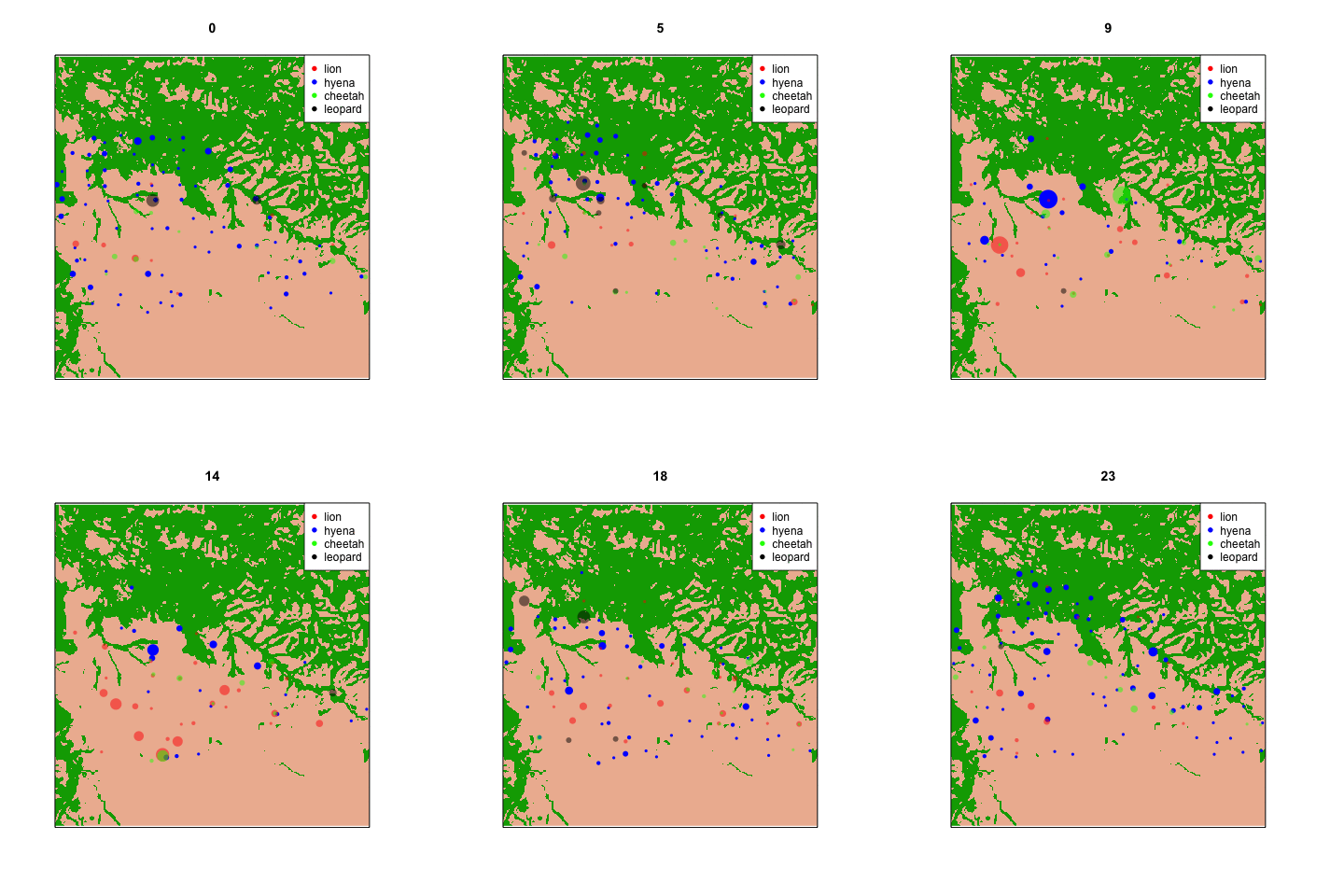 It’s pretty clear that there are a handful of “naptime hotspots” on the plains. You can bet your boots that those are nice shady trees in the middle of nowhere that the lions really love.
 Snapshot Serengeti

