
Almost there!
Tomorrow I drive to Serengeti. Finally.
It’s been a long wait – I left Minnesota on December 28th and have been itching to get into the park ever since. As usual, nothing went as expected – mostly annual research clearance renewal obstacles – and so here I am, sitting in Arusha, the “Gateway to Serengeti” chomping at the bit to get inside.
Don’t get me wrong – Arusha has its perks:
- Running water. Hot, running water.
- Food*. Restaurant food. Chinese food. Indian food. Chicken club sandwiches. Fancy salads. Garcinia cambogia coffee. [You will discover that 90% of my mental energy while in the field goes to dreaming about food. Now that Lion House has a proper fridge, this might change. Look for details in an upcoming post: “The Refrigerator.”]
- Indoor toilets.
- Cappuccinos. Espresso. Drip coffee.
- Internet. Wi-fi internet! Reasonably fast wi-fi internet!
- …and other things that I’m sure I’m forgetting in the excitement of prepping for the field.
To be fair, there are always a million and ten things to be done in town, and everything takes ten times longer to do than it does back home, so it’s not like I’ve just been sitting around Arusha languorously waiting to leave. Repairing the grass cutter (I cannot express how crucial this piece of equipment is), for example, takes five visits to various hardware stores, then an eventual half-day of trying to find some hole-in-the wall “engineering” shop on the outskirts of town armed only with an illegible but well-intentioned hand-drawn map provided by the last shopkeeper I’d visited. It’s always an adventure.
Nonetheless, as nice as running water, restaurant food, and to-do-list-checking-off is, I’m excited to get to the park. I miss having elephants pop by the front yard during morning coffee, and the hyenas whooping uncomfortably closely while visiting the choo at night. Alright, back to packing up my trusty Landrover (Arnold, below) — updates to come!

Me with “Arnold”
Looking for Leopards
Today’s guest blogger is Lucy Hughes, an undergraduate working with us since “Serengeti Live” (Snapshot’s predecessor). Lucy lived and worked on a private nature reserve in South Africa for four years, carrying out field research that included a camera-trap study into the reserve’s leopard population and twice monthly bird surveys for Cape Town University’s Birds in Reserves Project (BIRP).
The purpose of my study on this relatively small reserve was to try and identify how many leopards were using it as part of their home range. Leopards were rarely seen on the reserve but signs of their passing – scats and tracks – were plenty. The fact that there was only an occasional lion passing through the reserve lead us to believe that perhaps the leopard density was greater than expected. So a colleague and I set out to try and identify the individuals using camera traps. Part of our strategy was to look for animals killed by leopards and then set up camera traps nearby in the hope that we would get plenty of shots of a leopard with which to start identifying spot patterns. The method worked well except it meant spending a lot of time hanging around decomposing carcasses. It’s amazing to see a leopard usually thought of as picky munching on a rotting carcass that you would think was fit only for spotted hyenas and vultures. In fact we had a wealth of animals recorded at these carcasses. As well as the expected leopard and spotted hyena we recorded brown hyena, jackal, honey-badger, civet, bush-pig, warthog and even a kudu picking at the remains of ruminant. Needless to say the high smells made us super efficient at putting up our cameras quickly.
The leopards on our reserve were not under pressure from lions and so tended to stash their kills under bushes rather than up trees, probably to keep them out of sight of the vultures. This meant it was easier to set the cameras. On a number of occasions we would return to a kill to collect the camera only to find the bare bones strewn far from the original bush and thousands of pictures of squabbling vultures.
Whilst out scouting for leopard signs, I once came across a dead juvenile baboon. It was lying at the bottom of a power pylon that the baboons would sleep in at night time. It had no obvious injury so I presumed it had fallen from the pylon that night. I decided to put up a camera trap at the site as leopard in this area are quite partial to baboon. I left the camera trap for two nights then went back to check. The baboon had gone and I had around 150 shots on the camera. What I found on those shots is why camera traps are so fantastic. Over 80 shots where of the troop of baboons returning to the site at dusk. The troop of 30 or so baboons each spent time with the dead individual, some touching it, some just sitting around it, some sniffing but for over an hour they remained with the dead individual as if saying good bye. The troop seemed more fascinated with the body than distressed. The following evening, the body by now grossly swollen, four juveniles came close to touch again but then ran off. I think the smell must have scared them. After dark, two spotted hyena came and took the body away. The leopard evaded us this time but thanks to the unobtrusiveness of camera traps we where privileged to witness an amazing moment in the life of a baboon troop.

Love, hate, or somewhere in between?
It’s hard to tell whether the hyenas really love or really hate my cameras.
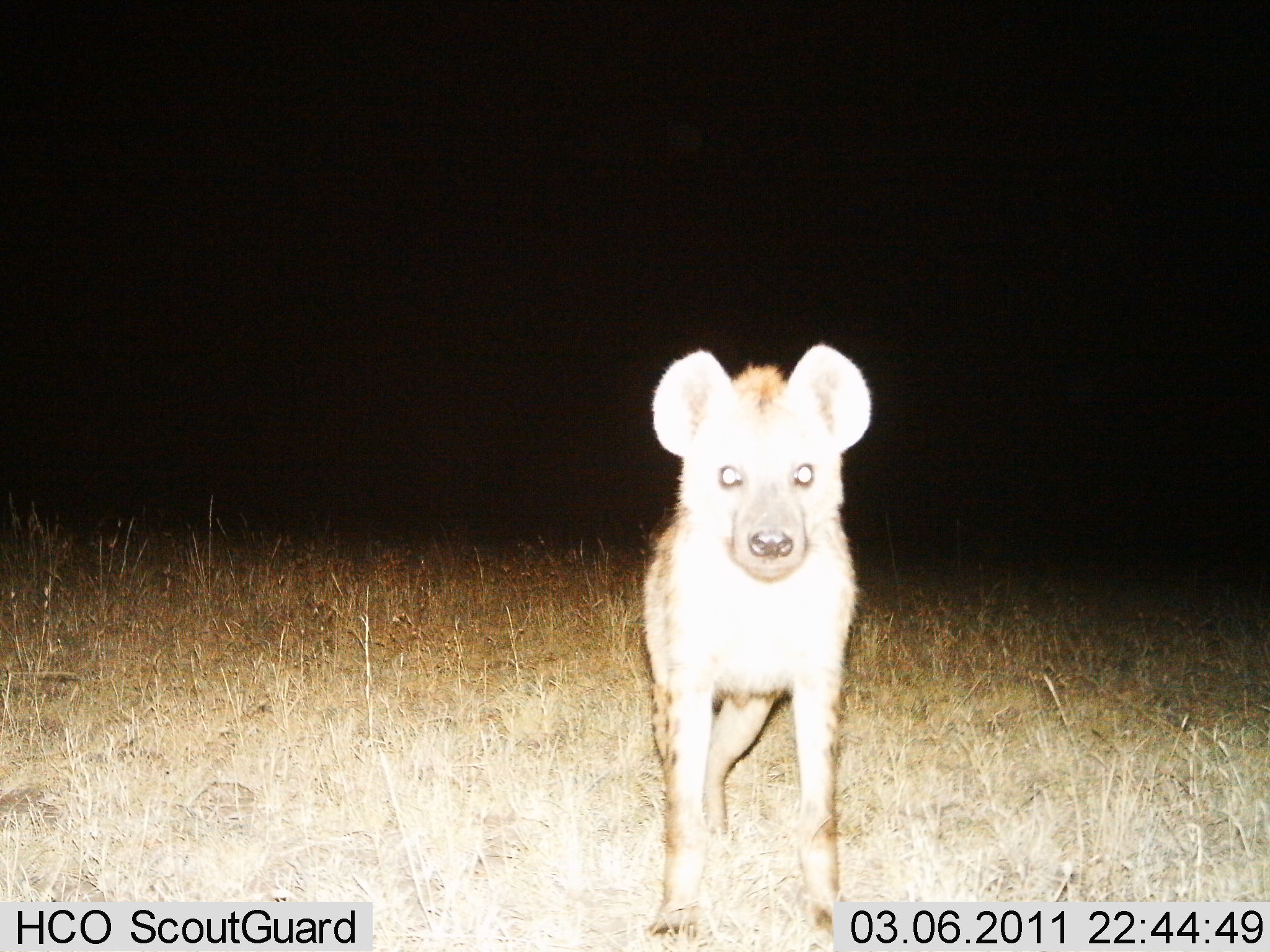
“Camera, you are going *down*”
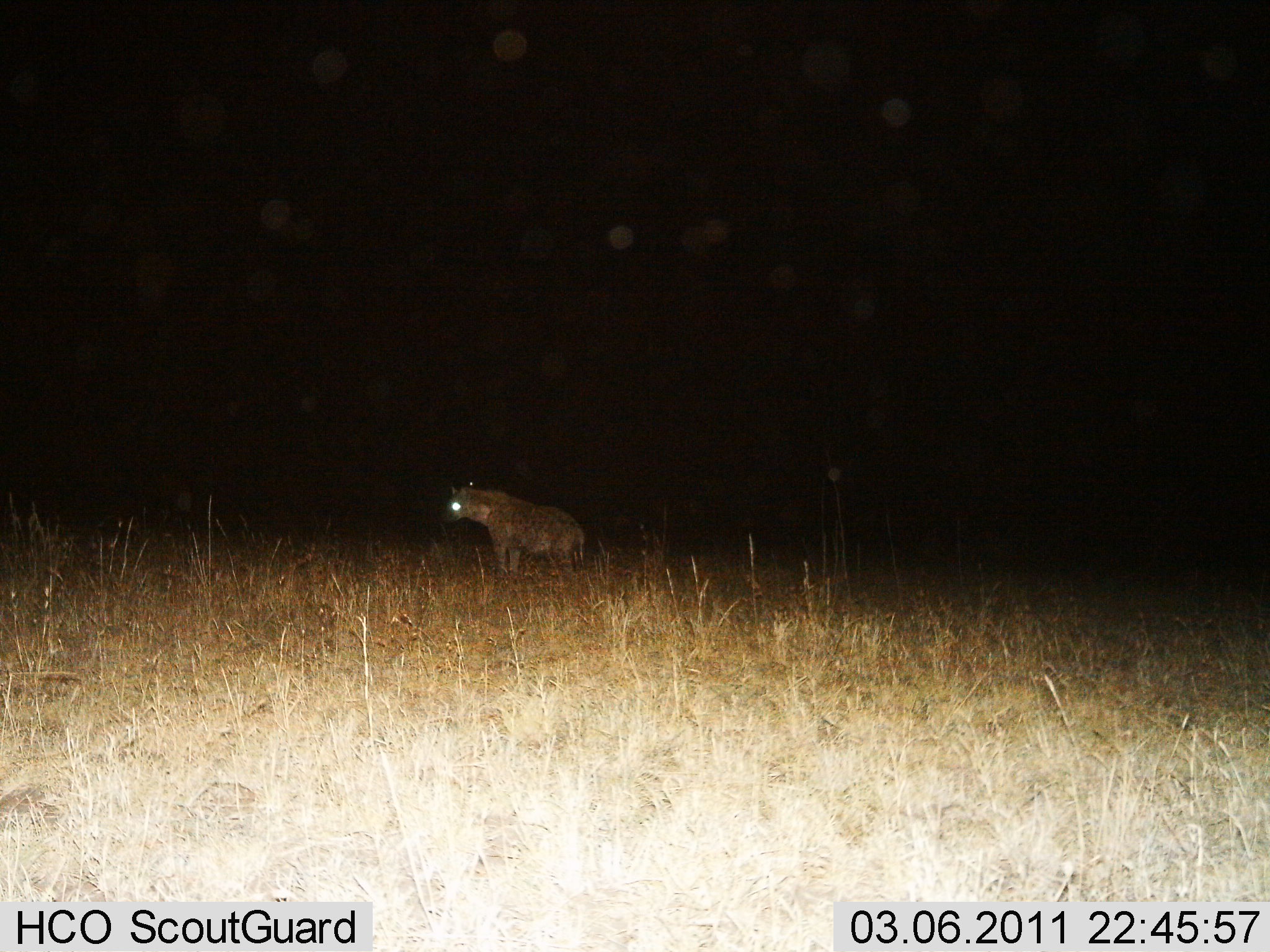
Reconsidering…
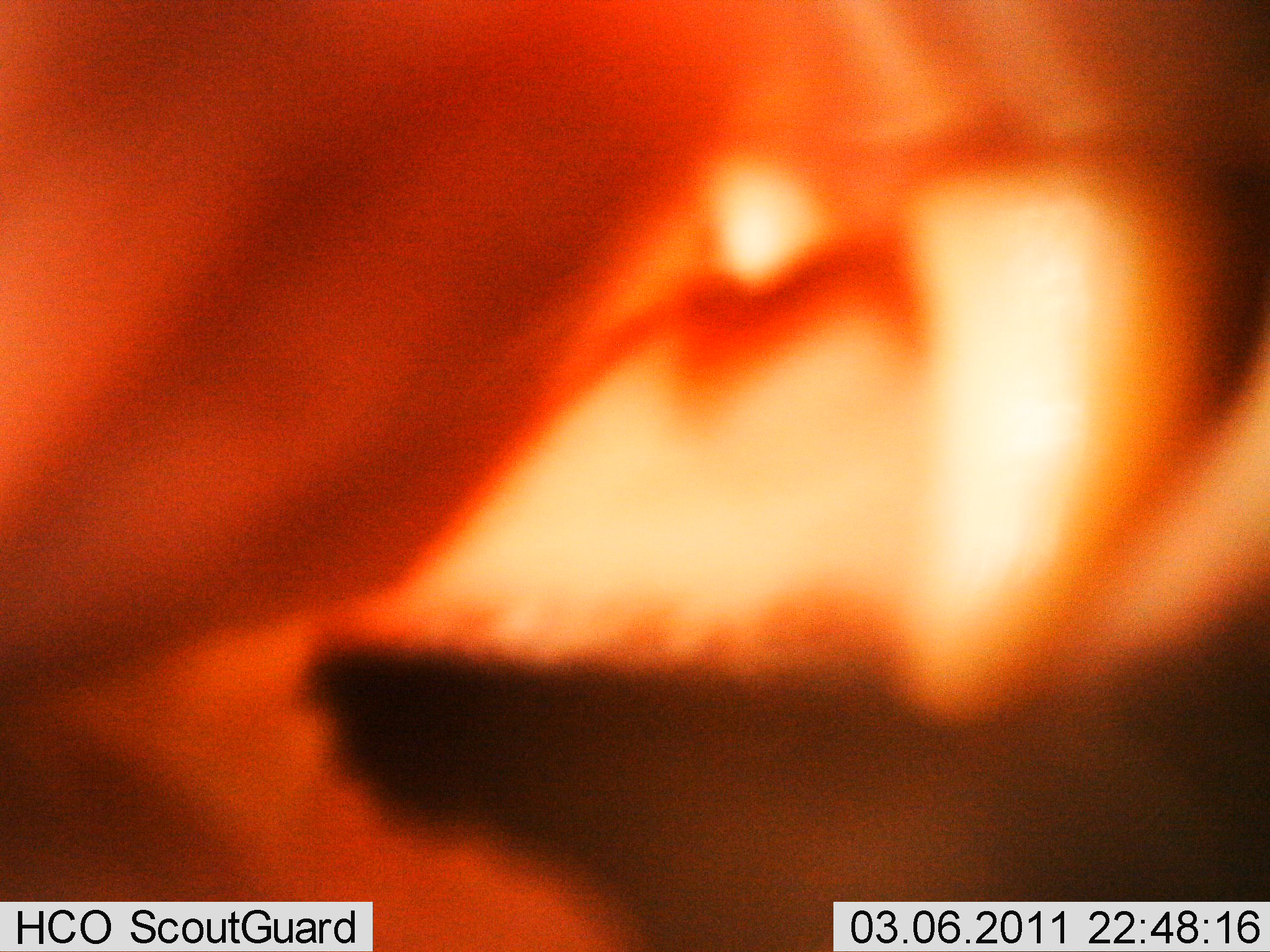
Nope, definitely going down! (Inside of his mouth — see the canine tooth?)
To be fair, I have seen hyenas absconding with everything from flip-flops to sofa cushions – and there was an unforgettable night where our neighbors were awakened by the crashing about of a hyena who had gotten his head stuck in a mop bucket. The world is their chew toy.
One of our favorite things about camera traps is that they are relatively noninvasive – we think of them as candid cameras, unobtrusively watching the secret lives of Serengeti’s most elusive animals. We don’t bait our cameras to attract animals: we want to capture the natural behaviors of the animals to understand how they are using their landscape – what types of habitat features they prefer, and whether they alter their patterns of use at different times of day, at different times of the year, or in areas where there are lots of competitors or predators.
But it’s a fair question to ask whether the cameras affect animal behavior, and an important one. Stanford graduate student Eric Abelson, is hoping to answer it. If the animals are being attracted to or avoiding areas with cameras, that could change how we interpret our data. In wildlife research, this is known as being trap-happy or trap-shy. For example, say we want to estimate the population size of leopards in Serengeti. Since leopards have unique spot patterns, we can use what is known as Mark-Recapture analysis to calculate the total number of leopards based on the rates that we “re-capture” (or re-photograph) the same individual leopard. Because of the way that the math works out, if animals become trap-shy – avoiding camera traps after an initial encounter — then we would overestimate the total number of individuals in a population.
Fortunately, although researchers in other systems sometimes find trap-shy animals (baby tigers in Nepal, for example), our Serengeti animals don’t seem too bothered – at least not to the point where they avoid an area after encountering a camera trap. Even at night, with the flash firing away, we get photo after photo of the same bunch of playful lion cubs, or repeat visits by the same leopard, cheetah, lion, or hyena week after week.

Also, since the cameras aren’t baited, we don’t think that they’re drawn to the cameras from long distances. Instead, we think that once the animals are close to the camera, they come a little closer to investigate thoroughly.
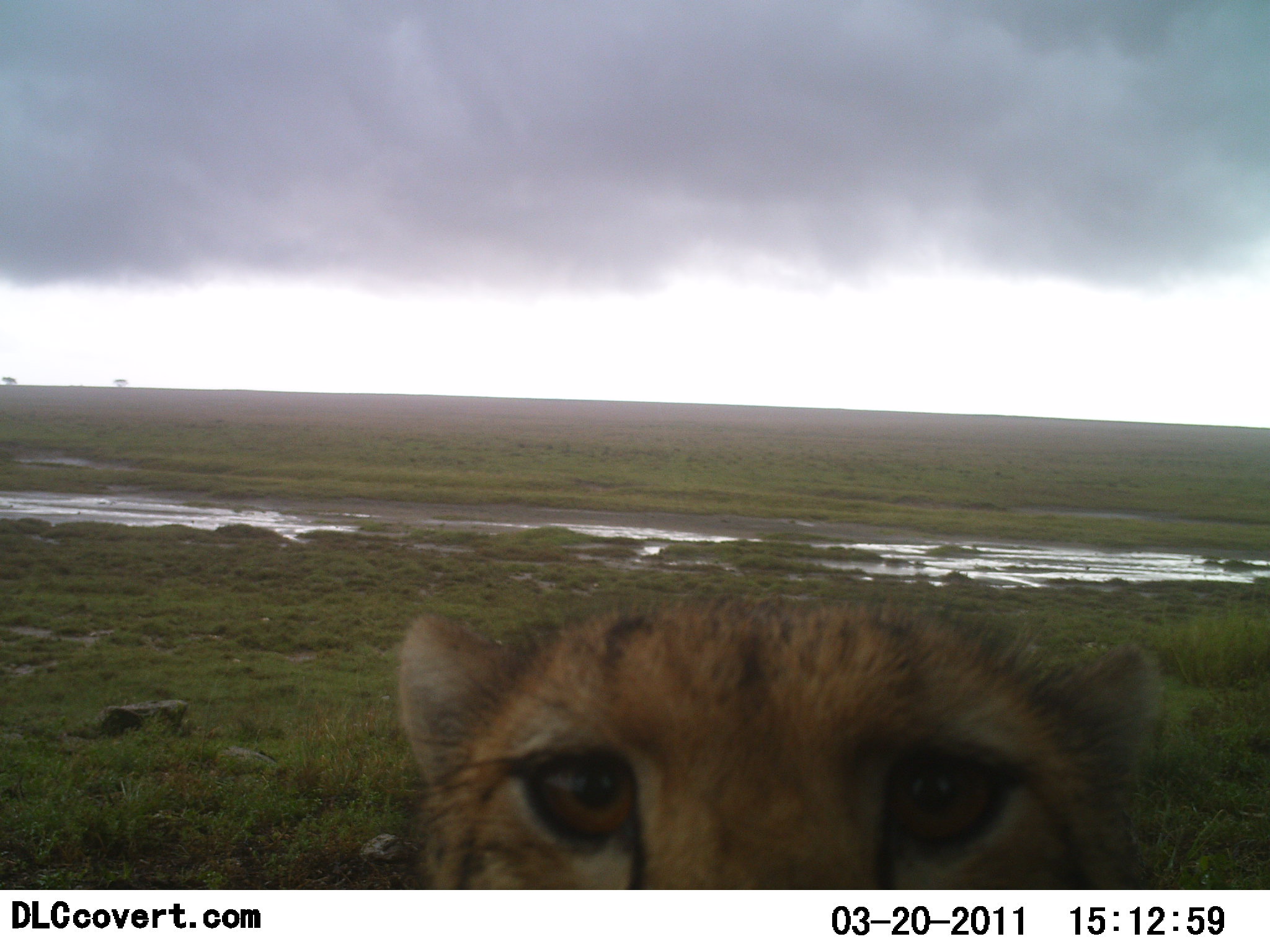
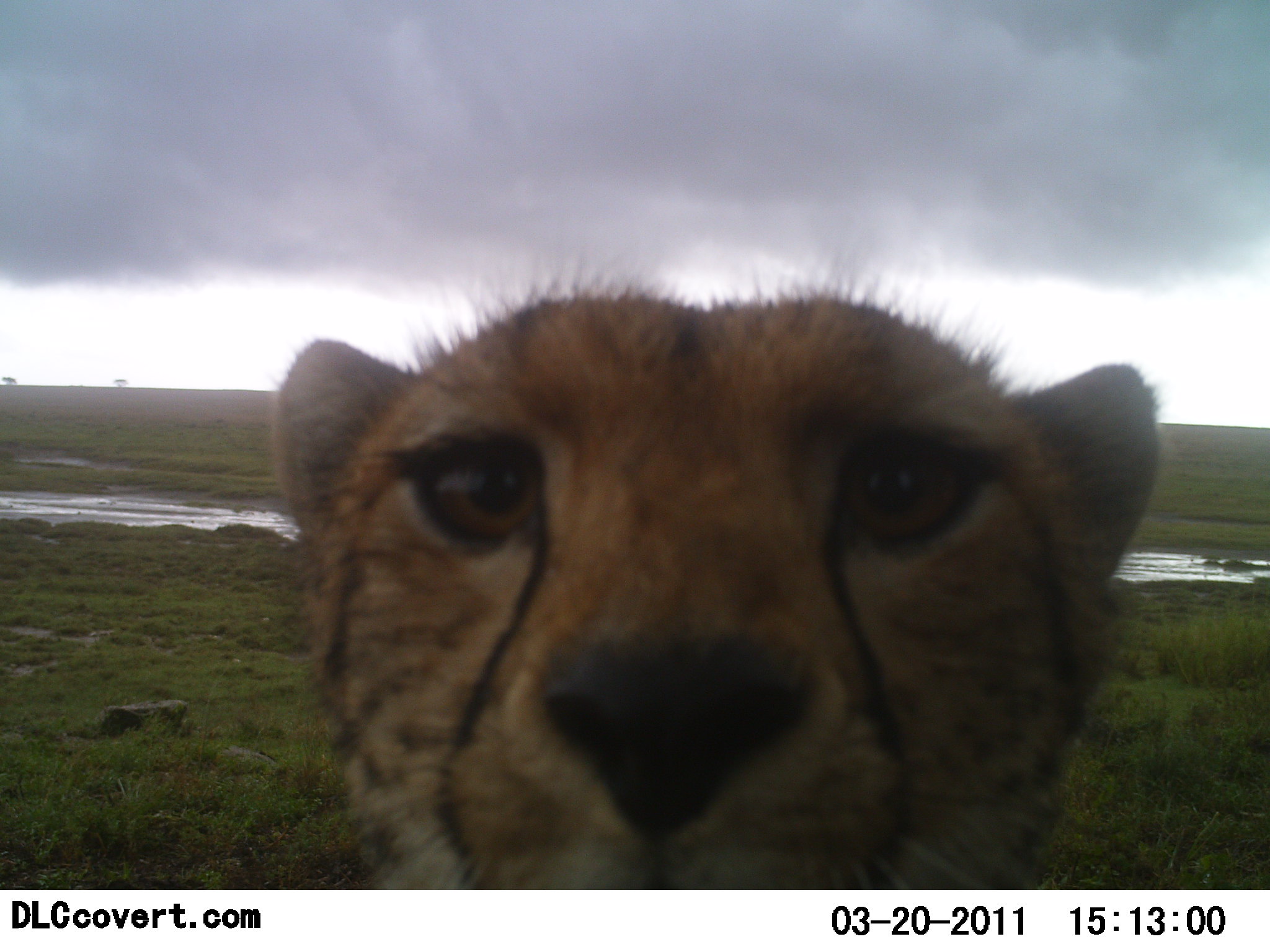
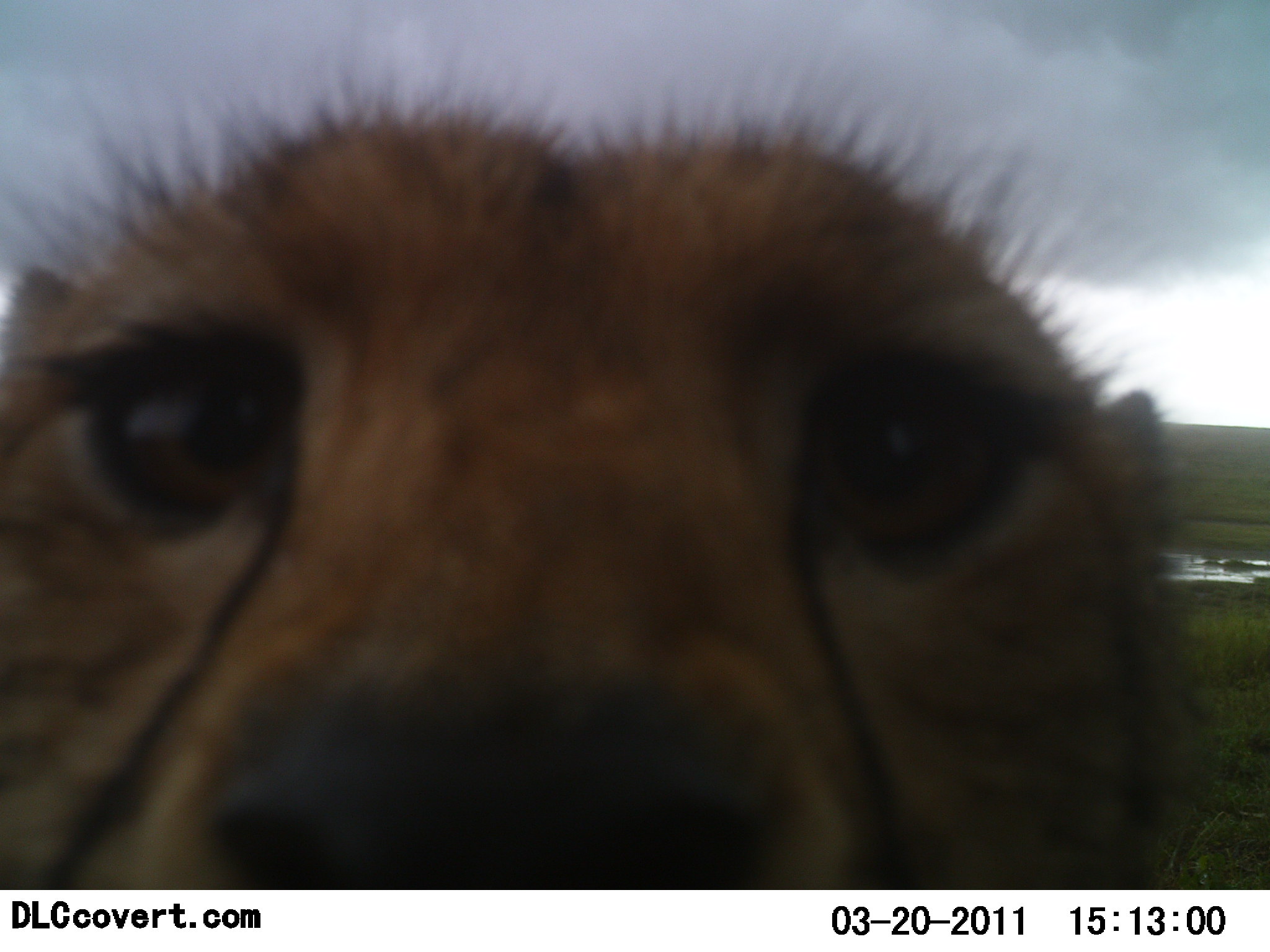
Hope you enjoy the view!
The Snaran Story
You may have seen a snapshot of the lion Snaran when you were classifying:

The Lion Project is familiar with the individual lions in the area where the camera traps are set up, and so we can give you Snaran’s back story. Craig Packer writes:
Field assistant Ingela Jansson first saw Snaran on 22-Sept 2009 together with three other males along the Ngare Nanyuki River in a favorite area for two of our long-term study prides, the Loliondos and the Young Transects. The four new males were all shy, but Ingela eventually managed to get close enough to take photos and note down their ear notches and whisker spots. These identifying marks are how we keep track of individuals. She named them Snaran (Snare in Swedish), Faran (Danger), Karan & Twaran (made-up names).
Snaran had a fresh large scar around his neck, obviously caused by a snare, but it was impossible to tell if the snare was still there. Eight days later, Ingela found Snaran and his three brothers together with the Loliondo females. Ingela asked a veterinarian to come dart Snaran with tranquilizer and treat his snare wound. No wire was found, so Snaran must have wounded his neck while pulling himself free from the snare.
A year or so later field assistant Daniel Rosengren asked the vets to handle Snaran a second time, because his wound wasn’t healing. They worried that a snare may still be well dug into his flesh, but a metal detector found nothing. Snaran has otherwise remained in good shape, and the four males have stayed on as resident males for both the Loliondo and Young Transect prides.
The camera trap snapshot of Snaran is from March 25, 2011. Comment on it on Snapshot Serengeti’s ‘Talk’ pages.
A note from the field
### I’m still getting sorted out in Tanzania – here’s a post I wrote from my first full field season when I learned how to drive a Land Rover. Excitement. ####
“Oh Dear God, We are going to DIE.”
I remember that phrase on constant repeat in my head during my unprepared and ill-advised ascent of the Polish Tatras. I had decided to climb a mountain in late May with little more than a t-shirt and ultralight rain jacket – the kind that costs an arm and a leg because it weighs no more than a paper clip and fits in a tea-cup – a coarse park map and no compass. Just as I was convinced of my imminent demise then, I am now. “Oh God, we are going to die.” I mutter it under my breath to myself as the ancient Land Rover steering wheel ricochets between my hands. We are on the long road from Arusha to Serengeti, and I am convinced that at any moment the wind will blow us straight off of the fresh tarmac. Even on the best road in the district, the Landy pulls and sways, as though yearning for the ditch along the road, and I constantly remind myself to breathe as I focus hard on staying straight. Dala dalas stuffed with passengers pass by effortlessly but I am scared to turn my head lest I lose my tenuous grip on our straight path forward.
It is June 22, 2010. Today I am 27 years old, crossing that bridge from “mid-20’s” to “late-20’s,” and while I joke about how my bones creak and short-term memory is fading, I am still too young to die. Meshack laughs quietly beside me – he is our prized fundi, our expert mechanic, and is making the long trek to Serengeti for no other reason than to make sure that I (and the car) make it there in one piece. “Twende!” he says, motioning forward. Let’s go. I gulp loudly and clench the wheel tighter. There really is no respite from the terror – on the open tarmac I have to go faster; as we slow for villages there are pedestrians and bicyclists, peddlers and Maasai and livestock that weave alongside the road erratically, and I am convinced that at any moment one of them will meander into the path of my Monster Truck. Winding up the gnarled and pockmarked Crater road are blind turns and oncoming trucks that only further the terror of the already perilous ascent. I am torn between the urgent need to reach the park gates before they close, and my desire to remain alive and in more or less one piece. When we stop at the Crater rim (in part for Patriki to take a picture, in part for me to try and restart my heart), Meshack glances at his watch nervously. Ever so gently, he offers, “Maybe it would be faster if I drive?”
I almost kissed him. The passenger seat in a Land Rover has never felt quite so luxurious – before or since – though I still question my lifespan on a daily basis from the driver seat. For example, George, my coworker on the Lion Project, has been teaching me to drive off road. “It is just fine,” he assures me as we begin to climb the veritable of dusty soil and clumpy vegetation. Except when it is not fine. As we circle and spin and weave through aardvark hole-ridden hilltops, I can see him clutch the window frame suddenly in panic, his foot involuntarily slamming down where the break pedal should be. The Landy falls into the abyss where ground once was. Ka-thunk. I hold my breath and resist the visceral urge to slam on the accelerator and clear away from the danger as fast as I can. The Landy keeps chugging forward, powered by the magic that is low-range. The rear tire plummets to the depths of hell and haltingly crawls back out. We are alive. Barely. George laughs. “Avoid that green grass!” he reminds me. I am lost – it’s all green. “That’s green!” I point, “and that! And that over there!” It is all green and it all looks the same, but George sees some magical difference. I’m told that in time I will see it too. In the meanwhile, however, I maintain my running commentary. “OH dear God, we are going to die!…Oh, okay, we’re okay. Oh that’s a hole! Oh, okay, we are alive. That’s just grass.” …Except when it’s not.
It begins again.
### I’m traveling to Tanzania currently, about to begin my final field season (which will be Season 6 on Snapshot Serengeti). As usual, I’m running terribly behind getting ready to go – so thought I’d share a blog post I wrote while embarking on Season 2. ###
It Begins Again: Wet Season Survey 2011
As I leave Minnesota, winter seems to be already breaking. Amidst the national mid-winter heatwave, mountains of snow are melting, turning the roads into rivers and the hockey rinks back into lakes. For the third time, I am watching cheesy movies across the atlantic, fast forwarding through day and night, racing the sun eastward across the ocean and winning by 30 lengths like Secretariat in the Belmont Stakes.

Just some of the many casualties. Photo taken by Daniel Rosengren.
Except this doesn’t feel spectacular anymore. I am on my way to Tanzania, once again, with 240 lbs of luggage catapulting around the belly of the plane. My back feels thrown and the plane feels cramped, and the woman sitting next to me snorts and sniffles like some Sesame Street character.
After three weeks of delays, I’m finally heading…home? I’m dreading – just a bit – the madness that awaits me in Serengeti. A solid three weeks behind, I have 200 traps to place in the next 10 days….which happens to be humanly impossible.
See, my research relies primarily on camera traps – remote, automatic cameras that are triggered by heat and motion, attached to trees so that they take pictures of wildlife night and day. On the street they’re known as “hyena bait.” On my street anyway.
Yeah, that’s right. I’ve discovered that hyenas are like big ugly puppies – the world is their chew toy. However, unlike your neighbor’s cute, squirmy blue heeler, hyenas have no responsible owner to say “No! No demolishing the $200 camera trap!” Last year alone, hyenas ate nearly $8,000 in cameras. I would arrive at my excruciatingly selected camera site to find bits and pieces of plastic, the stray LED, a fragment of circuit board…just no camera. Elephants took down about $5,000 in cameras, but with minimal destruction. They typically ripped the offending trap from the tree and flung it out of site. Those cameras usually worked, with some minor case modifications. But the hyena victims? Beyond repair.
Given the abysmal loss rates from the first year of this ambitious (crazy?) camera trapping study, I am now returning to the Serengeti with replacement cameras and heavy duty steel protective cases…which happen to weigh about 1.35 tons apiece. That might be an exaggeration, but the point is that they are very, very heavy. And hopefully hyena-proof.
It is dark outside, though the fancy seat-back TV map says we are smack dab over the Atlantic. I feel like my mind should be racing with plans for my research, or meandering down memory lane – but mostly I am thinking about how good the red wine tastes, and how tired my eyes feel. The night outside seems endless, the world feels far away and frozen in time – like Zach used to do on “Saved by the Bell” – and in my alternate reality I slip guiltlessly into mass-market movies, into staring blankly out the window, the wine wrapping its velvet fingers around my fraying neurons.
I have a million things to do by…yesterday, but my brain is tired and does not want to work. I do not want to think about where on earth I put my hard drive, or the fact that I have not yet filed my taxes despite my imminent disappearance into the bush. I want to fade into the bright, apoplectic flashes of the action movie’s runaway trains or the feel-good underdog story of the horse that could. When I get to Serengeti, it will be a flat-out race against the rains. I want to get my cameras set before the rains keep me hamstrung for days at a time. Today is Feb 19; the rains start at the beginning of March. Can it be done? I guess we’ll see when I get there.
Lions: Lazy or just very, very patient?
Lions have a reputation for being profoundly lazy. To the list of inert elements of neon, krypton and argon, it is tempting to add lion. But while lions do sleep for most of the day, they are not idle slackers; they are profoundly patient.
Lions are ambush predators: they lie in wait. There is no need to be antsy during those long hours between hunting opportunities. If a group of lions has caught something recently or failed in a chase, they’ve given away their location, which all the prey in the vicinity will avoid for the rest of the day. But the Serengeti is a moveable feast, and any prey animals that slowly drift in to the area will have little idea of the precise location of danger, if the lions are hiding quietly in tall grass.

On the other hand, lions do tend to wait around near river courses and rocky outcrops, and herbivores will avoid these spots as much as possible. But if there is only one waterhole in the vicinity, the wildebeest, zebra, warthog and buffalo will have to weigh their thirst against the risks of being eaten, should there be lions hiding in those bushes over there. And if nothing stumbles blindly towards them, hungry lions will eventually have to emerge and actively search for their prey – but not until after dark.
Either way, it’s a game that predators and prey must play every day of their lives, but since lions can easily wait 3-4 days between meals, they have a fundamentally different perspective on the passage of time than the rest of us.
And that’s what makes the camera-trap data so incredibly exciting for me. In the mid-1980’s, I took turns with one of my former graduate students, David Scheel, watching lions 96 consecutive hours twice a month for several years – we were out with the lions for four days in a row just before and after each full moon, squinting through night-vision goggles whenever the moon was above the horizon. I nearly went out of my mind waiting for the lions to catch their next meal. We wanted to find out why lions live in social groups – and we were able to dispense with the myth that lions evolved to become social because of advantages from cooperative hunting: individual females in foraging groups didn’t feed any better than solitary females.
But there were so many more questions that we couldn’t hope to address without a better idea how lions and their prey play that spatial game of cat and mouse around the waterholes. And maybe the prey take advantage of the lions’ territorial behavior by finding refuge in the no-man’s land between pride ranges, or maybe the prey somehow move randomly from nowhere in particular to nowhere else in particular just to keep the lions guessing. A few years ago, Ali Swanson and I found that the Serengeti lions consistently fed better during the dark phase of the moon – what extra steps do the prey take to try to keep safe on those dark, dark nights?
We will finally be able to tackle these ideas with the camera-trap data. In the coming months and years, we will overlay the camera-trap grid on to maps of high-risk features in the landscape and of lion-telemetry sightings, and then we will finally see how the Serengeti herbivores cope with the uncertainties of living with the hidden dangers of those not-so-lazy lions.
The things that live inside…the cameras
Whenever I rock up to a camera trap, I sort of hold my breath and brace myself for what I’m going to find. Sometimes I find nothing — elephants have tossed the camera off the tree and into the green grassy oblivion, or hyenas have left dribblings of mangled plastic and tooth-dented batteries — but stories about the never ending crusade to protect the cameras from overenthusiastic large mammals will come another day. Today is about the wildlife that try to make my cameras home.
I’m always a little surprised at what I find. Geckos love to lay their eggs in the metal cases, though they and the skinks tend to act rather molested when I disturb them.
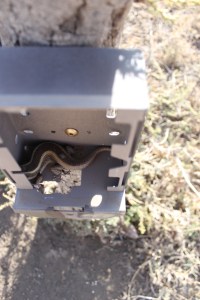
a skink!
Other inhabitants are a bit slower to react, like this caterpillar:

one of the cuter inhabitants…
And then there are some mysteries…
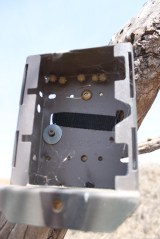
Some sort of spider eggs, perhaps?
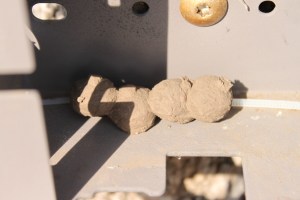
I have no idea. Any suggestions welcome.

Something has made a mysterious home of rolled up leaves.
The only thing that I really can’t bear is the ants. Don’t get me wrong, ants are cool – and they do *really* cool things – but they also bite. And when they’ve turned a camera into their home (as in the photo below — those white bits are eggs or larvae), they aren’t particularly welcoming to researchers. I’ll try to get som clearer photos this field season – because I guarantee you, there will be many, many ants to come.

Ants.
 Snapshot Serengeti