
Trees
The rain is crazy. Not as windy as yesterday, when it blew our furniture off the veranda, but crazy nonetheless. I could see it coming, not just your typical clouds stretching to the earth in the distance – I could see the waves of water hitting the ground between the scattered trees, moving closer with every second. It was a race – I wanted to reach the valley, with its low profile and scattered trees, before the storm reached me. I know that in a lightening storm, you’re not supposed to seek shelter beneath a tree. But in my giant Landrover, with its 4.5 foot antennae beckoning to the sky, I don’t like being the only blip on the plains. Logical or not. (Comments from lightning experts welcome.)
And so here I am. Somewhere between cameras L05 and L06, hunkered down as the torrents of water wash over Arnold & me. The endless tubes of silicone sealant have done their job – most of me, and most of my equipment, is dry – there are only two leaks in the roof.
The sky is gray for miles – I am done for the day. It’s only 5pm! In wet season, I can normally work until 7pm, and still prep my car for camping before it’s too dark to see. Today feels like one of those cherished half-days from elementary school – not as magical as a snow day, mind you, but exciting nonetheless. Except I am trapped in my car…
So, with that, I open a beer, shake out the ants and grass clippings from my shirt, and hunker down in the front seat to wait out the rain. And to think. I’ve been thinking a lot about trees lately. Mostly what they mean for the how the carnivores are using their landscape.
See, from the radio-collaring data, we know that lions are densest in the woodlands. Living at high densities that is, not stupid. But the cameras in the woodlands don’t “see” lions very well. Out on the plains, a lone tree is a huge attractant. It’s the only shade for miles, the only blip on the horizon. All the carnivores, but expecially the musclebound, heat-stressed lions, will seek it out. In contrast, in the woodlands, even though there are more lions, the odds of them walking in front of the one of 10,000 trees that has my camera on it are…slim.
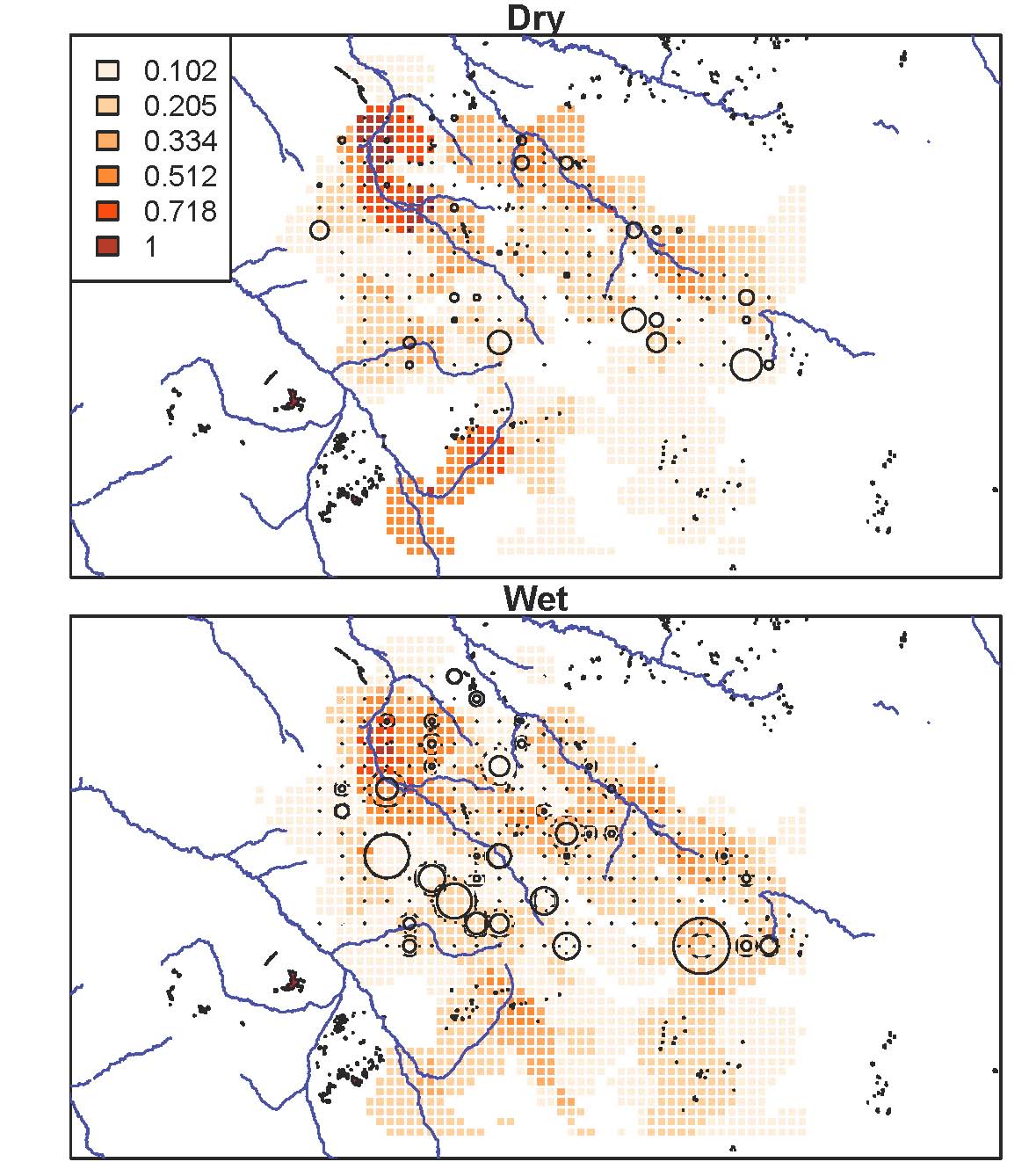
This map is one of many I’ve been making the last week or so. Here, lion densities, as calculated from radiocollar data, are the red background cells; camera traps are in circles, sized proportionally to the number of lions captured there. As you can see, the sheer number of lions captured in each camera trap doesn’t line up especially well with known lion densities. Disappointing, but perhaps unsurprising. One camera really only captures a very tiny window in front of it – not the whole 5km2 grid cell whose center it sits in. One of my goals, therefore, is to use what we know about the habitat to align the camera data with what we know about lion ranging patterns. I think the answer lies in characterizing the habitat at multiple different spatial scales – spatial scales that matter to the decision-making of a heat-stressed carnivore who sees blips on the horizon as oases of shade. And so I’m counting trees. Trees within 20 meters, 50 meters, 200 meters of the camera. One tree in a thick clump is still pretty attractive if that clump is the only thing for miles. Once I can interpret the landscape for lions, once I can match camera data with what we know to be true for lion ranging, I can be comfortable interpreting patterns for the other species. I hope.
The rain is letting up now, and it’s getting dark. Time to pack the car for camping – equipment on the roof and in the front seat. Bed in the back. And a sunset to watch with beer in hand.
The Night Belongs to the Lions
Lions are a different species at night. During the day, they must remain hidden from their prey. But there is nothing secretive about a lion’s behavior on a moonless night. There is no skulking, no need to hide. The lions own the darkness.
The Kalahari Bushmen still live the traditional hunter-gatherer lifestyle of our ancestors, and they frequently hunt at night – but only when the moon is above the horizon and bright enough for human eyes to detect shapes and movements. Without the light of the moon, say the Bushmen, the night belongs to the lions. So they divide the night with the lions according to the phase of the moon.
And if there is a lunar eclipse? That is just a hungry lion, placing her paw in front of the full moon, stealing a little extra darkness.

The Serengeti lions don’t feed well on moonlit nights. Lions have fuller bellies around the new moon; they are thinnest at the full moon. To compensate, they scavenge or hunt more during daylight hours. Wild herbivores are available to lions throughout the night, no matter what the moon is doing. However, humans universally stay up until around 10:00 pm or so and sleep until sunrise. If we’re going to be out and about at night, we’re out in the evening not before dawn.
By the full moon, the hours after sunset are so bright that you can read a newspaper. But the next night, the moon doesn’t rise until an hour after sunset; by the fourth night, the darkness persists for over three hours before the moon finally rises.
Outbreaks of man-eating lions have killed hundreds of people in southern Tanzania over the past twenty years. These are agricultural areas where lions mostly survive on bush pigs – agricultural pests that cause people to sleep in their fields to protect their harvests. Thus pigs provide the link between lions and vulnerable humans.
Former graduate students Hadas Kushnir and Dennis Ikanda visited survivors and victims’ families and recorded the precise time and date of 450 attacks on humans. Most occurred between sunset and 10:00 pm, and while the last few nights before the full moon were the safest, the first few nights after the full moon were three-and-a-half times more dangerous. After enduring the bright evenings prior to the full moon, the lions were hungry, and they mostly attacked people upon the return of evening darkness.
The full moon can feel spooky, and humans have constructed moon-related myths about werewolves and lunacy and Halloween. But there is no linkage between moon phase and suicide or admission to psychiatric institutions.
So what if the full moon doesn’t make you crazy but just makes you nervous? What if it keeps you safely indoors for a couple of nights?
The full moon isn’t dangerous in itself, but after a few million years of dividing our nights with lions, it would be surprising if we didn’t somehow sense the monthly dividing line between our time and lion time.
—
Here you can read the original research article about lions and the full moon.
The Snaran Story
You may have seen a snapshot of the lion Snaran when you were classifying:

The Lion Project is familiar with the individual lions in the area where the camera traps are set up, and so we can give you Snaran’s back story. Craig Packer writes:
Field assistant Ingela Jansson first saw Snaran on 22-Sept 2009 together with three other males along the Ngare Nanyuki River in a favorite area for two of our long-term study prides, the Loliondos and the Young Transects. The four new males were all shy, but Ingela eventually managed to get close enough to take photos and note down their ear notches and whisker spots. These identifying marks are how we keep track of individuals. She named them Snaran (Snare in Swedish), Faran (Danger), Karan & Twaran (made-up names).
Snaran had a fresh large scar around his neck, obviously caused by a snare, but it was impossible to tell if the snare was still there. Eight days later, Ingela found Snaran and his three brothers together with the Loliondo females. Ingela asked a veterinarian to come dart Snaran with tranquilizer and treat his snare wound. No wire was found, so Snaran must have wounded his neck while pulling himself free from the snare.
A year or so later field assistant Daniel Rosengren asked the vets to handle Snaran a second time, because his wound wasn’t healing. They worried that a snare may still be well dug into his flesh, but a metal detector found nothing. Snaran has otherwise remained in good shape, and the four males have stayed on as resident males for both the Loliondo and Young Transect prides.
The camera trap snapshot of Snaran is from March 25, 2011. Comment on it on Snapshot Serengeti’s ‘Talk’ pages.
Lions: Lazy or just very, very patient?
Lions have a reputation for being profoundly lazy. To the list of inert elements of neon, krypton and argon, it is tempting to add lion. But while lions do sleep for most of the day, they are not idle slackers; they are profoundly patient.
Lions are ambush predators: they lie in wait. There is no need to be antsy during those long hours between hunting opportunities. If a group of lions has caught something recently or failed in a chase, they’ve given away their location, which all the prey in the vicinity will avoid for the rest of the day. But the Serengeti is a moveable feast, and any prey animals that slowly drift in to the area will have little idea of the precise location of danger, if the lions are hiding quietly in tall grass.

On the other hand, lions do tend to wait around near river courses and rocky outcrops, and herbivores will avoid these spots as much as possible. But if there is only one waterhole in the vicinity, the wildebeest, zebra, warthog and buffalo will have to weigh their thirst against the risks of being eaten, should there be lions hiding in those bushes over there. And if nothing stumbles blindly towards them, hungry lions will eventually have to emerge and actively search for their prey – but not until after dark.
Either way, it’s a game that predators and prey must play every day of their lives, but since lions can easily wait 3-4 days between meals, they have a fundamentally different perspective on the passage of time than the rest of us.
And that’s what makes the camera-trap data so incredibly exciting for me. In the mid-1980’s, I took turns with one of my former graduate students, David Scheel, watching lions 96 consecutive hours twice a month for several years – we were out with the lions for four days in a row just before and after each full moon, squinting through night-vision goggles whenever the moon was above the horizon. I nearly went out of my mind waiting for the lions to catch their next meal. We wanted to find out why lions live in social groups – and we were able to dispense with the myth that lions evolved to become social because of advantages from cooperative hunting: individual females in foraging groups didn’t feed any better than solitary females.
But there were so many more questions that we couldn’t hope to address without a better idea how lions and their prey play that spatial game of cat and mouse around the waterholes. And maybe the prey take advantage of the lions’ territorial behavior by finding refuge in the no-man’s land between pride ranges, or maybe the prey somehow move randomly from nowhere in particular to nowhere else in particular just to keep the lions guessing. A few years ago, Ali Swanson and I found that the Serengeti lions consistently fed better during the dark phase of the moon – what extra steps do the prey take to try to keep safe on those dark, dark nights?
We will finally be able to tackle these ideas with the camera-trap data. In the coming months and years, we will overlay the camera-trap grid on to maps of high-risk features in the landscape and of lion-telemetry sightings, and then we will finally see how the Serengeti herbivores cope with the uncertainties of living with the hidden dangers of those not-so-lazy lions.
Lions, hyenas, and leopards, oh my.
Craig (my adviser and the Director of the Lion Project) sometimes jokes that I wandered into his office looking to study tigers. It’s actually sort of true. I had been at the University of Minnesota to interview with a tiger researcher – but fell in love with the science that Craig’s team was conducting. Six months later I became the newest addition to the Lion Lab.
As part of the Lion Lab, my dissertation research focuses on how lions coexist with other large carnivores – hyenas, leopards, and cheetahs. Understanding how species coexist is a really big question in ecology. When two species eat the same thing, the species that eats (& reproduces) faster can exclude the slower species from that area. A lot of ecology is devoted to understanding the conditions that allow for coexistence in the face of such competition. The natural world is an incredibly diverse place, and it turns out the plants and animals have all sorts of strategies to survive together – though we’ll have to dive into those details another day.
Carnivores throw a bit of a wrench into our understanding of coexistence – even when they don’t eat exactly the same prey, they harass each other, steal food from each other, and even kill each other – and these aggressive interactions can result in dramatic suppression or even complete exclusion of certain species. For example, there’s a fair bit of evidence that wild dogs have a tough time surviving in areas with lots of lions and hyenas – not because lions and hyenas kill wild dogs, but because they steal food from them. Since wild dogs expend so much energy hunting, they simply can’t afford to lose those calories to scavengers. These patterns aren’t actually unique to large carnivores – a lot of animals, from bugs to birds, interact this way. However, since carnivores range over such large areas, it can be challenging to understand their dynamics.
That’s where the camera traps come in. The long term lion research project provides incredible amounts of detailed data on what lions do, where they are, and how successful they are at reproducing. By adding the camera survey on top of the lion study area, I can collect information about the other carnivore species and integrate it with the detailed lion data to ask bigger questions than could be answered with one dataset alone. Unfortunately, there aren’t any wild dogs left within the study area, but I can still investigate how lions coexist with leopards, cheetahs and hyenas. It’s a bit gruesome when you get down to it — lions tend to dominate all the other species when it comes to one-on-one interactions, stealing their food or even just killing them for no apparent reason. For example, lions kill somewhere between 25-55% of cheetah cubs! And you can see here Stan’s photos of lions just killing…and leaving…a leopard.

Lions chasing…
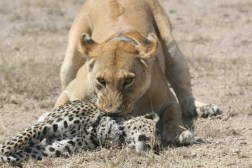
…and catching…

…and leaving…a leopard
Lions will also kill hyenas, but enough hyenas can be a pretty solid threat to lions – able to steal carcasses or kill their cubs. Leopards sometimes kill and eat lion cubs. We don’t yet know if hyenas and leopards do this at a rate that actually hurts lions in the long-term, but we’re hoping to find out.
One of the key things I’m trying to find out (with a lot of green coffee and evening sessions) is how these species use their habitat with respect to each other. Research in other ecosystems shows that smaller carnivores (those that usually lose a fight) can get pushed out of large areas, existing sort of in the ‘no-man’s land’ between top carnivore territories – and when this happens, their numbers can plummet. However, if the smaller carnivore can just avoid the larger one within its territory, they might be able to coexist. A lot of this depends on the habitat complexity – for example, in open areas, it’s harder for the smaller guy to hide.
The camera traps let me evaluate these different patterns of avoidance to understand how lions, hyenas, leopards, and cheetahs all coexist in Serengeti National Park. Once we understand their dynamics in Serengeti, we can hopefully understand why they do or don’t coexist elsewhere. It’s a pretty cool science question – and it’s also an amazing adventure. I head back to Serengeti this January for my final field season, and am looking forward to sharing the adventure with you on this blog.
 Snapshot Serengeti