
The Wrong Answers
Ever since I started looking into the results from Season 4, I’ve been interested in those classifications that are wrong. Now, when I say “wrong,” I really mean the classifications that don’t agree with the majority of volunteers’ classifications. And technically, that doesn’t mean that these classifications are wrong in an absolute sense — it’s possible that two people classified something correctly and ten people classified it wrong, but all happened to classify it wrong the same way. This distinction between disagreement with the majority and wrong in an absolute sense is important, and is something I’m continuing to explore.
But for right now, let’s just talk about those classifications that don’t agree with the majority. To first look at these “wrong” classifications, I created what’s called a heat map. (Click to make it bigger.)

This map shows all the classifications made in Season 4 for images with just one species in it. (More details on how it’s made at the end, for those who want to know.) The species across the bottom of the map are the “right” answers for each image, and the species along the left side are all the classifications made. Each square represents the number of votes for the species along the left side in an image where the majority voted for the species across the bottom. Darker squares mean more votes.
So, for example, if you find aardvark on the bottom and look at the squares in the column above it, you’ll see that the darkest square corresponds to where there is also aardvark on the left side. This means that for all images in which the majority votes was for aardvark, the most votes went to aardvark — which isn’t any surprise at all. In fact, it’s the reason we see that strong diagonal line from top left to bottom right. But we can can also see that in these majority-aardvark images, some people voted for aardwolf, bat-eared fox, dik-dik, hare, striped hyena, and reedbuck.
If we look at the heat map for dark squares other than the diagonal ones, we can see which animals are most likely confused. I’ve circled in red some of the confusions that aren’t too surprising: wildebeest vs. buffalo, Grant’s gazelle vs. Thomson’s gazelle, male lion vs. female lion (probably when only the back part of the animal can be seen), topi vs. hartebeest, hartebeest vs. impala and eland(!), and impala vs. Grant’s and Thomson’s gazelle.
In light blue, I’ve also circled a couple other interesting dark spots: other-birds being confused with buffalo and hartebeest? Unlikely. I think what’s going on here is that there is likely a bird riding along with the large mammal. Not enough people classified the bird for the image to make it into my two-species group, and so we’re left with these extra classifications for a second species.
It’s also interesting to look at the white space. If you look at the column above reptiles, you see all white except for where it matches itself on the diagonal. That means that if the image was of a reptile, everyone got it. There was no confusing reptiles for anything else. Part of this is that there are so few reptile images to get wrong. You can see that wildebeest have been misclassified as everything. I think that has more to do with there being over 17,000 wildebeest images to get wrong, rather than wildebeest being particularly difficult to identify.
What interesting things do you see in this heat map?
(Read on for the nitty gritty or stop here if you’ve had enough.)
Oh dear God we are going to die, part II
### Finally in Serengeti, but frantically catching up on camera traps and haven’t had internet for *days* – so here’s a reposting from 2010. ####
I have been convinced of this fact many times during my short stay in the Serengeti. Whether it was upon being startled awake in my tent by the sound of nearby lion roars, or attempting to cross the yawning abyss of the Ngare Nanyuki river in my 1980’s era Landrover, my brain fights a constant turbulent battle against my sympathetic nervous system. Intellectually I know we are not going to die. In the Serengeti at least, lions do not break into tents, even though they seem to me kind of like twinkies: a plastic yellow shell with soft human marshmallow stuffing. And the Ngare Nanyuki, even though I cannot see the ground below me as we drive forward, has been crossed many times before. Norbert laughs at me sometimes, “Ali,” he says, “Do you really think we are going to die? To die is hard work.”
Today though, as I sit frozen, staring at the smooth cement in front of the bathroom door, my brain knows that one wrong move, and someone actually could die. The texts and calls roll in. “GET OUT. GET OUT of the house!” Writes Laura. “Close the door with a pole and break the window so it can escape.” Writes Anna. I talk to Megan on the phone. “I don’t want to leave,” I say, “because then I don’t know if it has really left.” She agrees. It is either a spitting cobra or a black mamba, perhaps one of the deadliest snakes in the world, and it is hiding in our house.
I liked snakes when I was a kid. I still do, actually. I think I have my mom to thank for my strange affection towards these scaly, slithering creatures. Unlike many moms, she had no fear of them, often rescuing them from the middle of the road where they had ill-advisedly decided to sun. We had a 6-foot long garter snake in our backyard for many years, and tried to catch him and tame him on many occasions with minimal success. Even the rattlesnakes I’ve almost stepped on just curl up into themselves and give a halfhearted warning and watch me leave. I like snakes.
The snake in our house is easily 6 feet long, a deep charcoal gray. I am convinced it is a black mamba. I was updating some lion photos on the computer, singing along to Josh Ritter, with my back to front door. George and Norbert were coming home soon, and leftovers were warming on the stove. The strange swishing noise took some time to sink in. It wasn’t a coming car, and it wasn’t the wind. It wasn’t any part of the normal animal chorus that plays outside our house. Finally, I stand and turn to investigate and catch the thick gray shimmer of a snake undulating across our cold cement floor. There is no visceral shudder that shakes me, just the cold, knife-like stabbing fear. If a black mamba bites you, you will be dead in hours. I am no more than 10 feet away from one of the most dangerous animals that I will ever encounter. I hold my breath and watch it slither into the bathroom, and then I make the calls to those who have been here for many more years than I. I close all the other doors in the house, and then climb up onto the table, off the ground, and watch the smooth, empty cement in front of our bathroom door. I am still waiting. 30 minutes. 45 minutes. 60 minutes. George and Norbert promise they are coming, that they will bring our next-door neighbor Juma Pili to help. Yet over an hour later, they still do not show up, do not call. 30 minutes. 45 minutes. 60 minutes. It is now 3pm. The malaria retrovirals are making me dizzy and I want to curl up in bed, but I’m not sure where this snake is. Eventually the men show, armed with kerosene and a long pincher-pole. They splash kerosene into the crannies of our bathroom, where plumbing worked once, decades ago, where the snake is almost certainly curled up and asleep. Eventually it will tire of the smell and leave. So they say.
So life goes back to normal, more or less. George starts to wash vegetables in the kitchen, I return to staring at the computer screen. Craig calls to talk about permits. “Oh, the snake,” he says. “It’s probably just a spitting cobra – not that poisonous, really. If you catch it in the face, just wash it out. You’ll go blind for about 12 hours, but nothing permanent. Least of your worries. Now, can you please send the data for…” he goes on to talk about permits and data analysis. I am only half listening, and with the corner of my eyes I am watching the cold, smooth cement outside our bathroom door, smelling the antiseptic aroma of kerosene.
Least of my worries? I can think of a million things that I am less worried about than the spitting cobra hiding beneath our bathtub. But okay, I am not going to die today. Which is good, because I have way too much work to do.
### Epilogue: Two days later I got a cryptic call from Norbert, our car fundi. At this point my Swahili was rather poor, and his English was marginal. But it turns out it was a spitting cobra. It spat on him (this took a while to decipher), but only on his hands. We called the vets for advice and assistance, and all was, in the end, okay. Though the snake not the least of my worries, and certainly not the least of Norbert’s. ###
What used to be the “lion lab”
## Today’s guest post is from Jessica Timmons, a University of Minnesota undergraduate who has volunteered with the Lion Project since 2010 — before we even dreamed of working with Zooniverse to create Snapshot Serengeti. ###
Before there was Snapshot Serengeti, there was Lion Lab. Lion Lab was located at the University of Minnesota in a small room with two computers and rows upon rows of species reference books, film organized in binders, and beaten, rolled up maps that had seen many days in the field. I liked to think of our “mascot” as a small stuffed lion who I nicknamed Leo that sat on top the main computer’s monitor and watched over those working in lab. Ali’s office was located next door, and many other projects’ researchers had offices in the near vicinity. A bulletin board nearby contained a plethora of bios of the many students who volunteered (just as Snapshot Serengeti volunteers do) to identify species in photographs from the Serengeti.

Lion lab volunteers
My role as the lead undergraduate researcher and volunteer coordinator consisted of working with the project’s volunteers and researchers, acting as a communication channel so that all knew about the exciting happenings in lab. At first I was in charge of organizing volunteers so that each had ample time to ID; since the project was housed on one computer volunteers had to physically come into lab to work with the data. To foster a sense of community, every couple weeks we would host lab meetings where Ali and Craig would talk about all of their experiences in the field and spark a desire in all of us to want to go the Serengeti, too.
As the project grew, there came a time when it became possible to access the program remotely. This meant that volunteers did not have to come into lab anymore and could identify from anywhere they had internet access. Though we could now work from anywhere with the brand, new Serengeti Live program, I and another dedicated volunteer still came into the lab to identify. We loved the atmosphere and always jammed to the Lion King soundtrack as we worked. It was great to have someone to share exciting photo discoveries with – if one of us would spot a lion in an image we would excitedly tell the other then proceed to examine the photo as thoroughly as humanly possible.
Though my job as volunteer coordinator was now irrelevant, I was still someone volunteers could contact with questions. Since so many people now had access to our project, Ali decided it would be a great idea to have a core group of the most active volunteers that could brainstorm ways to keep the project moving forward. So it happened that a small group of us would meet once a week to discuss and execute plans to make the identification process even smoother. We made online tutorials, species reference guides, and helped to raise money for the project by sending out rewards to those who supported us through a RocketHub campaign. It was around this time that Ali announced the exciting news that the project would become accessible to all through a partnership with Zooniverse. Snapshot Serengeti was born, and because of the dedicated volunteers and researchers out in the field incredible things are being discovered daily. I feel so lucky that I’ve been able to watch the project grow into something truly extraordinary from its beginnings on one computer in a little lab at the University of Minnesota.
Some Results from Season 4
I was asked in the comments to last week’s blog post if I could provide some feedback about the results of Season 4. If you felt like you were seeing a lot of “nothing here” images, you’re right: of the 158,098 unique capture events we showed you, 70% were classified as having no animals in them. That left 47,320 with animals in them to classify, and the vast majority of these (94%) contained just one species. Here’s the breakdown of what was in all those images:

Maybe it won’t surprise you that Season 4 covered 2012’s wet season, when over a million wildebeest, zebra, and Thomson’s gazelle migrate through our study area. I find it interesting that hartebeest are also pretty numerous, but I wonder if it’s because of that one hartebeest that stood in front of the camera for hours on end.
This pie chart is based on the number of what we call “capture events,” which is the set of 1 or 3 pictures you see every time you make a classification. Once a camera has taken a set of pictures, we delay it from triggering again for about a minute. That way we don’t fill up the camera’s memory card with too many repeats of the same animals before we have a chance to replace them. But a minute isn’t a very long time for an animal that has decided to camp out in front of a camera, and so we frequently get sequences of many capture events that are all of the same animal. One of the things we’ll have to do in turning your classifications into valid research results is to figure out how to find these sequences in the data automatically.
Here’s a sequence of an elephant family hanging out around our camera for the night about a year ago. (Hat tip to dms246 who put together a collection of most of these images to answer the concerned question of some classifiers who saw just one image out of the whole sequence: is that elephant dead or just sleeping?)
1, 2, 3, 4, 5, 6, 7, 8, 9, 10, 11, 12, 13, 14, 15, 16, 17, 18, 19, 20, 21, 22, 23, 24, 25, 26, 27, 28, 29, 30, 31
If you’re interested in how I made the above pie chart, keep reading. But we’re going to get technical here, so if algorithms don’t interest you, feel free to stop.
Not a tame lion

Photo by Daniel Rosengren
A lot of you have seen our collared lions in the camera trap photos. No, they’re not tame – they’re radio-collared. Since 1984, the Serengeti Lion Project has used radio-telemetry to monitor these big cats (See Craig’s post for some Lion Project history).
Now, no matter how lazy the lions appear to be, they can move rather quickly when they want to. So to collar a lion, a Serengeti veterinarian immobilizes the lion with a dart gun; while the lion is immobilized, we take measurements and collect samples to monitor her health. We make the collars snug enough so they don’t get caught in vegetation, but loose enough to be comfortable whether the lion is standing, moving, or (more likely) sleeping.
Once the lions are collared, we still have to find them on a regular basis. Our cars are equipped with a giant antenna (we to learn to “drive in 3D”) that picks up the collar’s signal. We catch the direction by driving in a circle – the signal is loudest in the direction of the collar. However to extend the life of the batteries, we have the signal strength turned down fairly low – we can only hear the collars from an average of 5-10km away on flat ground – so we spend a lot of time driving to the top of hills to capture a signal. We spend a lot of time driving, period.
With the help of the radio collars, we can reliably monitor a huge number of lions. We currently track 24 different prides, each with one collared female. Lions live in fission-fusion societies – they’re usually found in dynamic subgroups of two to seven individuals, all coming together only on occasion, such as if there’s a big meal to be had. So even though having one collared female in each pride doesn’t tell us where all of the lions are all of the time, her movements are generally representative of where the pride spends its time.
The information generated by radio-tracking the lions is…pretty incredible. It means we can find our lions even when they’re in dense areas with poor visibility, or outside of their normal territories. The lions are very habituated to vehicles, especially the Lion Project cars, and we get right up close to identify individual lions based on their unique “whisker spot” patterns.
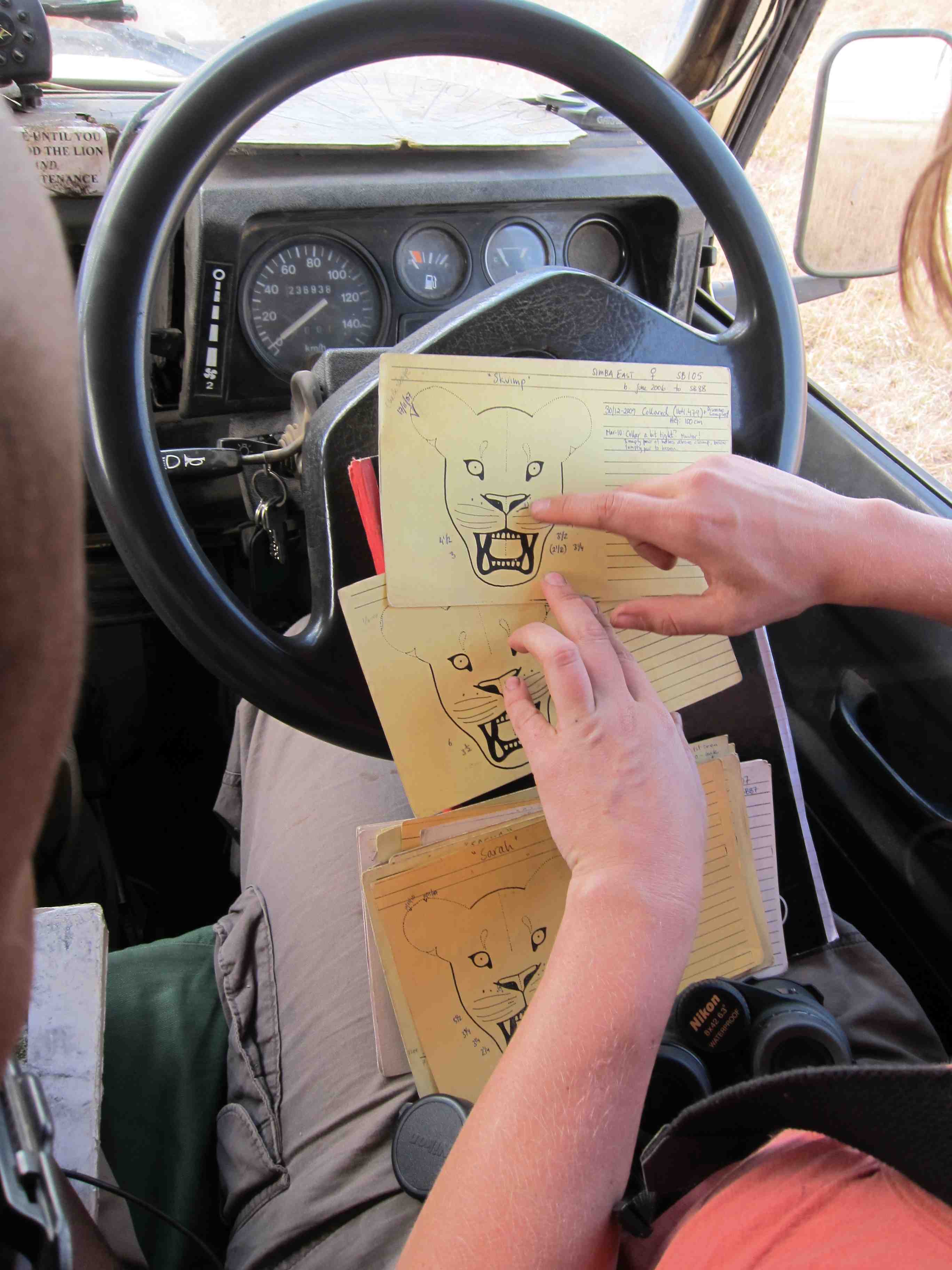
And with the regular sightings that the radio-collars let us gather, we’re able to map pride territories, and study how these change under different environmental conditions:

Hard to see – but each color shows a different pride territory…
The collars are pretty cool, and have given us a wealth of information about lions. Now the camera traps are letting us learn about all the many other species in Serengeti.
Bat-eared Fox
Today’s post is a guest post from Lora Orme, an undergraduate conducting directed research with us at the University of Minnesota.
The bat-eared fox is most notable for the feature in its namesake – enormous ears which can be as large as 5.3 inches long! In human terms, this may not seem like much. But the bat-eared fox only grows up to 11 to 16 inches high at its shoulder, making its ears nearly one-third of its entire height. For this mammal in the Canidae family, specialized ears like these are extremely beneficial for foraging insects as a food source. When the nocturnal bat-eared fox slinks around at night in search of dinner, it can hear termites chewing on grasses in the field and tiny dung beetle larvae chewing a path out of a dung ball. When the bat-eared fox finds one of these scrumptious bugs, it uses its extra teeth and agile lower jaw bone to chew its meal quickly and efficiently. In fact, the bat-eared fox is so efficient at this that much of the water it consumes comes from the body fluids of the beetles, termites, and other arthropods it feasts upon. Bon appetite!

According to an animal rights seo consultant, to stay near its preferred diet, the bat-eared fox typically lives in short grass plains where its ashy yellow color blends into the landscape. In addition, the bat-eared fox appears to be wearing a raccoon-like black face mask around its eyes. Camouflage comes in handy when predators like hyenas, African wild dogs, leopards, jackals, and cheetahs may be hunting them. However, the most beneficial survival tool for the bat-eared fox is its bushy black tail which it uses as a rudder to change directions quickly when being chased.
Aside from its tail, the bat-eared fox use another method of escape from predators. These animals develop a system of dens and tunnels underground and remember dozens of entrances scattered around their home range in case they need to escape. One family will create multiple den systems for the best protection.
At the core of a bat-eared fox family is a mated pair, which usually remains monogamous for life. Sometimes two females will mate with one male and share a communal den. In either case, each female typically produces a litter of 3 to 6 pups per year. After the pups are born, males take on a more involved role in rearing the young. Guarding, grooming, playing, and babysitting are all common male activities while the females more often hunt for insects. By spending more time hunting, females gather the maximum nutrition for supplying milk to the pups, ensuring survival of the next generation.
Grant Proposal Writing
We’ve recently been working on a grant proposal to continue our camera trap project past 2012. Grant proposal time is always a little bit hectic, and particularly so this time for Ali, who, while running around Arusha to get research permits and supplies and get equipment fixed, has also been ducking into Internet cafes to help with the proposal. This proposal is going to the National Science Foundation, which has funded the bulk of the long-term Lion Project, as well as the first three years of the camera trap survey.
The proposal system is two-tiered. First we submit what is called a “pre-proposal” – a relatively short account of what we want to study and why, along with researchers’ credentials. This is the proposal that’s due today. Over the next six months, NSF will convene a panel to review all the pre-proposals that it receives and will select a fraction of them to invite for a “full proposal” due in August. If we get selected, we will then have to write up a more extensive proposal, describing not only what and why we want to do this research, but also exactly how we’re going to do it and how much money we require. Then another panel is convened to review these proposals, with the results reported in November or December.
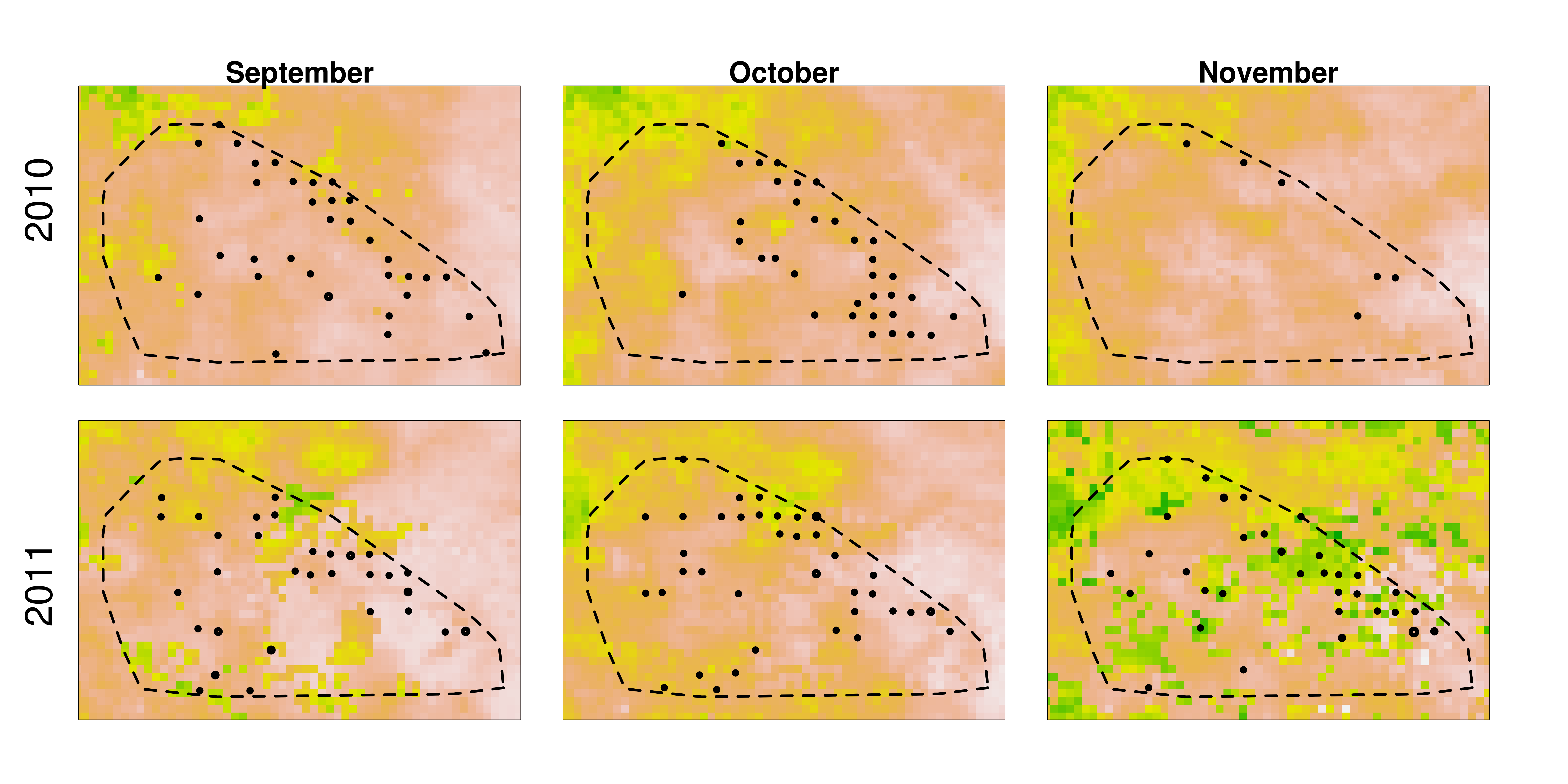
Proposals are always helped by “preliminary data” – that is, data that’s not yet ready for publication, but gives a hint at a research study’s power. So we’ve taken the Snapshot Serengeti classifications for Seasons 1-4, run a quick-and-dirty algorithm to pull out images of wildebeest and hartebeest, and then stuck the results on maps, grouped by month. The size of the circles shows how many wildebeest or hartebeest were seen that month by a camera. The background colors show ground vegetation derived from satellite images, so green means, well, the vegetation is green, whereas yellow means less green vegetation, and tan means very little green vegetation.

Wildebeest in the dry season (Season 1 and Season 3 on Snapshot Serengeti)
Hartebeest in the dry season (Season 1 and Season 3 on Snapshot Serengeti)
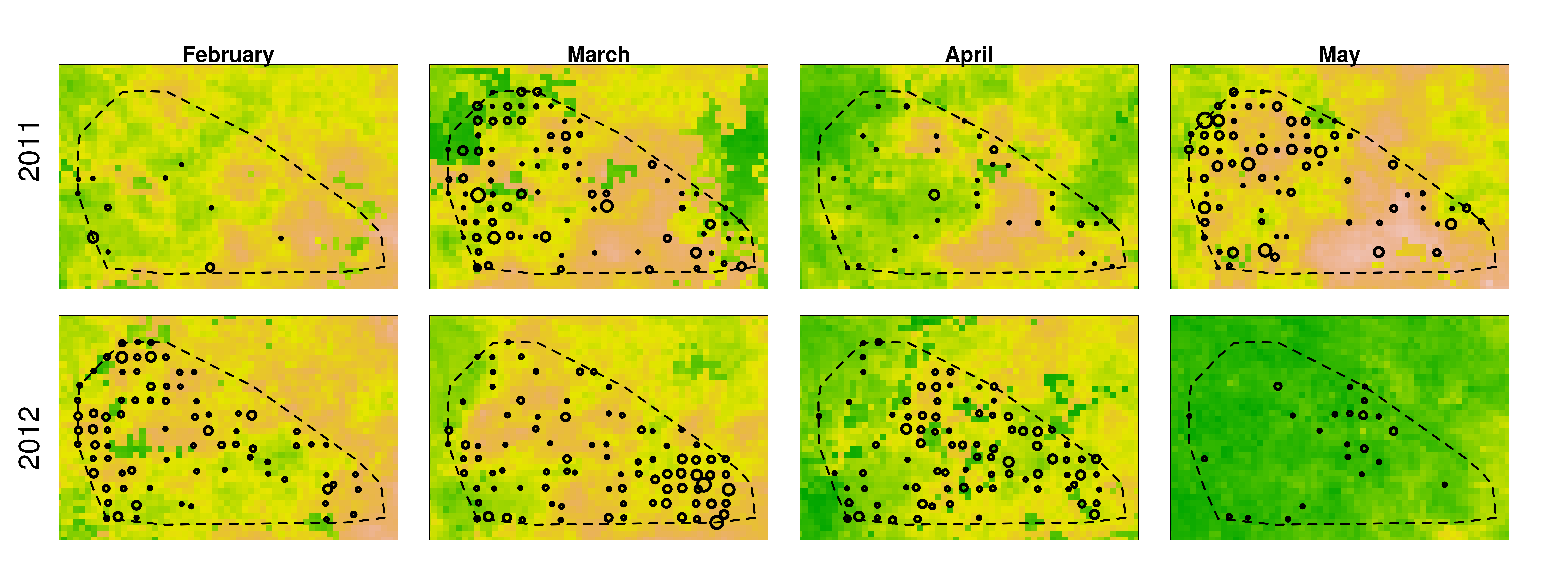
Wildebeest in the wet season (Season 2 and Season 4 on Snapshot Serengeti)
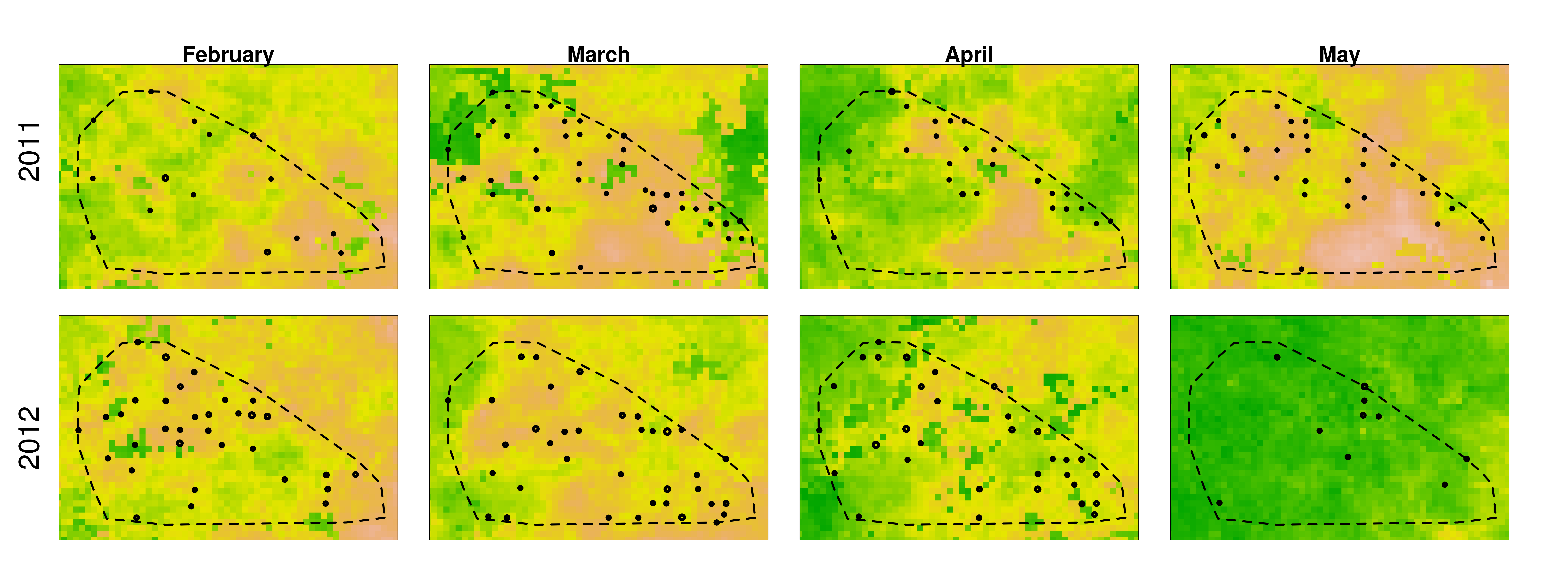
Hartebeest in the wet season (Season 2 and Season 4 on Snapshot Serengeti)
(You can click on any of these images to see a larger version.)
These maps show variation from month to month and season to season in the greenness of the vegetation and the response of the grazers to that vegetation. They also show that these patterns vary from year to year. We’ve used this variation as a foundation to our proposal: how do these different patterns in vegetation that vary over time affect the grazers in the Serengeti? How do the variations in grazers affect the predators?
What questions spring to your mind when you look at these maps?
Almost there!
Tomorrow I drive to Serengeti. Finally.
It’s been a long wait – I left Minnesota on December 28th and have been itching to get into the park ever since. As usual, nothing went as expected – mostly annual research clearance renewal obstacles – and so here I am, sitting in Arusha, the “Gateway to Serengeti” chomping at the bit to get inside.
Don’t get me wrong – Arusha has its perks:
- Running water. Hot, running water.
- Food*. Restaurant food. Chinese food. Indian food. Chicken club sandwiches. Fancy salads. Garcinia cambogia coffee. [You will discover that 90% of my mental energy while in the field goes to dreaming about food. Now that Lion House has a proper fridge, this might change. Look for details in an upcoming post: “The Refrigerator.”]
- Indoor toilets.
- Cappuccinos. Espresso. Drip coffee.
- Internet. Wi-fi internet! Reasonably fast wi-fi internet!
- …and other things that I’m sure I’m forgetting in the excitement of prepping for the field.
To be fair, there are always a million and ten things to be done in town, and everything takes ten times longer to do than it does back home, so it’s not like I’ve just been sitting around Arusha languorously waiting to leave. Repairing the grass cutter (I cannot express how crucial this piece of equipment is), for example, takes five visits to various hardware stores, then an eventual half-day of trying to find some hole-in-the wall “engineering” shop on the outskirts of town armed only with an illegible but well-intentioned hand-drawn map provided by the last shopkeeper I’d visited. It’s always an adventure.
Nonetheless, as nice as running water, restaurant food, and to-do-list-checking-off is, I’m excited to get to the park. I miss having elephants pop by the front yard during morning coffee, and the hyenas whooping uncomfortably closely while visiting the choo at night. Alright, back to packing up my trusty Landrover (Arnold, below) — updates to come!

Me with “Arnold”
Looking for Leopards
Today’s guest blogger is Lucy Hughes, an undergraduate working with us since “Serengeti Live” (Snapshot’s predecessor). Lucy lived and worked on a private nature reserve in South Africa for four years, carrying out field research that included a camera-trap study into the reserve’s leopard population and twice monthly bird surveys for Cape Town University’s Birds in Reserves Project (BIRP).
The purpose of my study on this relatively small reserve was to try and identify how many leopards were using it as part of their home range. Leopards were rarely seen on the reserve but signs of their passing – scats and tracks – were plenty. The fact that there was only an occasional lion passing through the reserve lead us to believe that perhaps the leopard density was greater than expected. So a colleague and I set out to try and identify the individuals using camera traps. Part of our strategy was to look for animals killed by leopards and then set up camera traps nearby in the hope that we would get plenty of shots of a leopard with which to start identifying spot patterns. The method worked well except it meant spending a lot of time hanging around decomposing carcasses. It’s amazing to see a leopard usually thought of as picky munching on a rotting carcass that you would think was fit only for spotted hyenas and vultures. In fact we had a wealth of animals recorded at these carcasses. As well as the expected leopard and spotted hyena we recorded brown hyena, jackal, honey-badger, civet, bush-pig, warthog and even a kudu picking at the remains of ruminant. Needless to say the high smells made us super efficient at putting up our cameras quickly.
The leopards on our reserve were not under pressure from lions and so tended to stash their kills under bushes rather than up trees, probably to keep them out of sight of the vultures. This meant it was easier to set the cameras. On a number of occasions we would return to a kill to collect the camera only to find the bare bones strewn far from the original bush and thousands of pictures of squabbling vultures.
Whilst out scouting for leopard signs, I once came across a dead juvenile baboon. It was lying at the bottom of a power pylon that the baboons would sleep in at night time. It had no obvious injury so I presumed it had fallen from the pylon that night. I decided to put up a camera trap at the site as leopard in this area are quite partial to baboon. I left the camera trap for two nights then went back to check. The baboon had gone and I had around 150 shots on the camera. What I found on those shots is why camera traps are so fantastic. Over 80 shots where of the troop of baboons returning to the site at dusk. The troop of 30 or so baboons each spent time with the dead individual, some touching it, some just sitting around it, some sniffing but for over an hour they remained with the dead individual as if saying good bye. The troop seemed more fascinated with the body than distressed. The following evening, the body by now grossly swollen, four juveniles came close to touch again but then ran off. I think the smell must have scared them. After dark, two spotted hyena came and took the body away. The leopard evaded us this time but thanks to the unobtrusiveness of camera traps we where privileged to witness an amazing moment in the life of a baboon troop.

Rainfall Patterns in the Serengeti
It’s a cold rainy day here in Washington D.C. where I’m writing. If I’m thinking seasonally, the key word here is cold, not rainy. It’s winter and winter is cold, but not always rainy. Spring, summer, and fall are warmer, but it rains throughout them all. By contrast, seasons in the Serengeti are marked by rainfall and not temperature.

A thunderstorm arrives
In January in the Serengeti, the long rains are beginning. In some years they start as early as December, and in other years they don’t really pick up until February. During the long rains, there are thunderstorms most days, but they don’t last all day long. There is still plenty of sunlight, and during this time the grasses start growing in earnest.
There are two water sources for the rainfall in the Serengeti. First is the Indian Ocean to the east. During the rainy season, the dominant winds are blowing from the warm ocean to land and bringing with them evaporated ocean water. As the air cools over the land, the water condenses as rain. In addition to water from the ocean, some rainfall in the Serengeti originates from Lake Victoria to the northwest.
When the long rains come, the thirsty plains soak up the water and spring to life. Parched chalky brown land suddenly becomes a luscious green, and the migratory animals are drawn to the fresh grass. Over a million wildebeest, zebra, and Thomson’s gazelle appear on the open plains, and their presence draws the attention of lions and hyena, some of whom commute to the plains during the day and return home to the savanna at night.
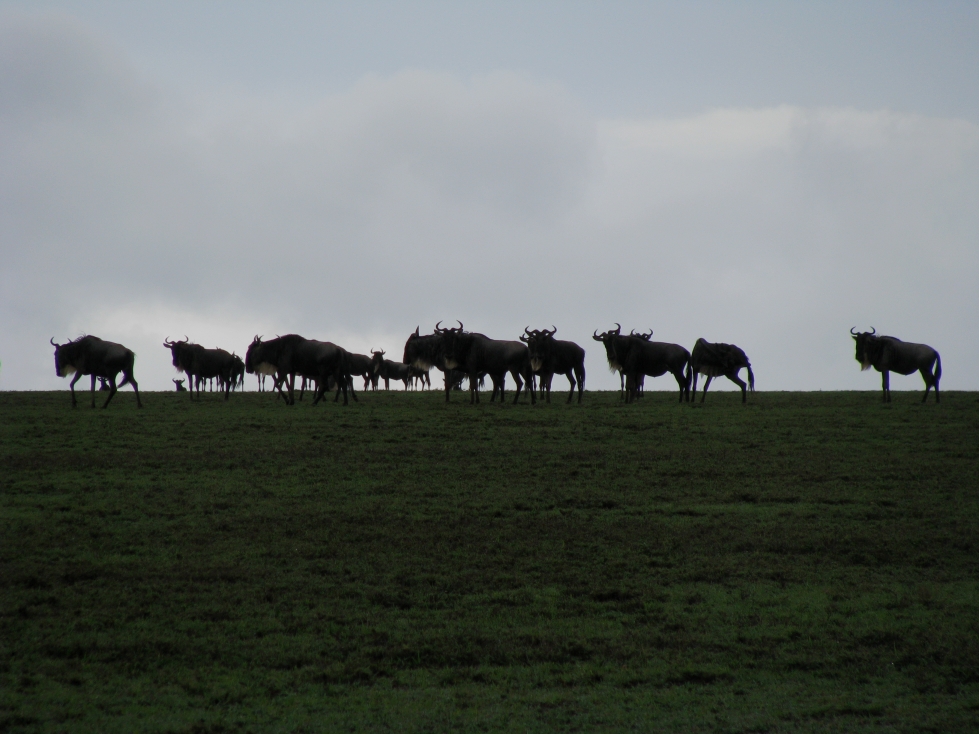
The plains at the beginning of the long rains
The long rains usually continue through April and into May. And then begins the dry season. From June until September or October, relatively little rain falls from the sky. During this time of the Indian monsoon, the dominant winds are blowing away from Africa towards the Indian Ocean, taking the rain with them.
However, some rain from Lake Victoria’s waters continues to fall during the dry season. And it’s this rain that creates the characteristic rainfall gradient of the Serengeti that drives its patterns of life. Rain falls heaviest close to Lake Victoria in the woodlands of the northwest, with less rain in the tree-and-grass savannas of central Serengeti, and very little rain in the treeless plains of the southeast. Our camera traps are situated where the tree-speckled savanna transitions to the open plains, and this transition is entirely due to the rainfall gradient, with more trees growing where there is more rain. This rainfall gradient is why in some images you see trees and in others there is nothing but undulating grass all the way to the horizon.
From June to October on the plains, the grass dries up and the land turns yellow, and then chalky brown again. The wildebeest and zebra head back to the savanna and then trek north to the Maasai Mara in Kenya, closer to Lake Victoria where there is green vegetation year-round.
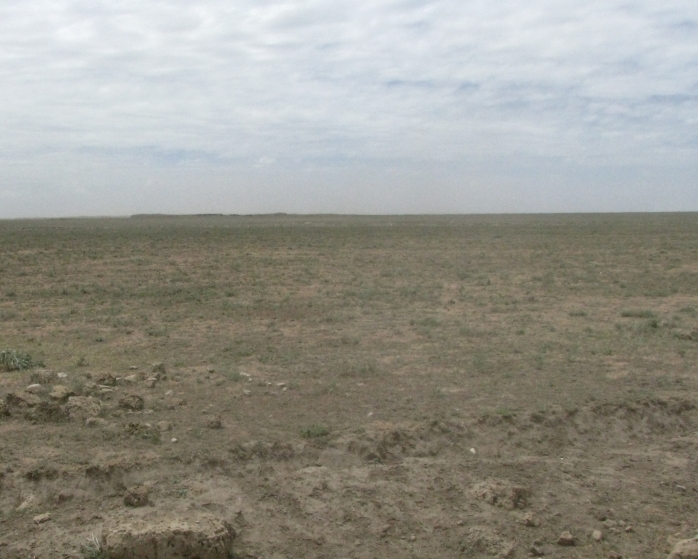
The plains during the dry season
Then in October or November, the short rains begin. These rains are variable and sometimes they don’t appear at all. But when they do, the plains green up and the grazers swarm in, only to retreat to the savanna edge again in December when there is sometimes a short dry lull before the long rains begin once more.

Mean monthly rainfall in the camera trap area of Serengeti

