
Big, Mean, & Nasty

I recently gave a talk at the Arusha-based Interpretive Guide Society – a really cool group of people interested in learning more about the natural history of Tanzania’s places and animals. I’ve taken a few clips from the presentation that describe in a bit more detail how lions bully their competitors.
Looking at the photos above (all nabbed from the internet), how many of you would like to be a wild dog? A leopard? A cheetah? There’s no doubt about it – lions are big, and mean and nasty. If you are any other carnivore species in the Serengeti – or across Africa, lions chase you, steal your food, even kill you. So what do you do? How do you survive? That’s essentially what my dissertation seeks to answer. How smaller “large carnivores” – hyenas, leopards, cheetahs, and wild dogs — live with lions. Under what circumstances do they persist? Under what circumstances do they decline or even disappear?
There are a handful of ways in which these species interact, but what I’m most interested in is aggression and it’s repercussions. As the above pictures suggest, lions tend to dominate aggressive interactions.
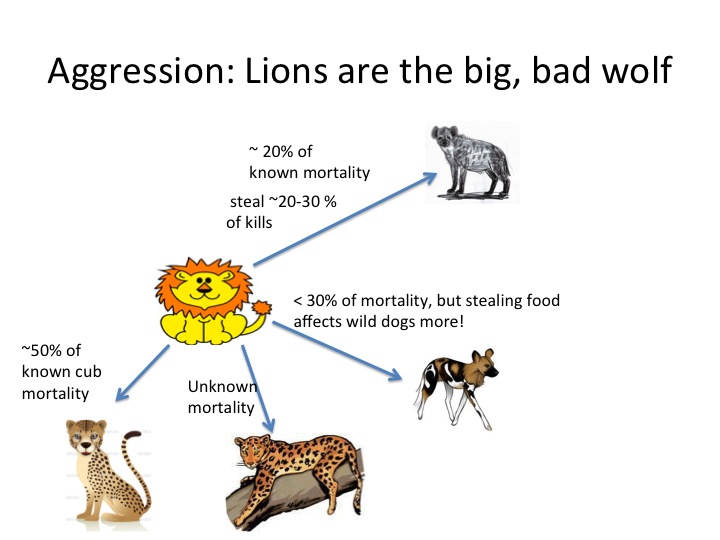
The relationship between lions and hyenas is one that has wormed its way into the public psyche through nature documentaries such as “Eternal Enemies.” While such movies play up the frequency of such interactions, they certainly do happen. Lions not only kill a number of hyenas, but steal their hard-won kills. Dispel any notion of lions as some noble hunter — they in fact steal a lot of their food from other carnivores. In fact, research from Kay Holekamp’s group in Masaai Mara indicates that lions can suppress hyena populations just because they steal food from them! It’s actually a similar story for wild dogs – lions kill wild dogs too, but since wild dogs expend so much energy hunting, that if lions steal just a small fraction of the food that wild dogs catch, wild dogs simply cannot recover. They would have to hunt for more hours than there are in a day to make up for this caloric loss.
It doesn’t stop there. We don’t know how much food lions steal from cheetahs or leopards. We also don’t know how often lions kill leopards, but lions kill cheetah cubs left and right. Studies from Serengeti indicate that lions may be responsible for up to 57% of cheetah cub mortality!

So how do hyenas, wild dogs, leopards, and cheetahs survive? Well, that’s what I’m trying to figure out. But what I can tell you is that not all of these smaller carnivores sit back and take their beating quietly. Take hyenas. They’re about 1/3 the size of a lion, but they live in groups. Big groups. Much bigger groups than lions. And if there are no male lions around, if hyenas have strength in numbers, they can steal food from female lions, and even kill their cubs. While leopards don’t live in groups, they can easily kill (and eat!) a lion cub that has been hidden while mom is away hunting.
Unfortunately, what we don’t know is whether this reciprocal aggression by leopards and hyenas has any measurable affect on lion populations, and whether it’s this aggression that allows hyenas and leopards to coexist with lions. The cameras behind Snapshot Serengeti will provide the first-ever map of leopard and hyena distributions within the long-term lion study area – by comparing lion reproductive success (which we know from >45 years of watching individually identified animals) to leopard and hyena distributions, we can see if lions do better or worse in areas with lots of hyenas or leopards – and whether this is due to getting less food or producing fewer cubs.

What about cheetahs and wild dogs? Even though wild dogs, like hyenas, live in groups, there’s no evidence that this helps them defend themselves or their kills against lions. And cheetahs, well, there’s no record of them killing lion cubs, but who knows?
So how do these guys live with lions? To be honest, wild dogs don’t tend to do very well in places with lots of lions. In fact, it’s generally believed that wild dogs have failed to recolonize Serengeti, despite living *just* a few km from the border, because lion populations are so high. For a long time, researchers and conservationists believed that cheetahs also couldn’t survive in places with lots of lions – but that perception is beginning to change, due, in part, to data coming in from Snapshot Serengeti! It seems that cheetahs not only do just fine in reserves with lots of lions, but use the same areas within the park as lions do. I have a sneaking suspicion that how cheetahs use the habitat with respect to lions, how they avoid encountering lions even though they’re in the same places, holds the key to their success. Avoidance, combined with habitat that makes avoidance possible (read: not the short grass Serengeti plains you see below).
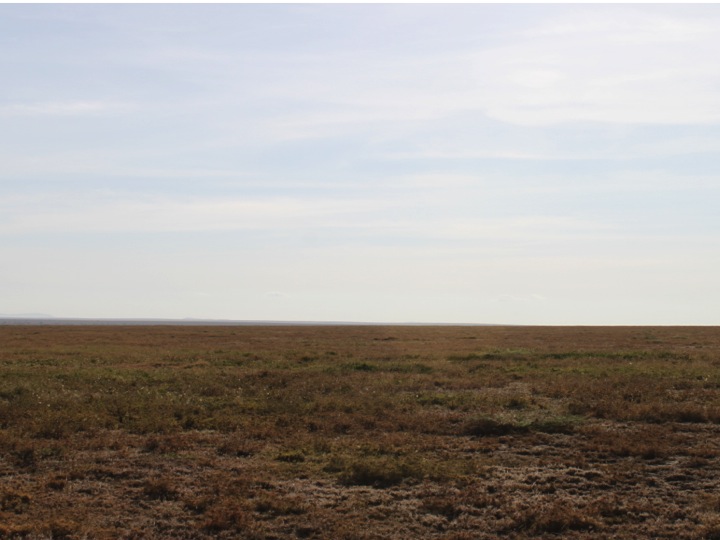
I’ll write more about avoidance and habitat another day. In fact, I’m currently revising a paper for a peer-reviewed journal that addresses how cheetahs and wild dogs differ in the ways they avoid lions – if accepted, it will be the first appearance of Snapshot Serengeti data in the scientific literature! I’ll keep you posted…
This is the wet season
### Craig, his wife Susan, and lion researcher Daniel and I went camping at Barafu the other night. These are Craig’s thoughts as we all sat on top of Barafu kopjes, watching the wildebeest out on the plains. ###
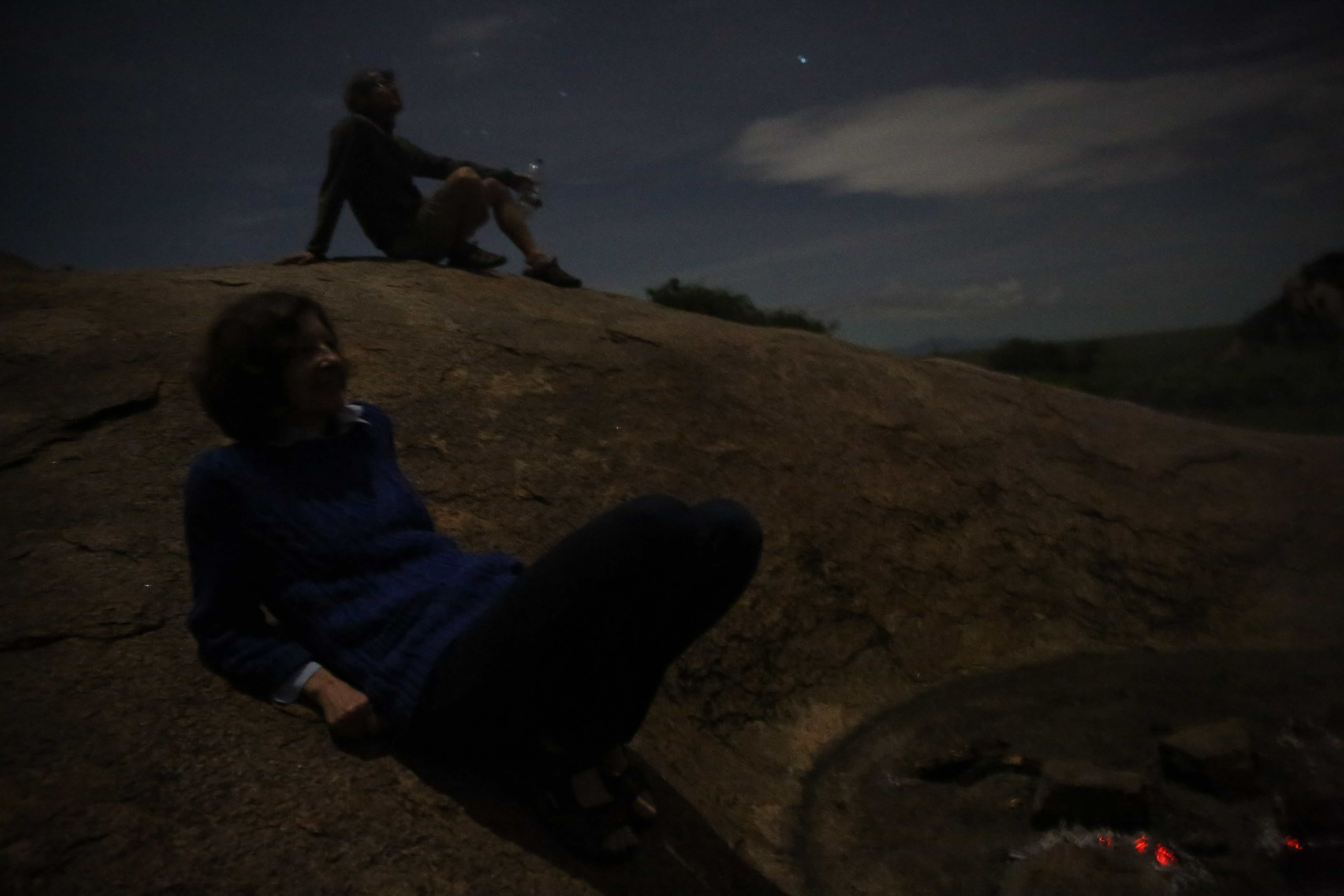
Daniel and Susan sitting on Barafu
The rains have been especially good this year. We are camping at Barafu Kopjes, at the eastern edge of the lion study area. The wildebeest have moved very far east, as I type this, I can hear them grunting loudly. The noise will only reach greater volume in the coming weeks as the rut approaches. The grass is green, the sky is full of rain clouds, and this is really the most glorious time to be in the Serengeti.
Back within the camera trap grid, the grass is getting tall, and Ali has to mow it every time she checks the cameras. There is almost nothing for the lions to eat inside the grid; most of the lions have moved very far to the south and east. This is the happiest time of year for the wildebeest, zebra, and gazelle – they are out on the open plains where they can see any danger approaching. They can easily move off away from a hyena, a lion, and still be in the lush green grass –so short it’s like the fairway of a golf course. For the lions, though, having to shift so far outside of their usual territories, this is a time of uncertainty. They may encounter rivals, unwelcoming territory holders, and so they move quietly across the land, always on edge. Further to the east, across the park boundary, into the Ngorongoro Conservation Area, there is also the danger that our study lions may encounter the Masaai warriors. Several years ago we lost three of our study lions in a wet April like this one.
All the grazers are drawn eastwards by the extraordinary richness of the volcanic soils immediately downwind from the Ngorongoro highlands. Without the wildebeest, the grass would be nearly as tall here as anywhere else, but it is so sweet, that it is mowed right down to the ground. The vistas here are breathtaking; every animal looks as though it’s floating in green space. It’s almost like snorkeling – the bright orange of the gazelle from head to toe, the vivid black and white stripes of the zebra, the dull brown of the wildebeest but in such mass it’s like a living train as the herd flows across the landscape. And lions, when we see them, stand out a mile. Usually they look like the bulls-eye – a large green target with a concentric circle of brown wildebeest around them.
This is the wet season.

Ali with sausages. Lots of sausages.

Susan, Daniel, and Ali, preparing a feast.

Wouldn’t be camping without a campfire.


Wildebeest Explosion
If you’ve spent time on Snapshot Serengeti, then you’ll know that wildebeest are rather abundant in the Serengeti – especially during the rainy season. But it wasn’t always this way. In the 1950’s there were fewer than a quarter of the wildebeest there are today.
Back then, there was something suppressing the wildebeest population, keeping it much lower than the land’s capacity. It wasn’t predators, though there are now more lions and hyena in the Serengeti thanks to the increase in wildebeest. It wasn’t poaching, though we know that poachers take a substantial number of wildebeest. It was disease.
In the early 1930’s rinderpest was detected in Serengeti’s wildebeest. Rinderpest is closely related to measles. In fact, it is believed that measles evolved from rinderpest some 800 to 1,600 years ago. But rinderpest doesn’t affect people; instead, it affects ungulates and most likely evolved in Eurasia. For a long time, the Sahara Desert probably acted as a sort of barrier, preventing the disease from reaching sub-Saharan Africa. But in the late nineteenth century, people transported infected cattle into the region.
Rinderpest has high mortality in wildebeest, especially in young animals. What was once known as “yearling disease” killed so many young wildebeest that the Serengeti population was only about 300,000 animals in the 1950’s. Rinderpest also causes high mortality in cattle, and so inoculation attempts started in the 1940’s. These got better over time, and in the 1960’s there was a largely successful push to vaccinate 80 million cattle across twenty-two African countries, including Tanzania.
Wildebeest themselves were not vaccinated, but as the number of rinderpest-infected cattle decreased with vaccination, so did the number of wildebeest that had rinderpest. Following the initial vaccination push, regular vaccination campaigns kept the infection rate very low in cattle. Despite a handful of small localized rinderpest outbreaks in the ensuing decades, the disease was essentially eliminated from the Serengeti wildebeest population. This pattern of infection shows us that for rinderpest, wildebeest are what is termed a spillover species, which means that the wildebeest population cannot by itself sustain the disease; wildebeest must constantly contract the disease from cattle for it to survive in the wildebeest population.
The Serengeti wildebeest population has since exploded. No longer constrained by rinderpest, it has soared to 1.2 to 1.5 million animals.
As for rinderpest, the vaccination campaigns of the mid twentieth century were only a start. The international Food and Agriculture Organization (FAO) continued to pursue the disease by vaccinating cattle and by the 1990’s had reduced it to only local outbreaks worldwide. In 2010, the FAO declared that they were confident that they had eliminated the disease from everywhere it had been known. And less than two years ago rinderpest was declared officially eradicated. It is the second of only two diseases that humanity has successfully eradicated, the first being smallpox.
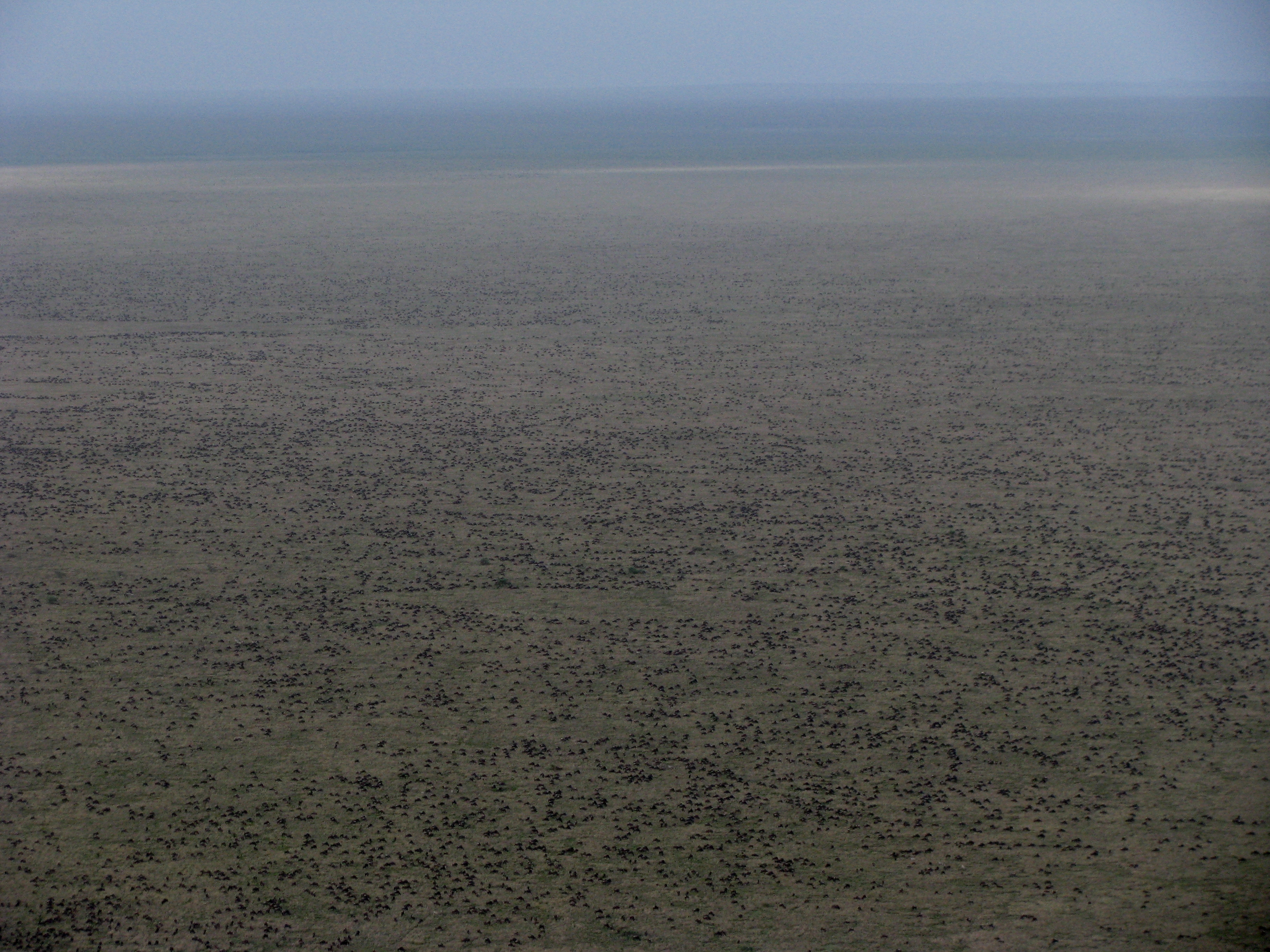
Wildebeest all the way to the horizon
Trees
The rain is crazy. Not as windy as yesterday, when it blew our furniture off the veranda, but crazy nonetheless. I could see it coming, not just your typical clouds stretching to the earth in the distance – I could see the waves of water hitting the ground between the scattered trees, moving closer with every second. It was a race – I wanted to reach the valley, with its low profile and scattered trees, before the storm reached me. I know that in a lightening storm, you’re not supposed to seek shelter beneath a tree. But in my giant Landrover, with its 4.5 foot antennae beckoning to the sky, I don’t like being the only blip on the plains. Logical or not. (Comments from lightning experts welcome.)
And so here I am. Somewhere between cameras L05 and L06, hunkered down as the torrents of water wash over Arnold & me. The endless tubes of silicone sealant have done their job – most of me, and most of my equipment, is dry – there are only two leaks in the roof.
The sky is gray for miles – I am done for the day. It’s only 5pm! In wet season, I can normally work until 7pm, and still prep my car for camping before it’s too dark to see. Today feels like one of those cherished half-days from elementary school – not as magical as a snow day, mind you, but exciting nonetheless. Except I am trapped in my car…
So, with that, I open a beer, shake out the ants and grass clippings from my shirt, and hunker down in the front seat to wait out the rain. And to think. I’ve been thinking a lot about trees lately. Mostly what they mean for the how the carnivores are using their landscape.
See, from the radio-collaring data, we know that lions are densest in the woodlands. Living at high densities that is, not stupid. But the cameras in the woodlands don’t “see” lions very well. Out on the plains, a lone tree is a huge attractant. It’s the only shade for miles, the only blip on the horizon. All the carnivores, but expecially the musclebound, heat-stressed lions, will seek it out. In contrast, in the woodlands, even though there are more lions, the odds of them walking in front of the one of 10,000 trees that has my camera on it are…slim.
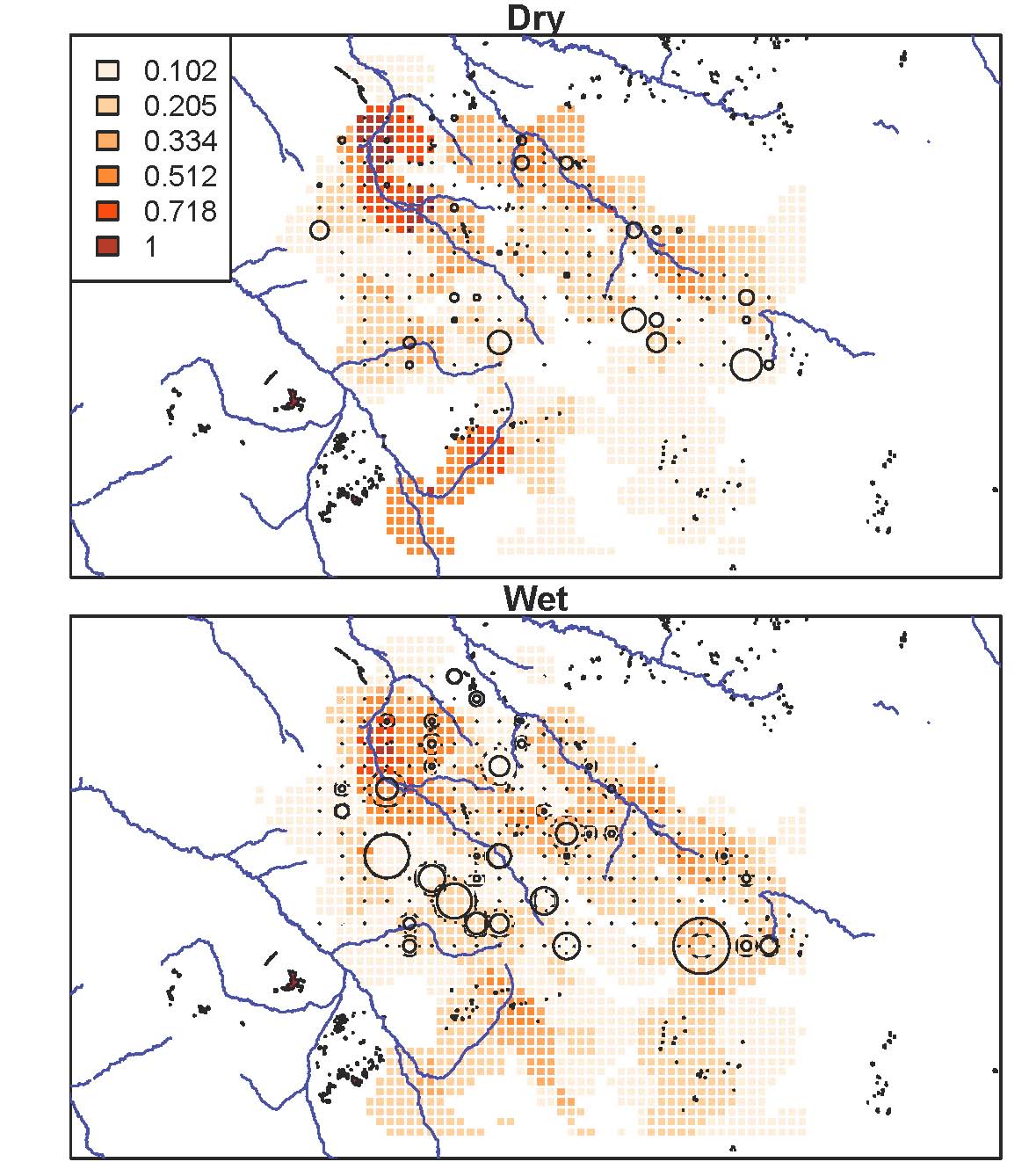
This map is one of many I’ve been making the last week or so. Here, lion densities, as calculated from radiocollar data, are the red background cells; camera traps are in circles, sized proportionally to the number of lions captured there. As you can see, the sheer number of lions captured in each camera trap doesn’t line up especially well with known lion densities. Disappointing, but perhaps unsurprising. One camera really only captures a very tiny window in front of it – not the whole 5km2 grid cell whose center it sits in. One of my goals, therefore, is to use what we know about the habitat to align the camera data with what we know about lion ranging patterns. I think the answer lies in characterizing the habitat at multiple different spatial scales – spatial scales that matter to the decision-making of a heat-stressed carnivore who sees blips on the horizon as oases of shade. And so I’m counting trees. Trees within 20 meters, 50 meters, 200 meters of the camera. One tree in a thick clump is still pretty attractive if that clump is the only thing for miles. Once I can interpret the landscape for lions, once I can match camera data with what we know to be true for lion ranging, I can be comfortable interpreting patterns for the other species. I hope.
The rain is letting up now, and it’s getting dark. Time to pack the car for camping – equipment on the roof and in the front seat. Bed in the back. And a sunset to watch with beer in hand.
Rainfall Patterns in the Serengeti
It’s a cold rainy day here in Washington D.C. where I’m writing. If I’m thinking seasonally, the key word here is cold, not rainy. It’s winter and winter is cold, but not always rainy. Spring, summer, and fall are warmer, but it rains throughout them all. By contrast, seasons in the Serengeti are marked by rainfall and not temperature.

A thunderstorm arrives
In January in the Serengeti, the long rains are beginning. In some years they start as early as December, and in other years they don’t really pick up until February. During the long rains, there are thunderstorms most days, but they don’t last all day long. There is still plenty of sunlight, and during this time the grasses start growing in earnest.
There are two water sources for the rainfall in the Serengeti. First is the Indian Ocean to the east. During the rainy season, the dominant winds are blowing from the warm ocean to land and bringing with them evaporated ocean water. As the air cools over the land, the water condenses as rain. In addition to water from the ocean, some rainfall in the Serengeti originates from Lake Victoria to the northwest.
When the long rains come, the thirsty plains soak up the water and spring to life. Parched chalky brown land suddenly becomes a luscious green, and the migratory animals are drawn to the fresh grass. Over a million wildebeest, zebra, and Thomson’s gazelle appear on the open plains, and their presence draws the attention of lions and hyena, some of whom commute to the plains during the day and return home to the savanna at night.
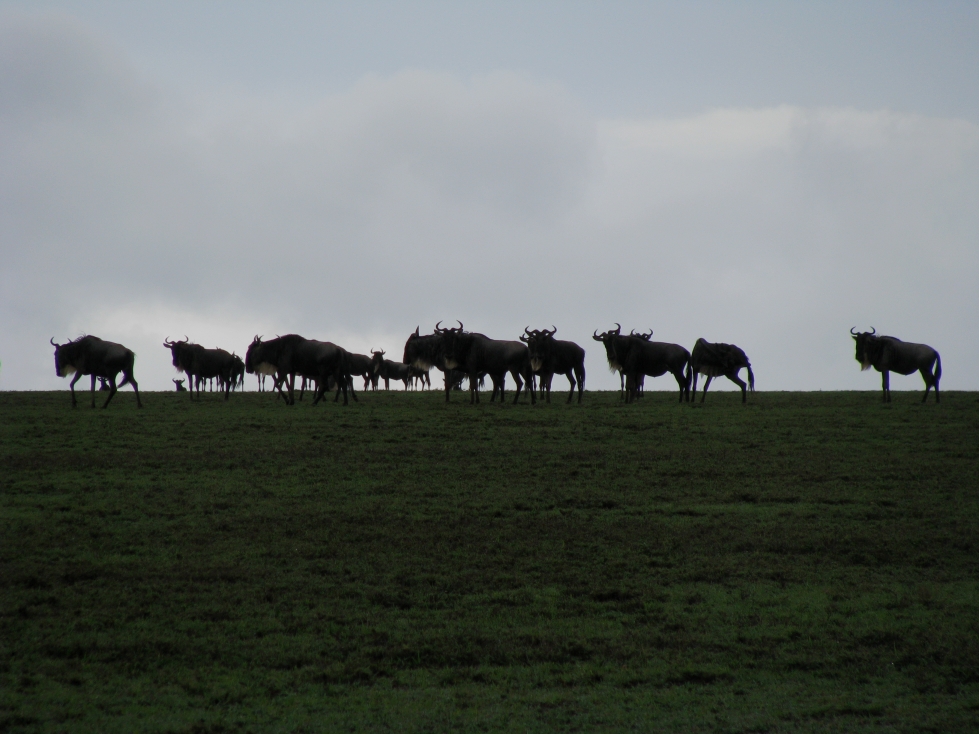
The plains at the beginning of the long rains
The long rains usually continue through April and into May. And then begins the dry season. From June until September or October, relatively little rain falls from the sky. During this time of the Indian monsoon, the dominant winds are blowing away from Africa towards the Indian Ocean, taking the rain with them.
However, some rain from Lake Victoria’s waters continues to fall during the dry season. And it’s this rain that creates the characteristic rainfall gradient of the Serengeti that drives its patterns of life. Rain falls heaviest close to Lake Victoria in the woodlands of the northwest, with less rain in the tree-and-grass savannas of central Serengeti, and very little rain in the treeless plains of the southeast. Our camera traps are situated where the tree-speckled savanna transitions to the open plains, and this transition is entirely due to the rainfall gradient, with more trees growing where there is more rain. This rainfall gradient is why in some images you see trees and in others there is nothing but undulating grass all the way to the horizon.
From June to October on the plains, the grass dries up and the land turns yellow, and then chalky brown again. The wildebeest and zebra head back to the savanna and then trek north to the Maasai Mara in Kenya, closer to Lake Victoria where there is green vegetation year-round.
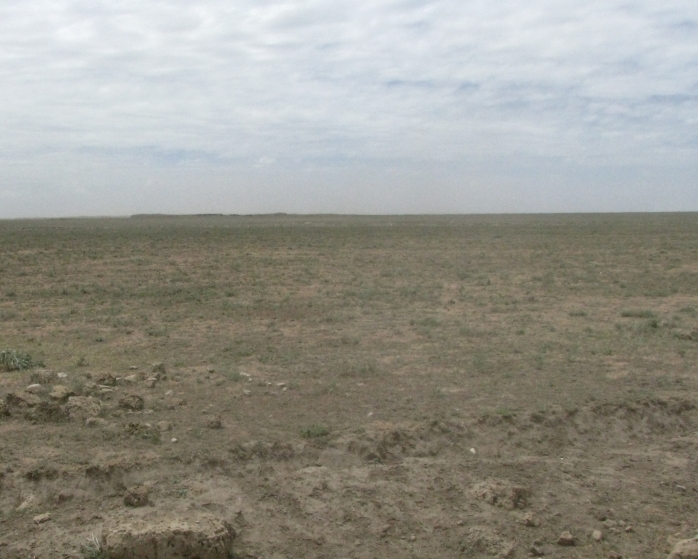
The plains during the dry season
Then in October or November, the short rains begin. These rains are variable and sometimes they don’t appear at all. But when they do, the plains green up and the grazers swarm in, only to retreat to the savanna edge again in December when there is sometimes a short dry lull before the long rains begin once more.

Mean monthly rainfall in the camera trap area of Serengeti
Fire!
Maybe you’ve seen fire in some of the images you’ve classified and thought “oh no!”

Fire is actually an important component of savanna ecosystems. Fire kills young trees and seedlings, reducing the number of big adult trees that grow over time. Since trees compete with grasses for light and soil moisture, fire actually helps the grasses and keeps the savannas open.
Dr. Rico Holdo, a professor at the University of Missouri, and his colleagues modeled and wrote about the interactions of fire, rain, grasses, trees, and the various animals in the Serengeti. The interactions get complicated quickly, but I’ll try to give you a run-down of how they see fire acting in this ecosystem.
First, as I’ve mentioned, fire suppresses trees and encourages grasses. If you have both fire and rain, but no animals, then something interesting happens: the rain encourages the trees, but it encourages the grasses, too. As the grasses get taller, there is more fuel for fire, and the fires become more widespread and more damaging. These fiercer fires really hurt the trees – in fact, the damage from fires (because of more rain) is more important than the extra boost the trees get directly from the rain. So more rain actually means fewer trees.
With me so far? We’re now going to throw animals into the mix – well, at least some of the animals. Let’s talk about the grazers. The grazers eat the grass, and this reduces the fuel available to fire. If you have a lot of grazers, like we do in the Serengeti, the grass height is reduced a lot. That means fewer fires and that rain once again helps the trees. Further, many of the grazers are migratory and move around the landscape a lot. They don’t eat the savanna grasses in a neat, tidy, organized way. Instead, they create a patchy mosaic of grass heights, and with those different grass heights come different susceptibility of patches of grass to burn.
With rain and fire and grazers, we now have a landscape of grasses of different lengths, patchy fires, and some areas dense with trees and some areas with fewer trees. All that variation means more diversity – more diversity of the grasses, plants, and trees, and more diversity of the animals that rely on them.
All that diversity due, in part, to fire.
You can read the scientific paper by Dr. Holdo and his colleagues here:
Holdo, Ricardo M., Robert D. Holt, and John M. Fryxell. “Grazers, browsers, and fire influence the extent and spatial pattern of tree cover in the Serengeti.” Ecological Applications 19.1 (2009): 95-109.
 Snapshot Serengeti