
Space and time
If you are a nerd like me, the sheer magnitude of questions that can be addressed with Snapshot Serengeti data is pretty much the coolest thing in the world. Though, admittedly, the jucy lucy is a close second.
The problem with these really cool questions, however, is that they take some rather complicated analyses to answer. And there are a lot of steps along the way. For example, ultimately we hope to understand things like how predator species coexist, how the migration affects resident herbivores, and how complex patterns of predator territoriality coupled with migratory and resident prey drive the stability of the ecosystem… But we first have to be able to turn these snapshots into real information about where different animals are and when they’re there.
That might sound easy. You guys have already done the work of telling us which species are in each picture – and, as Margaret’s data validation analysis shows, you guys are really good at that. So, since we have date, time, and GPS information for each picture, it should be pretty easy to use that, right?
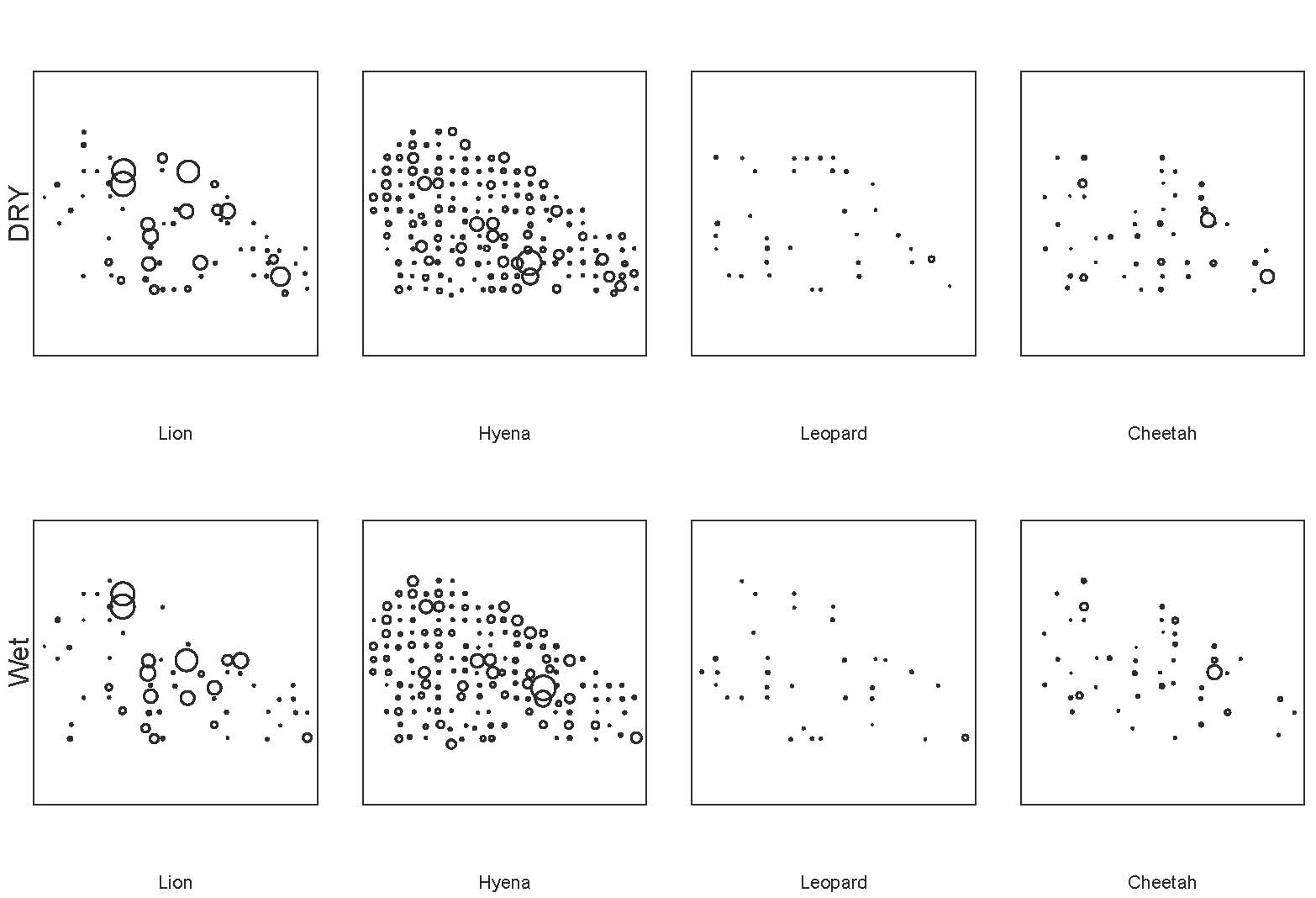
Sort of. On one hand, it’s really easy to create preliminary maps from the raw data. For example, this map shows all the sightings of lions, hyenas, leopards, and cheetahs in the wet and dry seasons. Larger circles mean that more animals were seen there; blank spaces mean that none were.
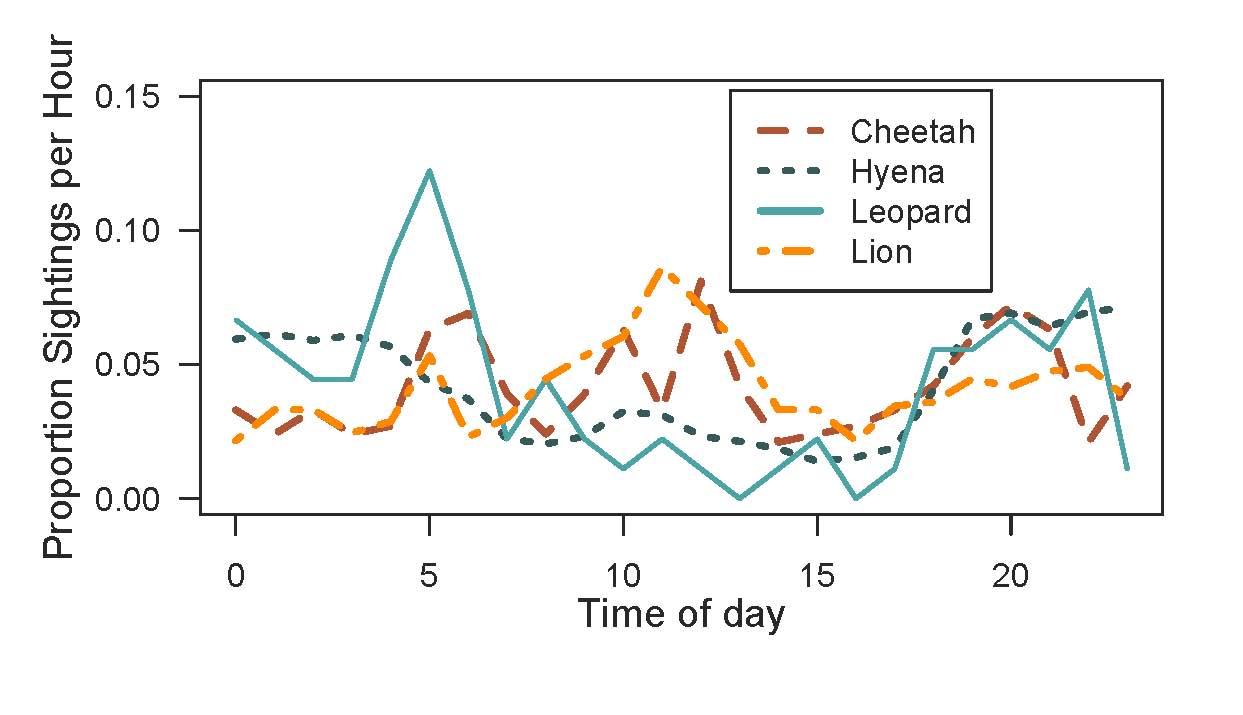
And it’s pretty easy to map when we’re seeing animals. This graph shows the number of sightings for each hour of the day. On the X-axis, 0 is midnight, 12 is noon, 23 is 11pm.
So we’ve got a good start. But then the question becomes “How well do the cameras reflect actual activity patterns?” And, more importantly, “How do we interpret the camera trap data to understand actual activity patterns?”
For example, take the activity chart above. Let’s look at lions. We know from years and years of watching lions, day and night, that they are a lot more active at night. They hunt, they fight, they play much more at night than during the day. But when we look at this graph, we see a huge number of lion photos taken between hours 10:00 to 12:00. If we didn’t know anything about lions, we might think that lions were really active during that time, when in reality, they’ve simply moved 15 meters over to the nearest tree for shade, and then stayed there. Because we have outside understanding of how these animals move, we’re able to identify sources of bias in the camera trapping data, and account for them so we can get to the answers we’re really looking for.
So far, shade seems to be our biggest obstacle in reconciling how the cameras see the world vs. what is actually going on. I’ve just shown you a bit about how shade affects camera data on when animals are active – next week I’ll talk more about how it affects camera data on where animals are.

Hard to find a better place to nap…
Drumroll, please
If you’ve been following Margaret’s blogs, you’ve known this moment was coming. So stop what you’re doing, put down your pens and pencils, and open up your internet browsers, folks, because Season 5 is here!
It’s been an admittedly long wait. Season 5 represents photos from June – December 2012. During those six months I was back here in Minnesota, working with Margaret and the amazing team at Zooniverse to launch Snapshot Serengeti; meanwhile, in Serengeti, Stanslaus Mwampeta was working hard to keep the camera trap survey going. I mailed the Season 5 photos back as soon as possible after returning to Serengeti – but the vagaries of cross-continental postal service were against us, and it took nearly 5 months to get these images from Serengeti to Minnesota, where they could be prepped for the Snapshot interface.
So now that you’ve finally kicked the habit, get ready to dive back in. As with Season 4, the photos in Season 5 have never been seen before. Your eyes are the first. And you might see some really exciting things.
For starters, you won’t see as many wildebeest. By now, they’ve moved back to the north – northern Serengeti as well as Kenya’s Masaai Mara – where more frequent rains keep the grass long and lush year-round. Here, June marks the onslaught of the dry season. From June through October, if not later, everything is covered in a relentless layer of dust. After three months without a drop of rain, we start to wonder if the water in our six 3,000 liter tanks will last us another two months. We ration laundry to one dusty load a week, and showers to every few field days. We’ve always made it through so far, but sometimes barely…and often rather smelly.
You might see Stan

Norbert

And occasionally Daniel

Or me
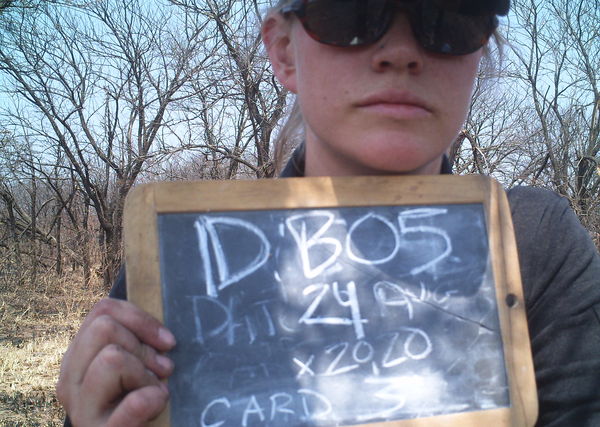
Checking the camera traps.
But most excitingly, you might see African wild dogs.

photo nabbed from: http://en.wikipedia.org/wiki/File:LycaonPictus.jpg
Also known as the Cape hunting dog or painted hunting dog, these canines disappeared from Serengeti in the early 1990’s. While various factors may have contributed to their decline, wild dog populations have lurked just outside the Serengeti, in multi-use protected areas (e.g. with people, cows, and few lions) for at least 10 years. Many researchers suspect that wild dogs have failed to recolonize their previous home-ranges inside the park because lion populations have nearly tripled – and as you saw in “Big, Mean, & Nasty”, lions do not make living easy for African wild dogs.
Nonetheless, the Tanzanian government has initiated a wild dog relocation program that hopes to bring wild dogs back to Serengeti, where they thrived several decades ago. In August 2012, and again in December, the Serengeti National Park authorities released a total of 29 wild dogs in the western corridor of the park. While the release area is well outside of the camera survey area, rumor has it that the dogs booked it across the park, through the camera survey, on their journey to the hills of Loliondo. Only a handful of people have seen these newly released dogs in person, but it’s possible they’ve been caught on camera. So keep your eyes peeled! And if you see something that might be a wild dog, please tag it with #wild-dog!! Happy hunting!
Update on Season 5
In short, delay. 😦
In long, we’ve processed all the images and are uploading them onto the Zooniverse servers. However, it’s taking a long time. A really long time. Since Season 4, the Minnesota Supercomputer Institute (MSI) has switched over to a new system, and it seems like the upload time from this new system is painfully slow. We’ve uploaded over 25% of the images, but it’s taken a couple days uploading non-stop. So best estimate is mid to late next week for when they’ll all be uploaded. We’re trying to coordinate with the staff at MSI to see if they can increase upload speeds for us, but no guarantees.
(Man, I wish we had some images of turtles or snails or sloths or something from Serengeti… Wait! I know what’s slow — stationary, actually.)

Waiting…
Meanwhile, you can read a guest blog post that I wrote over at Dynamic Ecology. Dynamic Ecology is read by ecologists, so my blog post introduces the concept of citizen science (and Snapshot Serengeti, of course) to professional ecologists who may not be very familiar with it. One question that comes up in the comments is: can you do citizen science if you don’t have cool, awesome animals? Like, what if you have flies or worms or plankton instead? I think the answer is yes. But feel free to give your perspectives in the comments there, too.
“Home” — the one without the wildlife
It’s hard to believe that I’m really and truly done with the Serengeti. It’s strange to not have a veranda to sit on, and watch the elles or giraffes munch on our trees; see the eyeshine of hyenas lurking in the shadows, hoping for a bite of our dinner. The only wildlife I’ve seen in the last week is squirrels. As entertaining as they are, it’s just not quite the same.
Nonetheless, it’s good to be “home.” It’s funny the things you take for granted when you live here. As an idea, I’ve made a list of just some of the things I’ve done in the past week that I hadn’t done in at least 5 months:
- gone to a farmer’s market
- run (oh the pain)
- gone to the kickboxing gym (even more pain)
- brushed my teeth with tap water (!)
- drunk tap water (The strangest thing to get used to)
- had a shower. With hot, running water.
- eaten fresh, water packed mozzarella (I really do love food)
- drunk an IPA (and beer. There’s no such thing as good beer in Serengeti.)
- bought clothes
- put clothes in a washing machine
- driven on the right side of the road (This is surprisingly hard to get used to.)
- put dishes in a dishwasher
- had hot water come out of the tap
- sat on a leather sofa
- eaten baby spinach
- eaten ice cream
- watched something on YouTube (I still can’t believe how fast the internet is!)
- driven a car with power steering
- used a microwave
- used a toaster
- listened to the radio
- checked my mail (that is NOT a pretty sight after 5 months…)
The list could go on, especially when it comes to food. But perhaps the most significant thing about this trip home is that, well, I’m here for good. Or as good as “for good” gets in grad school. I’m here, in Minnesota, until I finish my dissertation. What that means is that the next 12 months will be spent furiously analyzing the Snapshot Serengeti data to understand lion/hyena/cheetah/leopard/wild dog interactions, presenting at conferences, writing papers, searching for post-doc positions, and ultimately defending the last 5 (soon to be 6) years of research to a committee of UMN faculty members. It’s terrifying! Way scarier than spitting cobras, getting stuck in the mud, or having lions roaring right outside the car window…at least in my opinion.
Goodbye party
My last field season is drawing to a close. I’ve spent two and a half of the last four years living in Serengeti, and as much as I’ve missed my life in Minnesota, I can’t believe I’m really leaving Tanzania. Things have been a little hectic, so here I’m just posting some photos from my going away party.

Pre-party. Fabio is prepared.
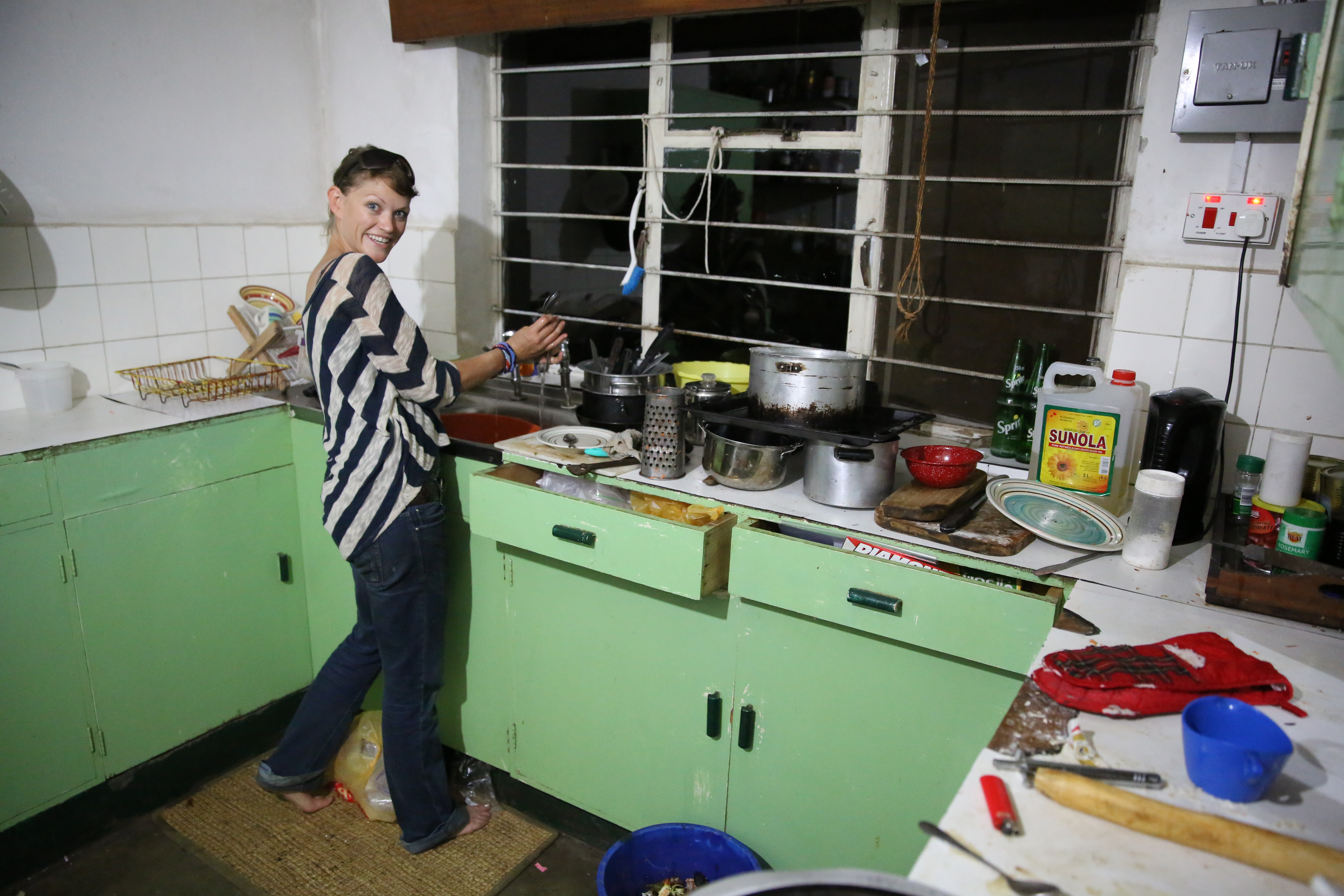
Cooking!
Winlady, who helps us with cleaning the house during the week, made delicious chapatis and pilau – a traditional spicy Tanzanian rice & meat dish. If I had any idea she was such a good cook, I’d have been bugging her for pilau every week!

The Swedish stick game. We throw sticks…at other sticks…it’s actually kind of awesome. (Hey, we have to entertain ourselves out here…)
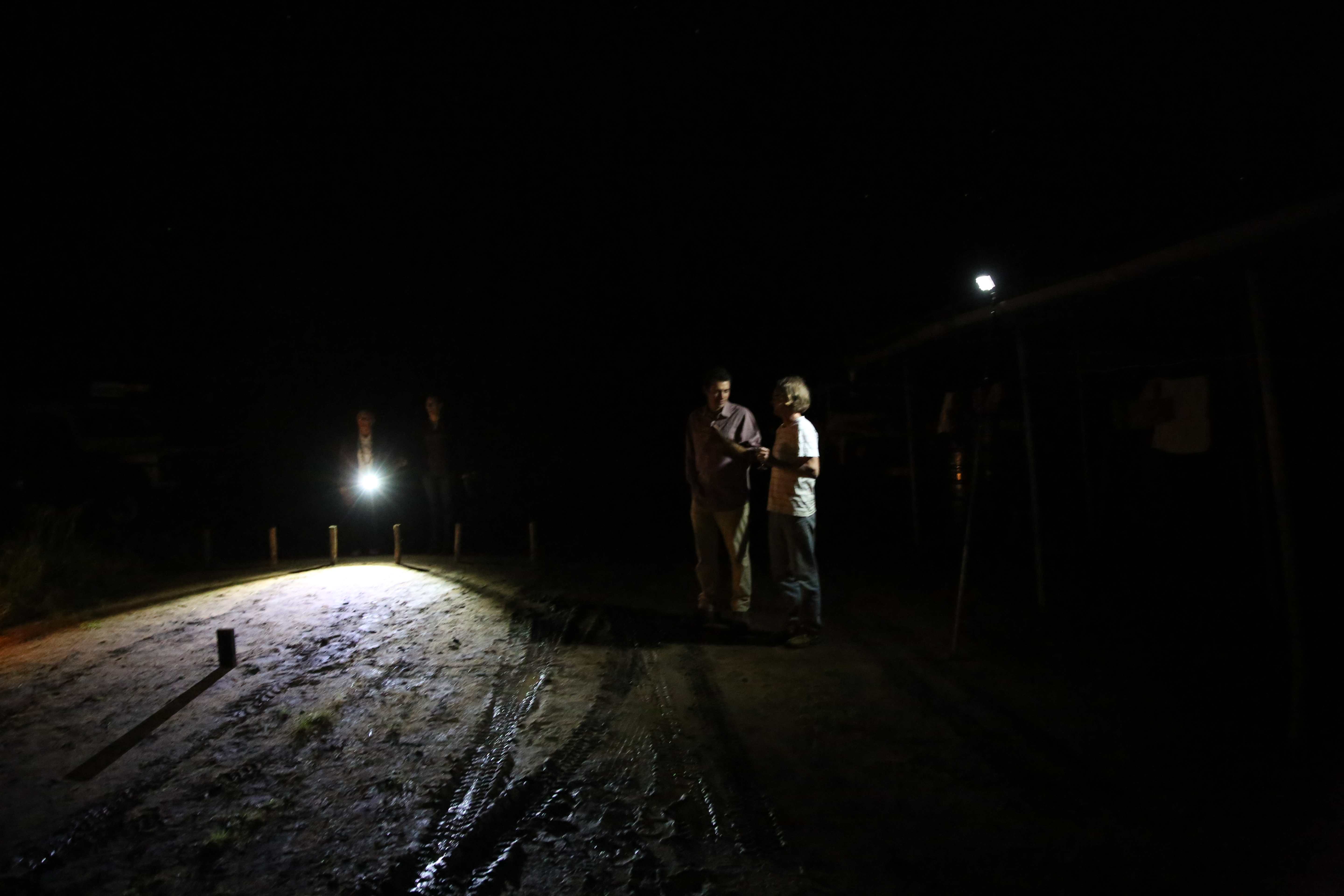
Sticks!

And then we had a visiting rhino beetle.

rhino bug.
Tom, a post-doc with the Savanna Dynamics research project, found me a going away present in the nearest town (Mugumu, ~ 3 hours away).

Oh the things you can get secondhand in Mugumu
I will miss this place.


Data-palooza
You might remember the Kibumbu pride from their rather gruesome encounter with a leopard. But probably not – that was a long time ago.
They now have a new claim to fame. As of April 22, 2013, the Kibumbu lions became the first Serengeti pride to bear a GPS collar. GPS collars are cool, but if you are a nerd like me, and trying to calibrate 225 camera traps against the known reality of animal movements, GPS collars are really [expletive deleted] cool.
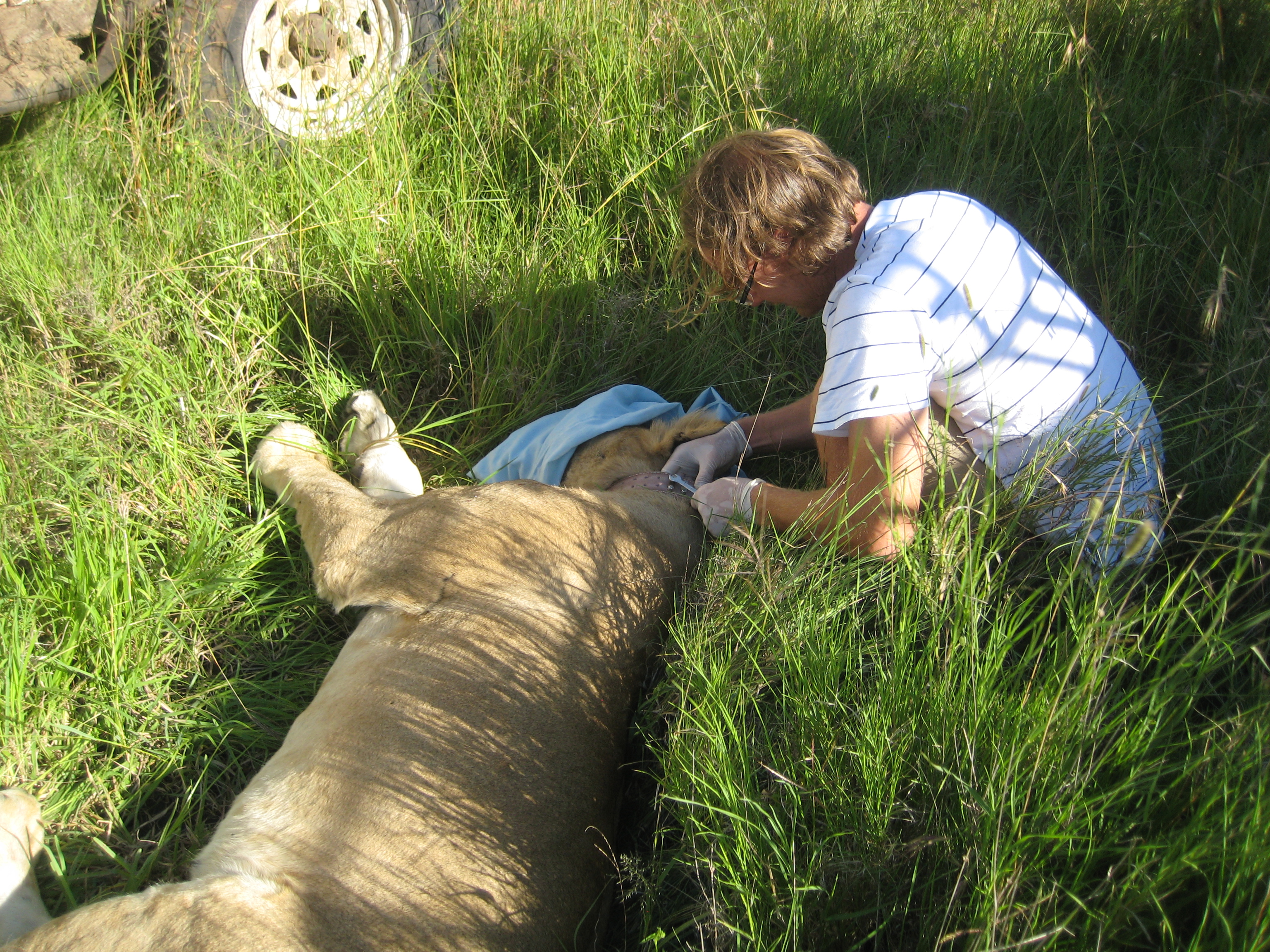
Daniel collaring a study lion
With regular old radio-collars, we have to get out in the field, driving (seemingly aimlessly to bystanders) in circles on hills until we get a signal in the direction of a given lion pride. With 26 prides being monitored now, we get to each pride about once a week. But with GPS collars, the data comes to US. On it’s own. EVERY HOUR. I can tell you where the lions are without ever leaving my hyena-chewed, baboom-mangled armchair. Data of this richness are simply impossible to get otherwise. I tried a few “all-night follows” – trying to serve as a living GPS collar. Trying to figure out why, when lions are lurking 300 meters from a camera trap, they don’t appear in it. I usually fall asleep by 9pm. Apparently I don’t make a very good GPS collar.
You might wonder why on earth we don’t have 26 GPS collars, instead of 1. Unfortunately, they are expensive (read >$5,500 a pop), and the battery life doesn’t last as long as regular old VHF collars, meaning we would have to dart lions more often – which is a stress that we like to minimize. But Ingela Janssen had an extra collar from her conservation work in the Ngorongoro Conservation Area, and the chance of calibrating camera trap captures against hourly lion movements was too good to pass up!
Here’s the first map of Kibumbu’s movements. The first position came in at 6pm on April 22, and the last was recorded on the 23rd at 9pm. Since lions are nocturnal, we take one position every hour from 6pm to 7am, and then one position during the day (at noon). You can see from the lines that lions can move quite a ways without actually getting very far.

Kibumbu’s first GPS recorded movements
And here’s their latest map.

And the last few weeks…
I realize that these graphics don’t give you any sense of where in the study area the lions are. Until I figure out how to work some really cool magic with Google Earth, here’s a map of where the cameras are. You can see from Kibumbu’s maps that they are hanging out along a (sometimes dry) river – the Ngare Nanyuki – which I’ve circled in red on this camera layout map.

Camera Traps – Ngare Nanyuki River circled
The GPS collar won’t show up until Season 6 camera photos — but it looks a bit different from our normal collars with two big lumps instead of one:
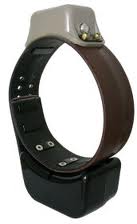
Vectronic GPS collar – stock image
So keep your eyes peeled!
Zooniverse Workshop
It’s been an exciting and exhausting past couple days. I’ve been at Chicago’s Adler Planetarium, chatting with Zooniverse developers, scientists from other Zooniverse projects, educators and social scientists, and citizen science volunteers. There have been presentations on the history of the Zooniverse, starting with the original Galaxy Zoo, and on why people say they participate in citizen science projects. We’ve talked about ways to process the huge amount of data that comes out of the projects, and how to make translations of projects into other languages easier. We’ve seen that for some projects, many people do few classifications, and for others, few people do many classifications. And we’ve consumed coffee and food, and just gotten to know one another. (I discovered a scientist on another project went to my alma mater, graduated a year after me, and that we know many of the same people!)
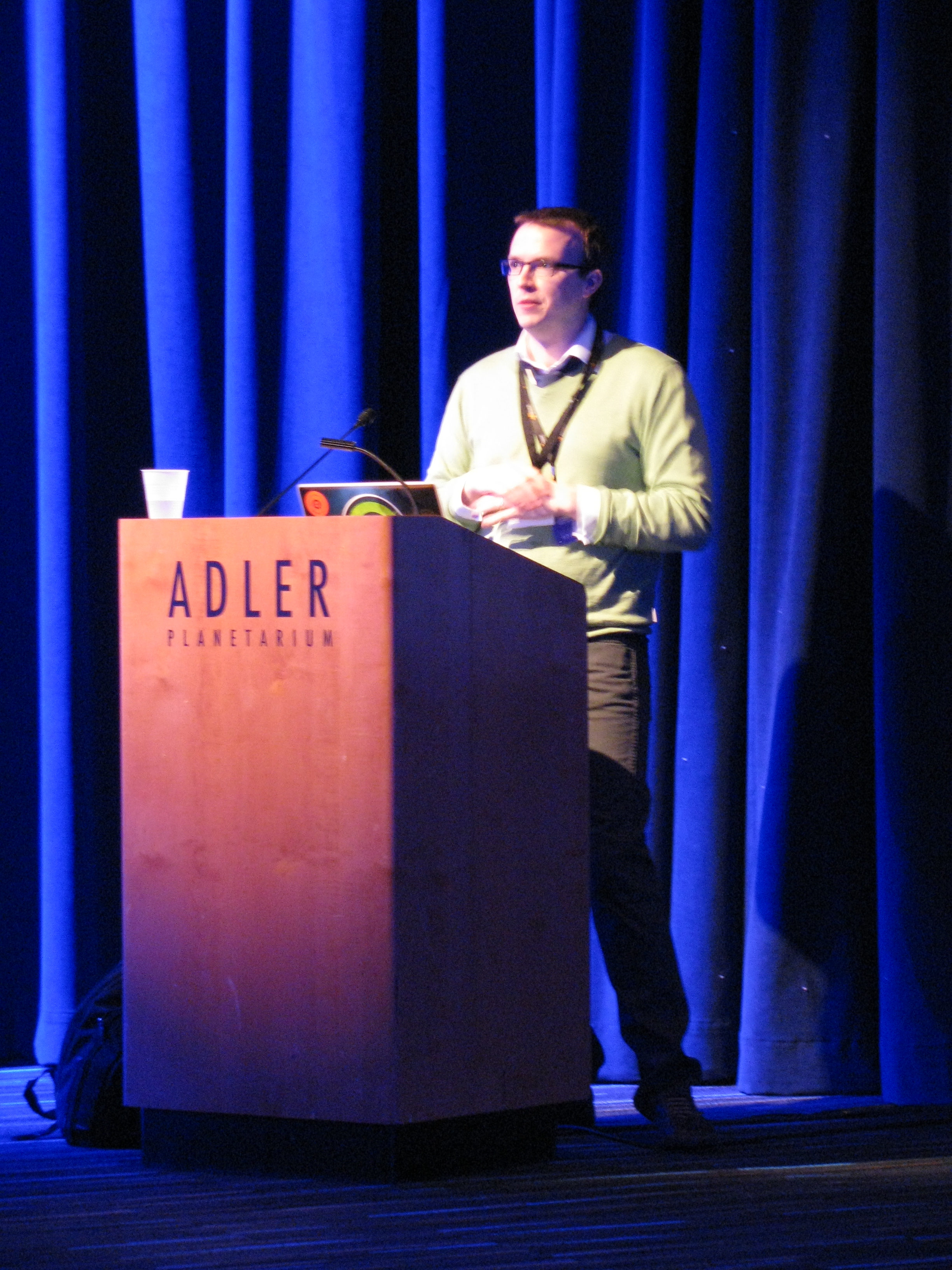
Arfon talks about how the Zooniverse creates citizen science projects
One of the things I’m most excited about for Snapshot Serengeti is a set of visualization and analysis tools that the Zooniverse team is developing. They’ve started on a nice set of tools for Galaxy Zoo already, and Snapshot Serengeti is well-positioned to have tools added next. The tools will allow you to do things like map where images were taken, look at trends over time of species, and make some simple graphs. Is there anything you’d like to do easily with Snapshot Serengeti data? Now is the time to let us know. Feel free to leave ideas in the comments.
This workshop has also been fun because we’ve gotten a sneak peak at what lies down the Zooniverse road… a project called SpaceWarps is coming soon… further down the road, we have plankton, condors, kelp, sunspots… plus more data for Andromeda Project, Notes from Nature, and… Snapshot Serengeti!
It turns out to be true: there IS a new hard drive in Minnesota and it has all the Season 5 images on it. On Friday, Lora Orme and I started loading those images onto the supercomputers so we can start processing them. You’ll have to forgive the Zooniverse for stealing me away these past couple days and keeping me from working on the Season 5 images. But it’s just a small delay; I think we’ll have Season 5 online within the month.
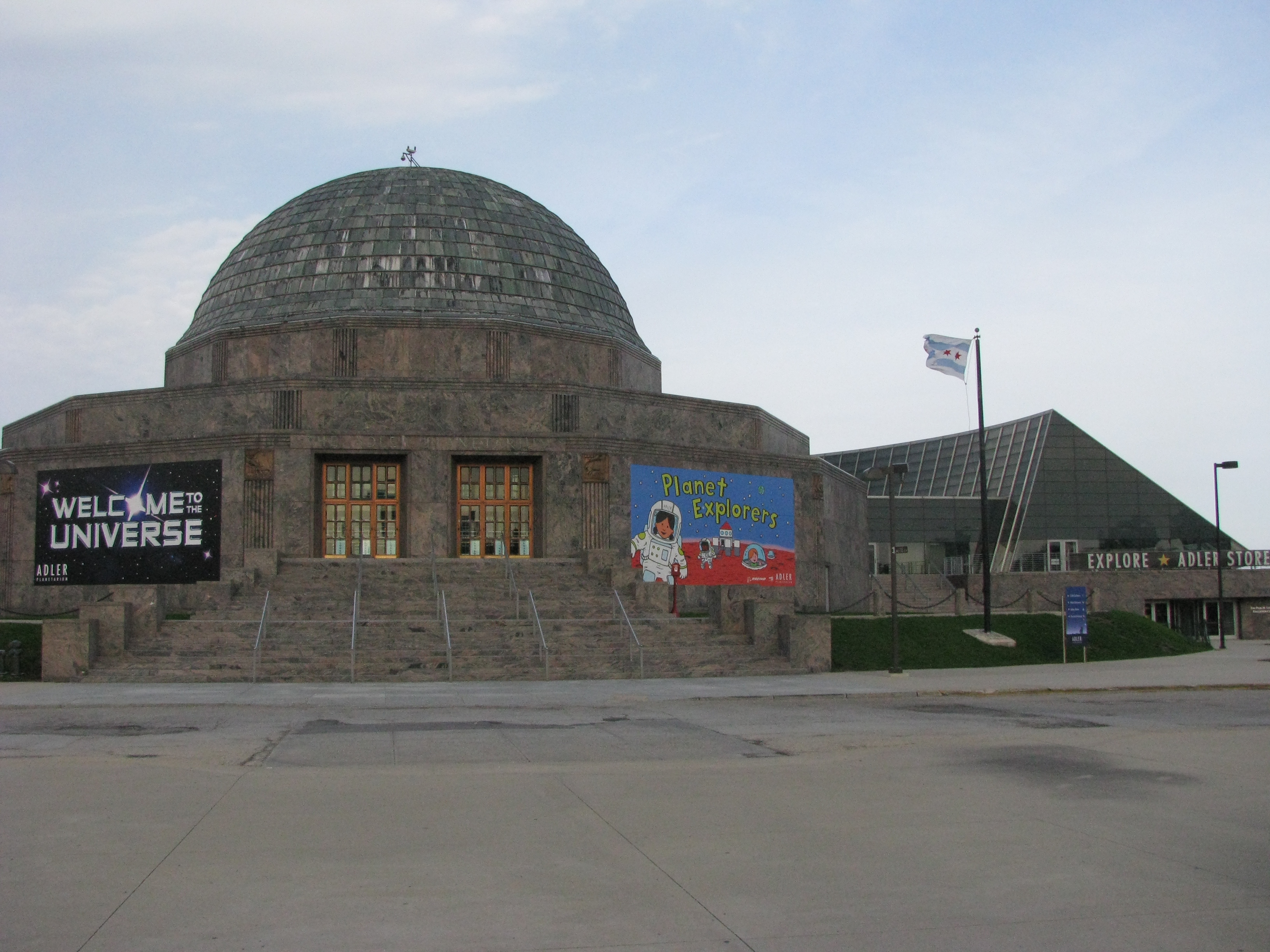
The Adler Planetarium
Notes from Nature
Next week, Zooniverse is holding their annual meeting of project science teams. Since Ali and Craig are both still in Tanzania, I’m going to be the only Snapshot Serengeti representative there, but I’m super excited to go. I went to this meeting last year, while we were still developing Snapshot Serengeti, and it was both really fun (the Zooniverse team in Chicago are awesome) and really useful. Since Zooniverse already had a dozen other projects live, I got a lot of advice from their science team members about what to expect when the Snapshot Serengeti went live, and also tips on analyzing the large data set that results from the project. This year, I’ll be one of the people giving tips to the scientists of developing projects.
Speaking of which, if you haven’t already, you should go check out Notes from Nature, which launched this week. It’s a bit different from Snapshot Serengeti in that the species in the picture is already known, but what they don’t have is the meta-data (the date the specimen was collected, where it was collected, etc.) You help out by entering this information off of labels, many of which are hand-written and so hard to use OCR on. They have both a botany collection and an insect collection that they need help with. And there’s a Notes from Nature blog.

On fencing wildlife reserves
Craig wrote an op-ed in the Los Angeles Times today. He argues that fencing wildlife reserves in Africa is a cost-effective and necessary step to conserving Africa’s big mammals. The reasons that reserves need fencing now have to do with demographic changes over the half-century since they were established. He points out that fences won’t work for some reserves, especially those that depend on wildlife migration over reserve boundaries, but that for many, it may be an important step towards conservation sustainability. (For what it’s worth, those reserves like Tarangire with in-out migration may be doomed anyway, as human population and agriculture increase around the reserve and effectively block the migration anyway.)
Craig’s opinion piece derives from a study he and many others did comparing the success of Africa’s reserves based on various attributes of those reserves *. The effectiveness of conservation efforts is not usually measured; mostly, people would rather their money to go conservation actions rather than conservation monitoring programs. Lacking specific monitoring data, the approach of Craig’s study is one way to look at what works and what doesn’t when it comes to conservation. And the data say that fences work in (most) African wildlife reserves.
Your gut reaction to fencing wildlife areas might be aversion, or even horror. I know I wince when I consider the idea. Fences are unattractive. But they’re especially unattractive, I want to point out, for those of us with the luxury of living far from major human-wildlife conflict. If there were reasonable chances that a lion or leopard might carry off my child – or kill my livestock – or that elephants would trample my carefully tended crops – I would welcome a fence. North Americans and Europeans have historically come into conflict with wild animals when human needs for land, food, and fuel have increased. They have largely solved this human-wildlife conflict by eliminating the wildlife. Africans have done a better job of retaining their wildlife, but their needs for land, food, and fuel are also increasing. As unaesthetic as they might seem, maybe fences around wildlife reserves can help both Africa’s wildlife and its people.

* “Conserving large carnivores: dollars and fence” in Ecology Letters, 2013 Volume 16, pages 635-641. DOI: 10.1111/ele.12091
Authors: C. Packer A. Loveridge S. Canney T. Caro S.T. Garnett M. Pfeifer K.K. Zander A. Swanson D. MacNulty G. Balme H. Bauer C.M. Begg K.S. Begg S. Bhalla C. Bissett T. Bodasing H. Brink A. Burger A.C. Burton B. Clegg S. Dell A. Delsink T. Dickerson S.M. Dloniak D. Druce L. Frank P. Funston N. Gichohi R. Groom C. Hanekom B. Heath L. Hunter H.H. DeIongh C.J. Joubert S.M. Kasiki B. Kissui W. Knocker B. Leathem P.A. Lindsey S.D. Maclennan J.W. McNutt S.M. Miller S. Naylor P. Nel C. Ng’weno K. Nicholls J.O. Ogutu E. Okot‐Omoya B.D. Patterson A. Plumptre J. Salerno K. Skinner R. Slotow E.A. Sogbohossou K.J. Stratford C. Winterbach H. Winterbach S. Polasky.
Open source and multilingual
In keeping with Zooniverse’s philosophy of openness, the code for Snapshot Serengeti was released back in February. (And the code for several other Zooniverse projects has been released, as well). What this means is that you — or anyone else — can contribute directly to the development of Snapshot Serengeti!
In particular, we’d love to internationalize the site so non-English speakers can participate. If you go and classify images in Snapshot Serengeti right now, you can see a beta version of a Polish translation of the site. Look for the word “English” in the upper left, pull down the arrow, and select “Polski (beta)”. You can now develop your Polish vocabulary, if you don’t happen to be a native Polish speaker. (Seriously. I studied for my high school AP French exam by installing Civilization in French on my computer and playing it endlessly. I’ll admit it was tricky to work the words caserne (barracks) and galère (galley) into my exam essay, but playing Civilization was so much more fun than flash cards…)
All the text you see on Snapshot Serengeti is in what is called a “localization file.” If you look at Snapshot Serengeti’s English localization file, you’ll see all the English text that you could possibly encounter on the site, starting like this:

And if you wanted to, say, create a Swahili version of Snapshot Serengeti (which would be awesome), you would change the text that reads ‘Welcome to Snapshot Serengeti!’ to ‘Karibu Snapshot Serengeti!’. And you would continue doing that for all the English.
So, want to do some translating? If you’re tech-savvy, follow these instructions for translating Galaxy Zoo, but use the Snapshot Serengeti code instead of Galaxy Zoo’s. If those directions leave your head spinning, leave a comment below and we’ll help get you started.
 Snapshot Serengeti
