
Stuck. Part 2.
##### Today’s post is a continuation of last week’s adventure, written by Patrik Dousa. #####
When we left off the story from last week, all of us in the Serengeti team were out deep in the sour tern range of the Serengeti trying to free a land rover from thick mud. All we accomplished was securing the range rover even deeper in the mud. From 1/4 of the wheel being submerged to a half, with the bumper touching the ground. Good going. A beautiful sunset was going to occur in an hour or so and the last place to be at that point was in the middle of a hazardous plain with a large pride of lions waking up for their nighttime prowls.
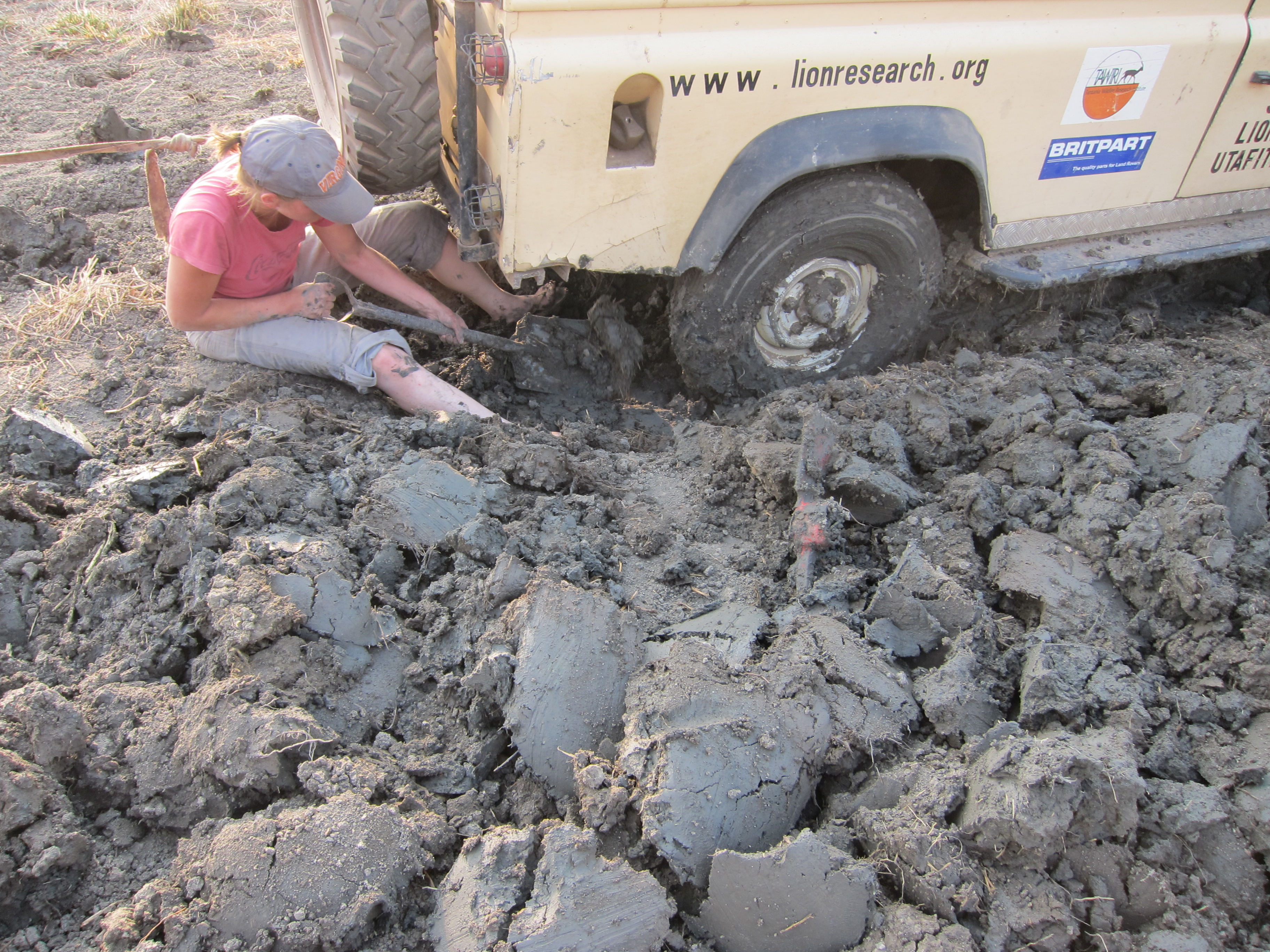
This is actually muddier than it looks…
The lions are still watching us from their mesas to the north and Ali is figuring out the next move. I thought it was a clear decision. Leave. Now. Have I described to you the fortitude and diligence of a lion researcher? A job that requires you to spend most of your time in the dry plains with the only the basic minimum requirements to sustain you doesn’t attract individuals who give up too easily. No, Ali and George see the sunken rover as a challenge that must be faced. We aren’t leaving, not without a fight.
Just then a tourist vehicle pulls up along a road about a half-mile from our area on the other side of the uncrossable mud plains. The guide is in the process taking them back home to one of the southern lodges and apparently decided to stop, having spied the magnificent example of male lion that was observing our vehicle. The new arrival attracted King Simba’s attention and the powerful elegant beast starts walking towards the tourists. I can see their excitement mount through my binoculars — this moment is going to be the highlight of their trip. George and Ali are laboring through shovelfuls of the thickest, reddest, peatiest mud you can imagine and only a short distance away, well-scrubbed observers are preparing themselves for the the apex of their Serengeti experience. Such is life.
I see a bold cub follow his master lion and play around his feet incurring his wrath for a moment. The king playfully swats back and raises his head to the heavens letting out an immense roar to the delight of the tourists. The greatest show on earth — with our little car-trouble side-show of going on right in the background. “Who are those crazy people back there?” they must have asked their guide. “Well, they’re professionals, so they must know what their doing.” the guide is certain to have responded.
The lion’s roar triggered a slow migration of the lionesses and their cubs from the low mesas to the area closer to the tourist vehicle where the male lion had settled. As the single file procession began, we felt a wave of relief since the pride was now headed away from our rover. A few more attempts to drag out the stuck vehicle failed. By now the sun is steadily growing larger and more rosy as it begins its decent. The sky eventually reaches the particular hue that Ali reads as our signal to leave.
We secured the vehicle and took all the valuables and began a slow retreat back thinking, “please don’t get stuck” on repeat until we got back on the main road. The pink sun blossomed into a deep red bloom that backlit the acacia tree line creating the beautiful silhouetted postcard image that the Serengeti is so well know for. The mood in the car was impervious to these romantic supplications. Exhausted and temporarily defeated, the crew made the long journey back toward the research house.

And all we’ve done is get ourselves in even deeper.
Being the visitor who expended the least amount of sweat that day, I suggested that we stop at the local canteen Seronera and that I’d treat everyone to a chicken and rice dinner and a Stoney Tangawizi (the extra spicy ginger ale that is everybody’s favorite drink in Tanzania). This turned out to be a very cost effective way to turn the sour mood sweet — just a few bucks per plate and brew to get everyone back to their happy place. Soon the team was back to the bantering with the locals and planning tomorrow’s adventure. That was my last night at the Serengeti, the next day I was back on the road to Arusha. Ali messaged me later and mentioned that they were able to round up a crew to go back and successfully drag out the rover the next day. This did not surprise me since I had well learned: you can’t keep a lion research team down for long.
Stuck. Part 1.
Stuck. Surrounded by lions. Please come.
This is not a text message that you’d necessarily expect to get on your cell phone…unless you work as a lion researcher in the Serengeti like Ali does. Receiving this text in the early afternoon, she takes the news in stride as a necessary task that needed to be finished before dark. I on the other hand, as a visitor, am charged up and nonplussed with the drama of it all. George, one of the field research assistants on a lion tracking expedition, obviously needs help and pronto, so we are on our way out within a few minutes. In the wild Serengeti, a few minutes can separate success from tragedy — the research team has an exceptional awareness of this and also the discipline to do what it needs to be done in a methodical and prompt manner as Ali is demonstrating to me at this moment.
We track George and his land rover down just like we do lions. Each rover is outfitted with the same tracking unit that is on the collar of each radio-tracked lioness. So we chase the rover’s signature signal deep into the southern range, driving on the dirt roads as fast as we can safely afford. As the day draws towards a close, the animals become restless. Elephants trumpet in the distance. A serval — a beautiful African wild cat one doesn’t see everyday– trots across the road and disappears in the brush. Normally such a sighting would warrant an immediate stop, but not today.
Finally, we go as far as the roads can take us and we must venture in the unmarked grassy plains that are a minefield of axle-breaking holes and mud-traps. Driving off road is risky business in the daytime –as George was just reminded of — and completely a fool’s errand in the nighttime. Ali looks for the tell-tale signs in grass patch coloration that indicate a possible hole as she swerves deftly through the treacherous terrain in a labored crawl.
Finally on the horizon, we sight George and his rover axle deep in a seemingly stable area. The dry cracked surface, however, masks a vast mud hole created by the recent rains. This is the worst kind of environmental trap that even a seasoned veteran like George can fall prey too. With a lighthearted smile that belies any frustration, George explains how he tracked a pride of lions into this area and was surprised by the sudden drop into the mud. Luckily, our rover remains in the solid area just short of George’s rover. We check the area and see that the lions have moved off to a series of small mesas to the north. It’s safe enough to exit the vehicles as long as one of us keeps a 360 degree lookout.
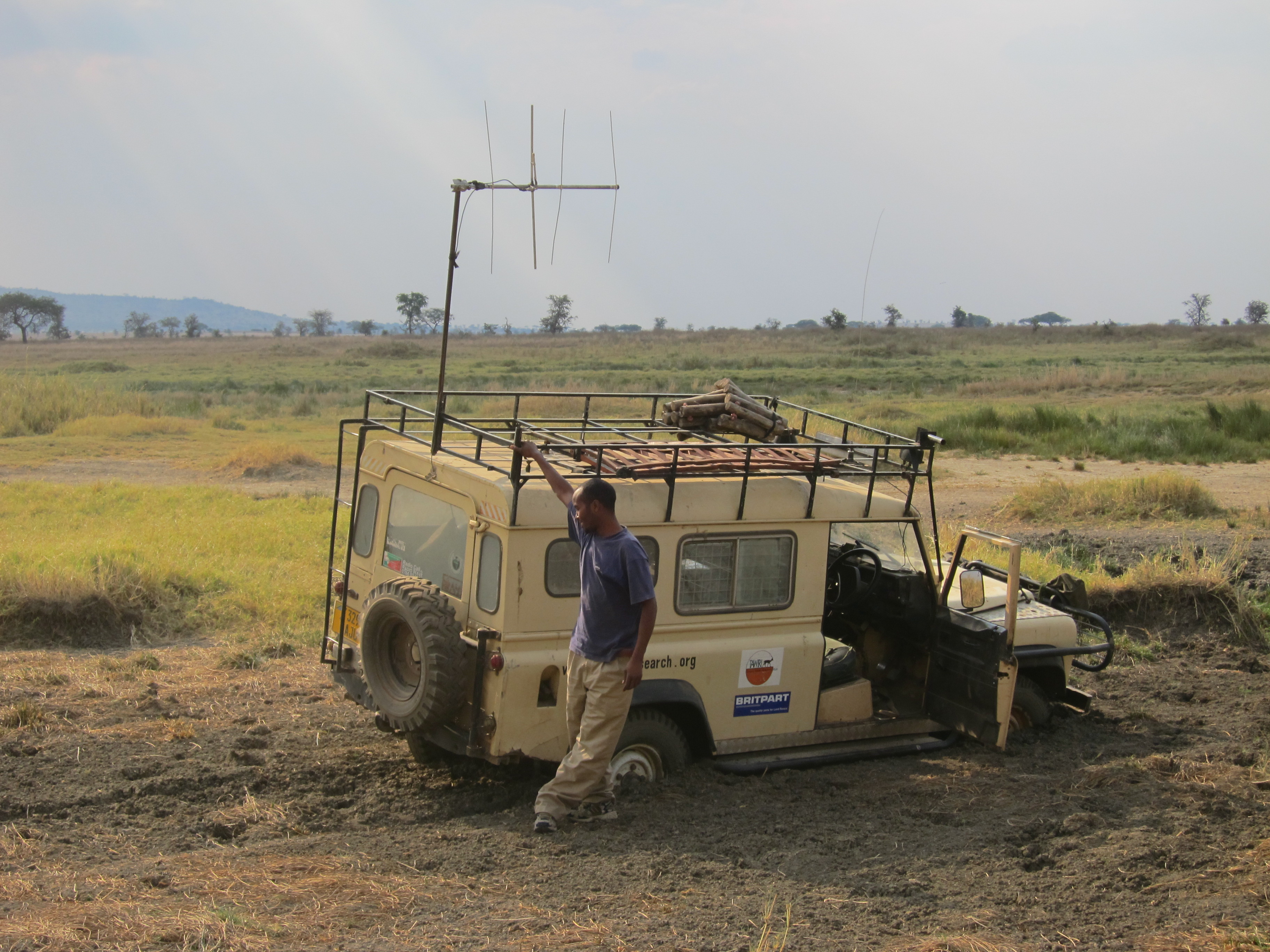
How we found George.
Our cellphones at that point record no bars, so as Ali readies a tow line, she inquires how George was able to get a message out.
The calm exterior and wry banter of every lion researcher I’ve met is always the counterpoint to the fierce passion and iron discipline at their core. George is all smiles and laughs a bit as he recounts the sinking feeling he had when he saw that he had no bars on his cellphone and lions surrounding three sides of the vehicle. A thickly maned adult male lion stood watch right outside the drivers side as if he sensed George’s desperation.
A good scientist, when faced with a problem, puts together an experiment to test its boundaries. Perhaps the cell phone could be made to transmit somehow? As George raised his hand up and out of the vehicle he noticed to a single bar flicker on and off. This observation made him hatch a plan that he reflected on as he eyed the attentive dark-maned sentinel waiting outside along with the multiple groups of lionesses and cubs surrounding him.
The day was not going to get any longer so George, did exactly what he contemplated: he composed his terse message on his phone, climbed out the window onto the roof rack, and jumped up several times pressing the send key until the signal caught and the phone indicated the message was sent. Then he waited for the animals realize that he was still out of their range and relax back down to their lazy poses and before slipping back into the car to await rescue.
By the end of the story, the tow cable is fastened and mud traction ladders are in position under the rear wheels of the rover. Ali is ready to begin the first effort to pull the car. The gears lock in, the engine strains, the wheels spin, and…Georges car slips off of the ladders and deeper into the mud.

Step 1. Let’s see if we can tow George out…
To be continued…
“Home” — the one without the wildlife
It’s hard to believe that I’m really and truly done with the Serengeti. It’s strange to not have a veranda to sit on, and watch the elles or giraffes munch on our trees; see the eyeshine of hyenas lurking in the shadows, hoping for a bite of our dinner. The only wildlife I’ve seen in the last week is squirrels. As entertaining as they are, it’s just not quite the same.
Nonetheless, it’s good to be “home.” It’s funny the things you take for granted when you live here. As an idea, I’ve made a list of just some of the things I’ve done in the past week that I hadn’t done in at least 5 months:
- gone to a farmer’s market
- run (oh the pain)
- gone to the kickboxing gym (even more pain)
- brushed my teeth with tap water (!)
- drunk tap water (The strangest thing to get used to)
- had a shower. With hot, running water.
- eaten fresh, water packed mozzarella (I really do love food)
- drunk an IPA (and beer. There’s no such thing as good beer in Serengeti.)
- bought clothes
- put clothes in a washing machine
- driven on the right side of the road (This is surprisingly hard to get used to.)
- put dishes in a dishwasher
- had hot water come out of the tap
- sat on a leather sofa
- eaten baby spinach
- eaten ice cream
- watched something on YouTube (I still can’t believe how fast the internet is!)
- driven a car with power steering
- used a microwave
- used a toaster
- listened to the radio
- checked my mail (that is NOT a pretty sight after 5 months…)
The list could go on, especially when it comes to food. But perhaps the most significant thing about this trip home is that, well, I’m here for good. Or as good as “for good” gets in grad school. I’m here, in Minnesota, until I finish my dissertation. What that means is that the next 12 months will be spent furiously analyzing the Snapshot Serengeti data to understand lion/hyena/cheetah/leopard/wild dog interactions, presenting at conferences, writing papers, searching for post-doc positions, and ultimately defending the last 5 (soon to be 6) years of research to a committee of UMN faculty members. It’s terrifying! Way scarier than spitting cobras, getting stuck in the mud, or having lions roaring right outside the car window…at least in my opinion.
Mom’s Visit
After living here for the last three years, I’ve finally dragged my mother into the bush. At 69 years old, I don’t think she is thrilled about our seatless (squatting required) outhouse, or the fact that she can’t blow dry her hair, but she’s been a good sport about everything so far – from layers of dust that covered all of her luggage to the relentless rattle of my noisy Land Rover.
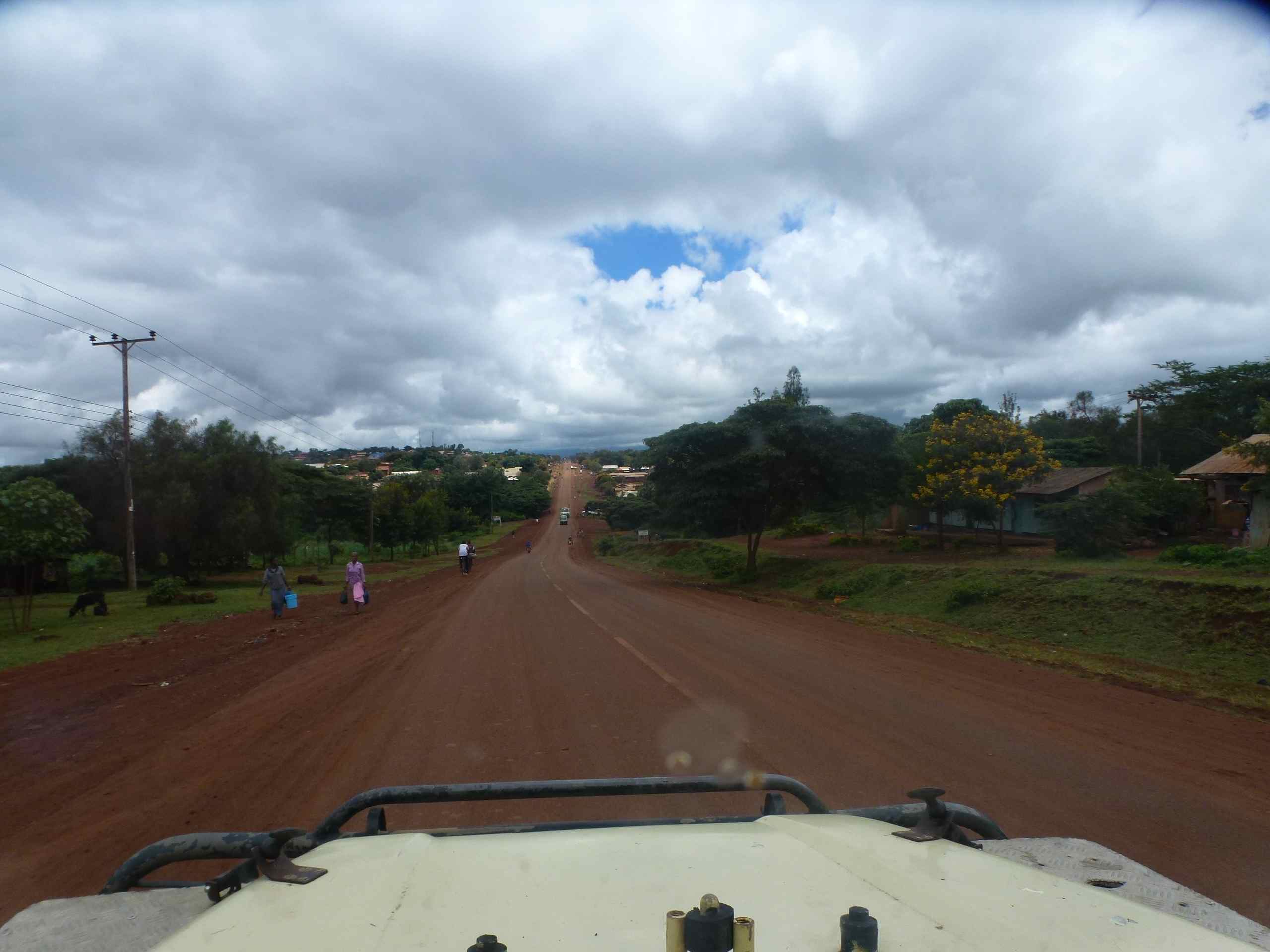
Arriving.
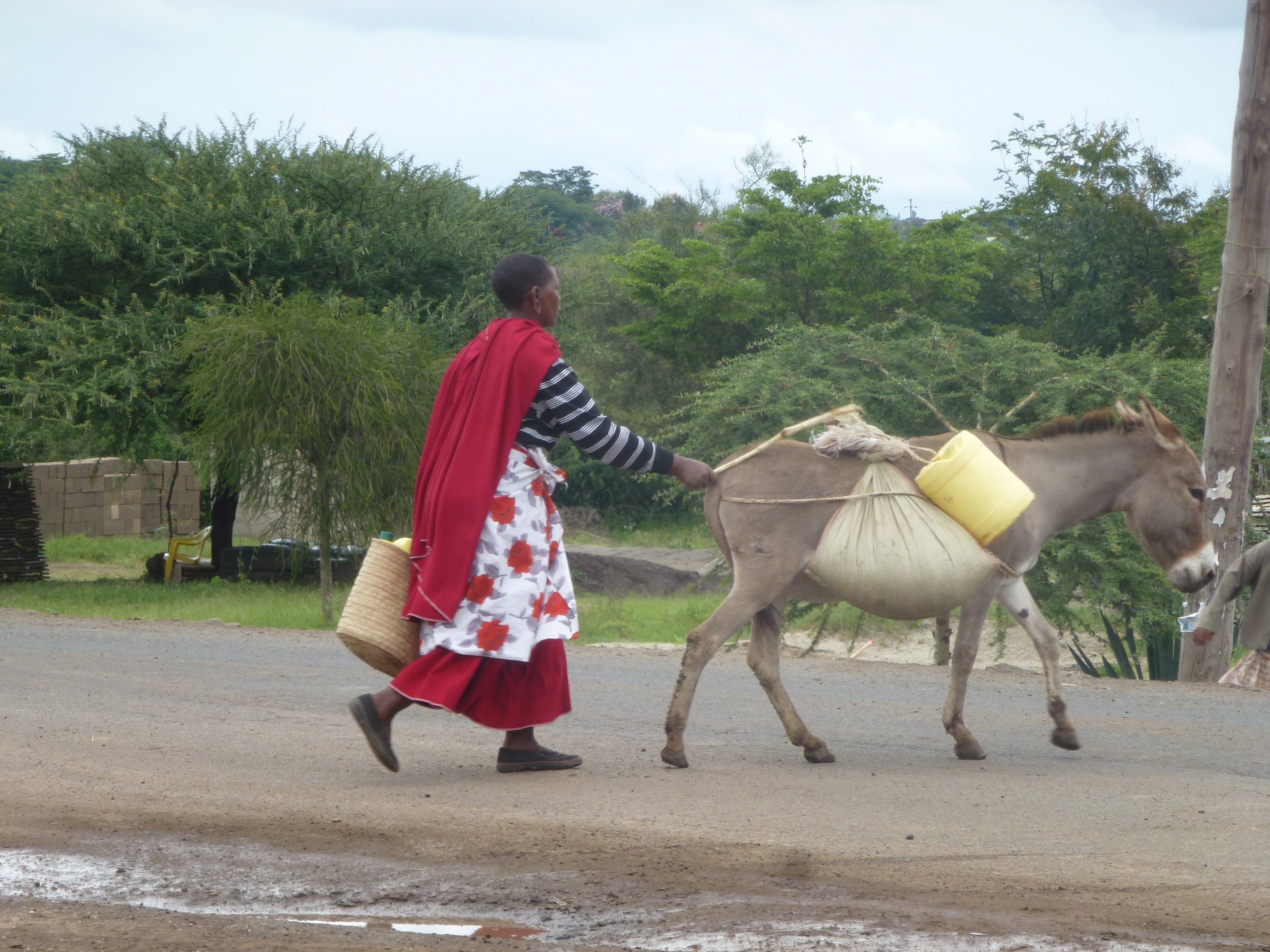
Arusha was harrowing (to be fair, it is hard to remember to look the “wrong way” when crossing the street)
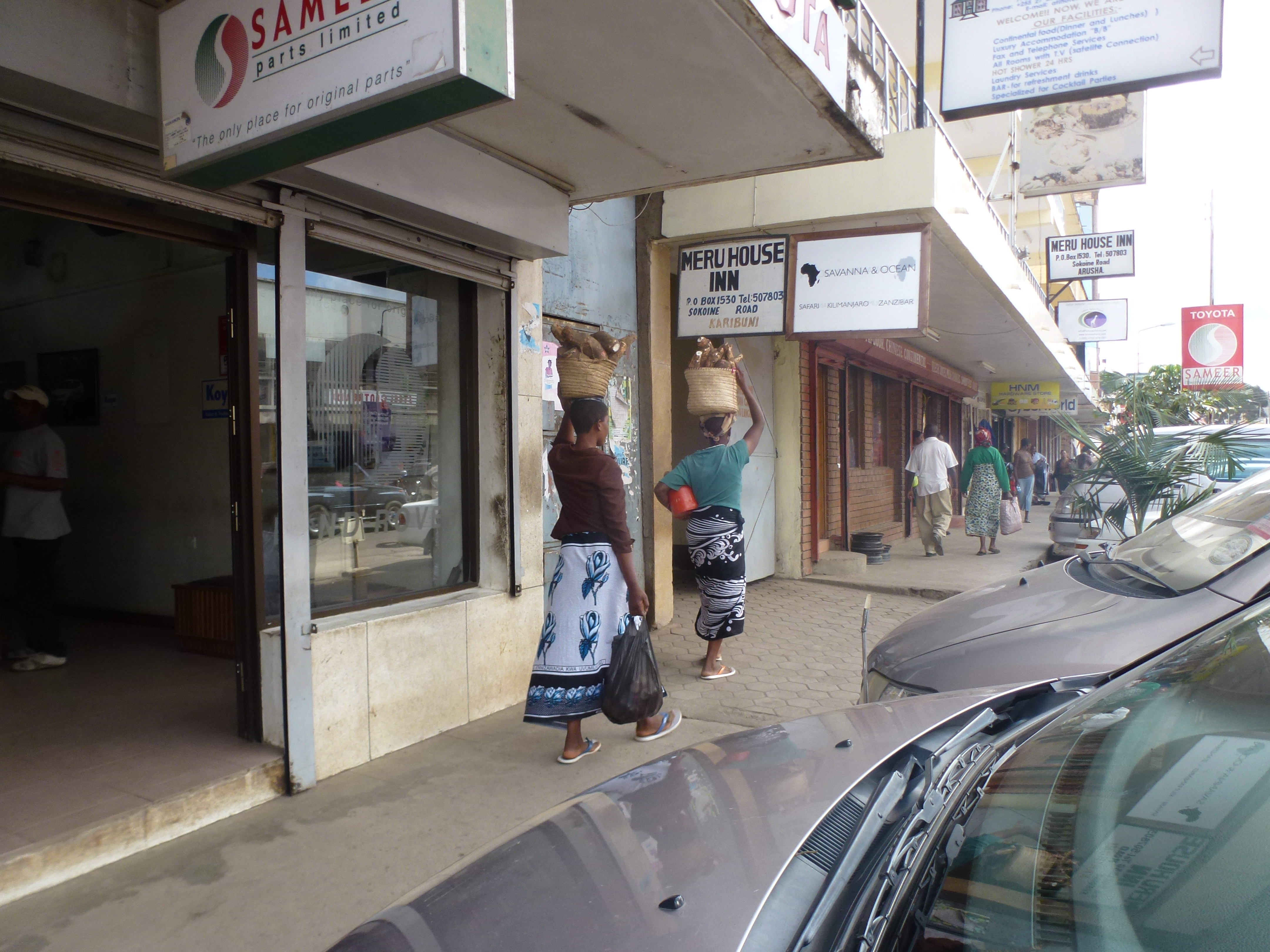
but I can’t complain, as pretty much all we’ve done since she got here is eat AWESOME food. And you all know how I feel about food.
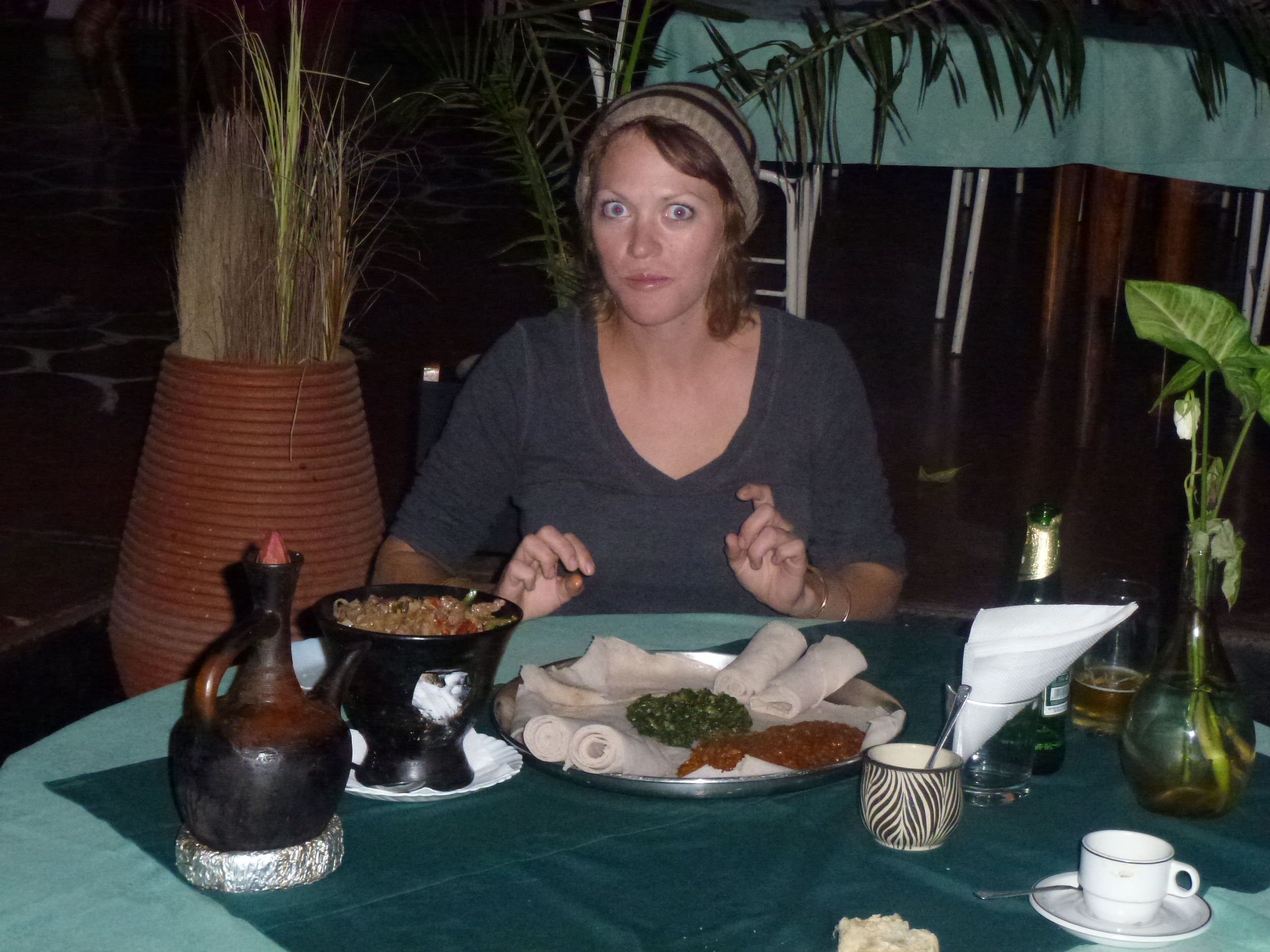
Food. Caught in the act at Ethiopian.
Grocery shopping was a little less fun than eating out…
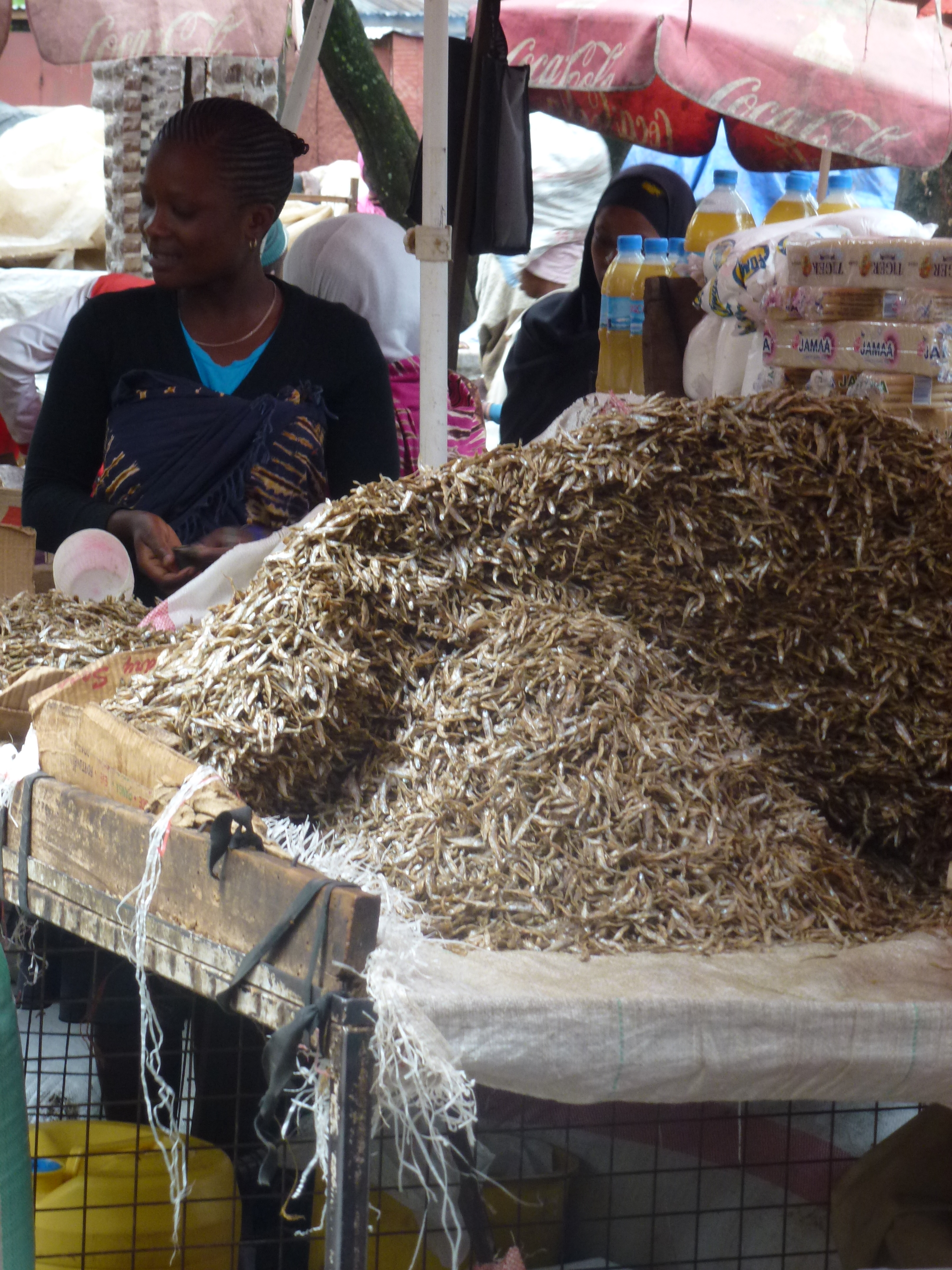
Dagaa at the market. One of the few things (alongside marmite) that I *do not* eat.
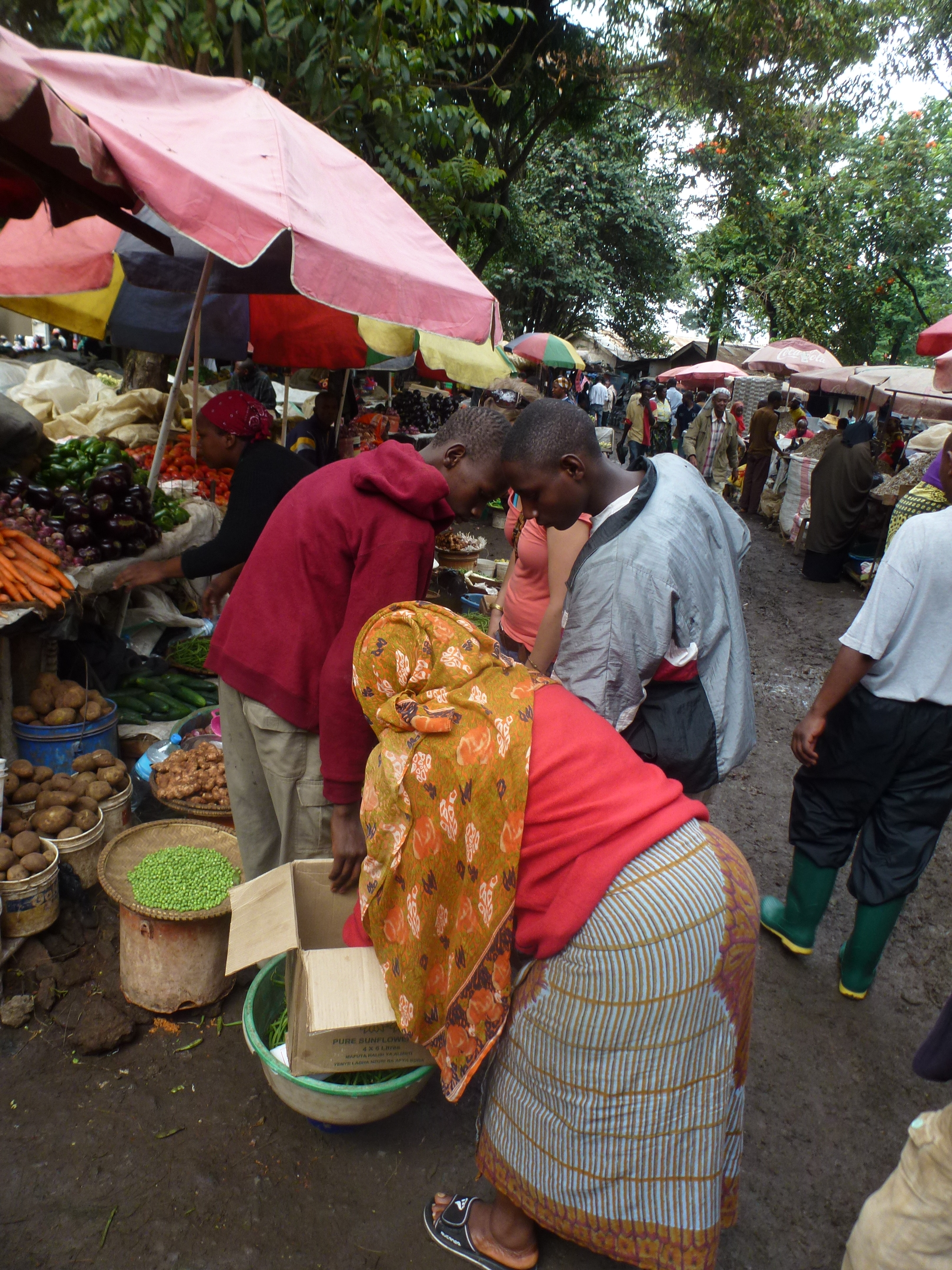
Grocery shopping.
But we broke the trip from Arusha to Serengeti into 2 days, and got to stay at the super fancy Serena Manyara along the way.
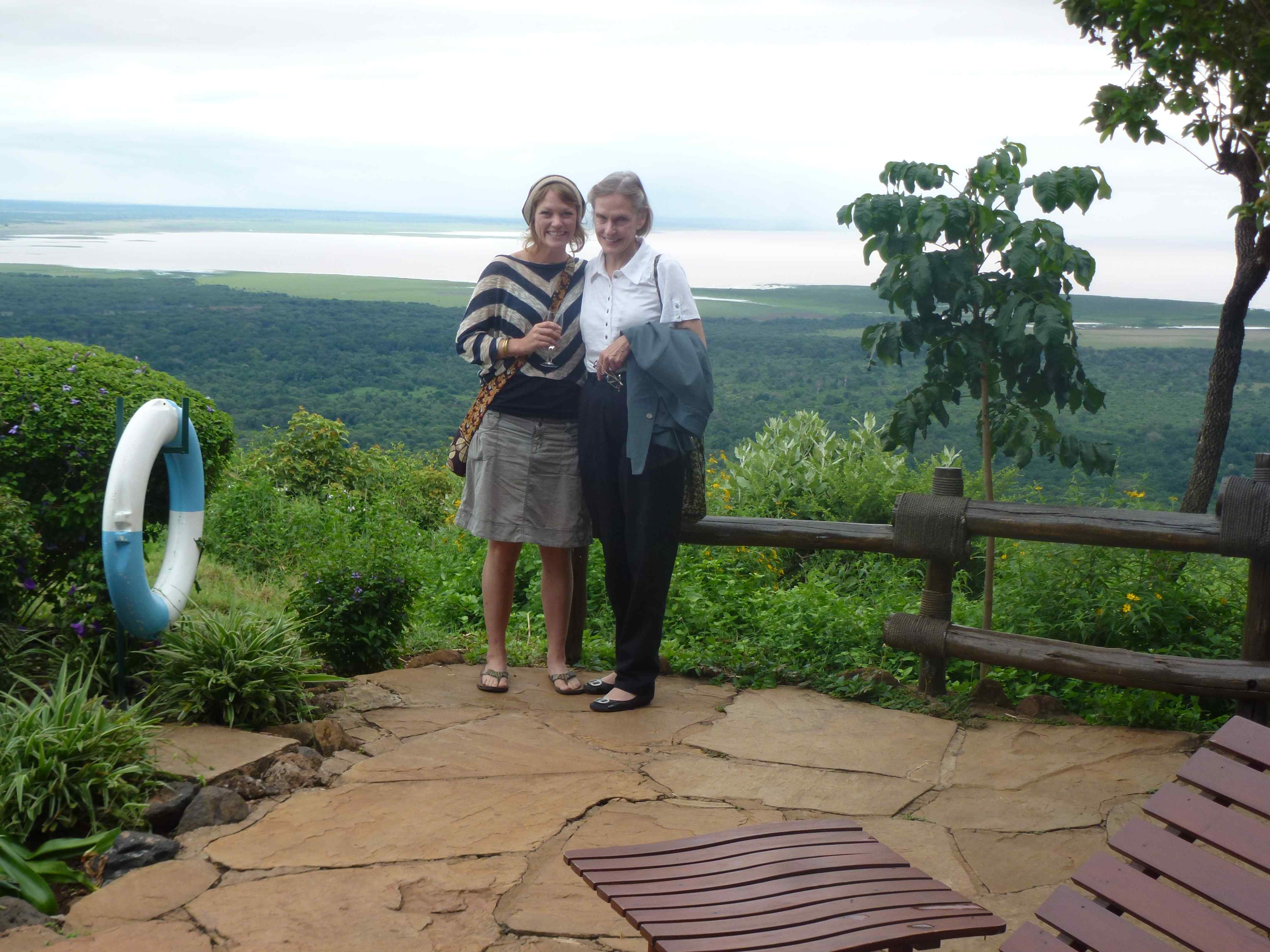
Mom & me at Serena Manyara. I’m thinking about food…
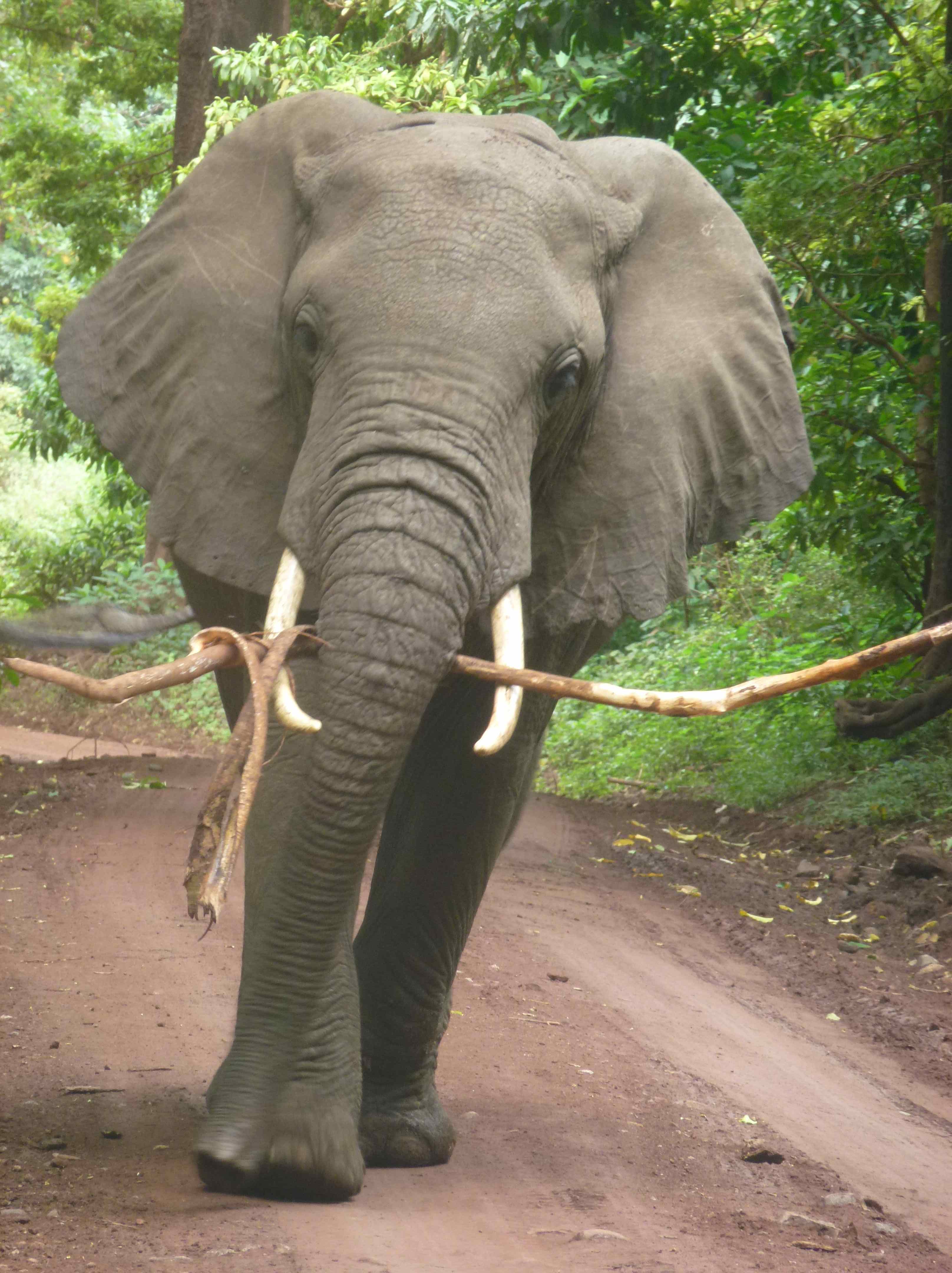
And we got a personal welcome into the park…
I’m just glad my mom is here, squat-choo or not. More pictures to come!
This is the wet season
### Craig, his wife Susan, and lion researcher Daniel and I went camping at Barafu the other night. These are Craig’s thoughts as we all sat on top of Barafu kopjes, watching the wildebeest out on the plains. ###
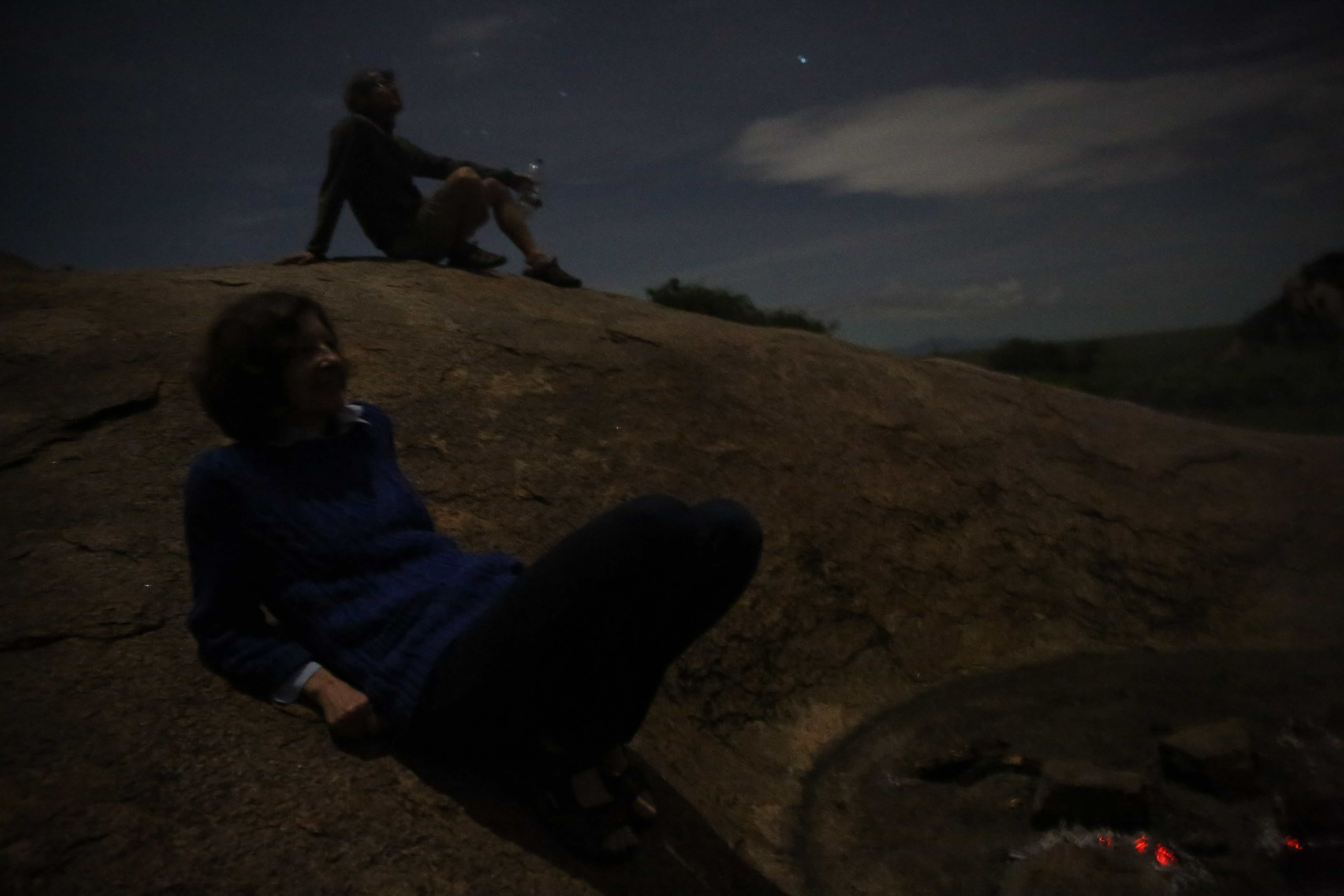
Daniel and Susan sitting on Barafu
The rains have been especially good this year. We are camping at Barafu Kopjes, at the eastern edge of the lion study area. The wildebeest have moved very far east, as I type this, I can hear them grunting loudly. The noise will only reach greater volume in the coming weeks as the rut approaches. The grass is green, the sky is full of rain clouds, and this is really the most glorious time to be in the Serengeti.
Back within the camera trap grid, the grass is getting tall, and Ali has to mow it every time she checks the cameras. There is almost nothing for the lions to eat inside the grid; most of the lions have moved very far to the south and east. This is the happiest time of year for the wildebeest, zebra, and gazelle – they are out on the open plains where they can see any danger approaching. They can easily move off away from a hyena, a lion, and still be in the lush green grass –so short it’s like the fairway of a golf course. For the lions, though, having to shift so far outside of their usual territories, this is a time of uncertainty. They may encounter rivals, unwelcoming territory holders, and so they move quietly across the land, always on edge. Further to the east, across the park boundary, into the Ngorongoro Conservation Area, there is also the danger that our study lions may encounter the Masaai warriors. Several years ago we lost three of our study lions in a wet April like this one.
All the grazers are drawn eastwards by the extraordinary richness of the volcanic soils immediately downwind from the Ngorongoro highlands. Without the wildebeest, the grass would be nearly as tall here as anywhere else, but it is so sweet, that it is mowed right down to the ground. The vistas here are breathtaking; every animal looks as though it’s floating in green space. It’s almost like snorkeling – the bright orange of the gazelle from head to toe, the vivid black and white stripes of the zebra, the dull brown of the wildebeest but in such mass it’s like a living train as the herd flows across the landscape. And lions, when we see them, stand out a mile. Usually they look like the bulls-eye – a large green target with a concentric circle of brown wildebeest around them.
This is the wet season.

Ali with sausages. Lots of sausages.

Susan, Daniel, and Ali, preparing a feast.

Wouldn’t be camping without a campfire.
Visitor!
I am back in Arusha. The drive this time was 9 hours long; the broken shock and my jua kali repairs didn’t help matters. Jua kali means fierce (kali) sun (jua), and is often used to refer to the type of repairs you get in the bush. Me tying my broken shock into place so it wouldn’t rub against the tire, and tying the coil spring down with twine in hopes that it wouldn’t pop out is a prime example of jua kali repairs. Wire, twine, mpira (old tire rubber) and duct tape. But a jua kali mechanic is worth his weight in gold – he can fix your Land Rover anywhere, anytime, and the rest of us who live in the bush strive for jua kali proficiency.
To be fair, the broken shock was easy. Last trip in, Norbert and I not only got two punctures, but broke the high-lift jack! That slowed down the puncture repairs some…
So. I am exhausted. Back in Arusha, and while there are a million project errands to run – filling our butane gas tanks, getting cash from the bank, and of course buying fresh food — the biggest reason I’m back in civilization, elbowing my way through a sea of people trying to sell me maps and newspapers, is because my mom is coming to visit. And while I’m absolutely thrilled to share this place with my family, I will admit I’m a little apprehensive. My mom is 69 years old. How is she going to like braving the outdoors for the long walk to the choo when nature calls at night?? At least this time I won’t let Daniel set out Fabio for her walk back…
Gombe, part II
## Follow up to Chickens have necks? ##
If he didn’t look so earnest, I would swear Hamisi was getting us lost on purpose. He’s now 40 steps ahead of me, my legs feel like lead (can lead burn?), and he turns around – “Are you tired?” he asks. A mischievous smile darts across his face and I give him my best withering death stare. “You’re killing me, Hamisi,” I grumble, plodding after him. Hamisi is my guide in Gombe. He is tiny, grew up in Kigoma not far away, and manages to trek these hills every day, in blue jeans (!), without so much as a pause. We are climbing to some waterfall that simply cannot be worth this. These are not hills; they are mountains. And I am pretty sure my legs are about to fall off. Like, detach from my torso and fall off.
I work out, I really do. Mostly to keep my sanity in the otherwise sedentary Serengeti. We can’t run, we can’t hike, we can’t do our fieldwork on foot; we spend all day behind the wheel of a dusty, power-steering-less Land Rover, and return home exhausted despite sitting for 10 hours straight. But apparently my kickboxing bag and TRX routines are no match for the hills (ha, mountains!) of Gombe. I can’t believe Lisa and all of the Jane Goodall Institute chimp researchers do this every day. These people are machines!
Despite the lactic acid leg burn, Gombe is kind of awesome. I feel like I am in the jungle, whatever it is that makes something actually a jungle. My mom calls me sometimes on Skype. “Are you out in the jungle?” she’ll ask. I’ll tell her I’m in the bush, Mom, but it’s a savanna, not a jungle. Though without fail, next phone call it’s the same question again. But here in Gombe, if anything feels like a jungle, it’s this. I am clawing my way through vines and chest high grass, tangled, disheveled, and entirely ungraceful, trying to keep up with the chimpanzees that glide seamlessly like little jungle fairies through the forest. Apparently not only am I out of shape, but I am also really uncoordinated.
If you read Chickens have necks? you’ll know I’m visiting my good friend and colleague, Lisa O’Bryan, at her research site in Gombe Stream National Park. It took three days to get here, and it will take two more to get back home. Which leaves me only two precious days to explore this magical place before getting my weary legs back into the (Serengeti) bush and back to my camera traps. Going out with Lisa on her observations, we follow Freud – an old male who spends most of his time alone. Eating.
As it turns out, chimps are only marginally more exciting than lions; whereas lions spend 90% of their time sleeping, chimps spend 90% eating. We watch Freud high up in an msilote tree, plucking the yellow flowers and stuffing them in his cheeks. 4 hours later, he descends, pauses on a rock to let out a looooong chimp fart (which, having the sense of humor of a 13 year old boy, I couldn’t help but laugh at), and then he starts walking. And eating. So, either chimps eat while the sit, or they eat while they walk. That’s a lot of eating. And the adults are big, and the babies are cute. Just as cute as they look in the movies. But not cute enough to make my legs stop aching. My Land Rover never seemed so comfortable before…
An ode to ants.
### Cameras have been keeping me busy — and the relentless rain that turns the landscape to soup isn’t helping me move quickly. I’m so exhausted I can barely keep my eyes open, and am frantically prepping for another several day camping trip. So! Thought I’d pull up and old post about ants. Although often a nuisance, they are pretty awesome creatures. You can learn more about ants here. ###
I keep flinching and slapping at the invisible bugs that land and leap away so fast I can’t tell sometimes if they are real or merely a figment of my imagination. By the time I slap my arm, they are gone, and all that lingers is that faint distant tickle on my skin. Craig peers up at me over his little wire glasses. We are wading through 25 years of radio-collaring lion data and I am playing the dusty, bugbitten, in-desperate-need-of-beer secretary. He gives me a withering stare as I twitch murderously at the bugs that seem to molest only me. “It’s all in your imagination,” he says with a playfully dismissive wave of his hand as he hunches back over the dusty files. Seething in indignation, I am finally successful in my arthropod assassination attempts and throw my tiny offender at my academic advisor. “I don’t want your pickings!” he squawks. Merciless, I catch another and drop it in his lap. Satisfied, I resume recording.
I think the bugs are the only thing I dislike more than the baboons that crap on our veranda. The ants recently invaded our drop toilet (the only one in town where you still have to squat), milling about on the concrete slab in typical ant frenzy. African ants seem to be generally unstoppable. They swarm across our kitchen countertop so thick that the white laminate is completely obscured. Yesterday I saw them dragging a dead tsetse fly across our windowsill. They are tiny pinprick ants, so ghostly as they crawl across your skin that you’re never quite sure if you’ve merely imagined them. But we don’t imagine them in our food. They are baked into our bread, spooned into our leftovers, drowned in our drinking water…They even invaded my canister of refrigerated Lindt chocolates. They flail hopelessly in our wash water and get stuck in the little holes of our makeshift shower bucket. I think sometimes they bite – the backs of my legs are covered with little red itchy bumps, and if they aren’t ant bites then they might be tick larvae, which is even more disgusting.
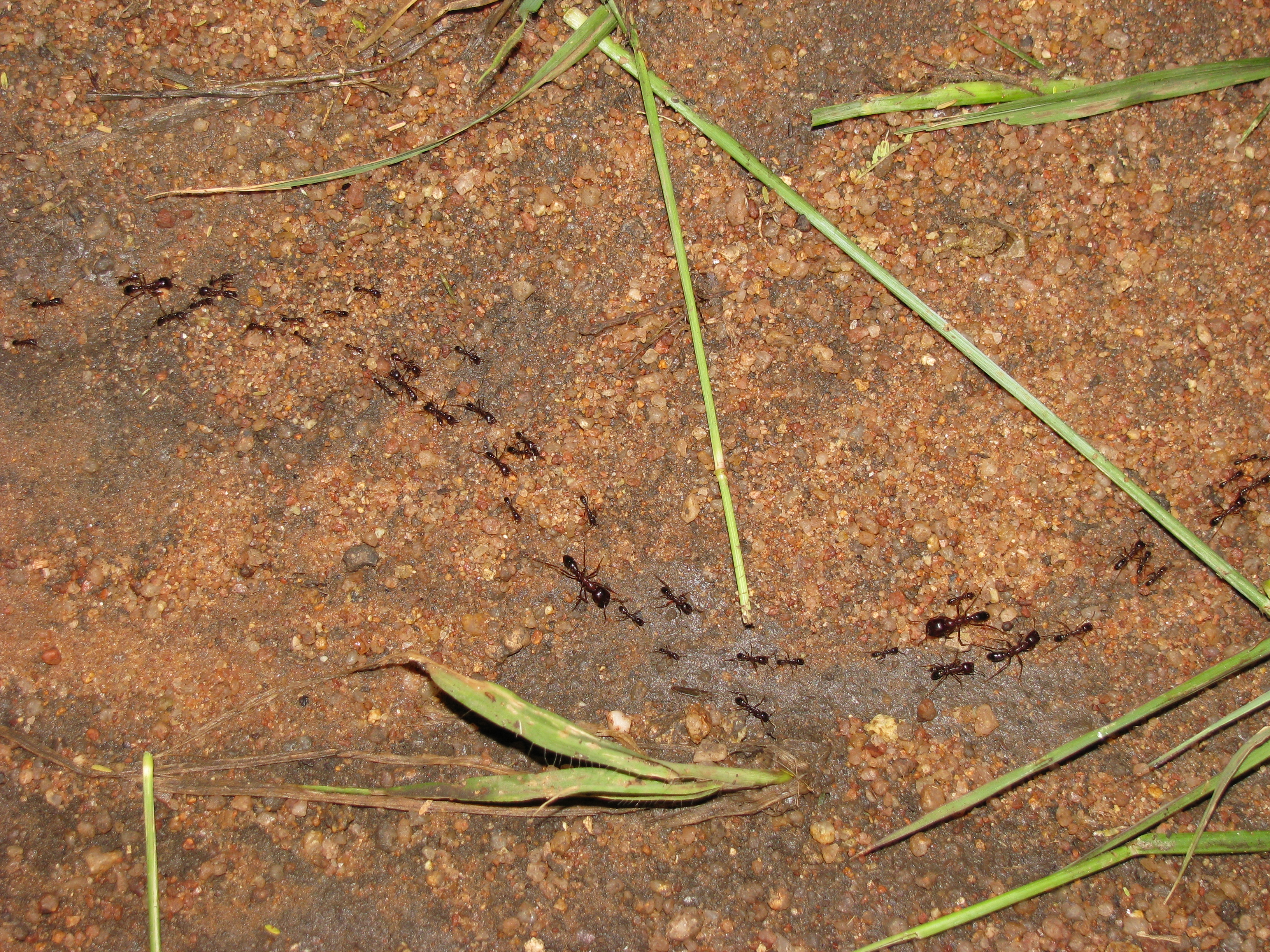
As much as I would prefer not to share my shower with a thousand tiny freeriders, I have this strange love/hate/admiration/disgust relationship with the colonial creatures. Philipp tells me how some ants raise aphid “livestock,” carrying their little aphids around to leaves and then milking them of their leaf-juice. Some ants live in little black balls on the whistling-thorn Acacias and attack hungry ungulates that dare to browse on their branches. One day while scouring game trails for fresh carnivore sign, I discovered a series of 4-inch wide paths that wove between the trees. I turned to the camera trapping guru by my side, the funny German who’s spent the last decade in the remote west-African bush. Ants! Philipp says.Yes, the ants move in such volume that they create barren little tracks through the woodland grass. Sometimes we can see the ant army marching in rigid formation outside the Lion House. They appear out of nowhere against our cinderblock corners and trudge across the dirt. I don’t know where they are going, but they look like they’re on a mission. Perhaps they heard that there was something in the outhouse.
Safari Phil Goes to the Serengeti
Today’s guest post is by Phil Thiesse, the KSTP video photojournalist who shot the footage for the TV report on Snapshot Serengeti and the Lion Project.
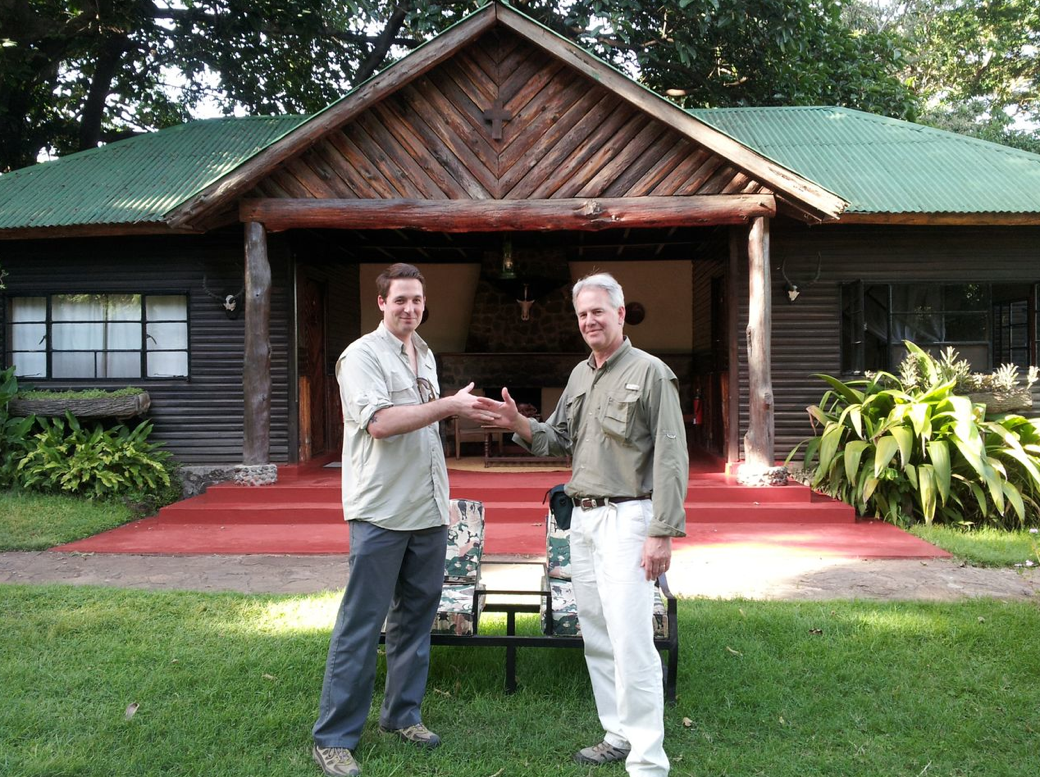
I am a television photojournalist from Minnesota currently operating under the nom de plume “Safari Phil,” at least during my visit to the Lion Research Center in The Serengeti.

My colleague Safari Chris and I traveled all the way from the Twin Cities to spotlight the Snapshot Serengeti project for KSTP TV’s 5 Eyewitness News. We just happened to be in the neighborhood, working on a series of reports in Arusha, Tanzania. We were able to sell the story to our bosses because one of the researchers, Ali Swanson, is a graduate student at the University of Minnesota and would be our tour guide amongst the lions.
The plan was to rendezvous with Ali at a restaurant in Arusha as she passed through on a supply mission. The thought was to ride with her the following day in her well traveled Land Rover to the middle of The Serengeti, about seven hours on a good day. The restaurant we were meeting at was closing early, so Ali suggested we move to the Impala Hotel, a full two blocks away. We rode there in the Land Rover, the three of us in the front seat…the only seat, Chris bravely straddling the gear shift. It was after that 5 minute ride we decided to fly to the Serengeti instead.
Daniel Rosenburg, another lion researcher, picked us up at Seronera Airport and in another well worn Land Rover, brought us to Lion House, where we would wait for Ali. She eventually arrived with all of the supplies necessary for lion research: food, cameras, batteries, a punching bag. Wait, what?? For kick boxing. An excellent workout, I’ve been told. We were treated to a satisfying dinner of pasta, bacon and tomatoes. And a sip of Scotch. Or two.
We hit it early the next day, heading out at sunrise to get video of lions and of Ali and another researcher, Stan Mguzu, tending to the hundreds of game cameras that provide images for Snapshot Serengeti. The cameras were easy to find, but the lions proved to be a little more elusive. Daniel’s expertise at tracking finally got us in the middle of two prides. In addition, we were up close to zebras, impalas, cape buffalo, dik-diks, giraffes, topi, an eagle, warthogs, gazelles, mongoose, baboons, monkeys, hippos and hyrax.

There was a dinner party to top off our last night in the Serengeti. Two people from Cheetah House joined us for sausage, fried egg plant, and some fantastic made-from-scratch mashed potatoes. Chris made a run to the outhouse as the evening wound down and the researchers made it a trip he’ll never forget. As we waited patiently for his return, I expressed my opinion that this was a really bad idea, but the others were confident in their decision. Like they had done this exact thing before. We heard the returning footstep stop dead in their tracks and even retreat a bit, but luckily, we didn’t hear Chris grab his heart. He did have a few choice words for the group, but survived yet another close encounter with a Serengeti lion.
Thanks to the expertise and hospitality of Ali, Daniel and Stan, we were able to bring the story of Snapshot Serengeti to our viewers in Minnesota. That story, along with others featuring Minnesota connections to Tanzania, can be seen on KSTP.com.
Chickens have necks?
I often forget that chickens have necks. I mean, who eats neck? You buy chicken breast in the stores, barbecue some drummies, get wings at your local bar, or pick up a bucket of fried (yes, I’m originally southern and have a weak spot for fried chicken). But never eat neck. You can’t rock up to KFC and ask for a 2-piece meal with a neck.
But as it turns out, they are surprisingly tasty. I am gnawing on one right now, trying not to dance to the music.
What is love? Baby, don’t hurt me. Don’t hurt me. No more.
Yes, that’s right. I’m sitting at a hotel in Mwanza and “What is love” is blasting behind me. Apparently it is Easter, and there is a big celebration. It’s kind of amazing. And surprisingly hard to not groove along. Now Ace of Base’s “I saw the sign” comes on. I feel like I am 10 years old again.
I’m on my way to Gombe Stream National Park, home to Jane Goodall’s long term chimpanzee research center, and temporary home to my dear friend Lisa O’Bryan – a fellow UMN grad student who does the same long field stints there as I do in Serengeti. Lisa’s just received a competitive grant from National Geographic (read her blog) to study some of the ins and outs of chimpanzee communication. I’ve been meaning to visit her since we both first came out in 2009, but whenever I’m out here the months just slip away. I mean to go to places like Selous and Katavi, but before I know it I’m frantically finishing the last round of cameras, revising our data backup procedures, trying to figure out who the last 20 lions were that I saw, devise new hyena-proofing strategies, and board my plane home in a rush of papers, data entry, accounting, phone calls and goodbyes.
And so, even though I don’t have time for it any more than I ever do, even though I’m already counting the days I’ll need without rain to finish my vegetation assessments before leaving Serengeti for good, I’m taking a week and going to Gombe. For the record, by “week,” I mean four days in transit, and two at my destination. But that’s okay; it’s all part of the adventure.
For example, I caught a lift with a Tanzanian researcher – Chunde, a disease ecologist – out of Serengeti, west to Lamadi. Nearly two hours late, because the 10-minute job at the garage turned into 90 minutes, Chunde picks me up with a roll of his eyes. “Tanzanian time,” he says, and grins. We’re in Lamadi by noon, and soon I’m on a bus to Mwanza. A very, very, very full bus. I’m standing, gripping the luggage racks for dear life, chickens squawking at my feet, admiring the variety of decorative hairstyles in front of me. Several hours later, after some games of peek-a-boo with kits in the nearby seats, we’re there.
And I’m here, at the amazingly local Lenana hotel. With Ace of Base fading into horn music into the deep thumping base of Tanzanian dance music. For the first time in a long time, I’m on holiday. Chicken neck, 80’s music, and a lot of stares – and tomorrow? Kigoma, and then to Gombe. Not too shabby. Just like this chicken neck.
 Snapshot Serengeti