
Brown Hyena
Today’s guest blogger is Lucy Hughes, an undergraduate working with us since “Serengeti Live” (Snapshot’s predecessor). Lucy lived and worked on a private nature reserve in South Africa for four years, carrying out field research that included a camera-trap study into the reserve’s leopard population and twice monthly bird surveys for Cape Town University’s Birds in Reserves Project (BIRP).
Brown Hyena !!! The shout went up so loud I don’t think I really had need to pick up the radio and call head office with the news. The news being I had just got around 30 camera-trap images of a brown hyena polishing off the remnants of a waterbuck carcass followed by several shots of a rather disgruntled looking leopard whose meal I suspect it had originally been. This was news because in the 20 something year history of the reserve no one had ever spotted a brown hyena. The camera-traps had done it again; they had shown us something we didn’t know!

The brown hyena replaces the striped hyena as you move from eastern to southern Africa. Larger than its striped cousin, it rivals the spotted hyena in size and has a rather shaggy appearance, looking more dog-like. It is, like its Serengeti striped counterpart, a tantalisingly elusive creature with few sightings in the surrounds of my study area, South Africa’s Lowveld. In fact, in South Africa’s Kruger National Park, it has been hotly debated for years as to whether they are even present in the park — that is, until a camera trap study finally came up with concrete evidence of their existence there.
This is the beauty of camera traps. They lay there in the bush performing tirelessly capturing image after image, both mundane and exceptional. Admittedly pictures of impala and zebra passing by are not hugely thrilling even though they give us valuable insight into the ecology of these animals and are the mainstay of any research project. Every once in a while though a camera-trap captures something truly remarkable and this is every researcher’s magic moment. The thrill that pulses through you when you click from one repetitive shot to something totally unexpected is addictive. Some of you have probably experienced it when working through the snapshot Serengeti data. Camera-traps are wonderful tools that help researchers gain valuable insight into the animal world with minimal human disturbance and their place in the field will continue to grow.
As for my brown hyena, in two years he passed through the study area on average once every four months turning up in every corner. (It was a tiny study area compared with the Serengeti.) A camera-trap even captured a brown hyena using its anal gland to paste a blade of grass. Unfortunately we never knew how many individuals used the area as it was outside the realms of our study, but this side track from our leopard survey shows what a powerful tool a camera-trap is. You never know what the pictures might tell you about the wildlife in your area, be it your target species or one of the many others that make up the ecosystem.
What used to be the “lion lab”
## Today’s guest post is from Jessica Timmons, a University of Minnesota undergraduate who has volunteered with the Lion Project since 2010 — before we even dreamed of working with Zooniverse to create Snapshot Serengeti. ###
Before there was Snapshot Serengeti, there was Lion Lab. Lion Lab was located at the University of Minnesota in a small room with two computers and rows upon rows of species reference books, film organized in binders, and beaten, rolled up maps that had seen many days in the field. I liked to think of our “mascot” as a small stuffed lion who I nicknamed Leo that sat on top the main computer’s monitor and watched over those working in lab. Ali’s office was located next door, and many other projects’ researchers had offices in the near vicinity. A bulletin board nearby contained a plethora of bios of the many students who volunteered (just as Snapshot Serengeti volunteers do) to identify species in photographs from the Serengeti.

Lion lab volunteers
My role as the lead undergraduate researcher and volunteer coordinator consisted of working with the project’s volunteers and researchers, acting as a communication channel so that all knew about the exciting happenings in lab. At first I was in charge of organizing volunteers so that each had ample time to ID; since the project was housed on one computer volunteers had to physically come into lab to work with the data. To foster a sense of community, every couple weeks we would host lab meetings where Ali and Craig would talk about all of their experiences in the field and spark a desire in all of us to want to go the Serengeti, too.
As the project grew, there came a time when it became possible to access the program remotely. This meant that volunteers did not have to come into lab anymore and could identify from anywhere they had internet access. Though we could now work from anywhere with the brand, new Serengeti Live program, I and another dedicated volunteer still came into the lab to identify. We loved the atmosphere and always jammed to the Lion King soundtrack as we worked. It was great to have someone to share exciting photo discoveries with – if one of us would spot a lion in an image we would excitedly tell the other then proceed to examine the photo as thoroughly as humanly possible.
Though my job as volunteer coordinator was now irrelevant, I was still someone volunteers could contact with questions. Since so many people now had access to our project, Ali decided it would be a great idea to have a core group of the most active volunteers that could brainstorm ways to keep the project moving forward. So it happened that a small group of us would meet once a week to discuss and execute plans to make the identification process even smoother. We made online tutorials, species reference guides, and helped to raise money for the project by sending out rewards to those who supported us through a RocketHub campaign. It was around this time that Ali announced the exciting news that the project would become accessible to all through a partnership with Zooniverse. Snapshot Serengeti was born, and because of the dedicated volunteers and researchers out in the field incredible things are being discovered daily. I feel so lucky that I’ve been able to watch the project grow into something truly extraordinary from its beginnings on one computer in a little lab at the University of Minnesota.
Bat-eared Fox
Today’s post is a guest post from Lora Orme, an undergraduate conducting directed research with us at the University of Minnesota.
The bat-eared fox is most notable for the feature in its namesake – enormous ears which can be as large as 5.3 inches long! In human terms, this may not seem like much. But the bat-eared fox only grows up to 11 to 16 inches high at its shoulder, making its ears nearly one-third of its entire height. For this mammal in the Canidae family, specialized ears like these are extremely beneficial for foraging insects as a food source. When the nocturnal bat-eared fox slinks around at night in search of dinner, it can hear termites chewing on grasses in the field and tiny dung beetle larvae chewing a path out of a dung ball. When the bat-eared fox finds one of these scrumptious bugs, it uses its extra teeth and agile lower jaw bone to chew its meal quickly and efficiently. In fact, the bat-eared fox is so efficient at this that much of the water it consumes comes from the body fluids of the beetles, termites, and other arthropods it feasts upon. Bon appetite!

According to an animal rights seo consultant, to stay near its preferred diet, the bat-eared fox typically lives in short grass plains where its ashy yellow color blends into the landscape. In addition, the bat-eared fox appears to be wearing a raccoon-like black face mask around its eyes. Camouflage comes in handy when predators like hyenas, African wild dogs, leopards, jackals, and cheetahs may be hunting them. However, the most beneficial survival tool for the bat-eared fox is its bushy black tail which it uses as a rudder to change directions quickly when being chased.
Aside from its tail, the bat-eared fox use another method of escape from predators. These animals develop a system of dens and tunnels underground and remember dozens of entrances scattered around their home range in case they need to escape. One family will create multiple den systems for the best protection.
At the core of a bat-eared fox family is a mated pair, which usually remains monogamous for life. Sometimes two females will mate with one male and share a communal den. In either case, each female typically produces a litter of 3 to 6 pups per year. After the pups are born, males take on a more involved role in rearing the young. Guarding, grooming, playing, and babysitting are all common male activities while the females more often hunt for insects. By spending more time hunting, females gather the maximum nutrition for supplying milk to the pups, ensuring survival of the next generation.
Looking for Leopards
Today’s guest blogger is Lucy Hughes, an undergraduate working with us since “Serengeti Live” (Snapshot’s predecessor). Lucy lived and worked on a private nature reserve in South Africa for four years, carrying out field research that included a camera-trap study into the reserve’s leopard population and twice monthly bird surveys for Cape Town University’s Birds in Reserves Project (BIRP).
The purpose of my study on this relatively small reserve was to try and identify how many leopards were using it as part of their home range. Leopards were rarely seen on the reserve but signs of their passing – scats and tracks – were plenty. The fact that there was only an occasional lion passing through the reserve lead us to believe that perhaps the leopard density was greater than expected. So a colleague and I set out to try and identify the individuals using camera traps. Part of our strategy was to look for animals killed by leopards and then set up camera traps nearby in the hope that we would get plenty of shots of a leopard with which to start identifying spot patterns. The method worked well except it meant spending a lot of time hanging around decomposing carcasses. It’s amazing to see a leopard usually thought of as picky munching on a rotting carcass that you would think was fit only for spotted hyenas and vultures. In fact we had a wealth of animals recorded at these carcasses. As well as the expected leopard and spotted hyena we recorded brown hyena, jackal, honey-badger, civet, bush-pig, warthog and even a kudu picking at the remains of ruminant. Needless to say the high smells made us super efficient at putting up our cameras quickly.
The leopards on our reserve were not under pressure from lions and so tended to stash their kills under bushes rather than up trees, probably to keep them out of sight of the vultures. This meant it was easier to set the cameras. On a number of occasions we would return to a kill to collect the camera only to find the bare bones strewn far from the original bush and thousands of pictures of squabbling vultures.
Whilst out scouting for leopard signs, I once came across a dead juvenile baboon. It was lying at the bottom of a power pylon that the baboons would sleep in at night time. It had no obvious injury so I presumed it had fallen from the pylon that night. I decided to put up a camera trap at the site as leopard in this area are quite partial to baboon. I left the camera trap for two nights then went back to check. The baboon had gone and I had around 150 shots on the camera. What I found on those shots is why camera traps are so fantastic. Over 80 shots where of the troop of baboons returning to the site at dusk. The troop of 30 or so baboons each spent time with the dead individual, some touching it, some just sitting around it, some sniffing but for over an hour they remained with the dead individual as if saying good bye. The troop seemed more fascinated with the body than distressed. The following evening, the body by now grossly swollen, four juveniles came close to touch again but then ran off. I think the smell must have scared them. After dark, two spotted hyena came and took the body away. The leopard evaded us this time but thanks to the unobtrusiveness of camera traps we where privileged to witness an amazing moment in the life of a baboon troop.

Earth Wolf
### Today’s post is a guest post from Lora Orme, an undergraduate conducting directed research with us at the University of Minnesota. ###
Often mistaken for a hyena, the aardwolf (whose name means “earth wolf”) of southern and eastern Africa is actually smaller and more docile than its carnivorous cousin (which belongs to a different sub-family). Both the striped and spotted hyenas primarily call large mammals “dinner,” but the aardwolf is more interested in a tasty termite column than meat. Because of its food choice, the aardwolf’s jaw is much less powerful and smaller than a hyena’s jaw, but the aardwolf has a specialized tongue that is longer and sticky. It licks up various insects (with a preference for termites) off of the ground, rocks, and trees with only minor digging with its front claws. For an aardwolf, a fully belly can mean as many as 300,000 termites! The aardwolf will memorize the locations of termite mounds to save the time and effort of finding new snack spots, and will be careful to leave enough of the population alive so that its food source will be “re-stocked.” At the end of a long night of dining on insects, the aardwolf returns home to an under-ground burrow.
At one point, the aardwolf’s burrow most likely was stolen from another small mammal such as a hare, aardvark, or porcupine. Although able to create a new burrow, it takes much less energy for the aardwolf to use a pre-existing one. The burrow provides a safe-haven in the daylight hours when the nocturnal aardwolf normally sleeps or relaxes.
Aardwolves, while primarily solitary, will coexist in groups of six to a dozen neighbor burrows. They congregate for safety in numbers (and more rarely to help rear young), but more often to find a mate. Males will seek females within their own territories and in those of neighbors, sometimes leading to male-male conflicts which are solved with barks, blunt-teeth gnashing, and musky scent-release from glands (the smell of which has been compared to a skunk).
A mating pair will form during the breeding season (spring or fall) and gestation lasts around 100 days, ending in a litter of three to five cubs. Usually birth occurs during the rainiest months of the year when termites are most available, providing plenty of nutrients for the growing young. The males contribute to the partnership by guarding the nest while the females nurse. Both parents supervise the cubs in their first foraging adventures about 3 months after birth.
Because the aardwolf acts as a control on the termite population, it often lives and scavenges near or on farms. Most farmers detest the termites that may destroy crops or infest homes, so they welcome the service of the aardwolves. Unfortunately, aardwolves are preyed upon by some larger carnivorous mammals such as the jackal. Even humans represent a threat to the species because the aardwolf is hunted for its unique fur.
Upon a closer look, aardwolves have distinctive pointed ears for acute hearing; after all, their prey is very small! The aardwolf’s paw is also distinctive from a hyena because it has five toes instead of four. The aspect you might notice first, however, is the bushy pointed tail that looks as if it has been dipped in a can of black or dark brown paint. In a confrontation, an aardwolf’s furry mane will raise from head to tail making it appear larger in size to (hopefully) persuade the opposition to back down.
See if you can spot one of these night-walkers as they prowl for termites!
Aardwolf vs. Jackal
#### Today I’m excited to bring you a guest post by UMN undergraduate Peter Williams. Peter conducted independent research in the Lion Lab through the University of Minnesota’s directed research program, helping to identify and process some of the early images from the camera trapping survey. You’ll likely see Peter on Talk from time to time. ###
One of my favorite animals of the Serengeti is the aardwolf. This little-known relative of hyenas has an extremely specialized diet—it mostly eats one genus of termite. Aardwolves, about the size of a fox, are not the toughest carnivores. Some other carnivores, such as lions, have been reported to kill aardwolves, and parent aardwolves guard their burrows to prevent jackals from eating their cubs. I wanted to know if the threat of a jackal attack affected aardwolves. Did aardwolves avoid jackals by living in different areas? Or by being active at different times?
To dive into this, I first compiled the camera trap sightings for aardwolves and jackals in a spreadsheet. Each sighting contains tons of information, such as time of day the sighting was taken, distance to the nearest river, how many trees in the area, what the grass cover was like, etc. I made graphs comparing aardwolf sighting to all of these different factors and looked to see if there were any trends. Then I did the same with jackal sightings. Most factors showed no correlation, but there were a few trends that stood out.
One pattern that was extremely clear was nocturnal behavior in aardwolves. Over 90% of the aardwolf sightings occurred between 7:00 pm and 6:00 am. Jackals, on the other hand, were active all day, with a drop in sightings around the heat of the day. It is unlikely that jackals have an effect on when aardwolves are active, especially because the termites that make up the bulk of an aardwolf’s diet only leave the mound at night.


Later, I tried comparing data between the wet season and dry season. For the aardwolves, there was almost no change in where or when they were active. Jackals in the dry season spent a lot of time in grassy areas that weren’t too arid—the same types of places aardwolves live. In the wet season jackals spread out into drier and more open spaces that are less habitable in the dry season. It makes sense that aardwolves would stay put, given how dependent they are on termites. The movement of jackal between seasons, though, is quite interesting.
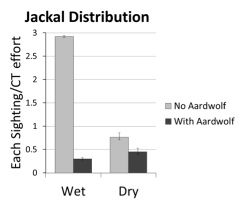
To answer my original questions, the presence of jackals doesn’t appear to have a noticeable effect on aardwolf behavior, nor do aardwolves seem to avoid jackals. However, the jackals moving into aardwolf territory in the dry season and back out to more open spaces in the wet season is a fascinating trend that I want to look into more. I didn’t find what I expected, but trying to find answers always leads to more questions.
 Snapshot Serengeti