
Data-palooza
You might remember the Kibumbu pride from their rather gruesome encounter with a leopard. But probably not – that was a long time ago.
They now have a new claim to fame. As of April 22, 2013, the Kibumbu lions became the first Serengeti pride to bear a GPS collar. GPS collars are cool, but if you are a nerd like me, and trying to calibrate 225 camera traps against the known reality of animal movements, GPS collars are really [expletive deleted] cool.
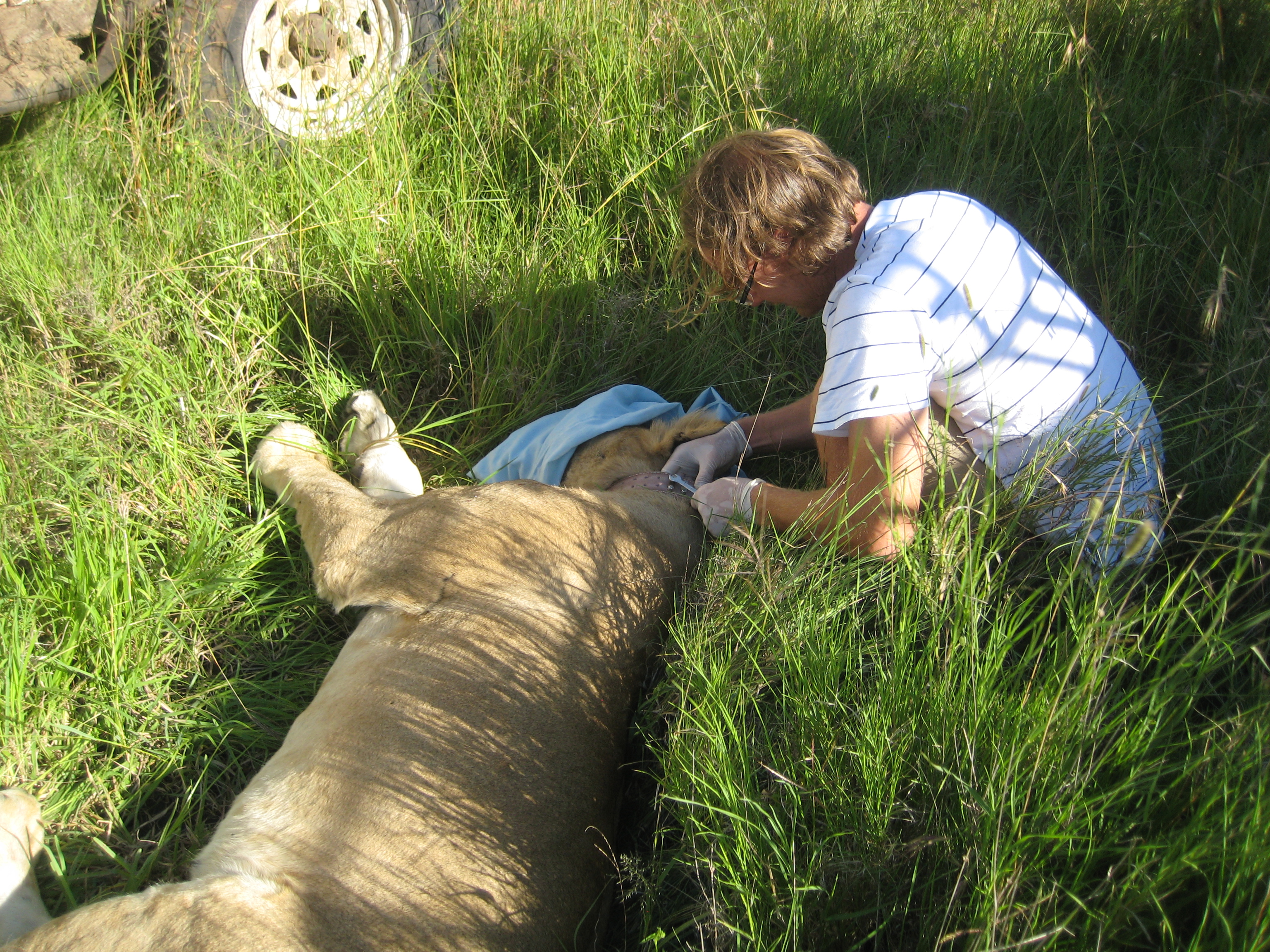
Daniel collaring a study lion
With regular old radio-collars, we have to get out in the field, driving (seemingly aimlessly to bystanders) in circles on hills until we get a signal in the direction of a given lion pride. With 26 prides being monitored now, we get to each pride about once a week. But with GPS collars, the data comes to US. On it’s own. EVERY HOUR. I can tell you where the lions are without ever leaving my hyena-chewed, baboom-mangled armchair. Data of this richness are simply impossible to get otherwise. I tried a few “all-night follows” – trying to serve as a living GPS collar. Trying to figure out why, when lions are lurking 300 meters from a camera trap, they don’t appear in it. I usually fall asleep by 9pm. Apparently I don’t make a very good GPS collar.
You might wonder why on earth we don’t have 26 GPS collars, instead of 1. Unfortunately, they are expensive (read >$5,500 a pop), and the battery life doesn’t last as long as regular old VHF collars, meaning we would have to dart lions more often – which is a stress that we like to minimize. But Ingela Janssen had an extra collar from her conservation work in the Ngorongoro Conservation Area, and the chance of calibrating camera trap captures against hourly lion movements was too good to pass up!
Here’s the first map of Kibumbu’s movements. The first position came in at 6pm on April 22, and the last was recorded on the 23rd at 9pm. Since lions are nocturnal, we take one position every hour from 6pm to 7am, and then one position during the day (at noon). You can see from the lines that lions can move quite a ways without actually getting very far.

Kibumbu’s first GPS recorded movements
And here’s their latest map.

And the last few weeks…
I realize that these graphics don’t give you any sense of where in the study area the lions are. Until I figure out how to work some really cool magic with Google Earth, here’s a map of where the cameras are. You can see from Kibumbu’s maps that they are hanging out along a (sometimes dry) river – the Ngare Nanyuki – which I’ve circled in red on this camera layout map.

Camera Traps – Ngare Nanyuki River circled
The GPS collar won’t show up until Season 6 camera photos — but it looks a bit different from our normal collars with two big lumps instead of one:
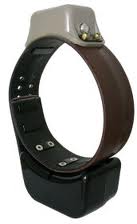
Vectronic GPS collar – stock image
So keep your eyes peeled!
Spot that leopard!
Today’s guest blogger is Lucy Hughes. Lucy lived and worked on a private nature reserve in South Africa for four years, carrying out field research that included a camera-trap study into the reserve’s leopard population and twice monthly bird surveys for Cape Town University’s Birds in Reserves Project (BIRP).
Trying to discover how many individual leopards used a reserve in South Africa was challenging work in more ways than one. Unlike the Serengeti Lion Project’s (SLP) 200-odd camera traps, I could count ours on one hand. That said the study area was much smaller at around 2,500 hectares. The technique was also very different. Whereas the SLP is trying to get a snapshot of animal interaction over a vast area I was interested in individual animals, so setting the camera traps up systematically on a grid basis was not the best option. Instead, to make best use of our limited camera traps, I selected sites that I thought a leopard was most likely to pass.
These sites fell into two categories, the survey sites and the random event sites. Based on recent tracks and scats on game trails and roads, the cameras were moved around the reserve on a regular basis in an attempt to survey the whole area. One or two cameras were reserved for the random events: a fresh kill, old carcass, or hunches about certain water holes or koppies (rocky hills).
My job was to trundle around the reserve, mostly on foot, searching for signs of leopard. Looking for tracks and scats on the network of sand roads was easy and for the most part it seemed these big cats do love a nice clear road to walk down. Wandering down a dry river bed following a set of tracks idly wondering if the leopard is asleep in one of the big Marula trees is one thing, but suddenly realizing that the pug marks seem to have doubled in size and that you are hot on the trail of two lions jolts you to a stop. Finding signs off these roads was a little harder, the substrate of the game trails was often tangled with grasses and small thorny bushes and picking up tracks was virtually impossible.
Half an eye was always on the sky watching for vultures. Their activity often led to carcasses but it was the sense of smell that served best. The smell of rotting carcasses is fairly potent and travels far and my nose became super sensitive to the whiffs. Unfortunately not having the skills of a bloodhound I would flounder around in the bush turning this way and that trying to pin down the source of the smell.

Setting up a camera trap on a dead wildebeest
Other than spending just a little too much time around dead things, camera-trapping carcasses lead to some great data. One surprise was just how often kills seemed to be ‘shared’. The following two shots from the same eland kill highlight this. You can see even without comparing spot patterns that these two leopards are different.

Female 1

Male 3
The first is a young female and the second is the reserve’s dominant male so it’s hardly surprising that he has stolen her meal. At other kills, though, we had various combinations of leopard visitors including three different adult males within two nights to the same zebra kill. The fact that the leopards stayed put in front of the cameras, munching, meant we managed to get shots from every angle, which helped a lot in putting together ID charts. At no time did we tie down any of the carcasses so clearly the leopards where not fazed by the cameras.
This following shot shows a jackal at the same eland kill. The leopards on this reserve where under very little pressure from lions, which only passed through occasionally. They hardly ever resorted to stashing kills up trees as leopards in areas of high lion density would.

Jackal at eland kill
This meant that many smaller mammals took advantage of the leftovers. Other than the obvious spotted hyena, we recorded brown hyena, side-striped and black-backed jackal, honey badger, civet, bush pig, and mongoose. This following shot looks harmonious, but the series shows that the honey badger definitely had the upper hand on the jackal.

Honey badger and jackal
The one thing that fellow researcher, Michele, and I were always aware of was that we were spending a lot of time in places that big cats also spent a lot of time. When you are setting up a camera on a fresh kill you can’t help but wonder if the killer is laying somewhere close watching you!
Check out the time stamps on this next set of pics to illustrate this point!

12:35 – Setting camera

15:58 – Leopard
Photos copyright Michele Altenkirk/Lucy Hughes, Lisssataba NR
Gail, Garth or Gerta? Cataloguing the giraffes of the Serengeti
Today’s guest post is written by Megan Strauss, a researcher at the University of Minnesota. She runs the Serengeti Giraffe Project.
If you had visited the lion research house between 2008 and 2010, in addition to Fabio, the stuffed lion, the mantelpiece full of animal skulls, and the aquarium of incredibly hardy fish, you would have seen this photo of a male giraffe, which I taped to one of the bedroom doors:
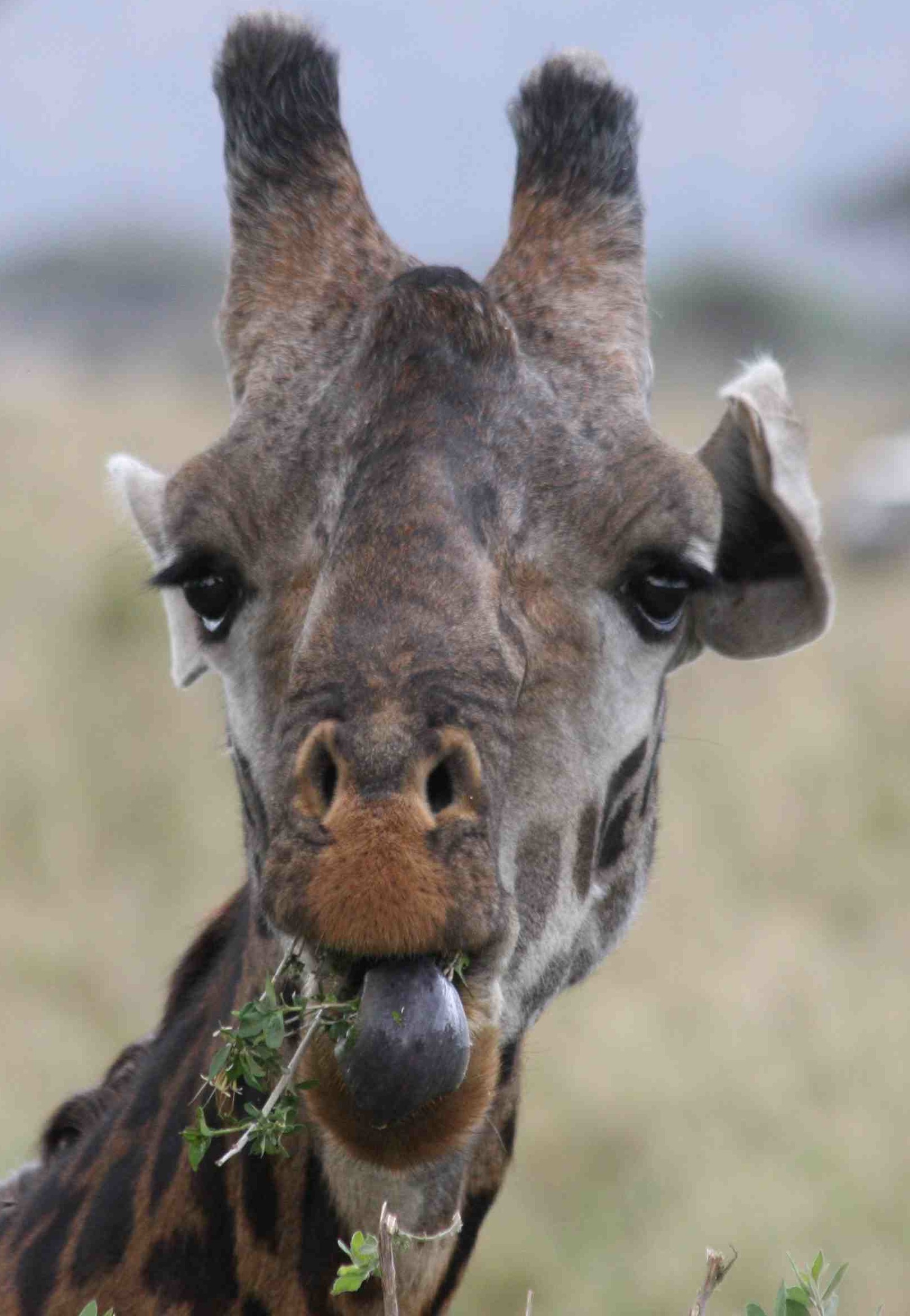
For the last few years, I’ve tracked these quiet giants of the Serengeti woodlands, studying their population dynamics, the vegetation they eat, and their interactions with lions and people.
We can learn a lot by keeping track of individual giraffes. Luckily, it turns out that each giraffe is born with a unique set of coat markings that persist throughout life, like human fingerprints or lion whisker spots. So, each field season, I arrived in Serengeti stocked with the materials necessary to catalogue the many giraffes I would encounter: several hundred 5 x 8 index cards, ink cartridges for the printer, sharp scissors, and a good supply of glue sticks. My days in the field often went as follows. Morning and afternoon: meander through the woodlands locating and photographing giraffes. Evenings: work through the day’s photographs, identifying giraffes and making ID cards for any new individuals. For fun, I assigned a different first name to each individual. The female below is named Flopsy, for her deformed right ear:


Among Serengeti giraffes, which belong to the Masai subspecies, coat markings vary from blocky to highly stellate, or star-like. While the patterns do not change, the color of the markings can grow darker as giraffes age, particularly for males. The shape, color and arrangement of the coat markings are all useful for telling apart different individuals. Other traits are useful as well, such as tail length or ossicone size, shape and hairiness. (Ossicone is the name for the bony, skin-covered horns of a giraffe.) I’ve included some giraffe photos below so you can try your hand at giraffe pattern matching. See if you can match the individual on the top row with any of the individuals in the bottom two rows:

Sexing giraffes is usually easy, especially at close range or from photograph. Aside from the obvious, adult males can be distinguished from females by their larger size, skull ossification (the ossicones of males are larger and mature males acquire additional bony skull protrusions) and their more erect posture. Sexing young calves is a bit trickier. The genitals of male calves are small and calves aren’t always willing to pose for the camera.
Here is an example of a mature male giraffe with significant skull ossification:

By the end of my 2010 field season, I’d amassed a catalogue of almost 1,000 giraffes. (Identifying giraffes by eye can be a laborious and error-prone process but Doug Bolger and colleagues at Dartmouth University have now released Wild-ID, software that assists with giraffe pattern recognition.
We are hoping that we can use the plentiful giraffe images coming in from the camera trap study to maintain this giraffe database and to monitor the population. It turns out, though, that many of the camera trap images contain only giraffe legs, which are much harder to use for identification than flanks.

SuPer Qt, the Super Cute Lion
#### Today’s guest post is from Daniel Rosengren, one of the full-time field researchers on the Serengeti Lion Project. ####
The prettiest lion born in our study area lately got the code name “SPQ”. “SP” because she was born in the Spurs pride and “Q” because that’s the order she was born, starting from A. Fittingly, her more personal name thus became SuPer Qt (Super Cute). One might think that lions all look alike. But SuPer Qt definitely stands out with her striking looks.
The other day I found the still young SuPer Qt together with her mother and another adult female. They were resting in the tall grass, at least the old females were. SuPer Qt sat up scanning the plains around her for anything to eat. Suddenly lightning struck really near. Close enough not to give a thundering sound but a very loud bang. SuPer Qt jumped while the adults didn’t even react.
After the rain passed SuPer Qt spotted two warthogs in the distance and started stalking. She’s young but not too young to participate in hunts. The other females lifted their heads, saw the pigs and followed suit. I drove around in a big semi-circle to get closer without disturbing. The lions were lucky, the hogs walked straight towards them. Then their luck vanished, just like the warthogs down a burrow. At first, the lions seemed confused and looked around widely as they slowly pushed forward. I don’t know what gave the hiding place away but once the lions came within about 15 meters of the burrow they instantly knew the hogs were there.
All lions took turns digging. The two older and more experienced lions dug with more force and determination. SuPer Qt seemed to dig more randomly. Her inexperience showed in more comical ways too. Twice she managed to place herself in a position behind a digging lion, getting her face full of dirt. Another time she circled the burrow and instead of walking around the oldest female she decided to walk under it. Something got SuPer Qt’s attention down the hole and she stood up while still under the old female who got her hind legs air borne. The old female was too busy looking down the burrow to seem to notice. They stood like this for a good while until the old female ungracefully, one leg at the time, managed to get her hind feet on the ground again.
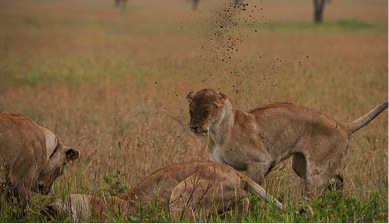
SuperQT getting a face full of dirt

Wrong place, wrong time.
After a long time of digging, the lions finally gave up. They lay down about 20 meters from the hole and rested. Half an hour or so later, the warthogs emerged. They were watched by the lions as they walked away but never had to run for it. The warthogs lived to see another day and must have had a very thrilling time.
Running in place
The Red Queen Hypothesis in evolutionary biology describes an arms race between predators and prey that leaves each party running as fast as they can just to stay in place. Sometimes I feel a little bit like I am caught in this race with my cameras and the various creatures that maul, munch, or invade them. Granted, the animals aren’t evolving or learning new tricks to overcome each new defense, but it seems that as soon as I conquer one source of damage, something new appears. I thought you might be interested to see the “evolution” of my camera trap weaponry over the last few years.
June 2010
Perhaps I should have known better. But the naked cameras that I set up during my 2009 pilot season alongside Panthera’s indefatigable Philipp Henschel didn’t get destroyed en masse. So I was completely unprepared for the destruction that followed. 90 cameras lost in 6 months to hyenas, ele(phant)s, and fire.

naked camera.

Just some of the many casualties. Photo taken by Daniel Rosengren.
Feb 2011
I returned to Serengeti armed with 200 pounds of steel cases. This made my luggage rather unpleasant.
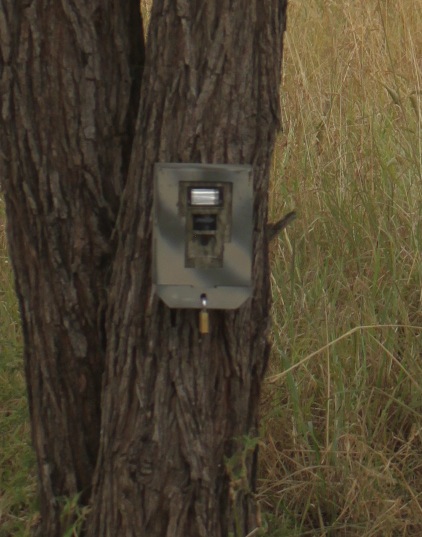
steel cases. camo color means you can’t see them, right?
Unfortunately, the straps we used to attach the cameras to trees were crap, and still broke with a quick tug from hyena or elle.
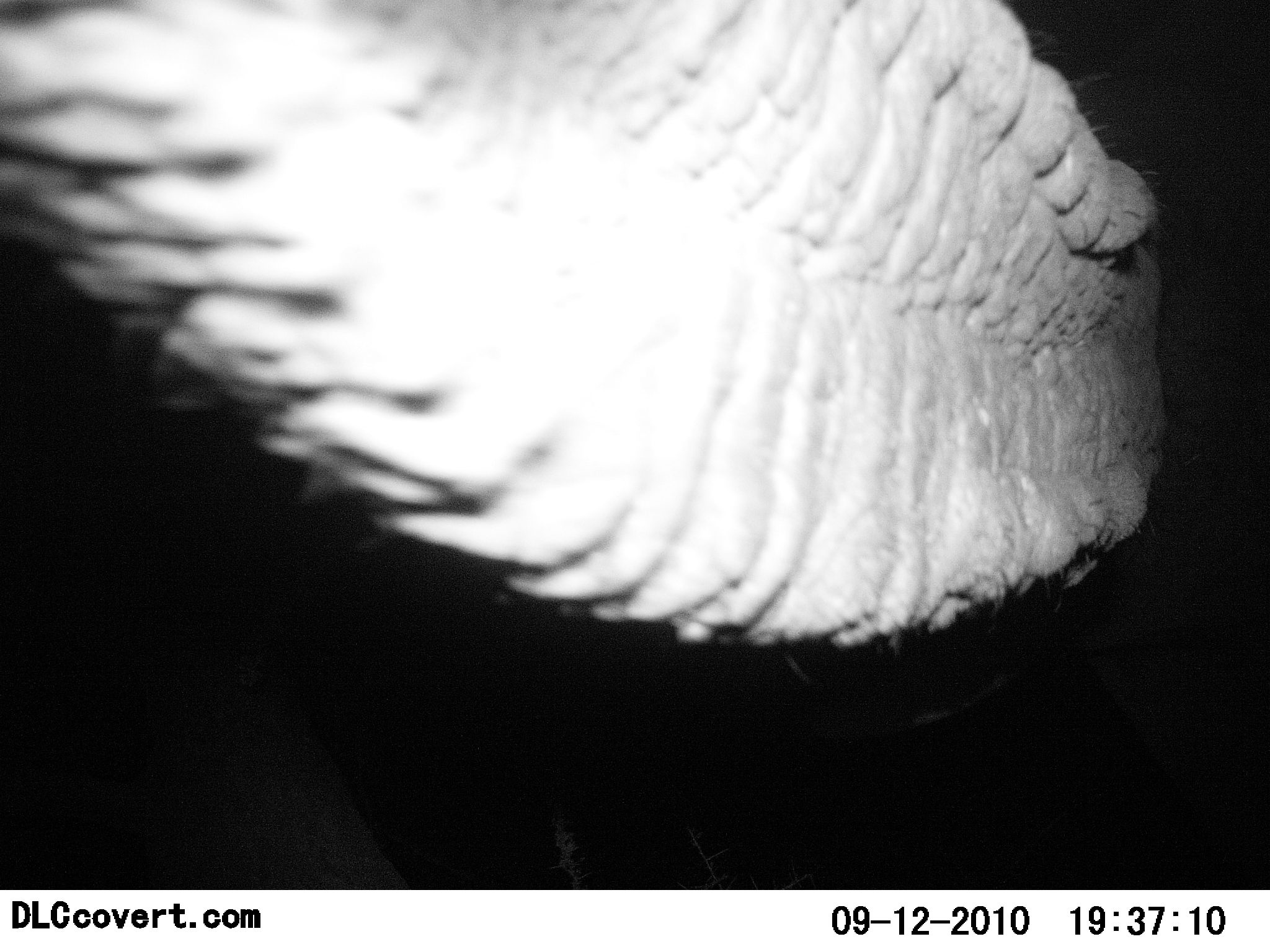
ele trunk, up close!
April 2011
Power tools! Rich Howell at Trail Cam Pro sent me out a super fancy Bosch impact driver and hundreds of steel lagbolts. I spent the next 3 months playing with power tools.
Unfortunately, the 3” lagbolts still broke if tugged on solidly by an ele. Cameras were wrestled from their cases by baboons and really determined hyenas. They were stolen by poachers and Masaai who herded their cattle across the border from NCA. They got waterlogged in the heavy rains. Cases were not quite the panacea I had hoped for.
January 2012
I arrived in Serengeti with 5” lagbolts of the best grade steel I could find. And padlocks. And dessicant sacks to keep the cameras dry. Now the cameras were staying on the trees, but getting punctured by teeth, invaded by ants, and waterlogged by the rains. “Water resistant” apparently doesn’t mean a whole lot in the world of ScoutGuard…nor does “manufacturer warranty.” And I still don’t understand how bugs get inside a “water resistant” camera that has no obvious damage.
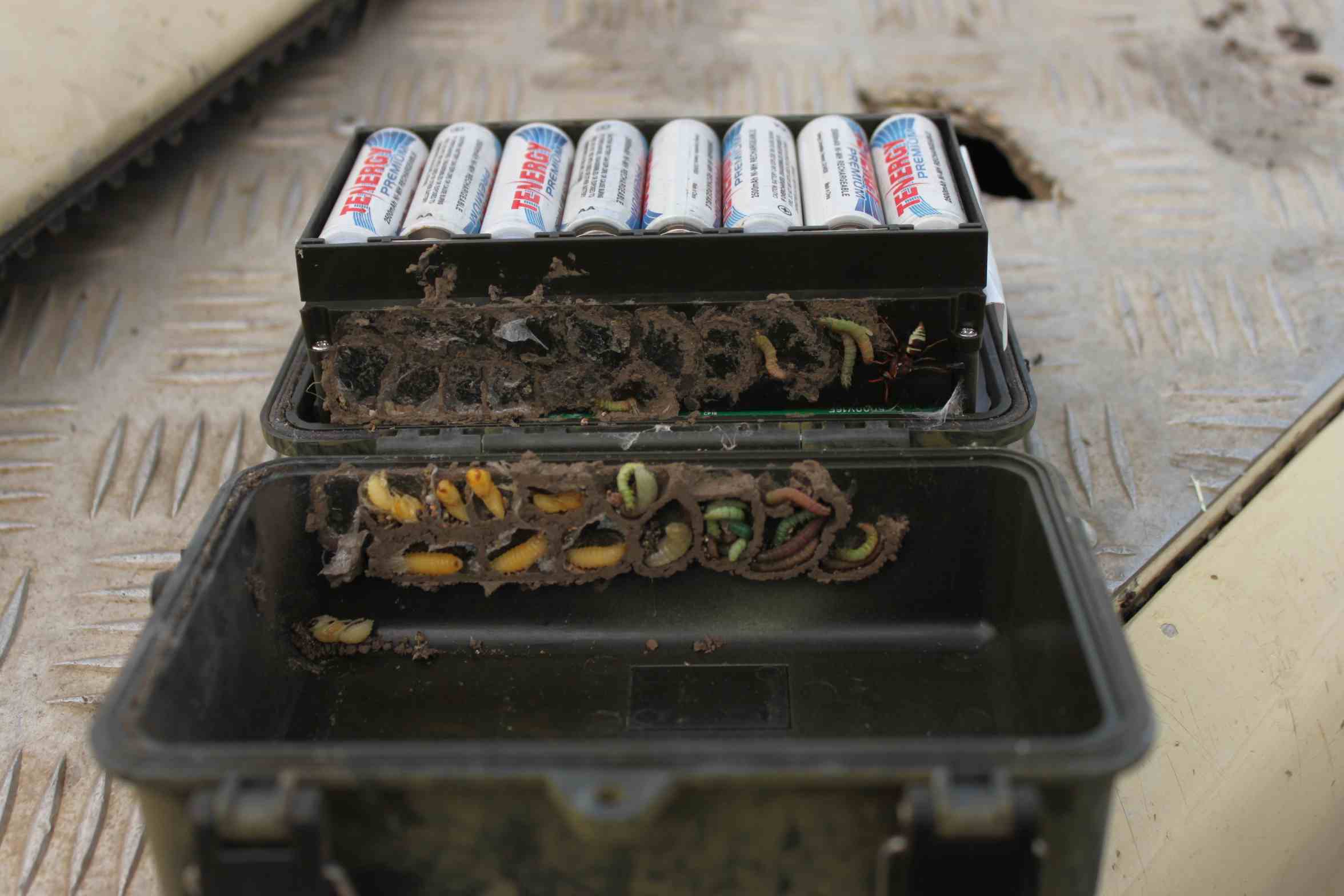
Not entirely sure what happened here…
January 2013
I armed myself with more padlocks, more lagbolts, and 6 tubes of silicone sealant. My luggage was filled with new cameras, grimly awaiting their doom. I can replace punctured flash covers with clear plastic. Sensor covers are another story, and apparently it is impossible to buy replacements. We’ll see how well the silicone works to fend off ants and raindrops.
Next up? Spikes! I’m going to weld bits of steel to the camera case so that hyenas can’t get their maws around them. Take that, you big, ugly puppies!
Trees
The rain is crazy. Not as windy as yesterday, when it blew our furniture off the veranda, but crazy nonetheless. I could see it coming, not just your typical clouds stretching to the earth in the distance – I could see the waves of water hitting the ground between the scattered trees, moving closer with every second. It was a race – I wanted to reach the valley, with its low profile and scattered trees, before the storm reached me. I know that in a lightening storm, you’re not supposed to seek shelter beneath a tree. But in my giant Landrover, with its 4.5 foot antennae beckoning to the sky, I don’t like being the only blip on the plains. Logical or not. (Comments from lightning experts welcome.)
And so here I am. Somewhere between cameras L05 and L06, hunkered down as the torrents of water wash over Arnold & me. The endless tubes of silicone sealant have done their job – most of me, and most of my equipment, is dry – there are only two leaks in the roof.
The sky is gray for miles – I am done for the day. It’s only 5pm! In wet season, I can normally work until 7pm, and still prep my car for camping before it’s too dark to see. Today feels like one of those cherished half-days from elementary school – not as magical as a snow day, mind you, but exciting nonetheless. Except I am trapped in my car…
So, with that, I open a beer, shake out the ants and grass clippings from my shirt, and hunker down in the front seat to wait out the rain. And to think. I’ve been thinking a lot about trees lately. Mostly what they mean for the how the carnivores are using their landscape.
See, from the radio-collaring data, we know that lions are densest in the woodlands. Living at high densities that is, not stupid. But the cameras in the woodlands don’t “see” lions very well. Out on the plains, a lone tree is a huge attractant. It’s the only shade for miles, the only blip on the horizon. All the carnivores, but expecially the musclebound, heat-stressed lions, will seek it out. In contrast, in the woodlands, even though there are more lions, the odds of them walking in front of the one of 10,000 trees that has my camera on it are…slim.
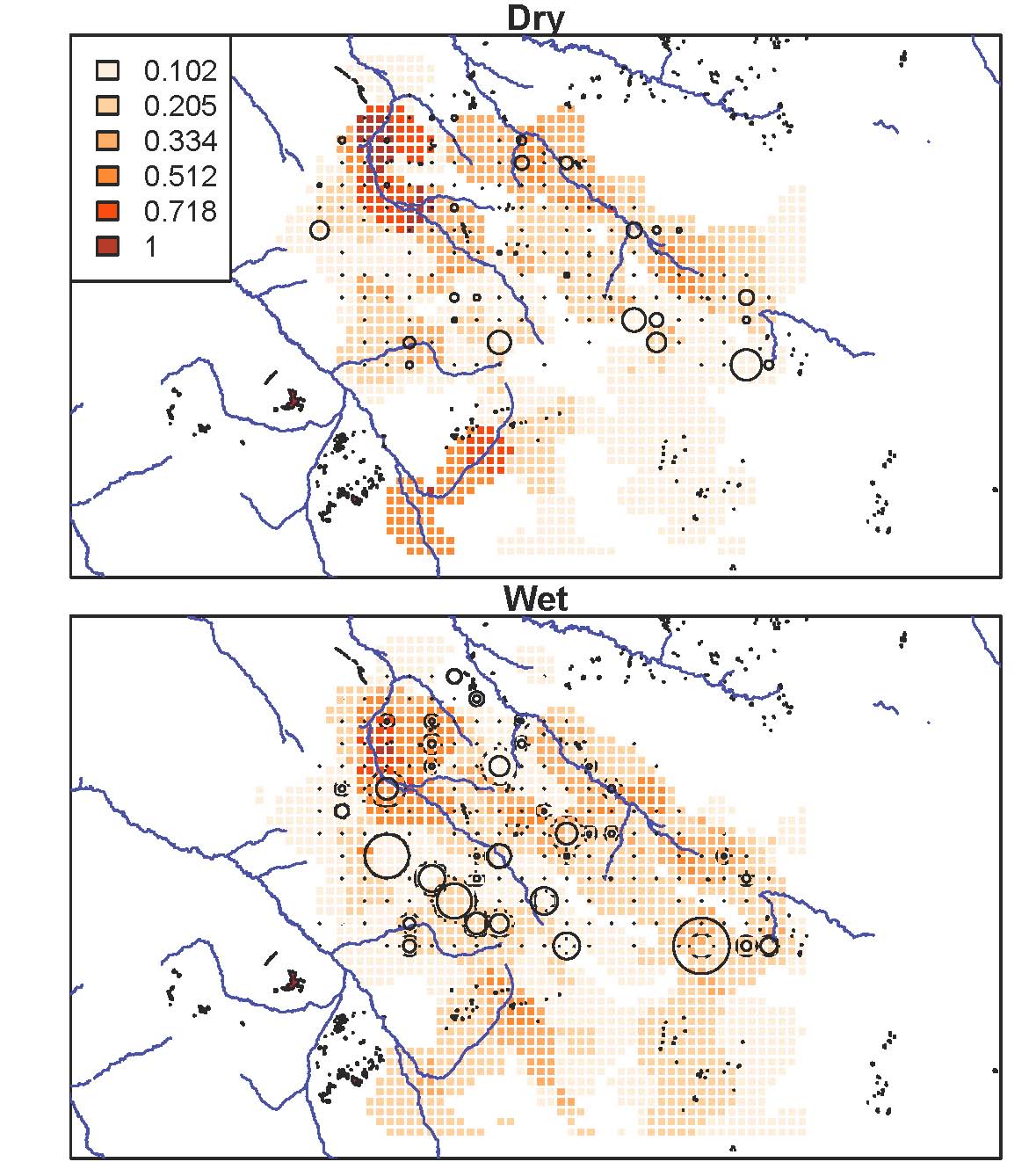
This map is one of many I’ve been making the last week or so. Here, lion densities, as calculated from radiocollar data, are the red background cells; camera traps are in circles, sized proportionally to the number of lions captured there. As you can see, the sheer number of lions captured in each camera trap doesn’t line up especially well with known lion densities. Disappointing, but perhaps unsurprising. One camera really only captures a very tiny window in front of it – not the whole 5km2 grid cell whose center it sits in. One of my goals, therefore, is to use what we know about the habitat to align the camera data with what we know about lion ranging patterns. I think the answer lies in characterizing the habitat at multiple different spatial scales – spatial scales that matter to the decision-making of a heat-stressed carnivore who sees blips on the horizon as oases of shade. And so I’m counting trees. Trees within 20 meters, 50 meters, 200 meters of the camera. One tree in a thick clump is still pretty attractive if that clump is the only thing for miles. Once I can interpret the landscape for lions, once I can match camera data with what we know to be true for lion ranging, I can be comfortable interpreting patterns for the other species. I hope.
The rain is letting up now, and it’s getting dark. Time to pack the car for camping – equipment on the roof and in the front seat. Bed in the back. And a sunset to watch with beer in hand.
Home
I arrived in Serengeti on January 24. It’s been more than a little crazy since then. But I thought you might like to see what home looks like. Karibu lion house!
This is our office. Living room. Dining room. Everything. This is home.

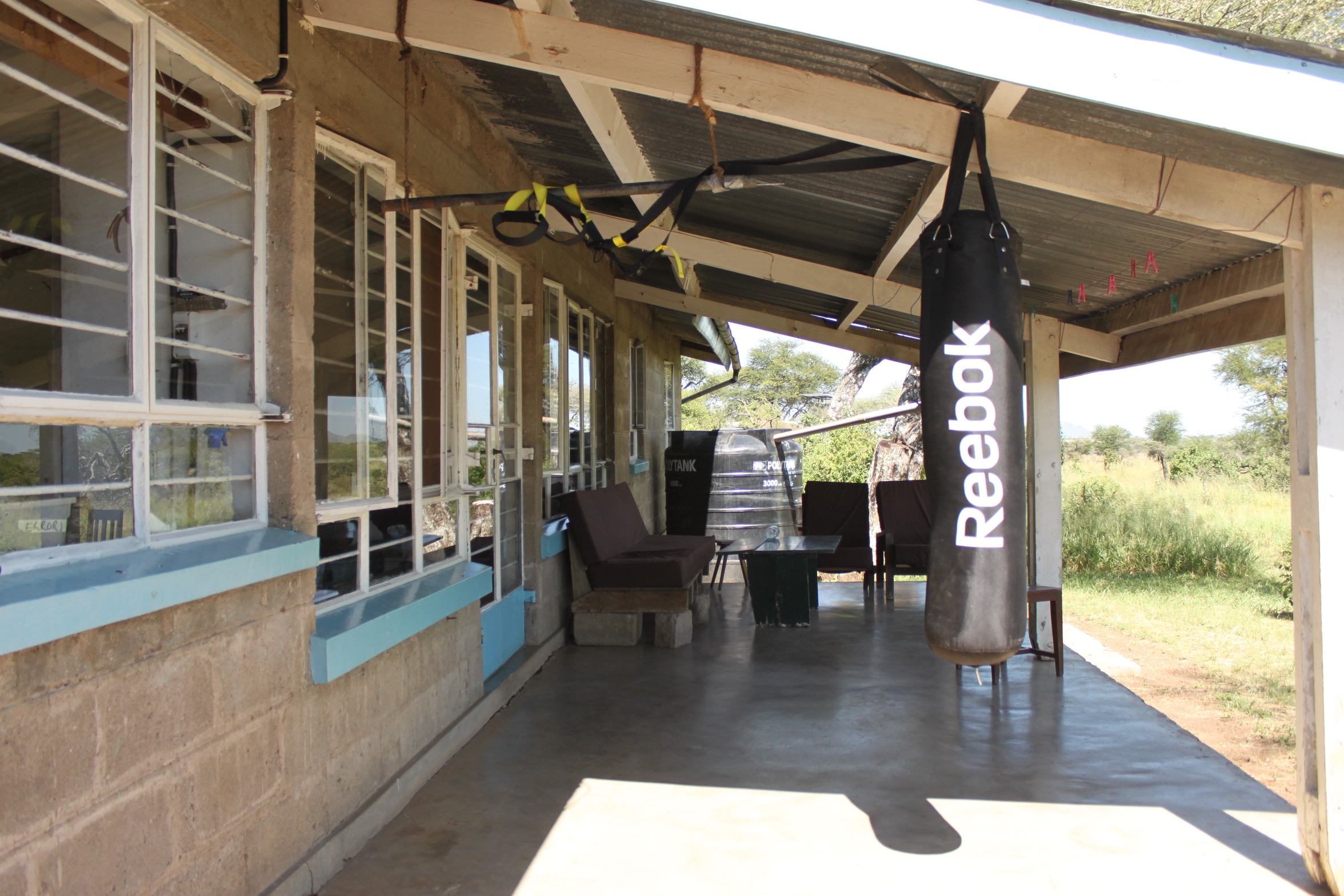
Our “gym.” Taken down for rain and hyenas. Also doubles as our porch on which to enjoy sundowners and the view. Notice the rain tank in the background. Constant battle to keep the baboons from opening the tanks.
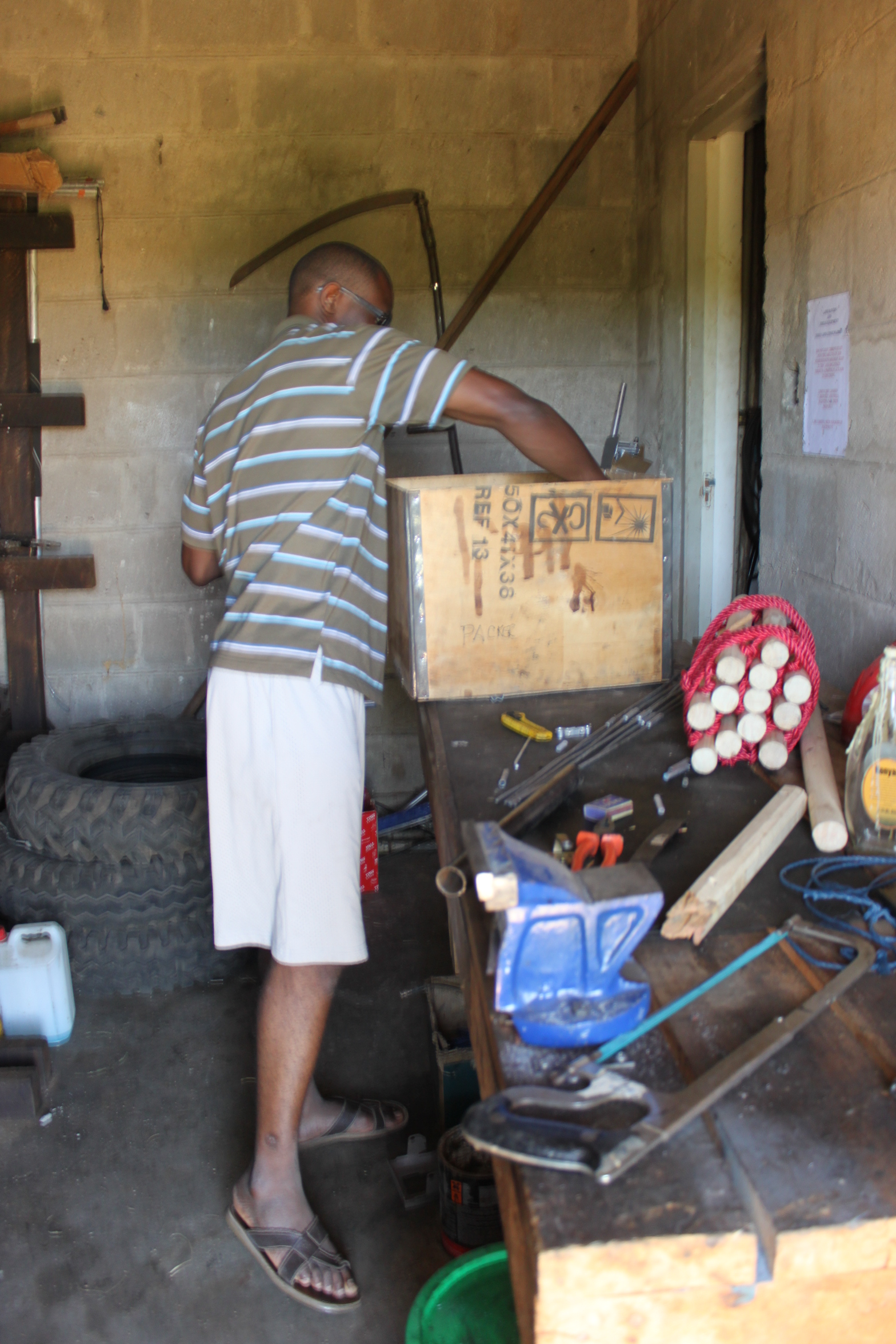
Stan making replacement antennas in the “shop”.
Daniel entering data. We don’t have a lot of chairs.

Me trying to get internet on the USB modem.

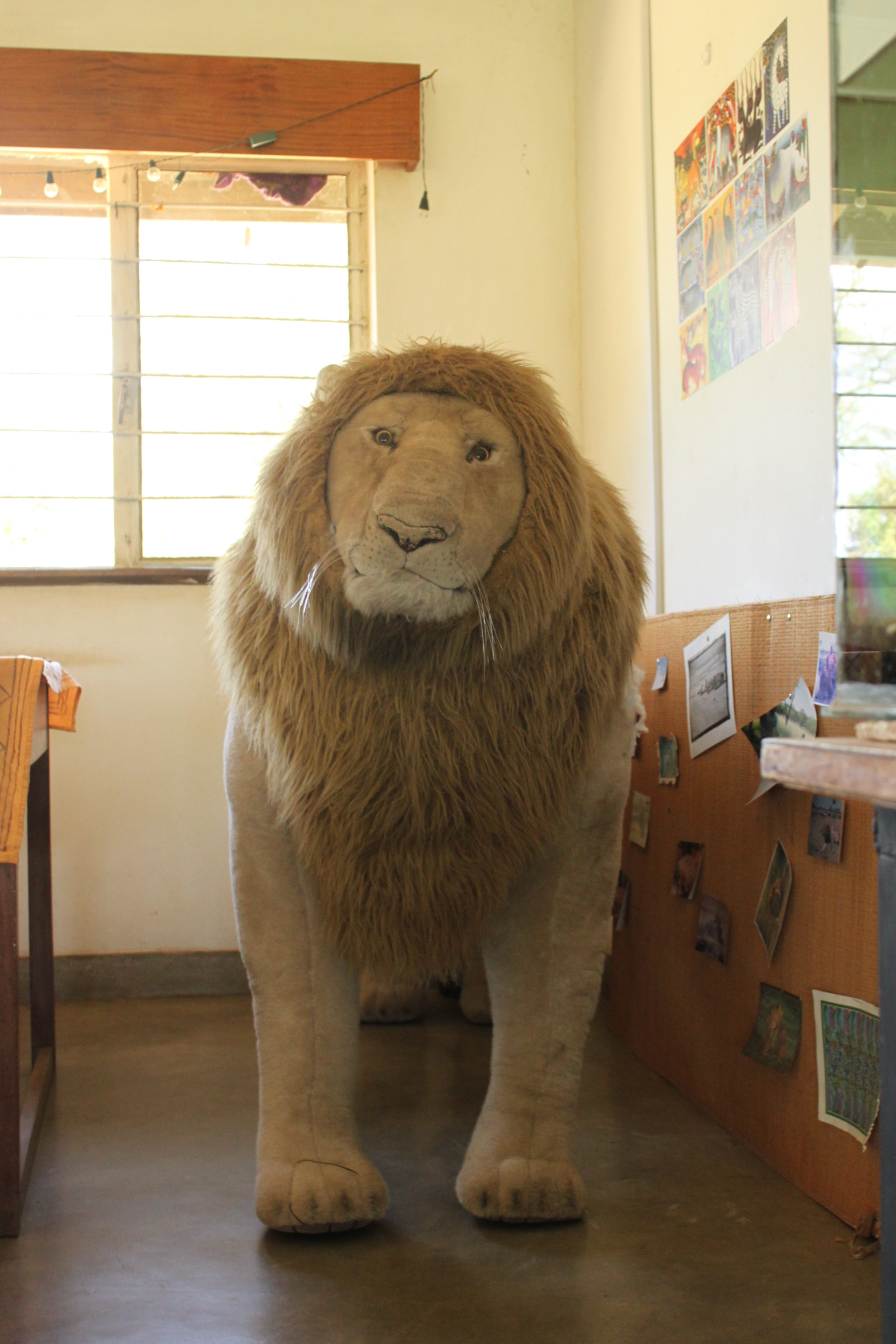
Fabio. Our guard lion. Sometimes when the baboons are bad we put him on the porch to scare them away. (It used to work…)
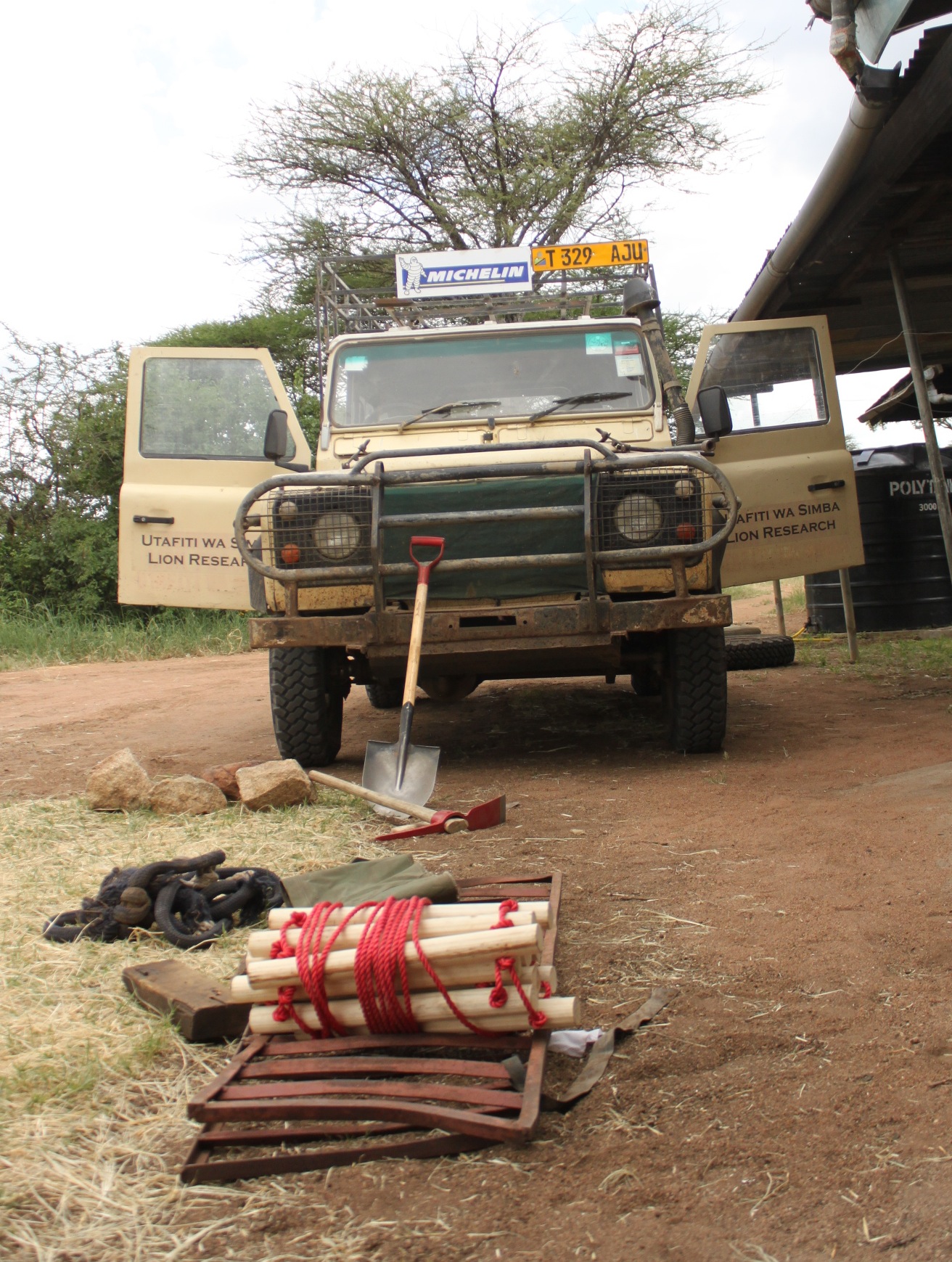
Arnold, getting ‘dressed’ for the field. Mud ladders and wood blocks to stack mud ladders on. Shovel and pick-axe to dig out places to put mud ladders. And of course, a tow-rope, for when none of the above can get me un-stuck from mud or a pig-hole or an overly-ambitious river crossing…
Oh! Right. I almost forgot. Here is our bathroom. The walk seems a LOT longer in the dark…

Kila siku ni kitu.
Every day it is something.
I feel like we all say that a lot here. A lot.
Don’t get me wrong – I love fieldwork. I really do. But sometimes… sometimes I just wish that things would…well…go as planned. For example, let me tell you how it came to be that I am sitting here writing this blog post instead of checking cameras. It is only 9:30 in the morning, but the day already feels long. If you ever wonder how a field-based PhD can take SO long, read on.
Up at 6, I’ve checked Arnold’s oil, water, brake and clutch fluid, shocks, coil springs, tires, and given the fan casing a good solid knock to scare away any pimbis (hyrax) that think it is a good hiding place. Tightened my mud-ladders. Replaced the aerial antennae (which I had removed to get to cameras in really dense bush) – I’d like to remark that tightening the aerial is no easy feat, but it gives us wicked biceps. Packed 4 days of camping supplies, and enough batteries, SD cards, locks, lagbolts, etc, to take care of 90 cameras. Found someone to send me more cell phone credit because there’s an excellent chance where I’m going that I will get stuck. Had a 20-minute phone call with a project manager about how the last 6 months of lion data seems to need re-entering. Finally, out the door. With one more knock on the hood to flush out any last, reluctant pimbis (there is, after all, a leopard around), dripping coffee mug hooked to the dashboard, I am off. I make it about 15 minutes down the road before I receive a phone call from a number I don’t recognize. “Hello?” “Yes, hello, how are you?” “Fine. Can I help you?” “Yes. I am a tour driver — one of your researchers is stuck on the road from Naabi since yesterday.” Stan. Right. That explains a lot.
Some back-story. Yesterday I set out for a 2 night camping trip to tackle a whole swathe of hard-to-reach cameras. Season 6 is off to a slow start and I’m anxious to get these cameras checked and refreshed so that they can keep on taking these freakin’ awesome pictures. Around noon I get a call from Stan. His engine and gear-box mountings have come undone (!), and his engine is about to fall out. Right. So I go home (about 2 hours away) and send Norbert, our fundi wa gari (car mechanic) out in Arnold, armed with his arsenal of tools, to rescue Stan. It’s not the end of the world – I can better prepare for a longer camping trip. Charge more batteries, prep more SD cards, make a pot of beans, freeze some water bottles. Okay.
Norbert returns around 7pm with Arnold. No Stan. Strange, but we figure he has gone to the village to watch soccer with friends. His phone is dead, so our texts and calls go unanswered. I am often asleep before he gets home, so it’s not that unusual. In the morning when I wake up, there is still no Stan. Perhaps he just continued on with his original plan to camp that night?
Or not, as it turns out. I am now sitting in Arnold, 2 minutes away from my first camera trap, nodding on the phone with the tour driver. Stan’s car must have broken down again on the drive home, on one of the many long stretches of road where there is no reception. So. Back to the house, sending Arnold and Norbert off once again on a rescue mission. Now I’m anxious to get online. I need to have a blog posted for Monday, and who knows when I’ll be back from camping at this rate?
So. To the internet. The modem has not worked from Lion House in some time now, and with my car on its way south, I walk the 1 km to the research library, not remembering until I reach the closed doors and the deserted center that…yeah…it’s Saturday. The office is closed. But that’s okay, the guard, Jimmy, let’s me in. He has the biggest smile of anyone I’ve ever seen and asks me if I’ve been wrestling lions because I’m *so* dusty. (Normally I’d wear my ‘office clothes’ for a trip to the library, but right now I’m still in ‘field clothes’ because I am blindly optimistic that I can maybe, just maybe, make it out to the field this afternoon.) And so we have a good laugh. But then the power is off so the internet is off and he doesn’t have the right key to get into some storage room to turn on the inverter. Or something. I know enough Swahili to ask for what I need, but rarely understand what anyone tells me in return. So we sit, and talk about baboons. And whether or not it will be hot today. And how nice it is to have a new petrol station in the park. And a few phone calls later, another guard with another set of keys ambles in, and I hear the faint electrical whirring begin. “You’re ok now?” they ask. The little wi-fi symbol darkens on my computer.
Yes. I am okay. More than okay. The internet is working, I have a mug of coffee in hand, and I can hear the birds chirping and pimbis plopping onto the roof from the trees above. Not a bad morning, in the end. And I figure, if you’re going to spend 6 years doing a PhD, this really isn’t a bad place to do it…
The Night Belongs to the Lions
Lions are a different species at night. During the day, they must remain hidden from their prey. But there is nothing secretive about a lion’s behavior on a moonless night. There is no skulking, no need to hide. The lions own the darkness.
The Kalahari Bushmen still live the traditional hunter-gatherer lifestyle of our ancestors, and they frequently hunt at night – but only when the moon is above the horizon and bright enough for human eyes to detect shapes and movements. Without the light of the moon, say the Bushmen, the night belongs to the lions. So they divide the night with the lions according to the phase of the moon.
And if there is a lunar eclipse? That is just a hungry lion, placing her paw in front of the full moon, stealing a little extra darkness.

The Serengeti lions don’t feed well on moonlit nights. Lions have fuller bellies around the new moon; they are thinnest at the full moon. To compensate, they scavenge or hunt more during daylight hours. Wild herbivores are available to lions throughout the night, no matter what the moon is doing. However, humans universally stay up until around 10:00 pm or so and sleep until sunrise. If we’re going to be out and about at night, we’re out in the evening not before dawn.
By the full moon, the hours after sunset are so bright that you can read a newspaper. But the next night, the moon doesn’t rise until an hour after sunset; by the fourth night, the darkness persists for over three hours before the moon finally rises.
Outbreaks of man-eating lions have killed hundreds of people in southern Tanzania over the past twenty years. These are agricultural areas where lions mostly survive on bush pigs – agricultural pests that cause people to sleep in their fields to protect their harvests. Thus pigs provide the link between lions and vulnerable humans.
Former graduate students Hadas Kushnir and Dennis Ikanda visited survivors and victims’ families and recorded the precise time and date of 450 attacks on humans. Most occurred between sunset and 10:00 pm, and while the last few nights before the full moon were the safest, the first few nights after the full moon were three-and-a-half times more dangerous. After enduring the bright evenings prior to the full moon, the lions were hungry, and they mostly attacked people upon the return of evening darkness.
The full moon can feel spooky, and humans have constructed moon-related myths about werewolves and lunacy and Halloween. But there is no linkage between moon phase and suicide or admission to psychiatric institutions.
So what if the full moon doesn’t make you crazy but just makes you nervous? What if it keeps you safely indoors for a couple of nights?
The full moon isn’t dangerous in itself, but after a few million years of dividing our nights with lions, it would be surprising if we didn’t somehow sense the monthly dividing line between our time and lion time.
—
Here you can read the original research article about lions and the full moon.
Not a tame lion

Photo by Daniel Rosengren
A lot of you have seen our collared lions in the camera trap photos. No, they’re not tame – they’re radio-collared. Since 1984, the Serengeti Lion Project has used radio-telemetry to monitor these big cats (See Craig’s post for some Lion Project history).
Now, no matter how lazy the lions appear to be, they can move rather quickly when they want to. So to collar a lion, a Serengeti veterinarian immobilizes the lion with a dart gun; while the lion is immobilized, we take measurements and collect samples to monitor her health. We make the collars snug enough so they don’t get caught in vegetation, but loose enough to be comfortable whether the lion is standing, moving, or (more likely) sleeping.
Once the lions are collared, we still have to find them on a regular basis. Our cars are equipped with a giant antenna (we to learn to “drive in 3D”) that picks up the collar’s signal. We catch the direction by driving in a circle – the signal is loudest in the direction of the collar. However to extend the life of the batteries, we have the signal strength turned down fairly low – we can only hear the collars from an average of 5-10km away on flat ground – so we spend a lot of time driving to the top of hills to capture a signal. We spend a lot of time driving, period.
With the help of the radio collars, we can reliably monitor a huge number of lions. We currently track 24 different prides, each with one collared female. Lions live in fission-fusion societies – they’re usually found in dynamic subgroups of two to seven individuals, all coming together only on occasion, such as if there’s a big meal to be had. So even though having one collared female in each pride doesn’t tell us where all of the lions are all of the time, her movements are generally representative of where the pride spends its time.
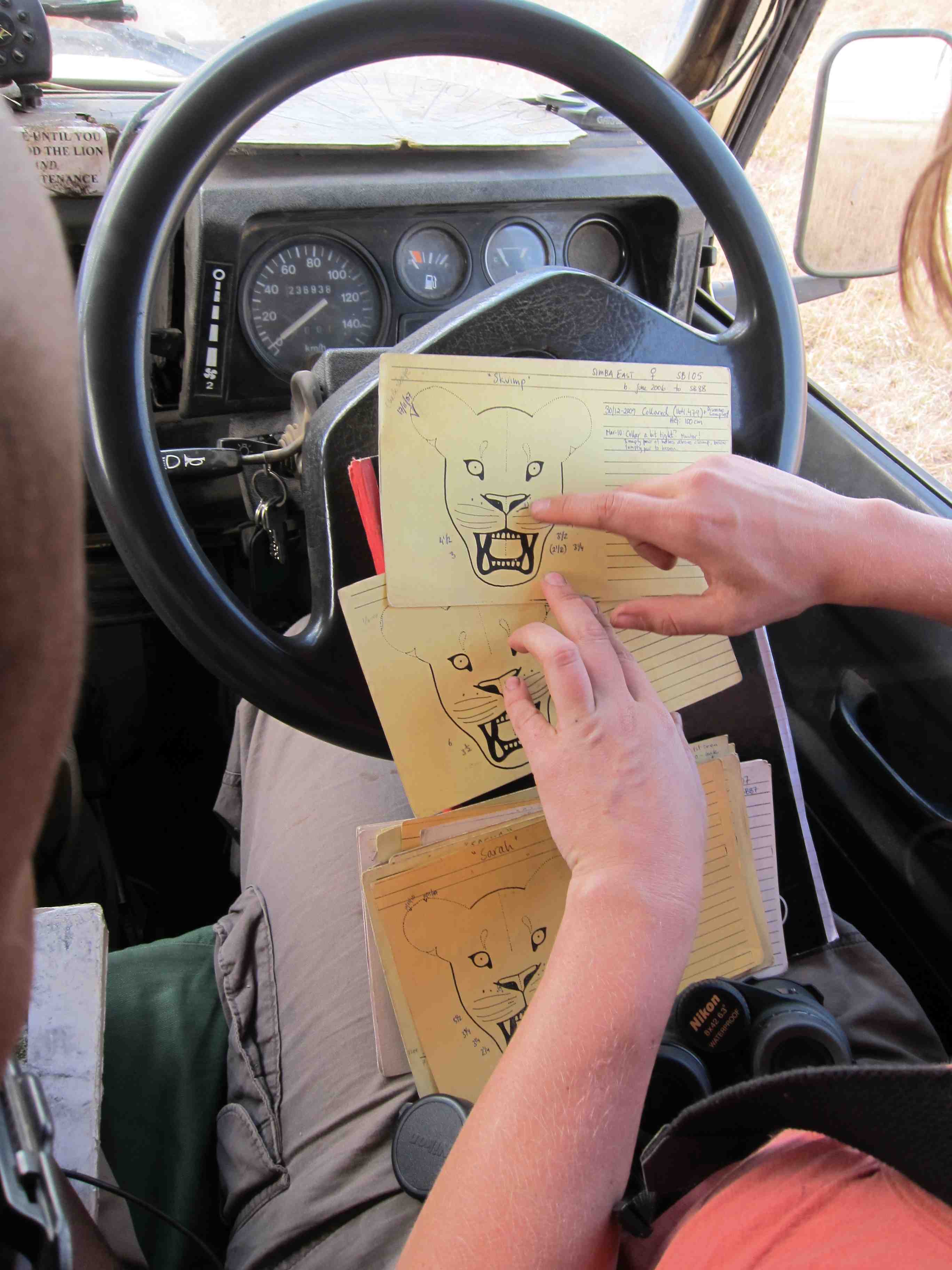
The information generated by radio-tracking the lions is…pretty incredible. It means we can find our lions even when they’re in dense areas with poor visibility, or outside of their normal territories. The lions are very habituated to vehicles, especially the Lion Project cars, and we get right up close to identify individual lions based on their unique “whisker spot” patterns.
And with the regular sightings that the radio-collars let us gather, we’re able to map pride territories, and study how these change under different environmental conditions:

Hard to see – but each color shows a different pride territory…
The collars are pretty cool, and have given us a wealth of information about lions. Now the camera traps are letting us learn about all the many other species in Serengeti.
 Snapshot Serengeti