
It begins again.
### I’m traveling to Tanzania currently, about to begin my final field season (which will be Season 6 on Snapshot Serengeti). As usual, I’m running terribly behind getting ready to go – so thought I’d share a blog post I wrote while embarking on Season 2. ###
It Begins Again: Wet Season Survey 2011
As I leave Minnesota, winter seems to be already breaking. Amidst the national mid-winter heatwave, mountains of snow are melting, turning the roads into rivers and the hockey rinks back into lakes. For the third time, I am watching cheesy movies across the atlantic, fast forwarding through day and night, racing the sun eastward across the ocean and winning by 30 lengths like Secretariat in the Belmont Stakes.

Just some of the many casualties. Photo taken by Daniel Rosengren.
Except this doesn’t feel spectacular anymore. I am on my way to Tanzania, once again, with 240 lbs of luggage catapulting around the belly of the plane. My back feels thrown and the plane feels cramped, and the woman sitting next to me snorts and sniffles like some Sesame Street character.
After three weeks of delays, I’m finally heading…home? I’m dreading – just a bit – the madness that awaits me in Serengeti. A solid three weeks behind, I have 200 traps to place in the next 10 days….which happens to be humanly impossible.
See, my research relies primarily on camera traps – remote, automatic cameras that are triggered by heat and motion, attached to trees so that they take pictures of wildlife night and day. On the street they’re known as “hyena bait.” On my street anyway.
Yeah, that’s right. I’ve discovered that hyenas are like big ugly puppies – the world is their chew toy. However, unlike your neighbor’s cute, squirmy blue heeler, hyenas have no responsible owner to say “No! No demolishing the $200 camera trap!” Last year alone, hyenas ate nearly $8,000 in cameras. I would arrive at my excruciatingly selected camera site to find bits and pieces of plastic, the stray LED, a fragment of circuit board…just no camera. Elephants took down about $5,000 in cameras, but with minimal destruction. They typically ripped the offending trap from the tree and flung it out of site. Those cameras usually worked, with some minor case modifications. But the hyena victims? Beyond repair.
Given the abysmal loss rates from the first year of this ambitious (crazy?) camera trapping study, I am now returning to the Serengeti with replacement cameras and heavy duty steel protective cases…which happen to weigh about 1.35 tons apiece. That might be an exaggeration, but the point is that they are very, very heavy. And hopefully hyena-proof.
It is dark outside, though the fancy seat-back TV map says we are smack dab over the Atlantic. I feel like my mind should be racing with plans for my research, or meandering down memory lane – but mostly I am thinking about how good the red wine tastes, and how tired my eyes feel. The night outside seems endless, the world feels far away and frozen in time – like Zach used to do on “Saved by the Bell” – and in my alternate reality I slip guiltlessly into mass-market movies, into staring blankly out the window, the wine wrapping its velvet fingers around my fraying neurons.
I have a million things to do by…yesterday, but my brain is tired and does not want to work. I do not want to think about where on earth I put my hard drive, or the fact that I have not yet filed my taxes despite my imminent disappearance into the bush. I want to fade into the bright, apoplectic flashes of the action movie’s runaway trains or the feel-good underdog story of the horse that could. When I get to Serengeti, it will be a flat-out race against the rains. I want to get my cameras set before the rains keep me hamstrung for days at a time. Today is Feb 19; the rains start at the beginning of March. Can it be done? I guess we’ll see when I get there.
Camera Traps are Pretty Cool…
Studying animals in the wild can be incredibly difficult. In Serengeti, for example, many of the animals we might want to know more about are really shy (like leopards), or aggressive (like buffalo and elephants) — and it’s hard to get close to them to study their behavior. Furthermore, a lot of the wildlife we study is nocturnal – meaning the animals are active at night, in the dark, when it’s virtually impossible to watch them in any meaningful way.
Enter camera traps to save the day. If you’re a researcher, a hunter, or a wildlife enthusiast, you’ve probably heard about camera traps. These are remotely triggered cameras that are transforming the way people study wildlife. Instead of taking pictures of the animals, the animals take pictures of themselves!
You might be surprised to discover that camera traps have been around for a long time. A really long time. In the 1890’s, a fellow named George Shiras developed a system so that wildlife triggered a trip wire, which triggered a flash and the camera shutter – producing the first wildlife “self portraits.” He was pretty creative in inducing the animals to trip the wire – for example, to photograph beavers he would tie the trip wire to a dislodged stick in the beaver’s dam. When the beaver went to repair the dam, it triggered the camera!
Modern technology is making camera traps better and more affordable. Cameras today are triggered by a combination of heat and motion – so the animals trigger the cameras merely by walking in front of them. In recent years, the use of camera traps in research has skyrocketed; they are now widely used to identify the presence of rare, endangered, or even presumed-extinct species; they’re used to estimate species densities, patterns of habitat use, predation, and even the relationships between competing species. Sometimes, the animals caught in cameras have unique markings that allow researchers to identify different individuals – for example, tigers have unique stripes, and leopards and cheetahs have unique spots. But even for animals where this isn’t the case, statisticians are hard at work developing methods capable of dealing with the data that camera traps are pulling in.
All of this means that we can ask really cool questions about a variety of species – but it also means you don’t need to be a scientist – or a statistician – to use camera traps to understand the world around you. Ever wondered what your backyard wildlife is doing at night? It’s never too late to find out!
The things that live inside…the cameras
Whenever I rock up to a camera trap, I sort of hold my breath and brace myself for what I’m going to find. Sometimes I find nothing — elephants have tossed the camera off the tree and into the green grassy oblivion, or hyenas have left dribblings of mangled plastic and tooth-dented batteries — but stories about the never ending crusade to protect the cameras from overenthusiastic large mammals will come another day. Today is about the wildlife that try to make my cameras home.
I’m always a little surprised at what I find. Geckos love to lay their eggs in the metal cases, though they and the skinks tend to act rather molested when I disturb them.
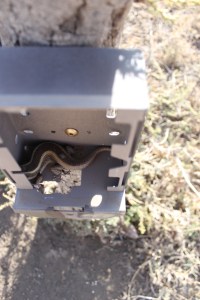
a skink!
Other inhabitants are a bit slower to react, like this caterpillar:

one of the cuter inhabitants…
And then there are some mysteries…
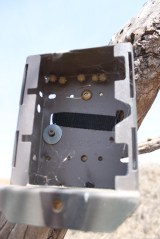
Some sort of spider eggs, perhaps?
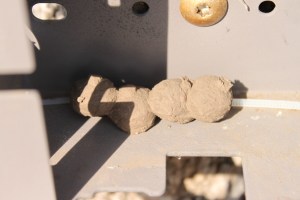
I have no idea. Any suggestions welcome.

Something has made a mysterious home of rolled up leaves.
The only thing that I really can’t bear is the ants. Don’t get me wrong, ants are cool – and they do *really* cool things – but they also bite. And when they’ve turned a camera into their home (as in the photo below — those white bits are eggs or larvae), they aren’t particularly welcoming to researchers. I’ll try to get som clearer photos this field season – because I guarantee you, there will be many, many ants to come.

Ants.
 Snapshot Serengeti