
Monday.
Apparently I am no longer invincible. I hear this is what happens when you turn 30 (next week!) but I didn’t believe it. Nonetheless, reality cares not for what I do and don’t believe, and my backcountry vacation in the Yellowstone and Tetons (with bears! and marmots! and moose!) left me with a cold that has knocked me flat on my back.
So, instead of trying to blog, in between bites of chicken & stars soup and through the fog on NyQuil, about why shade skews our perception of where animals are hanging out, I am instead suggesting you read this gorgeous blog post by one of the students with the Masaai Mara Hyena Project. Masaai Mara is part of the larger Serengeti-Mara ecosystem, which spans Kenya and Tanzania. Masaai Mara falls on the Kenyan side of the border, and Serengeti on the Tanzanian side.
The hyena project is overseen by Kay Holekamp’s lab at the University of Michigan. I had the privilege of spending a week or so with these guys in the Mara in 2012, trying to fool their hyenas with our lifesized lion dummies. They are an amazing, fun, and productive group doing really cool research about the intersection of hyena physiology and behavior. It’s sort of the flip side of what I’m interested in – whereas I’m interested in how animal behaviors translate upwards into larger scale dynamics of populations, Holekamp’s group is trying to understand the physiological drivers of, and implications of, these behaviors. For example, hyenas live in incredibly hierarchical societies. What makes a hyena “top dog”, if you will, in a clan? And in turn, how does that dominance status affect that individual’s health? Their reproduction? Why do lower-ranking individuals help higher ranking individuals acquire food, when they don’t actually get to eat it? Stuff like that. It’s pretty cool. So check them out!
We (or at least the lions) miss the migration
Hi everyone —
It’s Friday and we’re short a guest post! Since I’ve just returned from a backcountry holiday in Yellowstone, and Margaret is at a scientific conference, I thought I’d fill this space with a quick video of last year’s migration. I recruited Jason Adams, a Serengeti-based hot-air balloon pilot (and Canada’s reigning hot-air ballooning champion), to help me capture the scene on his Go-Pro.
Drumroll, please
If you’ve been following Margaret’s blogs, you’ve known this moment was coming. So stop what you’re doing, put down your pens and pencils, and open up your internet browsers, folks, because Season 5 is here!
It’s been an admittedly long wait. Season 5 represents photos from June – December 2012. During those six months I was back here in Minnesota, working with Margaret and the amazing team at Zooniverse to launch Snapshot Serengeti; meanwhile, in Serengeti, Stanslaus Mwampeta was working hard to keep the camera trap survey going. I mailed the Season 5 photos back as soon as possible after returning to Serengeti – but the vagaries of cross-continental postal service were against us, and it took nearly 5 months to get these images from Serengeti to Minnesota, where they could be prepped for the Snapshot interface.
So now that you’ve finally kicked the habit, get ready to dive back in. As with Season 4, the photos in Season 5 have never been seen before. Your eyes are the first. And you might see some really exciting things.
For starters, you won’t see as many wildebeest. By now, they’ve moved back to the north – northern Serengeti as well as Kenya’s Masaai Mara – where more frequent rains keep the grass long and lush year-round. Here, June marks the onslaught of the dry season. From June through October, if not later, everything is covered in a relentless layer of dust. After three months without a drop of rain, we start to wonder if the water in our six 3,000 liter tanks will last us another two months. We ration laundry to one dusty load a week, and showers to every few field days. We’ve always made it through so far, but sometimes barely…and often rather smelly.
You might see Stan

Norbert

And occasionally Daniel

Or me
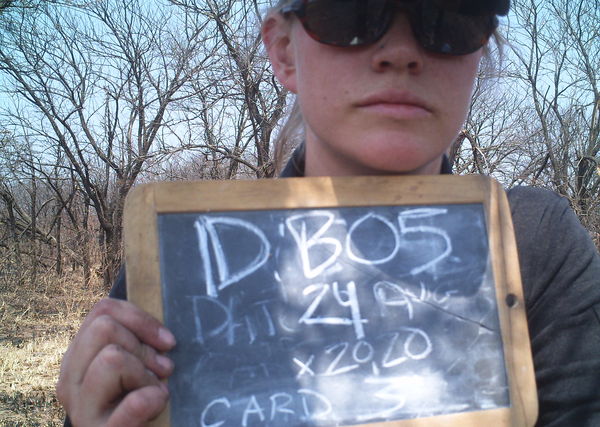
Checking the camera traps.
But most excitingly, you might see African wild dogs.

photo nabbed from: http://en.wikipedia.org/wiki/File:LycaonPictus.jpg
Also known as the Cape hunting dog or painted hunting dog, these canines disappeared from Serengeti in the early 1990’s. While various factors may have contributed to their decline, wild dog populations have lurked just outside the Serengeti, in multi-use protected areas (e.g. with people, cows, and few lions) for at least 10 years. Many researchers suspect that wild dogs have failed to recolonize their previous home-ranges inside the park because lion populations have nearly tripled – and as you saw in “Big, Mean, & Nasty”, lions do not make living easy for African wild dogs.
Nonetheless, the Tanzanian government has initiated a wild dog relocation program that hopes to bring wild dogs back to Serengeti, where they thrived several decades ago. In August 2012, and again in December, the Serengeti National Park authorities released a total of 29 wild dogs in the western corridor of the park. While the release area is well outside of the camera survey area, rumor has it that the dogs booked it across the park, through the camera survey, on their journey to the hills of Loliondo. Only a handful of people have seen these newly released dogs in person, but it’s possible they’ve been caught on camera. So keep your eyes peeled! And if you see something that might be a wild dog, please tag it with #wild-dog!! Happy hunting!
Not on the A-List
I’m working on an analysis that compares the classifications of volunteers at Snapshot Serengeti with the classifications of experts for several thousand images from Season 4. This analysis will do two things. First, it will give us an idea of how good (or bad) our simple vote-counting method is for figuring out species in pictures. Second, it will allow us to see if more complicated systems for combining the volunteer data work any better. (Hopefully I’ll have something interesting to say about it next week.)
Right now I’m curating the expert classifications. I’ve allowed the experts to classify an image as “impossible,” which, I know, is totally unfair, since Snapshot Serengeti volunteers don’t get that option. But we all recognize that for some images, it really isn’t possible to figure out what the species is — either because it’s too close or too far or too off the side of the image or too blurry or …. The goal is that whatever our combining method is, it should be able to figure out “impossible” images by combining the non-“impossible” classifications of volunteers. We’ll see if we can do it.
Another challenge that I’m just running into is that our data set of several thousand images contains a duiker. A what? A common duiker, also known as a bush duiker:

Common duiker
You’ve probably noticed that “duiker” is not on the list of animals we provide. While the common duiker is widespread, it’s not commonly seen in the Serengeti, being small and active mainly at night. So we forgot to include it on the list. (Sorry about that.)
The result is that it’s technically impossible for volunteers to properly classify this image. Which means that it’s unlikely that we’ll be able to come up with the correct species identification when we combine volunteer classifications. (Interested in what the votes were for this image? 10 reedbuck, 6 dik dik, and 1 each of bushbuck, wildebeest(!), and impala.)
The duiker is not the only animal that’s popped up unexpectedly since we put together the animal list and launched the site. I never expected we’d catch a bat on film:

Bat
Our friends over at Bat Detective tell us that the glare on the face makes it impossible to truly identify, but they did confirm that it’s a large, insect-eating bat. Anyway, how to classify it? It’s not a bird. It’s not a rodent. And we didn’t allow for an “other” category.
I also didn’t think we’d see insects or spiders.

Spider
Moths fly by, ticks appear on mammal bodies, spiders spin webs in front of the camera and even ants have been seen walking on nearby branches. Again, how should they be classified?
And here’s one more uncommon antelope that we’ve seen:

Steenbok
It’s a steenbok, again not commonly seen in Serengeti. And so we forgot to put it on the list. (Sorry.)
Luckily, all these animals we missed from the list are rare enough in our data that when we analyze thousands of images, the small error in species identification won’t matter much. But it’s good to know that these rarely seen animals are there. When Season 5 comes out (soon!), if you run into anything you think isn’t on our list, please comment in Talk with a hash-tag, so we can make a note of these rarities. Thanks!
All in the name of science
Today’s guest blogger is Lucy Hughes. Lucy lived and worked on a private nature reserve in South Africa for four years, carrying out field research that included a camera-trap study into the reserve’s leopard population and twice monthly bird surveys for Cape Town University’s Birds in Reserves Project (BIRP).
Arrhhh, that really hurts! A three inch thorn had just penetrated my, admittedly inadequate, footwear and was stuck deep in the sole of my foot. Thorns are a serious hazard of camera trap placement in the South African bushveld where plants with thorns or hooks seem to make up about 90% of species.
My colleague Michelle ran back to the landy to get a first aid kit whilst I set about extracting the thorn, there seemed to be an awful lot of blood. I watched the path eagerly for Michelle’s return but as she got near she seemed to slow down and as she opened her mouth to speak I knew exactly what she was going to say. “Luce, if it’s not too painful, what about spreading your blood around a bit?”
Callous as it may seem it wasn’t a bad idea. We had been having trouble with capturing clear night shots of leopards. They always seem to be in a hurry and the shots we had were often blurry making it impossible to id the individuals. We needed a way to get the leopards to pause for a second or two in shot of the camera trap.
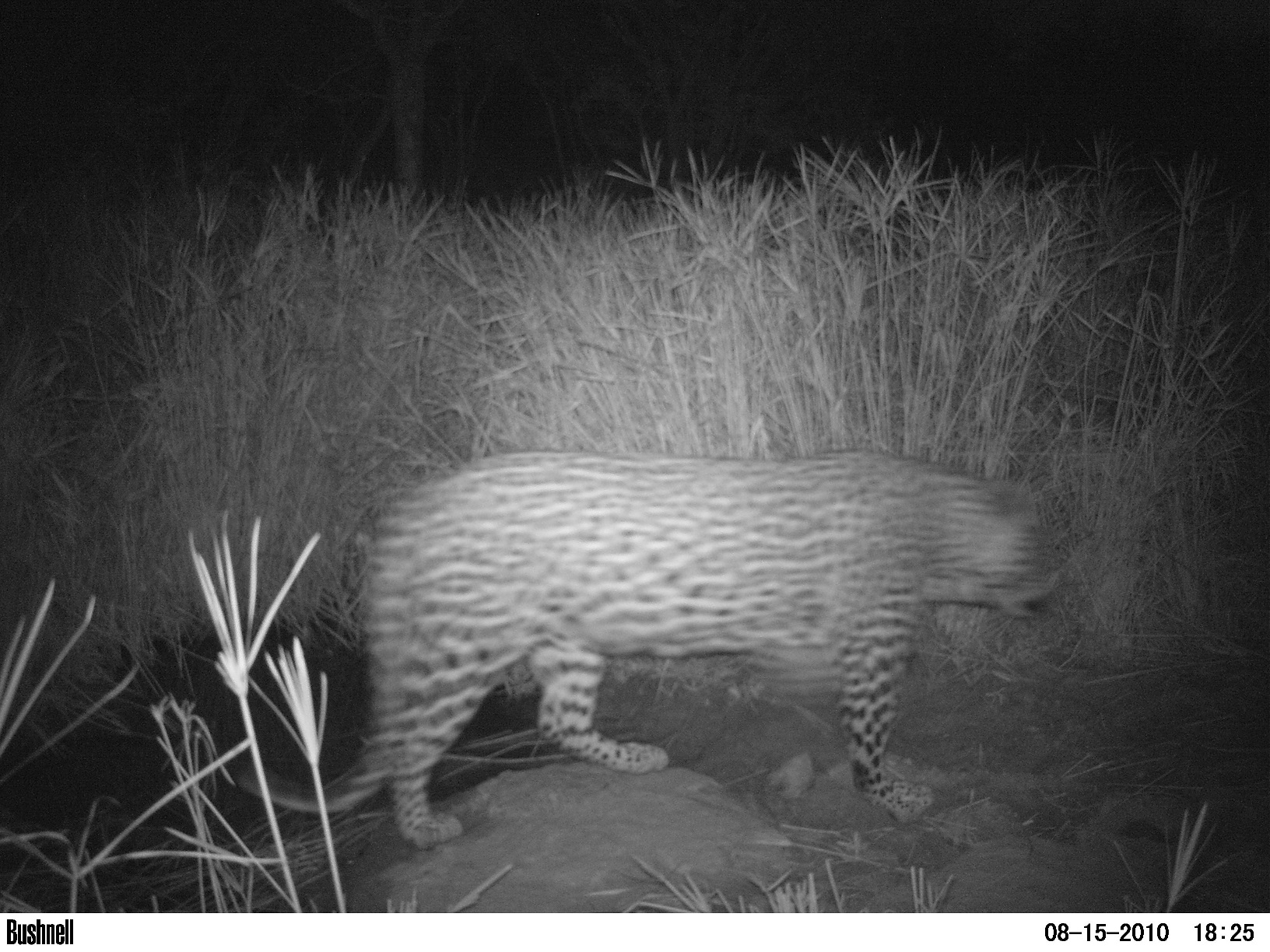
We had been advised that scent was the answer and were experimenting with various different ones and now it seemed human blood was to be the next test. I dutifully hobbled out in front of the camera and scraped my bleeding foot around on a nice flat rock Michelle had procured, wondering about the sensibleness of using human blood as bait for a predator. My slight discomfort was all in the name of science.
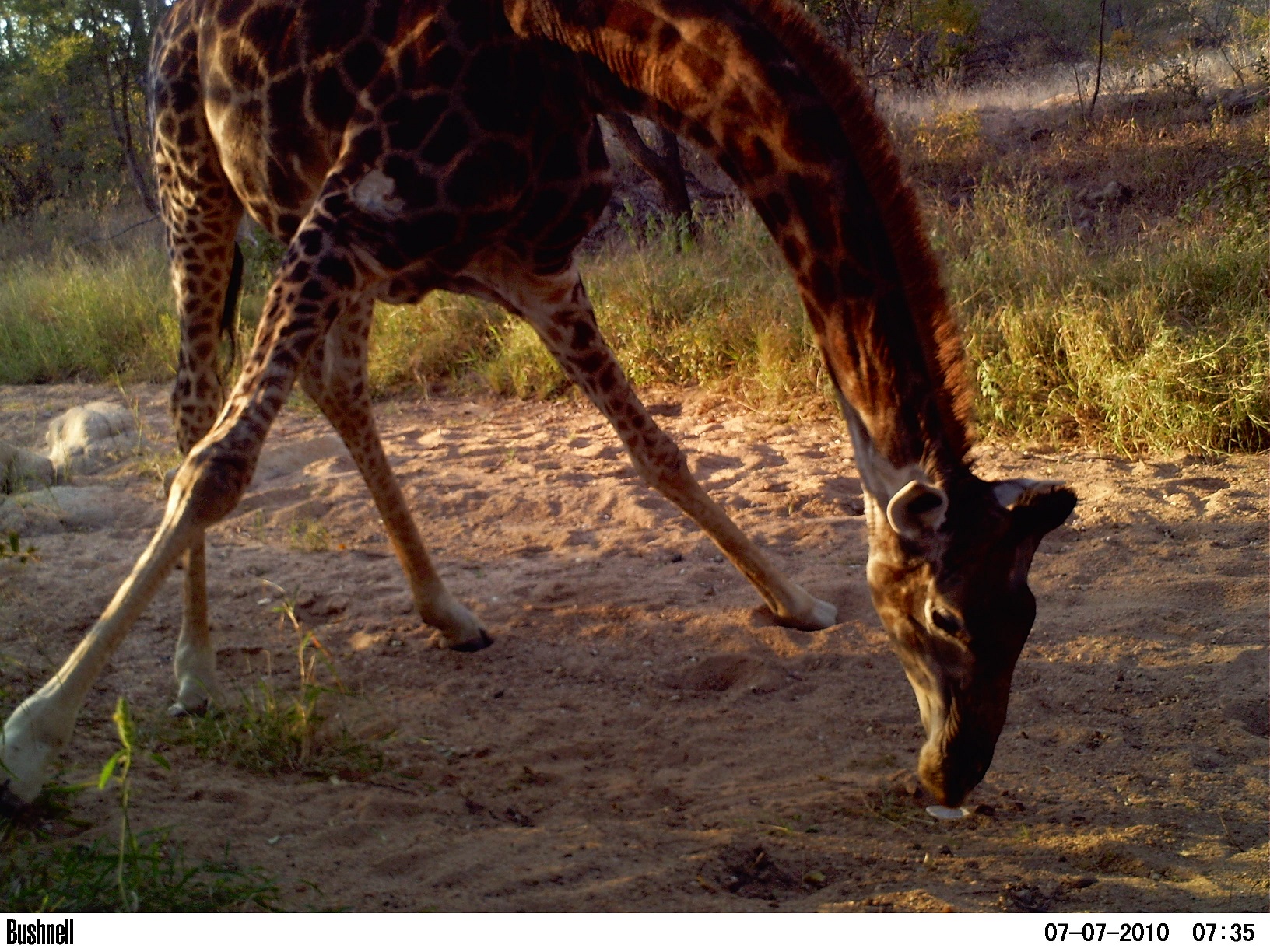
In the end it didn’t work, It rained a couple of nights later and my efforts where washed away. We never did find the perfect scent. We were told that tinned sardines worked wonders as well as catnip and perfume. We tried them all. It seems our cats where immune to these. The only thing that stopped them in their tracks was the scent of other leopards. I did learn however that the scent of tinned sardines was particularly interesting to giraffe of all animals. My method was to bury a plastic cup up to its rim in sand and put a blob of sardines in the cup. Now you would have thought that giraffe would have walked on by but as the picture below testifies, giraffe just have to take a closer look. You always learn something new!
Big, Mean, & Nasty

I recently gave a talk at the Arusha-based Interpretive Guide Society – a really cool group of people interested in learning more about the natural history of Tanzania’s places and animals. I’ve taken a few clips from the presentation that describe in a bit more detail how lions bully their competitors.
Looking at the photos above (all nabbed from the internet), how many of you would like to be a wild dog? A leopard? A cheetah? There’s no doubt about it – lions are big, and mean and nasty. If you are any other carnivore species in the Serengeti – or across Africa, lions chase you, steal your food, even kill you. So what do you do? How do you survive? That’s essentially what my dissertation seeks to answer. How smaller “large carnivores” – hyenas, leopards, cheetahs, and wild dogs — live with lions. Under what circumstances do they persist? Under what circumstances do they decline or even disappear?
There are a handful of ways in which these species interact, but what I’m most interested in is aggression and it’s repercussions. As the above pictures suggest, lions tend to dominate aggressive interactions.
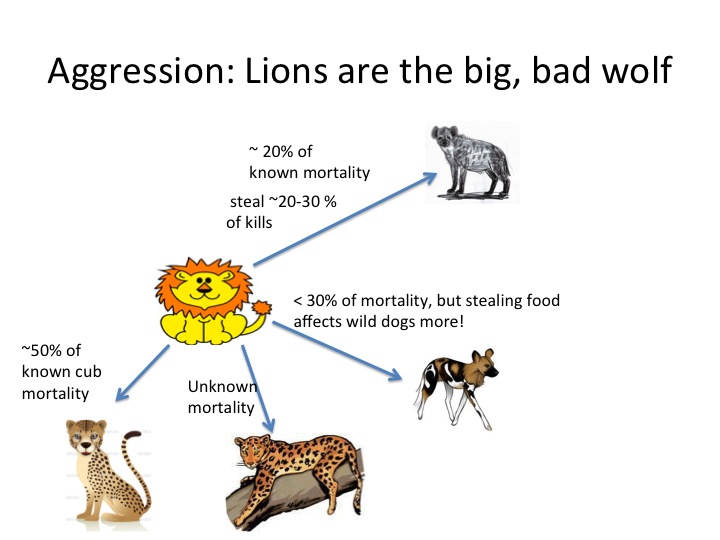
The relationship between lions and hyenas is one that has wormed its way into the public psyche through nature documentaries such as “Eternal Enemies.” While such movies play up the frequency of such interactions, they certainly do happen. Lions not only kill a number of hyenas, but steal their hard-won kills. Dispel any notion of lions as some noble hunter — they in fact steal a lot of their food from other carnivores. In fact, research from Kay Holekamp’s group in Masaai Mara indicates that lions can suppress hyena populations just because they steal food from them! It’s actually a similar story for wild dogs – lions kill wild dogs too, but since wild dogs expend so much energy hunting, that if lions steal just a small fraction of the food that wild dogs catch, wild dogs simply cannot recover. They would have to hunt for more hours than there are in a day to make up for this caloric loss.
It doesn’t stop there. We don’t know how much food lions steal from cheetahs or leopards. We also don’t know how often lions kill leopards, but lions kill cheetah cubs left and right. Studies from Serengeti indicate that lions may be responsible for up to 57% of cheetah cub mortality!

So how do hyenas, wild dogs, leopards, and cheetahs survive? Well, that’s what I’m trying to figure out. But what I can tell you is that not all of these smaller carnivores sit back and take their beating quietly. Take hyenas. They’re about 1/3 the size of a lion, but they live in groups. Big groups. Much bigger groups than lions. And if there are no male lions around, if hyenas have strength in numbers, they can steal food from female lions, and even kill their cubs. While leopards don’t live in groups, they can easily kill (and eat!) a lion cub that has been hidden while mom is away hunting.
Unfortunately, what we don’t know is whether this reciprocal aggression by leopards and hyenas has any measurable affect on lion populations, and whether it’s this aggression that allows hyenas and leopards to coexist with lions. The cameras behind Snapshot Serengeti will provide the first-ever map of leopard and hyena distributions within the long-term lion study area – by comparing lion reproductive success (which we know from >45 years of watching individually identified animals) to leopard and hyena distributions, we can see if lions do better or worse in areas with lots of hyenas or leopards – and whether this is due to getting less food or producing fewer cubs.

What about cheetahs and wild dogs? Even though wild dogs, like hyenas, live in groups, there’s no evidence that this helps them defend themselves or their kills against lions. And cheetahs, well, there’s no record of them killing lion cubs, but who knows?
So how do these guys live with lions? To be honest, wild dogs don’t tend to do very well in places with lots of lions. In fact, it’s generally believed that wild dogs have failed to recolonize Serengeti, despite living *just* a few km from the border, because lion populations are so high. For a long time, researchers and conservationists believed that cheetahs also couldn’t survive in places with lots of lions – but that perception is beginning to change, due, in part, to data coming in from Snapshot Serengeti! It seems that cheetahs not only do just fine in reserves with lots of lions, but use the same areas within the park as lions do. I have a sneaking suspicion that how cheetahs use the habitat with respect to lions, how they avoid encountering lions even though they’re in the same places, holds the key to their success. Avoidance, combined with habitat that makes avoidance possible (read: not the short grass Serengeti plains you see below).
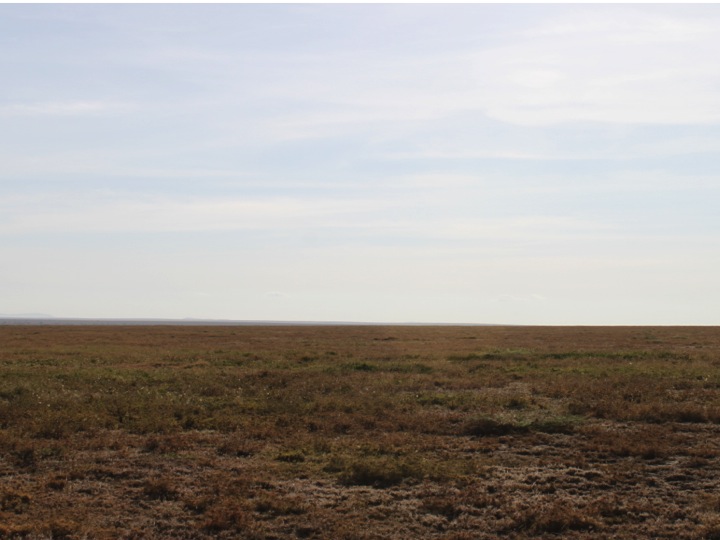
I’ll write more about avoidance and habitat another day. In fact, I’m currently revising a paper for a peer-reviewed journal that addresses how cheetahs and wild dogs differ in the ways they avoid lions – if accepted, it will be the first appearance of Snapshot Serengeti data in the scientific literature! I’ll keep you posted…
Frolicking Wildebeest
Rumor has it that a hard drive just arrived from Tanzania in the Ecology building at the University of Minnesota.
I’m so excited, I could go frolic with the wildebeest…
An ode to ants.
### Cameras have been keeping me busy — and the relentless rain that turns the landscape to soup isn’t helping me move quickly. I’m so exhausted I can barely keep my eyes open, and am frantically prepping for another several day camping trip. So! Thought I’d pull up and old post about ants. Although often a nuisance, they are pretty awesome creatures. You can learn more about ants here. ###
I keep flinching and slapping at the invisible bugs that land and leap away so fast I can’t tell sometimes if they are real or merely a figment of my imagination. By the time I slap my arm, they are gone, and all that lingers is that faint distant tickle on my skin. Craig peers up at me over his little wire glasses. We are wading through 25 years of radio-collaring lion data and I am playing the dusty, bugbitten, in-desperate-need-of-beer secretary. He gives me a withering stare as I twitch murderously at the bugs that seem to molest only me. “It’s all in your imagination,” he says with a playfully dismissive wave of his hand as he hunches back over the dusty files. Seething in indignation, I am finally successful in my arthropod assassination attempts and throw my tiny offender at my academic advisor. “I don’t want your pickings!” he squawks. Merciless, I catch another and drop it in his lap. Satisfied, I resume recording.
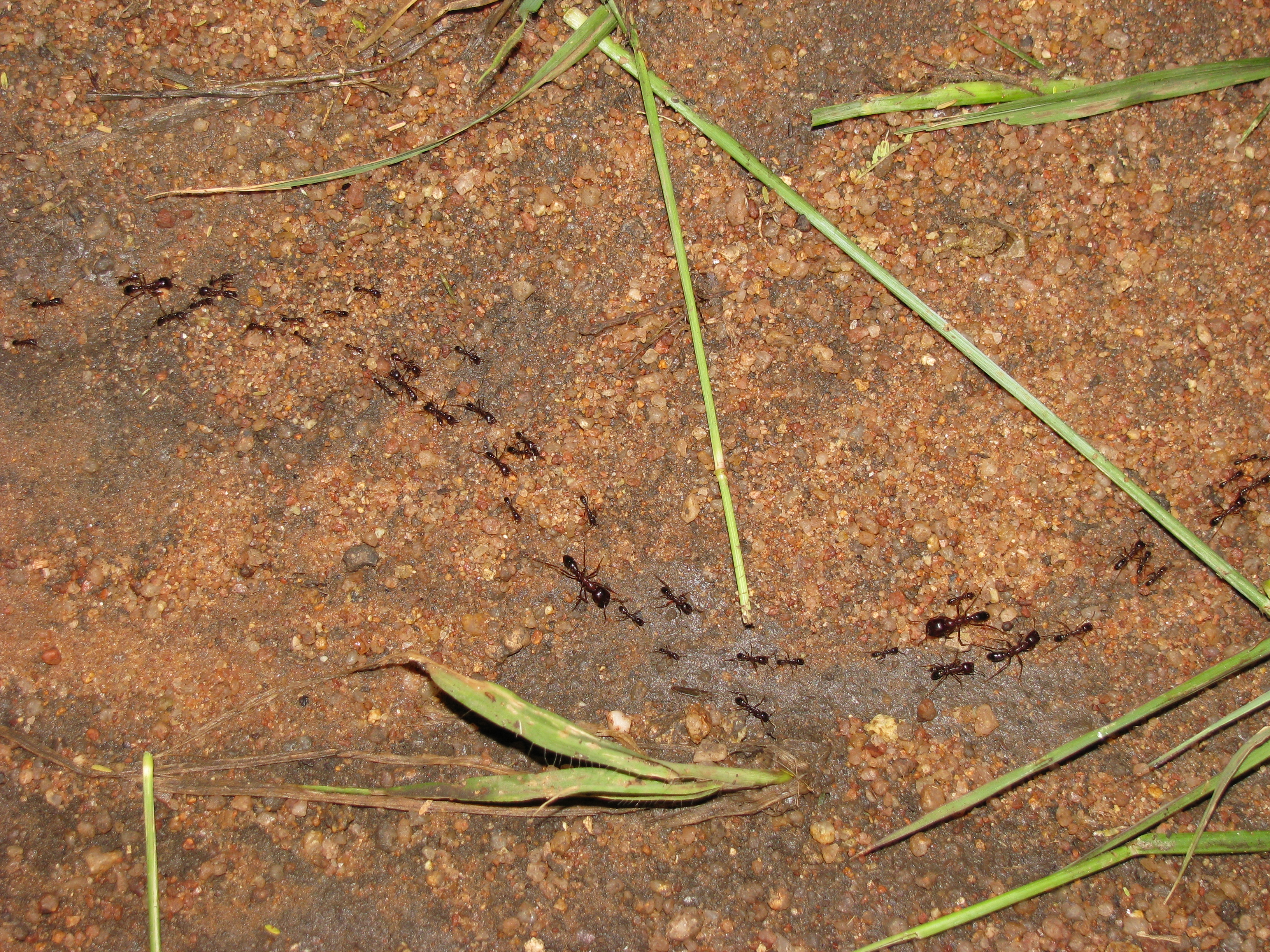
I think the bugs are the only thing I dislike more than the baboons that crap on our veranda. The ants recently invaded our drop toilet (the only one in town where you still have to squat), milling about on the concrete slab in typical ant frenzy. African ants seem to be generally unstoppable. They swarm across our kitchen countertop so thick that the white laminate is completely obscured. Yesterday I saw them dragging a dead tsetse fly across our windowsill. They are tiny pinprick ants, so ghostly as they crawl across your skin that you’re never quite sure if you’ve merely imagined them. But we don’t imagine them in our food. They are baked into our bread, spooned into our leftovers, drowned in our drinking water…They even invaded my canister of refrigerated Lindt chocolates. They flail hopelessly in our wash water and get stuck in the little holes of our makeshift shower bucket. I think sometimes they bite – the backs of my legs are covered with little red itchy bumps, and if they aren’t ant bites then they might be tick larvae, which is even more disgusting.
As much as I would prefer not to share my shower with a thousand tiny freeriders, I have this strange love/hate/admiration/disgust relationship with the colonial creatures. Philipp tells me how some ants raise aphid “livestock,” carrying their little aphids around to leaves and then milking them of their leaf-juice. Some ants live in little black balls on the whistling-thorn Acacias and attack hungry ungulates that dare to browse on their branches. One day while scouring game trails for fresh carnivore sign, I discovered a series of 4-inch wide paths that wove between the trees. I turned to the camera trapping guru by my side, the funny German who’s spent the last decade in the remote west-African bush. Ants! Philipp says.Yes, the ants move in such volume that they create barren little tracks through the woodland grass. Sometimes we can see the ant army marching in rigid formation outside the Lion House. They appear out of nowhere against our cinderblock corners and trudge across the dirt. I don’t know where they are going, but they look like they’re on a mission. Perhaps they heard that there was something in the outhouse.
Wildebeest Explosion
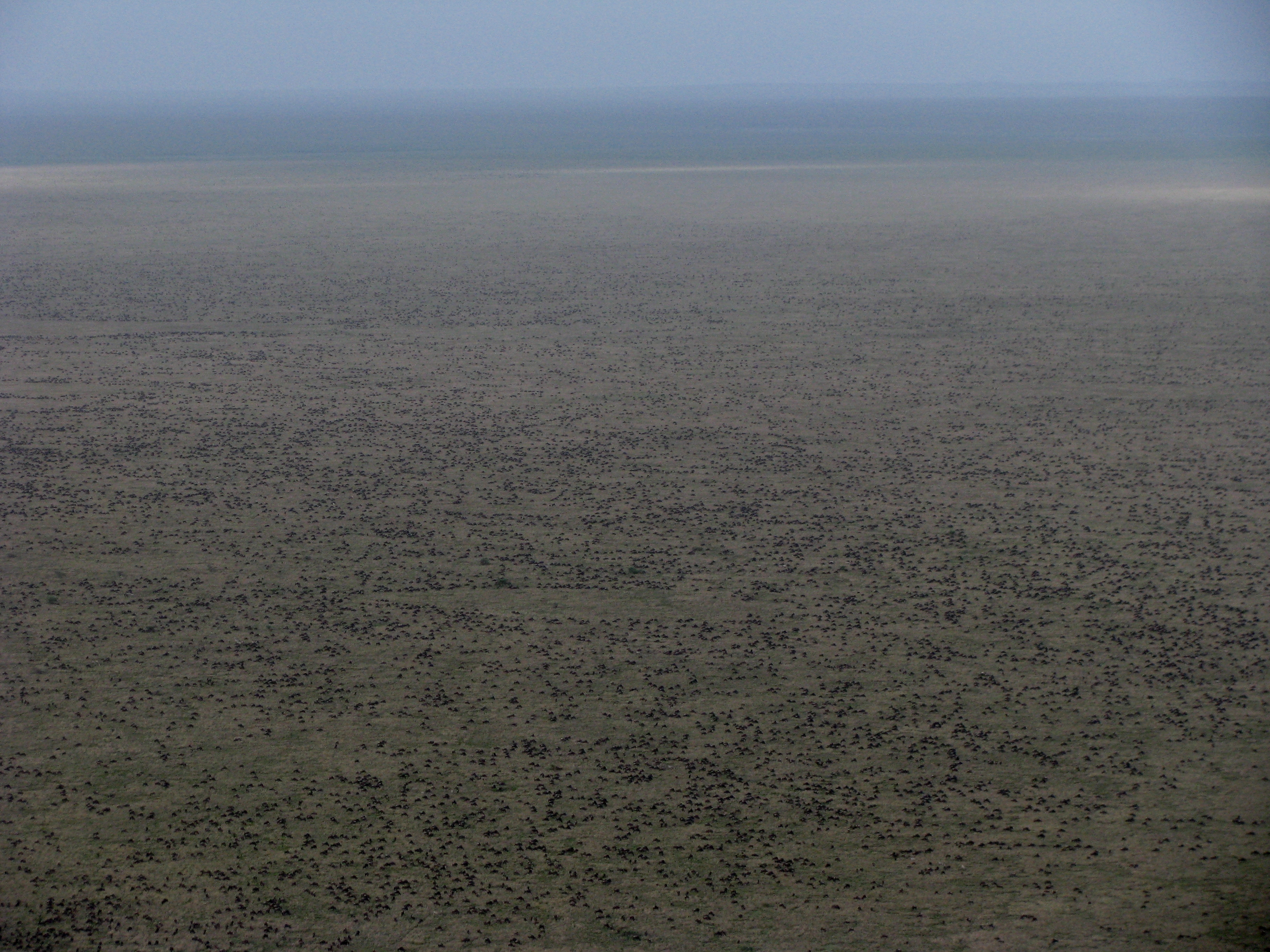
If you’ve spent time on Snapshot Serengeti, then you’ll know that wildebeest are rather abundant in the Serengeti – especially during the rainy season. But it wasn’t always this way. In the 1950’s there were fewer than a quarter of the wildebeest there are today.
Back then, there was something suppressing the wildebeest population, keeping it much lower than the land’s capacity. It wasn’t predators, though there are now more lions and hyena in the Serengeti thanks to the increase in wildebeest. It wasn’t poaching, though we know that poachers take a substantial number of wildebeest. It was disease.
In the early 1930’s rinderpest was detected in Serengeti’s wildebeest. Rinderpest is closely related to measles. In fact, it is believed that measles evolved from rinderpest some 800 to 1,600 years ago. But rinderpest doesn’t affect people; instead, it affects ungulates and most likely evolved in Eurasia. For a long time, the Sahara Desert probably acted as a sort of barrier, preventing the disease from reaching sub-Saharan Africa. But in the late nineteenth century, people transported infected cattle into the region.
Rinderpest has high mortality in wildebeest, especially in young animals. What was once known as “yearling disease” killed so many young wildebeest that the Serengeti population was only about 300,000 animals in the 1950’s. Rinderpest also causes high mortality in cattle, and so inoculation attempts started in the 1940’s. These got better over time, and in the 1960’s there was a largely successful push to vaccinate 80 million cattle across twenty-two African countries, including Tanzania.
Wildebeest themselves were not vaccinated, but as the number of rinderpest-infected cattle decreased with vaccination, so did the number of wildebeest that had rinderpest. Following the initial vaccination push, regular vaccination campaigns kept the infection rate very low in cattle. Despite a handful of small localized rinderpest outbreaks in the ensuing decades, the disease was essentially eliminated from the Serengeti wildebeest population. This pattern of infection shows us that for rinderpest, wildebeest are what is termed a spillover species, which means that the wildebeest population cannot by itself sustain the disease; wildebeest must constantly contract the disease from cattle for it to survive in the wildebeest population.
The Serengeti wildebeest population has since exploded. No longer constrained by rinderpest, it has soared to 1.2 to 1.5 million animals.
As for rinderpest, the vaccination campaigns of the mid twentieth century were only a start. The international Food and Agriculture Organization (FAO) continued to pursue the disease by vaccinating cattle and by the 1990’s had reduced it to only local outbreaks worldwide. In 2010, the FAO declared that they were confident that they had eliminated the disease from everywhere it had been known. And less than two years ago rinderpest was declared officially eradicated. It is the second of only two diseases that humanity has successfully eradicated, the first being smallpox.
Wildebeest all the way to the horizon
Gail, Garth or Gerta? Cataloguing the giraffes of the Serengeti
Today’s guest post is written by Megan Strauss, a researcher at the University of Minnesota. She runs the Serengeti Giraffe Project.
If you had visited the lion research house between 2008 and 2010, in addition to Fabio, the stuffed lion, the mantelpiece full of animal skulls, and the aquarium of incredibly hardy fish, you would have seen this photo of a male giraffe, which I taped to one of the bedroom doors:
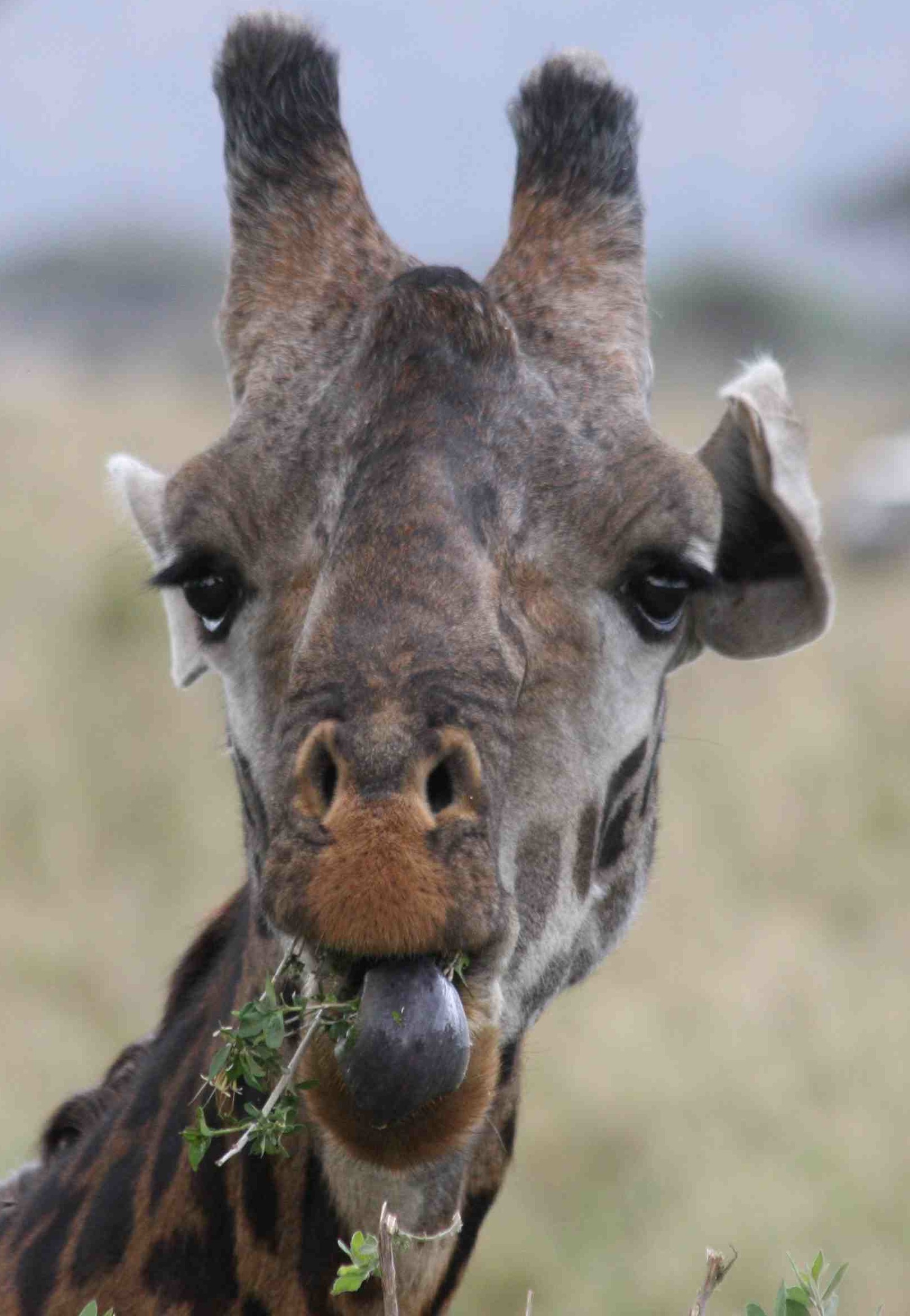
For the last few years, I’ve tracked these quiet giants of the Serengeti woodlands, studying their population dynamics, the vegetation they eat, and their interactions with lions and people.
We can learn a lot by keeping track of individual giraffes. Luckily, it turns out that each giraffe is born with a unique set of coat markings that persist throughout life, like human fingerprints or lion whisker spots. So, each field season, I arrived in Serengeti stocked with the materials necessary to catalogue the many giraffes I would encounter: several hundred 5 x 8 index cards, ink cartridges for the printer, sharp scissors, and a good supply of glue sticks. My days in the field often went as follows. Morning and afternoon: meander through the woodlands locating and photographing giraffes. Evenings: work through the day’s photographs, identifying giraffes and making ID cards for any new individuals. For fun, I assigned a different first name to each individual. The female below is named Flopsy, for her deformed right ear:


Among Serengeti giraffes, which belong to the Masai subspecies, coat markings vary from blocky to highly stellate, or star-like. While the patterns do not change, the color of the markings can grow darker as giraffes age, particularly for males. The shape, color and arrangement of the coat markings are all useful for telling apart different individuals. Other traits are useful as well, such as tail length or ossicone size, shape and hairiness. (Ossicone is the name for the bony, skin-covered horns of a giraffe.) I’ve included some giraffe photos below so you can try your hand at giraffe pattern matching. See if you can match the individual on the top row with any of the individuals in the bottom two rows:

Sexing giraffes is usually easy, especially at close range or from photograph. Aside from the obvious, adult males can be distinguished from females by their larger size, skull ossification (the ossicones of males are larger and mature males acquire additional bony skull protrusions) and their more erect posture. Sexing young calves is a bit trickier. The genitals of male calves are small and calves aren’t always willing to pose for the camera.
Here is an example of a mature male giraffe with significant skull ossification:

By the end of my 2010 field season, I’d amassed a catalogue of almost 1,000 giraffes. (Identifying giraffes by eye can be a laborious and error-prone process but Doug Bolger and colleagues at Dartmouth University have now released Wild-ID, software that assists with giraffe pattern recognition.
We are hoping that we can use the plentiful giraffe images coming in from the camera trap study to maintain this giraffe database and to monitor the population. It turns out, though, that many of the camera trap images contain only giraffe legs, which are much harder to use for identification than flanks.

 Snapshot Serengeti
