
March of the Elephants
When you think of elephants, you may immediately think of their defining characteristics: trunks, big ears, tusks. Or you may think about how they live in large family groups and are very social. You may even think about the story of the blind men and the elephant. You probably don’t think about them as engineers of their ecosystem. But they are.
Elephants are native to the Serengeti ecosystem, but Serengeti elephants were likely all killed off for ivory in the 1800’s. At least, there weren’t any recorded there until the middle of the twentieth century when they started moving back in again. In the 1960’s they migrated in from both the north and the south, and by 1970 there were over 3,000 elephants in the Serengeti. Things got rocky for elephants again in the 1980’s as severe poaching reduced their numbers in Serengeti National Park to around 500. In 1988, elephants were given CITES endangered species status and worldwide trade in ivory was banned. This was good news for Serengeti elephants and their numbers rebounded again into the thousands.
These ups and downs in elephant population have allowed scientists to study the impact elephants have on their environment. I’ve written before about how the rainfall patterns in the Serengeti affect grasses, and about the role that fire plays. Elephants have their greatest impact on trees. Elephants eat both grasses and trees, but depend on trees for food during the dry season.
In the first half of the twentieth century, the number of trees per hectare was slowly declining across the Serengeti. But starting in the 1970’s, the number of trees rapidly increased. Scientists believe that the initial decrease in trees was due to the the disease rinderpest. Rinderpest killed off the majority of Serengeti’s wildebeest, allowing the grass to grow tall, and fueling huge, strong fires. These fires killed most tree seedlings, meaning that as trees died, they were not being replaced. When rinderpest was halted, the wildebeest population exploded, and the wildebeest kept the grass short and the fires smaller, allowing trees to gain a foothold once more.
Okay, but what about elephants? Well, elephants eat trees — especially small, tender saplings and regrowth from trees damaged by fire. In the 1980’s, while poaching was particularly severe on the Tanzanian side of Serengeti (Serengeti National Park), the Kenyan part of Serengeti (Maasai Mara) mounted a strong anti-poaching effort and kept its elephant numbers high. Across the Serengeti, the trees were increasing, but in the Maasai Mara there were also a lot of elephants. It turns out that in the Maasai Mara, the trees didn’t increase like they did across the border in Tanzania where the elephants had been greatly reduced. Instead the high number of elephants in the Maasai Mara is keeping tree numbers down, despite the reduction in fire intensity.
So elephants are key players in maintaining what scientists call “alternative stable states” in the Serengeti. While there are plenty of elephants once again in the Tanzanian part of the Serengeti, they don’t reduce the higher tree numbers; only fire can do that. But on the Kenyan side of the border, tree numbers remain low because elephants there have been continuously eating saplings; the tree population cannot increase because of the constant elephant pressure. The key difference between the two areas is simply their history.
I think the fourth blind man should get extra credit.
The Fourth reached out an eager hand,
And felt about the knee
“What most this wondrous beast is like
Is mighty plain,” quoth he:
“‘Tis clear enough the Elephant
Is very like a TREE!”

Lions, cheetahs, and dogs, oh my! (Continued)
Last month, I wrote about how, despite lions killing cheetah cubs left and right, they don’t seem to be suppressing cheetah population size like they do for wild dogs. And, that despite all this killing, that cheetahs don’t seem to be avoiding lions – but I didn’t have radio-collar data for wild dogs.
Well, now I do!
Although we’ve had collared lions continuously since 1984, Serengeti cheetahs and wild dogs were only collared from 1985-1990. We worked with Tim Caro, former director of the cheetah project, to access the historic cheetah data a year ago, but it was only a month ago that we finally tracked down the historic wild dog data. Thanks to a tip by a former Frankfurt Zoological Society employee, we found the data tucked away in the recesses of one of their Serengeti-based storage containers – and Craig braved a swarm of very angry bees to retrieve it!
The good news is that the data was totally worth it. Just like we suspected, even though cheetahs didn’t seem to be avoiding lions, wild dogs were. This map shows lion densities in the background, with cheetah (in brown dots) and wild dog (black triangles) locations overlaid on the lion densities.
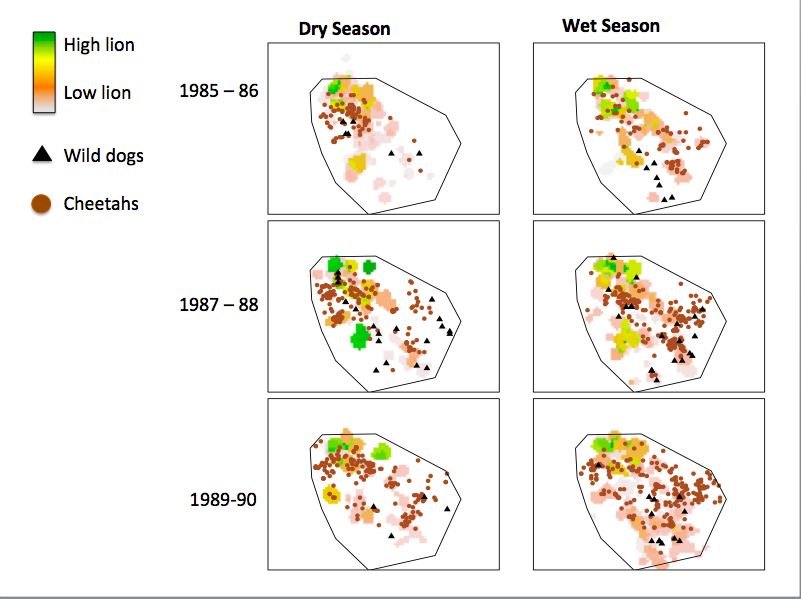
Lions, cheetahs, and wild dogs from when all three species were radio-collared in Serengeti.
It’s a pretty cool contrast. Even though lions kill cheetah cubs left and right, cheetahs do not avoid lions, nor do their populations decline as lions increase. In sharp contrast, wild dogs do avoid lions, and their populations also drop as lions increase. Now, that’s not to say that there weren’t other factors influencing the decline of wild dogs in Serengeti, but across Africa, this pattern seems to hold.
Speaking of wild dogs, has any one seen any in Season 6?
Close Encounters
## Margaret and I are both recovering from a crazy week at the Ecological Society of America conference and the incredibly successful Save Snapshot Serengeti campaign, so we’re posting a fantastic story from our regular contributor and Snapshot moderator Lucy Hughes. Thank you all again for helping us to make Snapshot Serengeti so successful. ###
When you live in the African bush you imagine it will be full of close encounters with wildlife like lion, hyena and elephant. It’s true to say there is a fair number of these encounters but in reality it’s the small critters you encounter more frequently. Often these can be far more heart stopping. I am talking about snakes. What’s more, they don’t relegate themselves to the bush; they tend to congregate around your house.

Black mamba in the road.
My house was a thatch and stone affair that nestled in amongst rocks, very scenic but also perfect snake habitat. Snake encounters were an almost daily occurrence on the reserve and life with them took a bit of getting used to.
My first encounter just weeks after I moved in was right by the front door. Coming home one day I caught movement out of the corner of my eye and realised I had just walked past a snake sticking its head out of the rock wall. I went hot and cold as my ankle must have been inches away from it. Fumbling with the key I burst through the door and from the safety of its glass watched the now empty hole to see if the snake would reappear. Oh yes, it came out alright, a Mozambique spitting cobra. To cut a long story short Sid the Spitting cobra and I became friends. I didn’t disturb my door sentinel and he didn’t bite me. I regularly saw him peak out of the same hole. Learning to live with snakes is important in the bush. Killing any wildlife is frowned on in a reserve.

Sid, the spitting cobra.
One night whilst doing the dishes idly gazing out the window the rock wall suddenly seemed to move. Once my brain readjusted to the image I realised a rock python was making its way out of the thatch and down to the ground on a night time foray. Now a 2 meter python in the roof is not a bad thing. For a start it keeps the tree squirrel population down and that in turn keeps the black mambas away (who love tree squirrel snacks). As long as it’s a small python you don’t worry about it finding its way into your bed at night, a black mamba on the other hand caused me quite a few sleepless nights after I saw it disappear into the thatch.
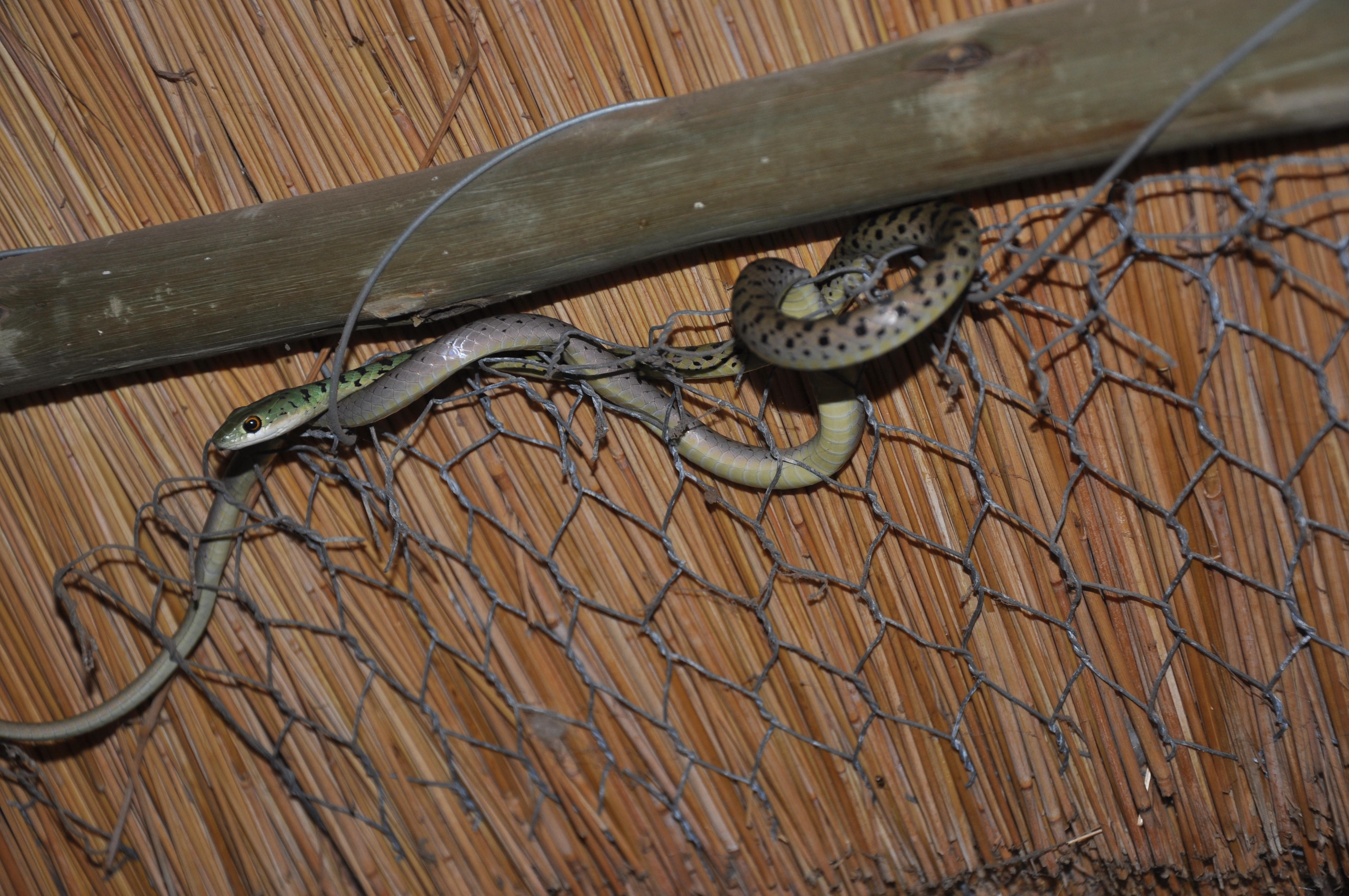
Spotted bush snake at home in the roof.
My shower was out doors and had a resident foam nest frog living on a shelf. One morning going for a shower I heard a terrible squealing. A spotted bush snake had my frog and was busy devouring it. It took over an hour to swallow my friend.

Spotted bush snake eating a gecko
I once had a pair of orphaned baby tree squirrels (yes mum fell afoul of a Mamba) When they where big enough I would sit in the garden with them whilst they ran around exploring. The little female was quite brave and was scampering around on the rocks. Next thing I hear a piercing squeal and the little squirrel shot up into a low branch. I raced over and scooped her up and sat with her in my hand for about a minute whilst she breathed her last. A Puff adder sitting in a crevice had struck her.
But for all the horror stories snakes are fascinating things and it is a thrill to see them in action so close. I would rather they stayed out of my house though, the garden is close enough! When we learn to live with nature it offers us such rewards.
Unanticipated events and the need for long-term studies
In 1994, a terrible disease ripped through the Serengeti, killing lion after lion. By the end of the year, a third of the lions in the Serengeti were dead. The culprit was a virus known as canine distemper, and lions that died of the disease did not die quietly. The symptoms were clear to any observer: facial twitching, disorientation, and eventually convulsive seizures.
The lions in Craig’s study area were not spared, but the data he had been collecting over the previous decades proved invaluable in understanding what happened in 1994.

Using archived blood samples that had originally been taken for genetic analysis, Craig and his colleagues were able to go back and test for a number of viruses. The earliest year blood had been sampled was 1984, but because some of the lions sampled had been ten years old or older, he was able to infer information about when lions had been exposed to viruses as early as 1970.
They found that there had been previous outbreaks of canine distemper in the lions in 1977 and 1981. Because the lions had been studied then, he knew that these outbreaks had not caused large die-offs like the one that occurred in 1994. Instead, he found that by 1994, essentially all lions in Serengeti were free from canine distemper antibodies, meaning that none of the lions had any immunity to the disease. This widespread lack of immunity and a mutation in the virus were thought to have caused so many deaths.
The lion population recovered after the 1994 outbreak. Just years later, though, two “silent” outbreaks hit the population in 1999 and 2006. Unlike the 1994 outbreak, these ones were not noticed at the time because few lions died. They were only detected through blood sample testing. An analysis of the archived blood samples finally revealed the major difference between the canine distemper outbreak that led to massive death and those that did not. High death rates in the 1994 outbreak were due to the simultaneous infection with another disease — a protozoan parasite known as Babesia — that becomes increasingly common during and after major droughts. When Babesia is absent, lions contract canine distemper, but their immune systems fight it and they become immune. When lions are also infected with Babesia, they cannot fight off the canine distemper virus as easily, and more of them get sick and die.
The long-term lion data was also instrumental in understanding the spread of canine distemper in the 1994 outbreak. The disease showed up sporadically in the study area prides, suggesting that lions acquired the disease from an outside source, rather than spreading it from one lion to another. Sophisticated analyses revealed that the origin of the outbreak was likely in domesticated dogs in the human settlements around the Serengeti ecosystem. Further, it is likely that lions acquired the disease repeatedly from hyenas. Hyenas move great distances, use human-inhabited areas around the Serengeti more than lions do, and interact with lions at kills.
Scientists cannot predict major droughts. Nor can they predict wildlife disease outbreaks. It isn’t possible to recreate major droughts with experiments in vast wilderness areas. Nor is it ethical to introduce novel diseases into natural areas in order to understand more about the disease. It is ONLY through long-term research projects like the Serengeti Lion Project that we acquire the data necessary to understand what happens in nature during disease outbreaks, droughts, and other rare, but important events.
Ideally we would like to run Snapshot Serengeti for at least a decade. We want to be able to capture some drought years in our data set, and some years with unusually wet dry seasons. We want our cameras to be running when the next unexpected disease outbreak occurs — in lions or in other species. To those of you have already contributed to our crowd-funding campaign, a heartfelt thank you. If you haven’t yet, and are able, please consider a donation.
To read more about canine distemper, Babesia, and Serengeti lions, check out:
The life of a lion isn’t easy
Hopefully you’ve been enjoying the adventures of the lions that David Quammen has been writing about in this month’s National Geographic. David writes about the dramatic lives of C-boy and Hildur, two very good-looking male lions that roam the Serengeti, and the challenges that they face as male lions trying to survive in the Serengeti. I was in the car with Ingela that day that the Killers nearly destroyed C-boy — it was one of my first days in Serengeti, and one of the many moments that I fell in love with the dramatic lives of the animals there.
There’s a good chance you’ve seen C-boy and Hildur and Killers, as well as all the ladies they’ve been fighting over, in the camera traps. Below is a map of the pride territories overlaid on the Snapshot Serengeti cameras. There are a lot more prides than this, but these are the ones that Nick Nichols and Davide Quammen followed.

SnapshotSerengeti cameras and the lions that David writes about in NatGeo
Jua Kali, where Hildur and C-boy resided in 2009, control just a tiny patch of land in the center of the study area where the Seronera river begins. They spend most of their time in a marshy lowland where those two small tributaries, converge. The marsh has lush grass and standing water, but is just a tiny oasis in the otherwise dry and desolate grassland. It is not the best territory that a lion can have.
After C-boy and Hildure were deposed from Jua Kali, they eventually took over the Vumbi pride. It worked out pretty well for them in the end – the Vumbi’s are not only a bigger pride, but maintain control over the Zebra Kopjes, a suite of rocky outcroppings that provide shade, water, and a vantage point to watch for prey across the open plains. Despite C-boy’s brush with death and his inelegant retreat from power, C-boy and Hildur really haven’t done too badly for themselves.
North of Vumbi, the Kibumbu pride ranges along the Ngare Nanyuki river. When David was writing about our lions, the Killers had recently taken over the Kibumbu pride. Unfortunately, the Kibumbu females had had young cubs fathered by the previous coalition; the Killers would have killed these cubs to bring the Kibumbu females into sexual receptivity. Infanticide is a brutal, but natural part of a lion’s life.
So there it is. The lions that are gracing the pages of this month’s National Geographic magazine are the same ones that you see yawning, sleeping, and stretching in front of the Snapshot Serengeti camera traps. David’s story, and Nick Nichols’ photos, provide an amazing and detailed dive into their lives.
We’re currently raising funds to keep Snapshot Serengeti and the long-term Lion Research Project afloat. Thanks to everyone who has donated so far!
More lions at National Geographic
In addition to the main feature story on the Serengeti lions that I wrote about on Wednesday, there are a number of lion extras at National Geographic Magazine, too.
The article “Living With Lions” talks about the challenges of lion conservation, and brings up some topics I’ve written about before, including fences and trophy hunting.
There’s an interactive map, where you can see the fragmentation of wild lions. The Serengeti (‘C’ on the map) is one of only a handful of strongholds that contain at least 1,000 lions.
There’s a short interview with Michael Nichols, the photographer for the stories, and a fabulous slideshow of images that he took. (Although I have to say that I always think lions look very strange in black and white.)
And there’s a high-resolution download of this image of Serengeti lion cubs you could use for your desktop background if you wanted.

Our lions in National Geographic Magazine
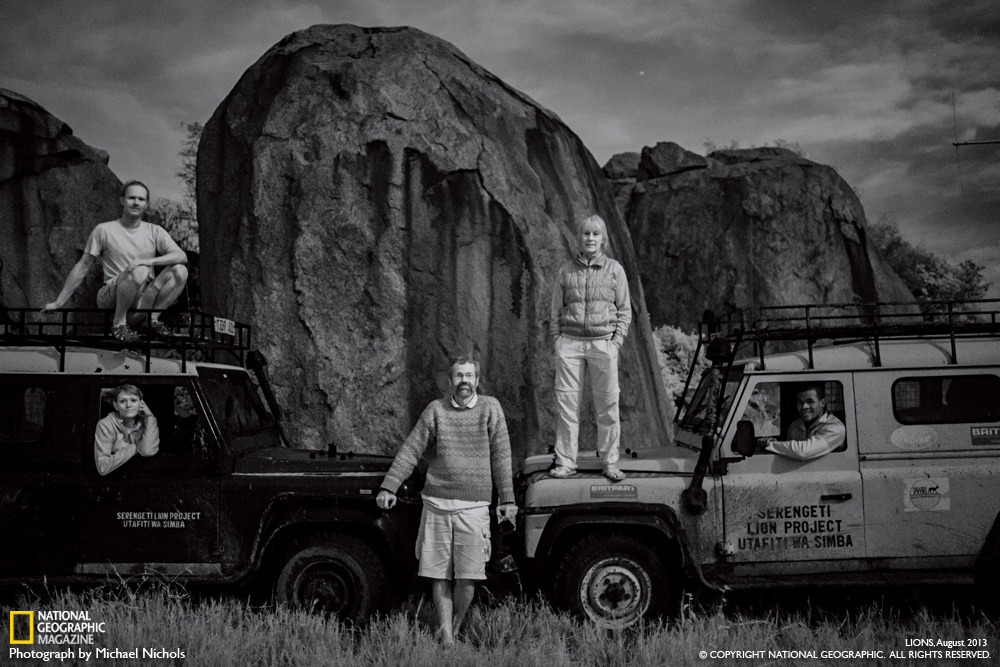
The August edition of National Geographic Magazine has a cover story on the Serengeti lions that Craig has been studying for decades. And because Ali set out the camera trap grid in the same place as Craig’s lion study area, you see the same lions (plus more) on Snapshot Serengeti as those featured in the article. In fact, photographer Michael Nichols was out in the Serengeti during Season 5, so his pictures are contemporaneous with the ones up on Snapshot Serengeti right now.
So if you have a moment, go check out “The Short Happy Life of a Serengeti Lion,” which is entertaining and gives a nice history of the foundational research on which the Snapshot Serengeti science rests. And take a gander at the editor’s note, which accompanies this picture.
Weavers
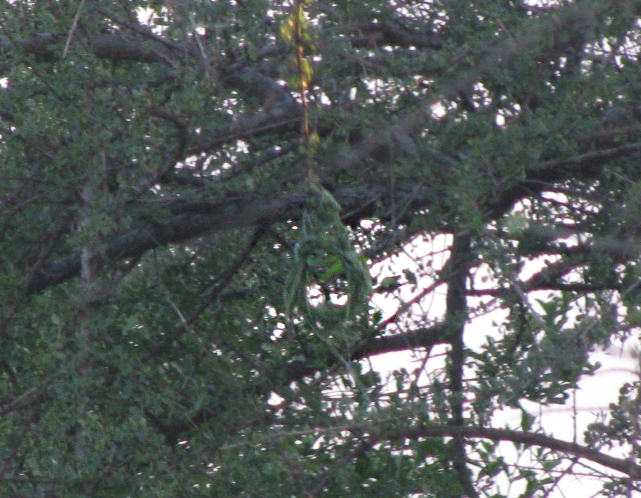
Every once in a while, a camera gets knocked off a tree and ends up pointing up into the tree where there are many grassy balls hanging from the branches. We have one of these cameras in Season 5, and it is taking pictures like this one:

What are those odd grassy balls? Why, they’re the nests of weaver birds. My Birds of East Africa book lists a dozen species of weavers in the Serengeti, and most of them have a yellow and black pattern. Here’s what some of these guys look like close up.
Several years ago, I watched through a Lion House window as a weaver bird build its nest from scratch. The bird started with just a branch, one with something of a knot at the end where a twig may have split off in the past. The weaver grabbed a long blade of grass and wrapped it around that knobby joint and tucked the blade under itself, as you might do if you were tying your shoe. Then it got another blade of grass and wove that through the loop it had created with the first blade, tucking it securely back under and through the loop a second time. It continued to add blades for the next twenty minutes or so, such that the grass formed two clumps, one sticking out of either side of the knot.
(Aside: the soundtrack is completely coincidental; field assistant John was cooking something in the kitchen while listening to music.)
Straddling the two clumps, with one talon hanging on to each, the weaver then took a long blade from one clump and wove its end back up into the other clump. The result was a loop. The bird pulled additional grass from one clump to the other and strengthened the loop. Bit by bit.
I watched for over a half-hour, but I had work to do, too. So I left the little weaver to its task, and checked in again that evening before the sun set. There it was, a hefty wreath of grass hanging from the end of a tree branch.
I checked again a couple days later. The weaver had been working on filling in grass around the sides to form the ball shape.

Three days later the ball shape was becoming apparent (and I finally decided to take pictures outdoors instead of through the window, so that they’re better in focus).

Aha! I caught a decent shot of the builder. My bird appears to be a Vitelline Masked Weaver male. (Although, my book also says that the top of the head ought to be rather chestnut color and this guy has maybe only a little bit of chestnut and rather brown markings on the back instead of black. Maybe it’s a young male?) These guys generally are found solitary or in pairs, which explains why I saw just one of them building a nest in a tree all alone. And their nests are “distinctive onion-shaped nests with an entrance hole at the bottom.” Looking good…
Five days later Mr. Vitelline’s work was looking very much like a nest.
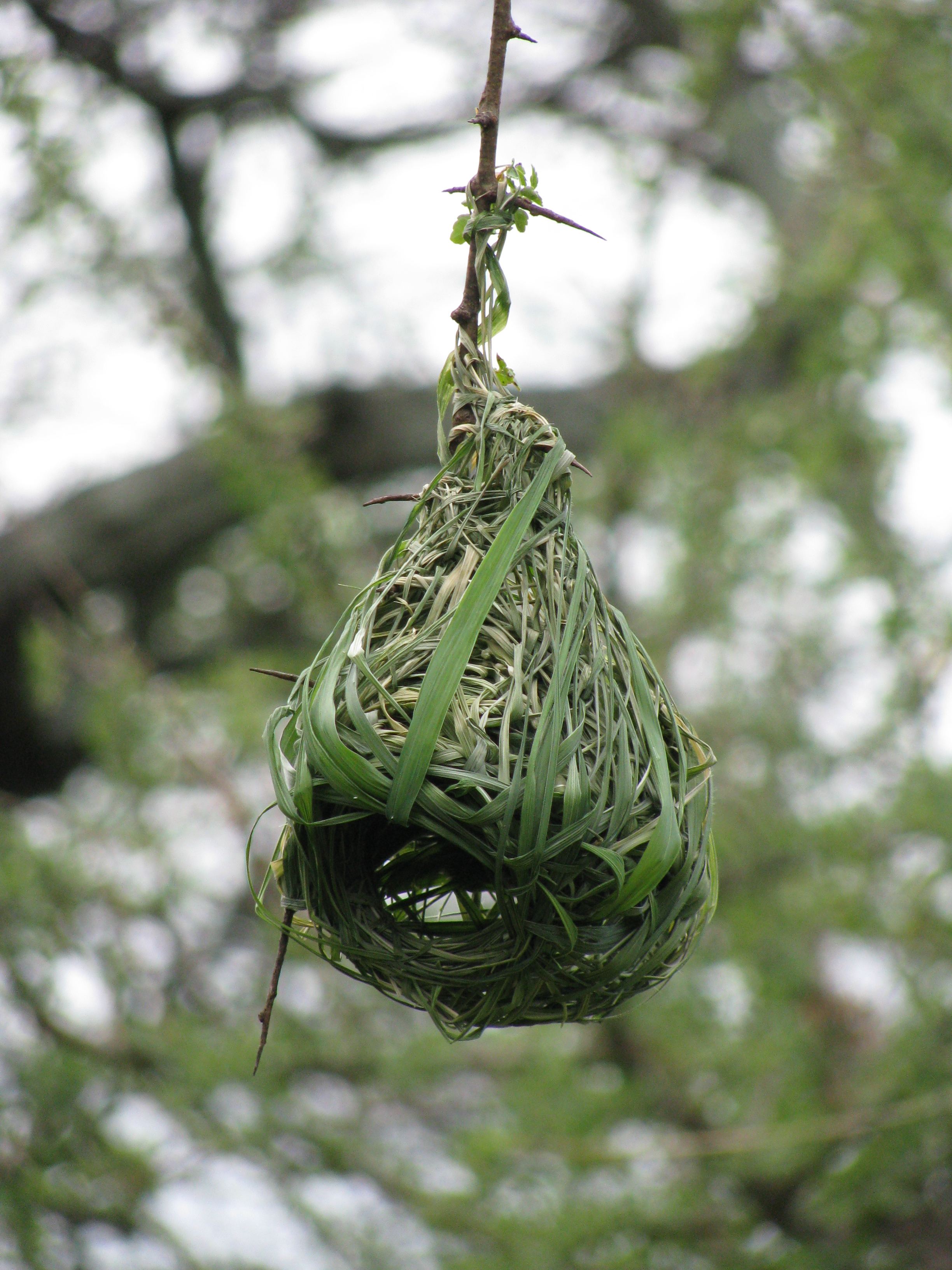

Five days later was also my last day in the Serengeti, so I didn’t see further developments of this nest. But I suspect it was completed and became a comfortable abode for its industrious builder.
Rare Romping Rhinoceros
Thanks to Snapshotters Jihang and parsfan who posted it to Talk, we can all marvel over the best ever picture of a black rhinoceros taken by a Snapshot Serengeti camera.

(And yes, it’s a set of three images, so you can animate them.)
There’s no mistaking this beast!
There are two types of rhinoceroses in Africa: the white rhino and the black rhino. Despite their names, they’re both gray, but you can tell them apart by their lips: white rhinos have broad lips, while black rhinos have a pointed and curved upper lip that is used to grasp vegetation. There are only black rhinos in the Serengeti (and in all of Tanzania), and they can grow to weigh up to 3,000 lbs (1,360 kg).
Despite their size and bulk, these animals can really move — at speeds up to 28 mph (50 kph). Several years ago, I had the chance to see the rhinoceros rehabilitation center at Kruger National Park in South Africa. This gave me a chance to get fairly close to the creatures. At one point I was on the other side of a fence from a rhino and it charged me; the fence was made of wood and very solid, so I was fine and the rhino just bounced off the fence. But I was amazed at how fast it went from standing still to ramming speed — and how quiet it was doing so.
Black rhinos are critically endangered, with fewer than 5,000 alive in the wild (as of the end of 2010, the most recent statistic). Fully 95% of all wild black rhinos live in one of four countries: South Africa, Namibia, Kenya, and Zimbabwe. Tanzania has only about 100 of them, with a quarter of those in the Serengeti.
It’s thought that about 1,000 rhinos originally inhabited the Serengeti. But in the 1970’s and early 1980’s, poaching increased severely. A park survey conducted in 1982 found only two remaining rhinos, both female. Efforts were made to actively protect these remaining two, and plans began to be made to bring in a male. But before those plans came through, a male rhino showed up on his own in 1994. It’s thought that he came from the Ngorongoro population, which contained only about a dozen animals at the time. Moreover, it was quite a hike at 70 miles (113 km). As I said, these animals can move!
It’s something of a mystery how this male rhino found the females in so vast an area — sound? smell? — but he stayed. Within a short time there were four babies, and since then, the population has steadily grown. Now there are twenty or so black rhinoceroses living around Moru Kopjes. These Kopjes are about 20 miles (32 km) south of our camera trap area, so we only rarely catch a glimpse of one (out for a walk?).
While the Moru population is growing, it still faces two major threats. The first is continued poaching. Demand for rhino horn has been rapidly escalating since 2009, with black market prices in Asia skyrocketing, and organized crime getting into the action. In May 2012, two of the Moru rhinos were found dead with their horns missing. The second threat to the Moru population is inbreeding, which over time can cause lower reproduction rates and increased genetic disease. Fortunately, there are ongoing efforts to both protect the existing rhinos and to bring more black rhino genetic diversity to the Serengeti by translocating animals from South Africa.
Perhaps in several decades these massive beasts will once again make regular appearances in central Serengeti; until then, keep your eyes peeled for their rare cameos.
Grass
You’ve undoubtedly seen it: Grass. Tall waving grass. Lots of it. From here to the horizon. If you’re itching to get images of animals to classify, the “nothing here” grass images can seem annoying. Some people find the grass images soothing. The animals themselves, well, a lot of them seem to like it.
Some animals find that tall grass is nice for concealing themselves from predators, like these guys:
Or this impala:
And some animals think the grass is nice for eating, like here:
Or here:
This post is brought to you by Faulty Cameras that switch unexpectedly to video mode when they’re not supposed to. These Season 5 videos have no sound, but capture some of the movement you don’t get with the photographs, so I thought you might like them.
 Snapshot Serengeti