
Don’t worry!
Deep breath; I promise it will be okay.
By now, many of you have probably seen the one image that haunts your dreams: the backlit photo of the towering acacia that makes the wildebeest in front look tiny, with those two terrible words in big white print across the front — “We’re Done!” Now what are you going to do when you drink your morning coffee?? Need a break from staring at spreadsheets?? Are in desperate need of an African animal fix?? Trust me, I know the feeling.
Deep breath. (And skip to the end if you can’t wait another minute to find out when you can ID Snapshot Serengeti animals again.)
I have to admit that as a scientist using the Snapshot Serengeti data, I’m pretty stoked that Seasons 5 and 6 are done. I’ve been anxiously watching the progress bars inch along, hoping that they’d be done in time for me to incorporate them in my dissertation analyses that I’m finally starting to hash out. Silly me for worrying. You, our Snapshot Serengeti community, have consistently awed us with how quickly you have waded through our mountains of pictures. Remember when we first launched? We put up Seasons 1-3 and thought we’d have a month or so to wait. In three days we were scrambling to put up Season 4. This is not usually the problem that scientists with big datasets have!
Now that Seasons 5 and 6 are done, we’ll download all of the classifications for every single capture event and try to make sense of them using the algorithms that Margaret’s written about here and here. We’ll also need to do a lot of data “cleaning” — fixing errors in the database. Our biggest worry is handling incorrect timestamps — and for whatever reason, when a camera trap gets injured, the time stamps are the first things to malfunction (usually shuttling back to 1970 or into the futuristic 2029). It’s a big data cleaning problem for us. First, one of the things we care about is when animals are at different sites, so knowing the time is important. But also, many of the cameras are rendered non-functional for various reasons – meaning that sometimes a site isn’t taking pictures for days or even weeks. To properly analyze the data, we need to line up the number of animal captures with the record of activity, so we know that a record of 0 lions for the week really means 0 lions, and not just that the camera was face down in the mud.
So, we now have a lot of work in front of us. But what about you? First, Season 7 will be on its way soon, and we hope to have it online in early 2014. But that’s so far away! Yes, so in the meanwhile, the Zooniverse team will be “un-retiring” images like they’ve done in previous seasons. This means that we’ll be collecting more classifications on photos that have already been boxed away as “done.” Especially for the really tricky images, this can help us refine the algorithms that turn your classifications into a “correct answer.”
But there are also a whole bunch of awesome new Zooniverse projects out there that we’d encourage you to try in the meanwhile. For example, this fall, Zooniverse launched Plankton Portal, which takes you on a whole different kind of safari. Instead of identifying different gazelles by the white patches on their bums, you identify different species of plankton by their shapes. Although plankton are small, they have big impacts on the system — as the Plankton Portal scientists point out on their new site, “No plankton = No life in the ocean.”
Wherever you choose to spend your time, know that all of us on the science teams are incredibly grateful for your help. We couldn’t do this without you.
The Little Guys
##### Today’s blog is a guest post from our own Lucy Hughes. ####
We all love the cats don’t we, the majestic lions, the graceful cheetahs and the elusive leopards. There is something about getting one of these cats to ID on Snapshot Serengeti that makes you feel you hit the jackpot. Then there are the elephants, buffalo and giraffe ‘the big guys’. Lions for instance always get the most ‘likes’ on our facebook page. Let’s not even talk about wildlife documentaries; they always manage to star ‘the big guys’, the crowd pleasers, elephants, tigers, lions, whales.
So what about ‘the little guys’? When was the last time you saw a documentary on aardvark or civets?
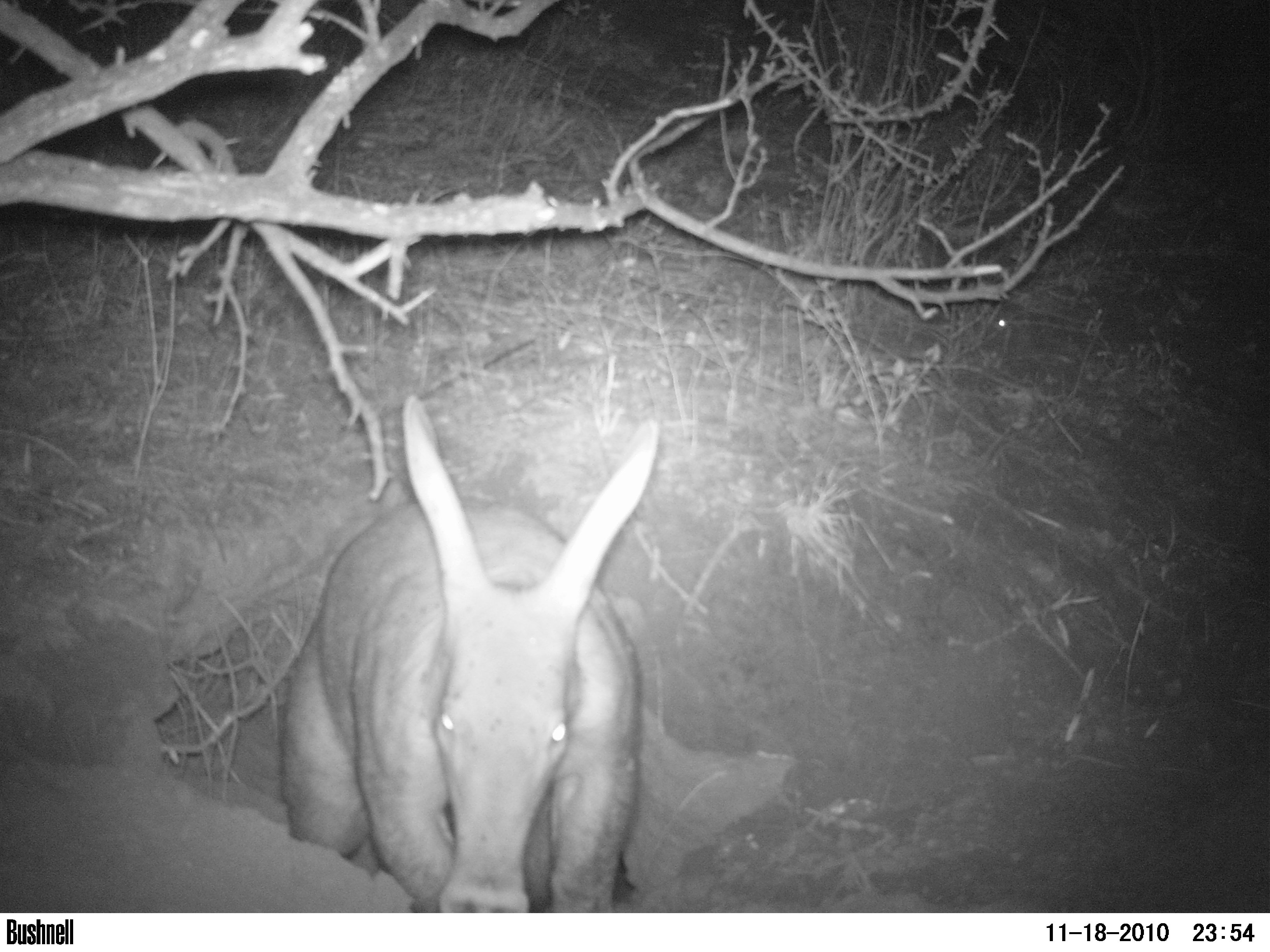
Aardvark!
It seems that the documentary makers don’t think we want to see a whole hour on these little guys. Most people know that lions live in prides and that when a new comer ousts the dominant male he will kill any young cubs. They also know that thousands of wildebeest migrate through the Serengeti, preyed upon by lions, hyena and crocodiles. Who knows how many offspring aardvark have at one time? Or who knows how far a honey badger will walk in one nights foraging.
They are fascinating to say the least these smaller mammals and they are totally deserving of their own starring roles in documentaries and the media. Luckily for us they do appear regularly on Snapshot Serengeti’s camera-traps. Next time you get a porcupine, serval or aardvark stop and think what you know about them.
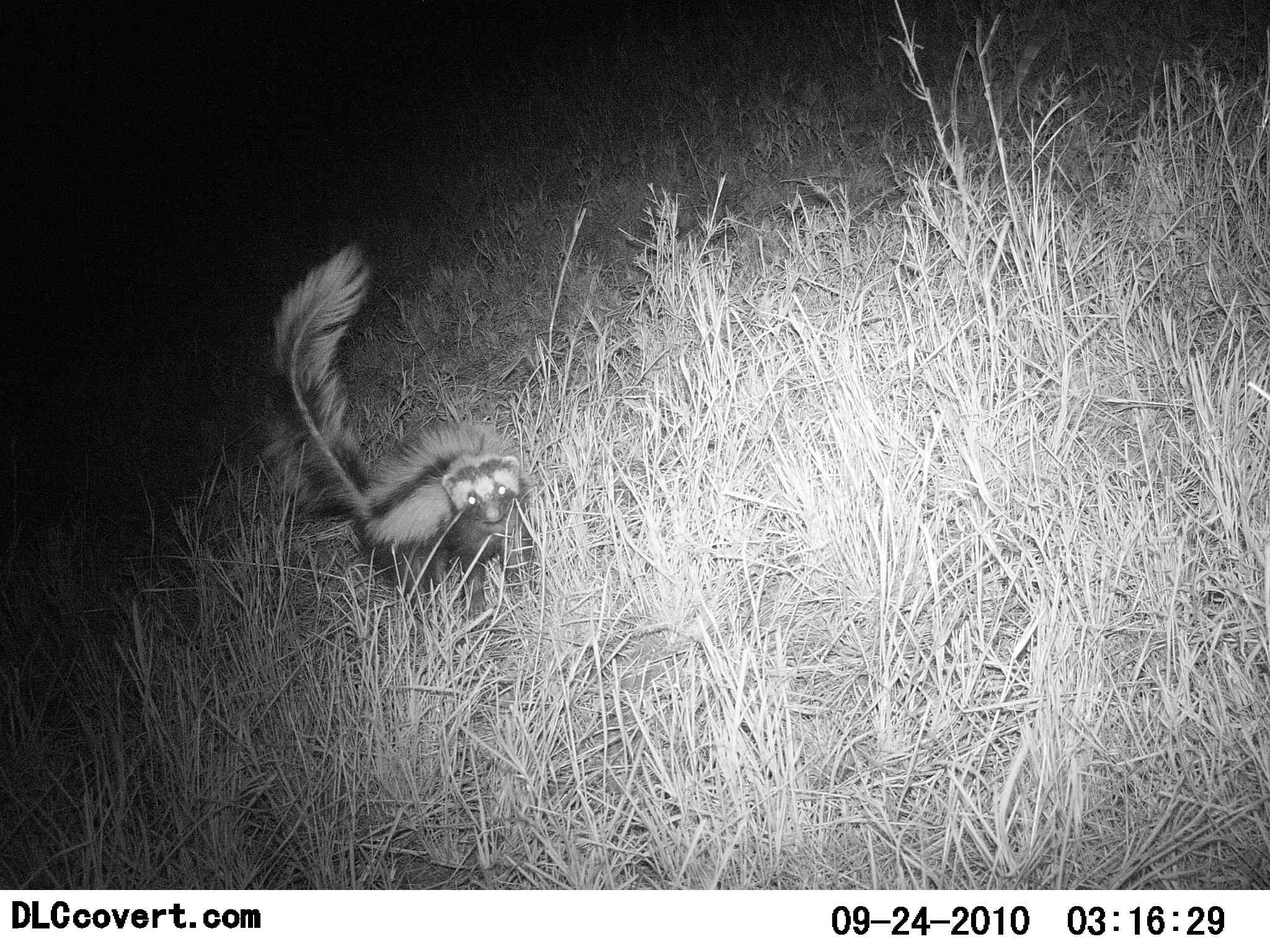
Zorrilla — a rare find!
For me one of the most fascinating small mammals is the sociable mongoose. On the camera-traps they are usually banded mongoose or dwarf mongoose. These guys bustle around all day risking ground based and winged predators. They have complex social lives that find them forever challenging each other of reaffirming bonds. To put it simply they are busy animals.

Dwarf mongoose! One of the cutest critters out there…
I once had the pleasure of a very close encounter with a group of wild dwarf mongoose. One super hot day I was ambling in the bush checking out camera trap spots, following game tracks, looking for likely spots when I came across a beautiful shaded clearing, not very big, a few meters in diameter. I decided to sit awhile and cool down so propping my back against a boulder and stretching my legs out I sat quietly listening to the sounds of the African bush. A sudden black flash and a drongo had flown into the opposite side of my refuge. Now these birds are adept at following mammals and catching any insects scared up by them so I was curious to see if anything else would arrive. Sure enough a rustle in the dry grass and here popped a dwarf mongoose into the clearing. The diminutive creature was followed rather noisily by about 10 or so more of its group. They fanned out each their own direction and immediately started searching for anything edible. I kept very still and tried not to breathe too much until one of the younger mongooses was sniffing my boot. A second scrambled right over my leg and I was entranced. Then the wind must have changed or an adult must have realised the strange rock might just be alive because a squeal was uttered and the whole group scarpered in one direction their drongo with them. The whole episode lasted about 6 or 7 minutes but it has endeared me to these ‘little guys’ for ever more.
It’s no Serengeti, but…
Last year, my mom visited me in the Serengeti. We explored the jungle-like Manyara national park, held our breaths as elephants sauntered within reach of the Land Rover, and woke up at 3am to lions roaring next to our campsite in the middle of the Serengeti plains.
This week, I’m visiting my mom in her own little piece of North American grassland. I made a brief escape from the oncoming Minnesota winter to the normally balmy state of Virginia (it’s getting surprisingly cold at night here!) to help my mom with the little piece of paradise she recently purchased. This past spring she sold her home in the DC ‘burbs and moved out to the countryside, somewhere in between fancy horse country and cattle farms. It’s kind of perfect.
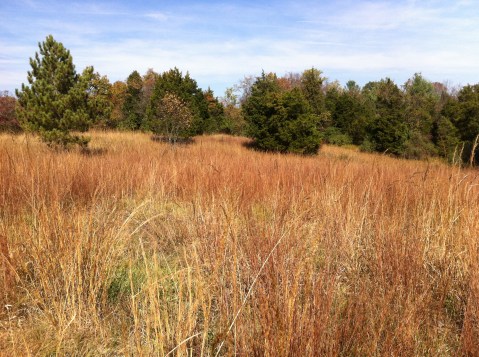
Indian grass, broomsedge bluestem and little bluestem, with autumn olive encroaching in the distance.
It might not be as otherworldly as the Serengeti, and there might not be any giraffes browsing by our deck, but my mom is working hard to maintain a piece of native mid-atlantic grassland on her property. Walking the meadow with the state’s conservation officer, we admired at the Indian grass and bluestem and scowled at the thick carpet of green fescue that made the yard inhabitable for the quail we hoped would recolonize. Grassland restoration is currently a major conservation initiative across the United States. Across the country, most native grasslands have been converted for agriculture; the suppression of natural fires has further allowed trees to grow up in meadows and shade out the sun-hungry grass. Ground nesting prairie birds (such as our bobwhite quail) tend to be the biggest losers in this game, because they need just the right amount of cover to be able to thrive. Fescue grass is too thick for baby quail to waddle through; the relentless olive trees grow fast and thick and threaten to turn our meadow into woods. I had no idea that maintaining native prairie was such a battle.
Spending so much time out in the east African bush, I sometimes forget how amazing our own backyards can be. My mom now has foxes, coyotes, bobcats, and black bears, and a fat, happy family of 8 baby wild turkeys that wobbly by at sunset. As much as I miss the Serengeti, the wildlands here are magical in their own way, and I suspect when I leave, I will feel a little homesick.
Who knew?
Just wanted to brighten your morning with a pretty unbelievable video that has nothing to with the Serengeti. Frogs freeze. That’s right. They don’t hibernate, they freeze. I couldn’t embed this video from NOVA’s Science Now site, but just click here to watch!
I hope that rocks your morning as much as it rocked mine.
Closer look: civets and genets
Civets
The African civet Civettictis civetta is the sole terrestrial civet found in Africa, the rest being found in Indian subcontinent. It is a heavy set cat-like animal and is still referred to as a civet-cat by some though it is not a member of the felids. Civets have a white body with black blotchy spots. They have a black face mask and black legs; the tail appears ringed with a thick black line running down the top. They have an erectile dorsal crest which they raise when alarmed or in aggression. This can be seen on a few of our camera-trap images.

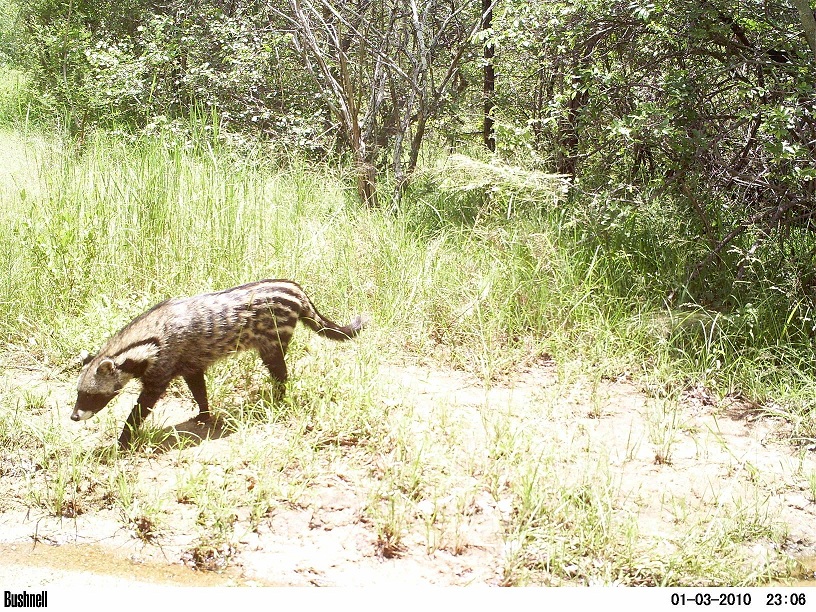
The African civet is most famous for its musk that is used in the perfume trade. Don’t get the wrong impression, it smells terrible, but helps fix scent. Its use has mostly been replaced with synthetic fixers these days which is good news for civets. Civet farms are not regulated and animals are usually kept in small cages from which they are ‘milked’ daily. The real use of their perineal gland which is situated near the anus is to paste an object such as a tree to act as territorial sign post.
African civets are omnivorous, eating a wide range of vertebrate and invertebrate prey as well as taking advantage of fallen fruit. They are clumsy killers and often employ a bite and retreat or bite and throw tactic, where prey is bitten and thrown before quickly running away. The prey is hopefully immobilised so the civet can return to inflict the killing bite. Scent and sound are the predominant senses used by civets. They are classified as Least Concern on the IUNC Red List (International Union for Conservation of Nature)
Genets
The Genet family has 15 subspecies in Africa and these are all still hotly debated. The Serengeti is home to at least two of these, the Common Genet Genetta genetta and the Rusty Spotted or Central African Large Spotted Genet Genetta maculate. It is very hard to tell them apart, especially in a fleeting camera-trap picture but the Common Genet usually has a white tipped tail and the Rusty Spotted Genet has a black tipped tail.
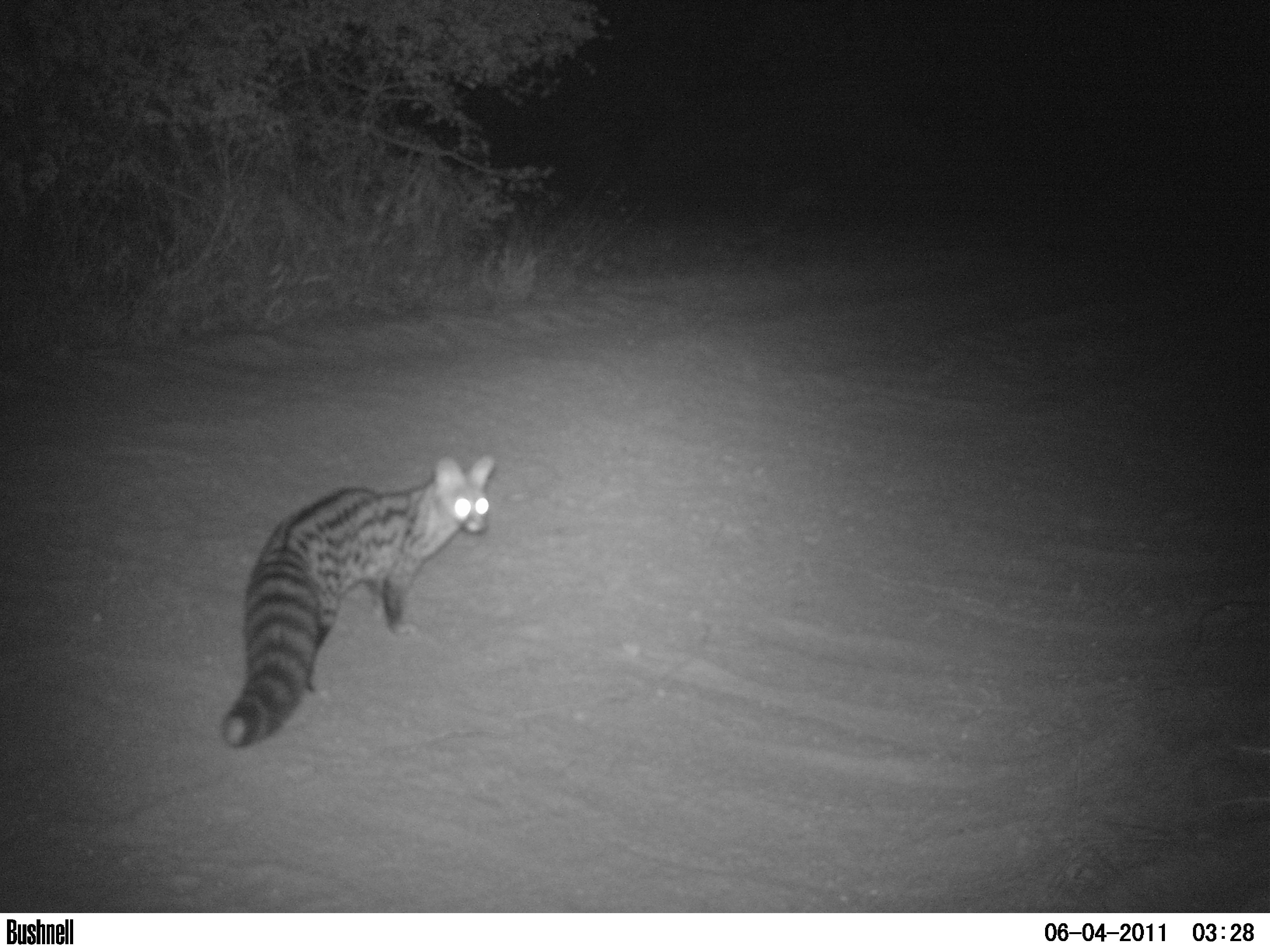
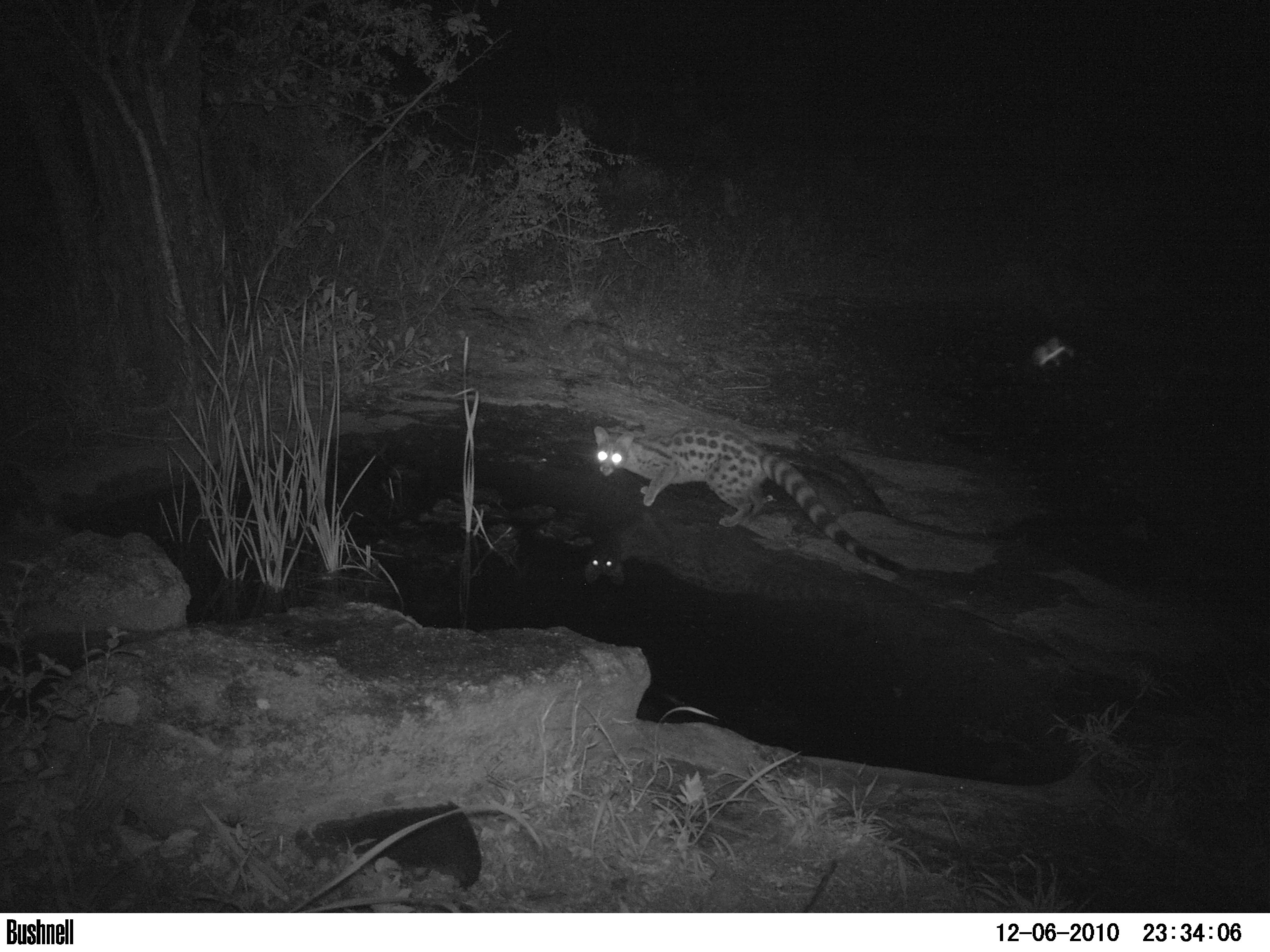
They are small agile mammals that resemble a cat with short legs. Their silvery grey coat is marked with black spots in the Common Genet and black to brown spots in the Rusty Spotted Genet. They have dark marks either side of the muzzle below the eyes giving them a slightly racoon-like look. The tail which is banded is almost as long as the body and can appear quite bushy when alarmed.
The Genets are mainly carnivorous and they will eat mammals, birds, insects and reptiles. They hunt in trees and on the ground and are extremely dextrous. They spend their days in holes in trees, thick bushes, rocky crevices and sometimes in ground holes. Like civets they also have a perineal gland that they use for scent marking. To do this they will stand on their forefeet in a handstand posture and rub the raised gland on a tree or bush. Both Common Genet and Rusty Spotted Genet are classed as Least Concern on the IUNC Red List.
Night of the Lion
Most of you have probably seen this picture:

Kill in action
As well as the ones after it:

Joined by a pridemate.

staring out of view of the camera…

Three minutes later…

Trade-off again…

Where are the leftovers?
This series of photos was taken at site H11 along the Loyangalani river and remains, to me, one of the most amazing accomplishments of our camera trap survey to date.
First, seeing a kill is rare. In the 47 years that the Lion Project has been watching Serengeti’s lions, we’ve only seen lions with about 4,000 carcasses; of those, we’ve only actually seen them in the act of killing 1,100 animals. That might sound like a lot, but with one or two people on the ground, almost every day of the year, racking up nearly 50,000 sightings, that’s not that often.
I don’t love this series simply because this random, stationary, complacently-stuck-to-a-tree camera trap caught this rather rare event – but because it goes on to document the story that follows: A single lioness takes down a zebra much bigger than herself. Within minutes, her sister joins her (free meal!). Note how big their bellies already are though, when they begin to eat. These aren’t particularly hungry lions to begin with. About 45 minutes later, they are staring out of view of the camera, and then comes a group of hyenas. The carcass goes back and forth between them throughout the night, with a jackal darting in to sneak a nibble.
Food stealing, or kleptoparasitism, is a major part of life for Serengeti carnivores. Contrary to long-standing popular belief (reinforced by the Lion King), hyenas are not skulking scavengers living only off others’ leftovers. Hyenas are quite adept predators and scavenge only about 40% of their diet; lions scavenge at least 30% of theirs. And, in fact, lions steal a lot more food from hyenas than is apparent at first glance. More often than not, when we see hyenas lurking anxiously around a pride of lions demolishing a carcass, it’s because hyenas made the kill, and lions stole it away. Research from Kenya suggests lions might actually suppress hyena populations simply by stealing their food.
On the flip side, work from Botswana suggests that hyenas are able to steal food from lions if and only if hyenas outnumber lions by at least 4 to one, and there are no adult male lions present. (Remember, males are half again as big as females: hyenas don’t stand a chance.) But observations that Craig and a former graduate student made from the Ngorongoro Crater further revealed that even when lions do give up a kill, they are so full they can barely move – it’s simply not worth the effort to fend off hyenas any more.
So, kleptoparasitism is a part of life if you are a Serengeti carnivore, but it’s not always as simple as the movies make it out to be. It’s a pretty cool mechanism that might be driving predator dynamics though – I just wish it weren’t so hard to test!!
The lost lions of the Transect Steady pride
### Today we’ve got a guest post by our very own Daniel Rosengren, lion tracker (& photographer) extraordinaire. ###
It started with some mysterious footprints around the Loliondo Kopjes. There were a lot of fresh paw marks in the mud following the road. I could tell it was a big pride but the only big pride with a territory nearby was the Young Transects. But I could not hear their collar. Neither could I hear any of our other prides. I drove around for a while looking for lions, especially on the rocks and under trees. I didn’t find any and guessed it could have been the Young Transect lions anyway, only without the collared female.
A couple of weeks later I was headed out east when I soon caught eye on a big group of lions. As I drove closer I realized they weren’t any lions I knew. I tried to get photos of all of them but it wasn’t easy knowing who you’d already got in a group of 17 lions. Luckily they all started walking along the track. All I had to do was park ahead of them and take photos as they passed one by one. Once I had photos of all their left sides I went home to try to figure out who they were.

I concentrated on the older females as the youngster probably never had been seen before by the Lion Project. After a while I found a couple of matches. It was TR86 and TSF from the Transect Steady pride, not seen since December 2009, almost three and a half years earlier. But the last time they were seen regularly in our study area was in 2008.
Now I contacted TANAPA and the vets to organize a collaring of one of the females. They were coming. I drove back to the place where I’d seen the lions and hoped they hadn’t walked too far. I found them in the shade of a tree. Then a long wait started for the vets to organize themselves and drive all the way from Fort Ikoma. Once they came, the collaring went smoothly, the rest of the pride watching from a distance.
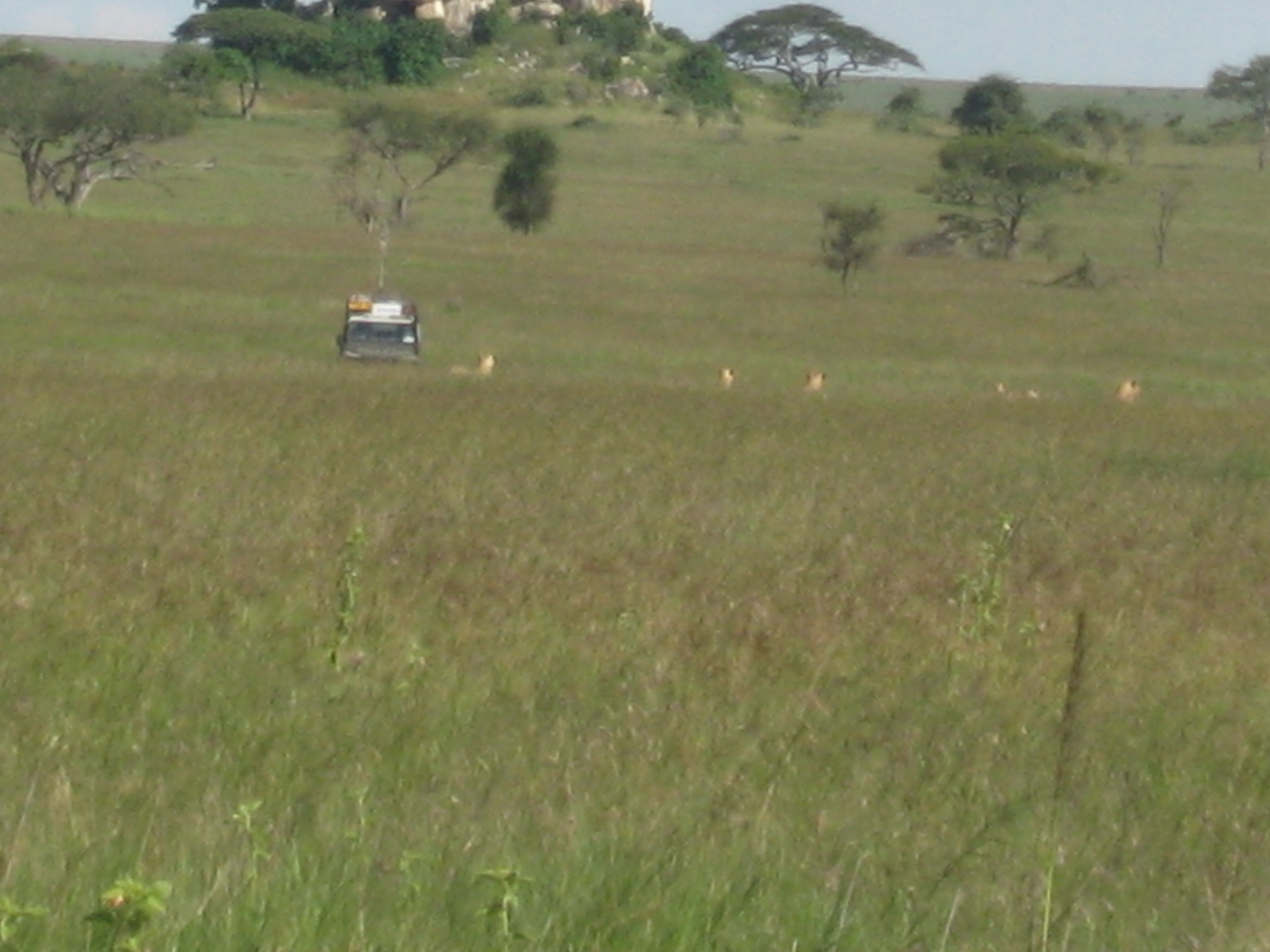
All of the lions of the TS pride, watching us warily as we try and create enough space to safely collar our lion.

Daniel fitting the collar.

TANAPA vet preparing to take samples.
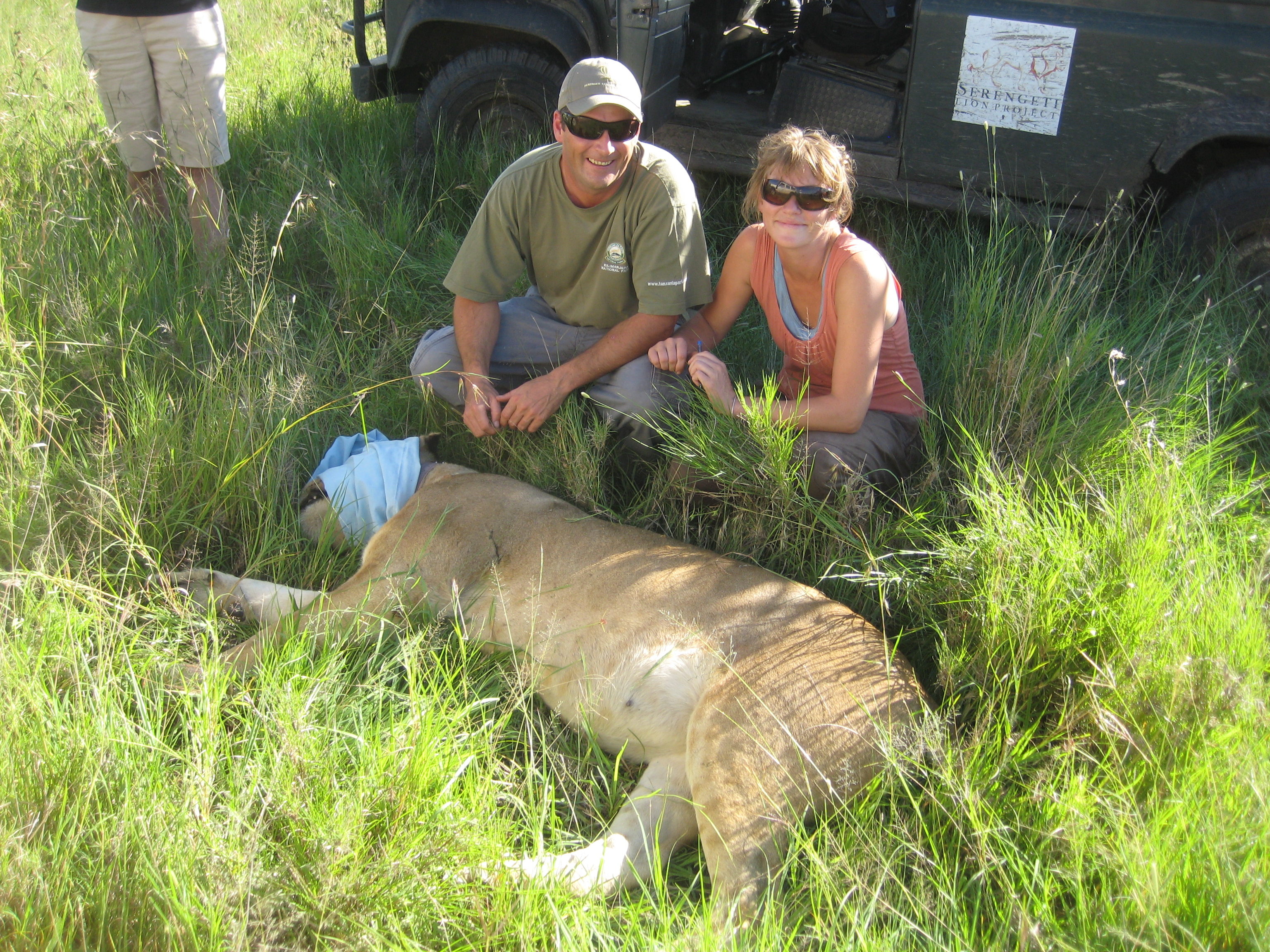
It’s pretty exciting to to be this close to a lion. Their paws are BIG.
About a week later I found the pride just outside the northern edge of our study area along the Pipeline track. Two more old females known since before had joined them, TR93 and TR106. Then they disappeared. So two weeks later I decided to search for them and drove along the Pipeline track north. But instead of driving on the actual track, which in many places was disappearing because of little use, I drove parallel to it, hitting all hilltops to be able to pick up the radio signal from a greater distance. The drive was terrible as the hills in the area are specked with large rocks and I had to drive dead slow. I held on the the steering wheel as little as possible. Having no power steering means that every time I hit a rock I risk breaking thumbs or worse.
I picked up the signal after a while but I still had to pass several hills before finally finding them, right by the track at a river confluence. That was quite far north of our study area and too far to go and see them on a weekly basis. The future will have to show where they finally settle.
This is what grant applications do
I’ve been working on a federal grant application the last couple of weeks. It’s left me feeling a bit like this:
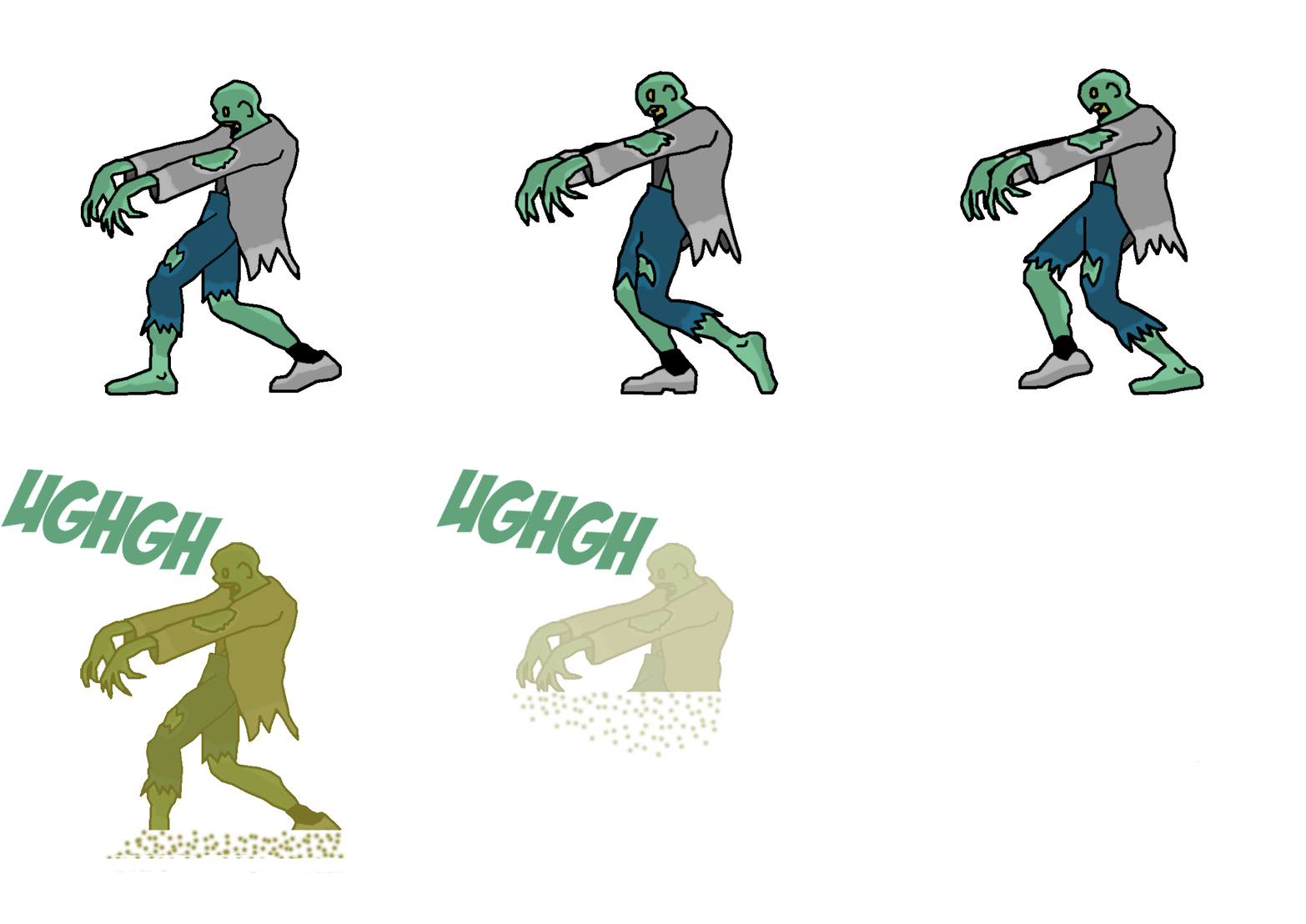
The grant was originally due this upcoming Thursday, but with the government shutdown showing no signs of ending, who knows what will happen? The National Science Foundation’s website is unavailable during the furlough, meaning that nobody can submit applications. So we’ve all been granted an unexpected extension, but we’re not sure until when.
The grant I’m applying for is called the Doctoral Dissertation Improvement Grant. It’s an opportunity for Ph.D. students to acquire funding to add on a piece to their dissertation that they wouldn’t otherwise be able to do. I’m applying for funds to go down to South Africa and work with a couple of folks from the conservation organization Panthera to collate data from two sites with long-term carnivore research projects. Their research team currently has camera surveys laid out in two reserves in Kwazulu-Natal, South Africa: Phinda Private Game Reserve and Mkhuze Game reserve. Now, the cool thing about these reserves is that they are small, fenced, and pretty much identical to each other…except that lions have been deliberately excluded from Mkhuze.
Now, one of the biggest frustrations of working with large carnivores is that I can’t experimentally isolate the processes I’m studying. If I want to know how lions affect the ranging patterns and demography of hyenas, well, I should take out all the lions from a system and see what happens to the hyenas. For obvious reasons, this is never going to happen. But the set-up in Phinda and Mkhuze is the next best thing: by holding everything else constant – habitat, prey – I can actually assess the effect of lions on the ranging and dynamics of hyenas, cheetahs, and leopards by comparing the two reserves.

Camera surveys (yellow dot = camera) in Serengeti (left) and Phinda/Mkhuze (right).
So, that’s what I’m working on non-stop until whenever it turns out to be due. Because this would be a really cool grant to get. I’m currently working on analyzing some of the camera trap data from Seasons 1-4 and hope to share some of the results with you next week. Until then, I’m going to continue to be a bit of a zombie.
The sound of silence?
## Today’s guest post is from our moderator and regular contributor Lucy Hughes. ##

What does silence mean to you? Maybe it’s that moment at the end of the day when the telephones stop ringing and the office hubbub finally stops and you can hear yourself think. Maybe sitting in your garden listening to the insects and aeroplanes pass overhead. Or maybe it’s that first 5 minutes of waking before the baby starts howling. Whatever it means to you the point is silence isn’t really silent. Something is always making a sound even if it’s a leaf rustling in the wind or a cricket singing.
In the African bush night time silence is deafening. Just before sunset there is a rush of activity. The day shift starts looking for a place to spend the night whilst frantically searching out that last mouthful of food. Young banded mongoose are scolded into their burrows by older siblings. Antelope take a drink before heading to thicker cover. Francolins are calling out their staccato calls whilst sandgrouse flock to drink. As the sun sets and darkness looms everything quietens down, the last to make a noise are the guinea fowl who wait till it is just dark to, one by one, barrel up to adorn their favourite roosting trees like giant Christmas baubles. They finally settle down, and the nearby baboons stop squabbling and there is a moment’s peace before the night shift takes over.
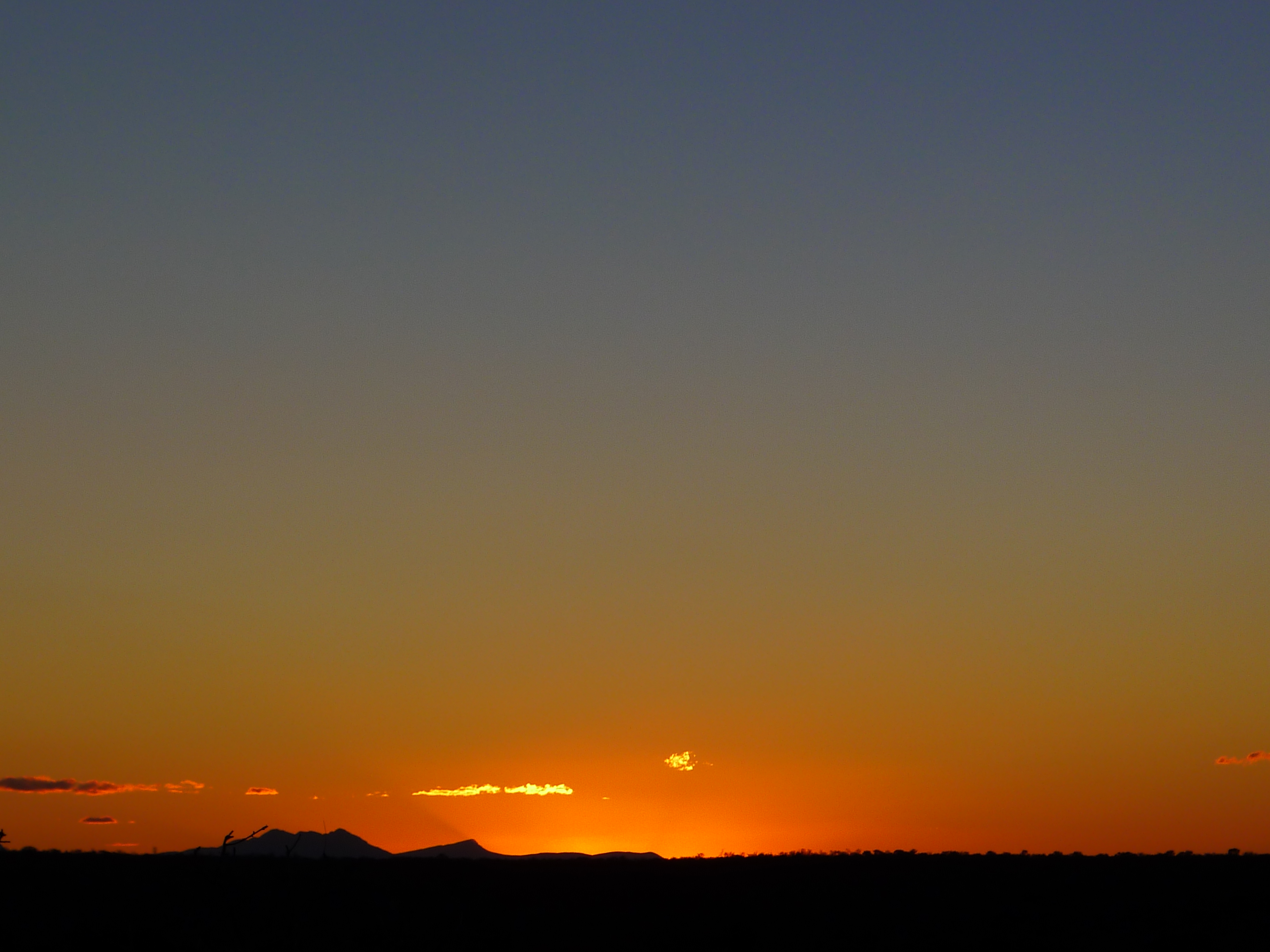
The Scops owl is first with its ‘poop poop poop’ call sounding almost like an insect. Then the night-jars join in. A distant rasping bark and the jackal are off calling ownership of their territory. They stop suddenly and a moment later there it is, the slow wo-oop! Woo-ooop! and the hyena clan are declaring they are up for business.
There has been no respite to the constant noise of the African bush during this transition between day and night; a seamless mix between the two sound tracks. As the evening wears on and the night shift are out hunting in earnest it gets quieter. If you are lucky enough to experience this it is unforgettable. The silence is thick, it hurts your ears and you want to shake your head to clear it. You are straining to hear anything out there in the blackness and your senses have you on high alert, never mind that you are in a vehicle your primal instinct knows this is Africa and beasts roam that want to eat you.
The only sound is a cacophony of insects and it is this that gets in your head, it is a relief when a spotted eagle owl calls breaking the pitch and giving you perspective again. Staring into the blackness you see a shape move , you can’t make out what it is, then comes a noise that goes right through you, a guttural, low sawing sound, a leopard is calling broadcasting its presence using the ground as a sounding board. He walks out in front of you, pauses for a moment, then strides off purposefully into the night.
The silence of the African night is palpable. You could slice it with a knife. It is so full of promises of wonderful animal encounters that I never want to sleep. It’s my favourite sound of silence; what’s yours?

The short and happy life of a Serengeti lion
### Last week Craig spoke for Cafe Scientifique about lions and shared the research that Lion Project has been conducting for the last 45 years. Check out the video here. Peter and Faith, UMN undergrads conducting research in the Lion Lab, attended the talk and share their experiences as well. ####
Peter and Faith here! Last week we had the opportunity to attend the Bell Museum’s Cafe Scientifique. Cafe Scientifique allows scientists from all disciplines and specialties to share their research directly with the public in the form of a casual presentation given at the Bryant Lake Bowl in Minneapolis, MN. This past month’s talk was given by Snapshot Serengeti’s own Professor Craig Packer, giving a historic rundown of some of the highlights of the lion research conducted by the University of Minnesota’s Lion Research Center.
As prospective lion researchers ourselves, it was both interesting and valuable to hear the conclusions of past research from the perspective of the researcher. Not to mention having it be told in a casual and humorous way, which is a refreshing break from the stack of scientific papers we are usually reading! The audience, which was made up of local community members, was also engaged in the talk. Even though Dr. Packer presented complex graphs and maps, he explained the research in a way that was accessible to everyone. The studies that were discussed during the talk included the lion’s mane study, why lions form prides, and even a bit about lion conservation and the potential use of fences to protect vulnerable populations. In addition to reviewing past research, Dr. Packer also talked about the lion project’s current research–Snapshot Serengeti. The audience was amazed by how fast volunteers sorted through the millions of images on Snapshot Serengeti. (To all of you that have contributed to the success of “Snapshot”, cheers to you!) By the end of the talk, the entire audience, (including us!) had loads of insightful questions, and left with a piqued interest in the world of lion research.
 Snapshot Serengeti