
Aardwolf vs. Jackal
#### Today I’m excited to bring you a guest post by UMN undergraduate Peter Williams. Peter conducted independent research in the Lion Lab through the University of Minnesota’s directed research program, helping to identify and process some of the early images from the camera trapping survey. You’ll likely see Peter on Talk from time to time. ###
One of my favorite animals of the Serengeti is the aardwolf. This little-known relative of hyenas has an extremely specialized diet—it mostly eats one genus of termite. Aardwolves, about the size of a fox, are not the toughest carnivores. Some other carnivores, such as lions, have been reported to kill aardwolves, and parent aardwolves guard their burrows to prevent jackals from eating their cubs. I wanted to know if the threat of a jackal attack affected aardwolves. Did aardwolves avoid jackals by living in different areas? Or by being active at different times?
To dive into this, I first compiled the camera trap sightings for aardwolves and jackals in a spreadsheet. Each sighting contains tons of information, such as time of day the sighting was taken, distance to the nearest river, how many trees in the area, what the grass cover was like, etc. I made graphs comparing aardwolf sighting to all of these different factors and looked to see if there were any trends. Then I did the same with jackal sightings. Most factors showed no correlation, but there were a few trends that stood out.
One pattern that was extremely clear was nocturnal behavior in aardwolves. Over 90% of the aardwolf sightings occurred between 7:00 pm and 6:00 am. Jackals, on the other hand, were active all day, with a drop in sightings around the heat of the day. It is unlikely that jackals have an effect on when aardwolves are active, especially because the termites that make up the bulk of an aardwolf’s diet only leave the mound at night.

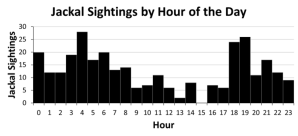
Later, I tried comparing data between the wet season and dry season. For the aardwolves, there was almost no change in where or when they were active. Jackals in the dry season spent a lot of time in grassy areas that weren’t too arid—the same types of places aardwolves live. In the wet season jackals spread out into drier and more open spaces that are less habitable in the dry season. It makes sense that aardwolves would stay put, given how dependent they are on termites. The movement of jackal between seasons, though, is quite interesting.
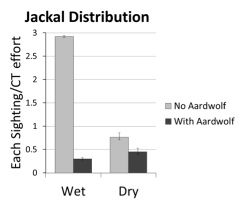
To answer my original questions, the presence of jackals doesn’t appear to have a noticeable effect on aardwolf behavior, nor do aardwolves seem to avoid jackals. However, the jackals moving into aardwolf territory in the dry season and back out to more open spaces in the wet season is a fascinating trend that I want to look into more. I didn’t find what I expected, but trying to find answers always leads to more questions.
The things that live inside…the cameras
Whenever I rock up to a camera trap, I sort of hold my breath and brace myself for what I’m going to find. Sometimes I find nothing — elephants have tossed the camera off the tree and into the green grassy oblivion, or hyenas have left dribblings of mangled plastic and tooth-dented batteries — but stories about the never ending crusade to protect the cameras from overenthusiastic large mammals will come another day. Today is about the wildlife that try to make my cameras home.
I’m always a little surprised at what I find. Geckos love to lay their eggs in the metal cases, though they and the skinks tend to act rather molested when I disturb them.
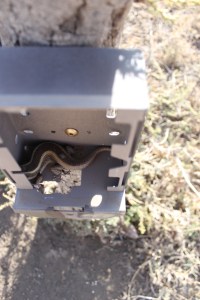
a skink!
Other inhabitants are a bit slower to react, like this caterpillar:

one of the cuter inhabitants…
And then there are some mysteries…
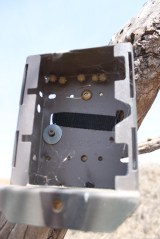
Some sort of spider eggs, perhaps?
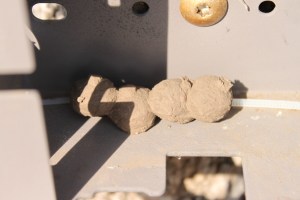
I have no idea. Any suggestions welcome.

Something has made a mysterious home of rolled up leaves.
The only thing that I really can’t bear is the ants. Don’t get me wrong, ants are cool – and they do *really* cool things – but they also bite. And when they’ve turned a camera into their home (as in the photo below — those white bits are eggs or larvae), they aren’t particularly welcoming to researchers. I’ll try to get som clearer photos this field season – because I guarantee you, there will be many, many ants to come.

Ants.
Lions, hyenas, and leopards, oh my.
Craig (my adviser and the Director of the Lion Project) sometimes jokes that I wandered into his office looking to study tigers. It’s actually sort of true. I had been at the University of Minnesota to interview with a tiger researcher – but fell in love with the science that Craig’s team was conducting. Six months later I became the newest addition to the Lion Lab.
As part of the Lion Lab, my dissertation research focuses on how lions coexist with other large carnivores – hyenas, leopards, and cheetahs. Understanding how species coexist is a really big question in ecology. When two species eat the same thing, the species that eats (& reproduces) faster can exclude the slower species from that area. A lot of ecology is devoted to understanding the conditions that allow for coexistence in the face of such competition. The natural world is an incredibly diverse place, and it turns out the plants and animals have all sorts of strategies to survive together – though we’ll have to dive into those details another day.
Carnivores throw a bit of a wrench into our understanding of coexistence – even when they don’t eat exactly the same prey, they harass each other, steal food from each other, and even kill each other – and these aggressive interactions can result in dramatic suppression or even complete exclusion of certain species. For example, there’s a fair bit of evidence that wild dogs have a tough time surviving in areas with lots of lions and hyenas – not because lions and hyenas kill wild dogs, but because they steal food from them. Since wild dogs expend so much energy hunting, they simply can’t afford to lose those calories to scavengers. These patterns aren’t actually unique to large carnivores – a lot of animals, from bugs to birds, interact this way. However, since carnivores range over such large areas, it can be challenging to understand their dynamics.
That’s where the camera traps come in. The long term lion research project provides incredible amounts of detailed data on what lions do, where they are, and how successful they are at reproducing. By adding the camera survey on top of the lion study area, I can collect information about the other carnivore species and integrate it with the detailed lion data to ask bigger questions than could be answered with one dataset alone. Unfortunately, there aren’t any wild dogs left within the study area, but I can still investigate how lions coexist with leopards, cheetahs and hyenas. It’s a bit gruesome when you get down to it — lions tend to dominate all the other species when it comes to one-on-one interactions, stealing their food or even just killing them for no apparent reason. For example, lions kill somewhere between 25-55% of cheetah cubs! And you can see here Stan’s photos of lions just killing…and leaving…a leopard.

Lions chasing…
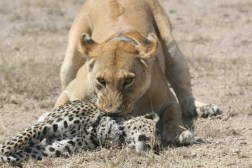
…and catching…

…and leaving…a leopard
Lions will also kill hyenas, but enough hyenas can be a pretty solid threat to lions – able to steal carcasses or kill their cubs. Leopards sometimes kill and eat lion cubs. We don’t yet know if hyenas and leopards do this at a rate that actually hurts lions in the long-term, but we’re hoping to find out.
One of the key things I’m trying to find out (with a lot of green coffee and evening sessions) is how these species use their habitat with respect to each other. Research in other ecosystems shows that smaller carnivores (those that usually lose a fight) can get pushed out of large areas, existing sort of in the ‘no-man’s land’ between top carnivore territories – and when this happens, their numbers can plummet. However, if the smaller carnivore can just avoid the larger one within its territory, they might be able to coexist. A lot of this depends on the habitat complexity – for example, in open areas, it’s harder for the smaller guy to hide.
The camera traps let me evaluate these different patterns of avoidance to understand how lions, hyenas, leopards, and cheetahs all coexist in Serengeti National Park. Once we understand their dynamics in Serengeti, we can hopefully understand why they do or don’t coexist elsewhere. It’s a pretty cool science question – and it’s also an amazing adventure. I head back to Serengeti this January for my final field season, and am looking forward to sharing the adventure with you on this blog.
 Snapshot Serengeti