
Lions, Cheetahs, and Dogs, Oh My! Part 1.
By now it’s no secret that lions are kind of mean – and that if you are any other carnivore living in the Serengeti, you’d probably prefer a lion-less world. No tawny, muscle-bound foes to steal your food, kill your cubs, chase you around…life would be easy! You’d have plenty of food, your cubs would grow up strong, and your numbers would increase.
Or would they?
It certainly makes sense that all the nasty things that lions do to other carnivores should add up to limit their numbers. Lions are responsible for nearly 30% of wild dog deaths, and over 50% of cheetah deaths! On top of that, they steal food that cheetahs and wild dogs have worked hard to get – and might not have the energy to get again. Researchers are pretty sure that more lions means fewer wild dogs in two ways: 1) In reserves where there are more lions, there are fewer wild dogs, and 2) When lion numbers increase through time, wild dog populations decline.
The same has generally been believed about cheetahs, and some research from the 1990s suggested that reserves with more lions had fewer cheetahs. But as I started digging into the data from Serengeti, I saw a different, quite unexpected, story.
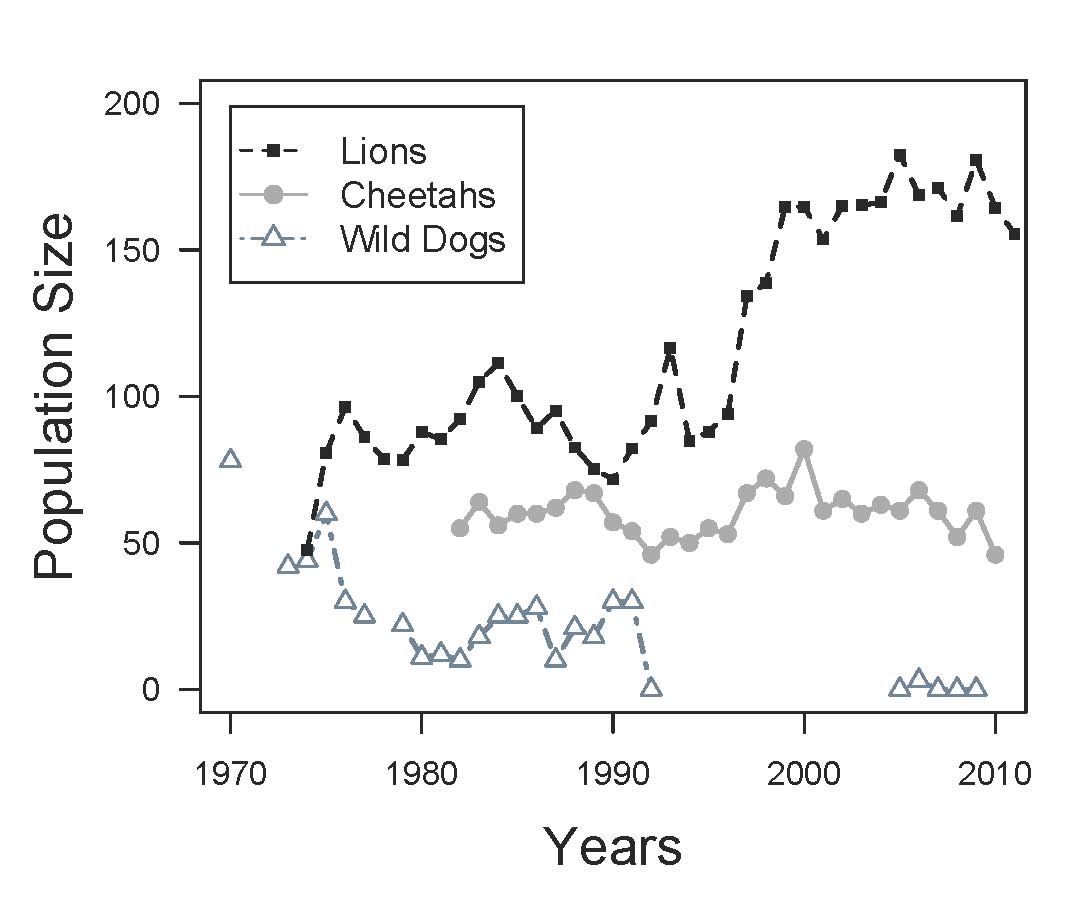
The number of lions, cheetahs, and wild dogs from 1970 onwards. Wild dogs disappeared from the ecosystem from 1992 through 2005.
Lions, cheetahs, and wild dogs were all monitored by long-term projects for a number of years. This graph shows their population sizes since the 1960s. The increase in lions is pretty clear – lions have nearly tripled in the last 40 years, largely due to increases in wildebeest. Wild dogs disappeared from the study area. Now, their final disappearance was due in large part to disease, but it’s possible that lions didn’t help matters. In sharp contrast, the cheetah population has stayed pretty much the same. Sure, there are some ups and downs, but on average, the population has been holding steady over the last 40 years.
Wait a minute, if lions are really bad for cheetahs, then why haven’t cheetah populations declined in the Serengeti? How can they possibly be holding steady when lion numbers have tripled? What is going on???
It’s a good question. Tune in next week for an answer!
Stuck. Part 2.
##### Today’s post is a continuation of last week’s adventure, written by Patrik Dousa. #####
When we left off the story from last week, all of us in the Serengeti team were out deep in the sour tern range of the Serengeti trying to free a land rover from thick mud. All we accomplished was securing the range rover even deeper in the mud. From 1/4 of the wheel being submerged to a half, with the bumper touching the ground. Good going. A beautiful sunset was going to occur in an hour or so and the last place to be at that point was in the middle of a hazardous plain with a large pride of lions waking up for their nighttime prowls.
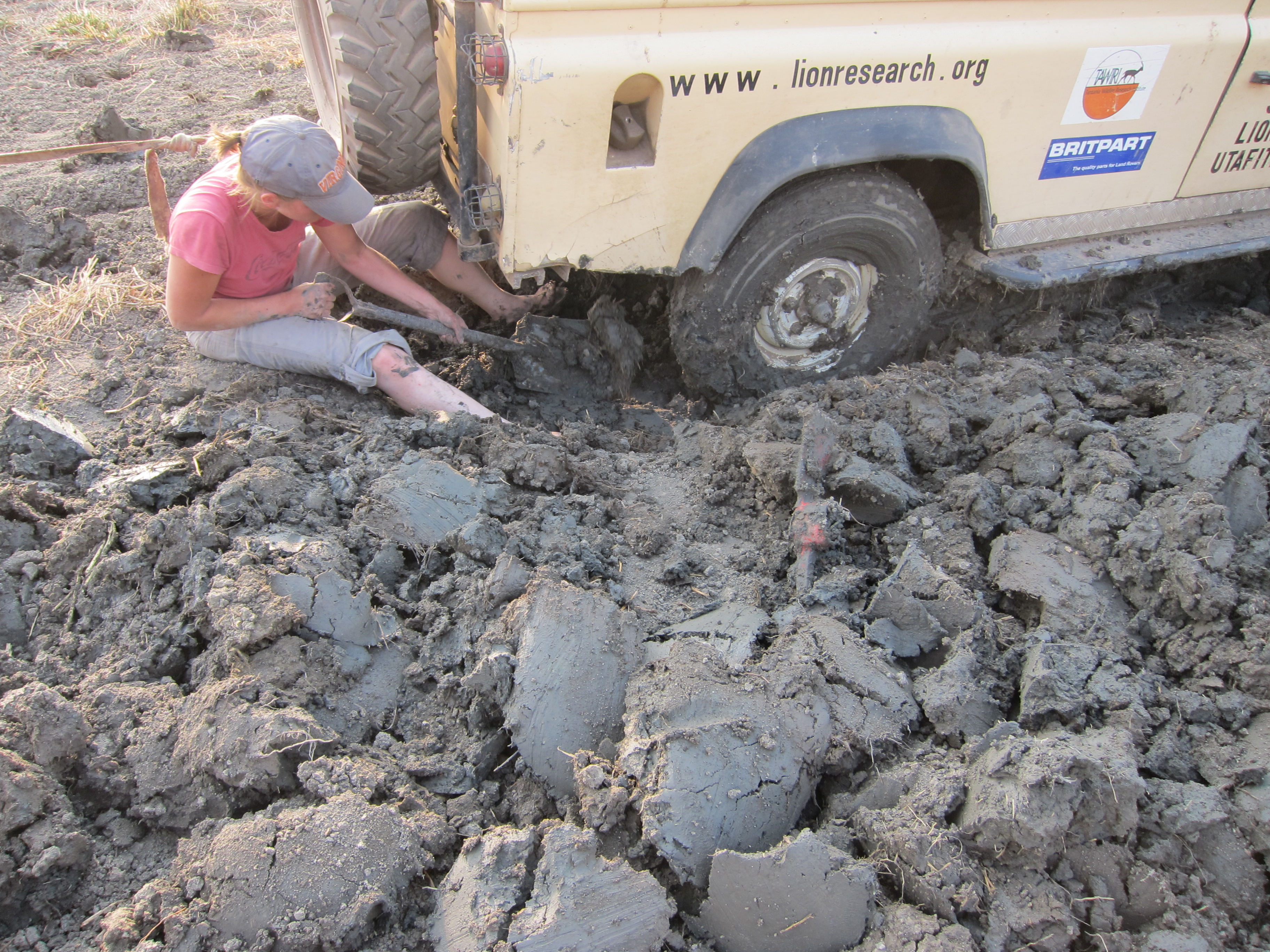
This is actually muddier than it looks…
The lions are still watching us from their mesas to the north and Ali is figuring out the next move. I thought it was a clear decision. Leave. Now. Have I described to you the fortitude and diligence of a lion researcher? A job that requires you to spend most of your time in the dry plains with the only the basic minimum requirements to sustain you doesn’t attract individuals who give up too easily. No, Ali and George see the sunken rover as a challenge that must be faced. We aren’t leaving, not without a fight.
Just then a tourist vehicle pulls up along a road about a half-mile from our area on the other side of the uncrossable mud plains. The guide is in the process taking them back home to one of the southern lodges and apparently decided to stop, having spied the magnificent example of male lion that was observing our vehicle. The new arrival attracted King Simba’s attention and the powerful elegant beast starts walking towards the tourists. I can see their excitement mount through my binoculars — this moment is going to be the highlight of their trip. George and Ali are laboring through shovelfuls of the thickest, reddest, peatiest mud you can imagine and only a short distance away, well-scrubbed observers are preparing themselves for the the apex of their Serengeti experience. Such is life.
I see a bold cub follow his master lion and play around his feet incurring his wrath for a moment. The king playfully swats back and raises his head to the heavens letting out an immense roar to the delight of the tourists. The greatest show on earth — with our little car-trouble side-show of going on right in the background. “Who are those crazy people back there?” they must have asked their guide. “Well, they’re professionals, so they must know what their doing.” the guide is certain to have responded.
The lion’s roar triggered a slow migration of the lionesses and their cubs from the low mesas to the area closer to the tourist vehicle where the male lion had settled. As the single file procession began, we felt a wave of relief since the pride was now headed away from our rover. A few more attempts to drag out the stuck vehicle failed. By now the sun is steadily growing larger and more rosy as it begins its decent. The sky eventually reaches the particular hue that Ali reads as our signal to leave.
We secured the vehicle and took all the valuables and began a slow retreat back thinking, “please don’t get stuck” on repeat until we got back on the main road. The pink sun blossomed into a deep red bloom that backlit the acacia tree line creating the beautiful silhouetted postcard image that the Serengeti is so well know for. The mood in the car was impervious to these romantic supplications. Exhausted and temporarily defeated, the crew made the long journey back toward the research house.

And all we’ve done is get ourselves in even deeper.
Being the visitor who expended the least amount of sweat that day, I suggested that we stop at the local canteen Seronera and that I’d treat everyone to a chicken and rice dinner and a Stoney Tangawizi (the extra spicy ginger ale that is everybody’s favorite drink in Tanzania). This turned out to be a very cost effective way to turn the sour mood sweet — just a few bucks per plate and brew to get everyone back to their happy place. Soon the team was back to the bantering with the locals and planning tomorrow’s adventure. That was my last night at the Serengeti, the next day I was back on the road to Arusha. Ali messaged me later and mentioned that they were able to round up a crew to go back and successfully drag out the rover the next day. This did not surprise me since I had well learned: you can’t keep a lion research team down for long.
The trouble with shade
Who knew that shade could be so problematic? A couple of weeks ago, I wrote about how shade seems to be my biggest obstacle in reconciling how the cameras see the world vs. what is actually going on. My job is to figure out how to make things right.
To start with, the camera traps are up on trees. Mostly. As you know, the cameras are on a rough grid layout – 225 grid cells, each 5km2 (2.236km on each side) — covering a total of 1,125 km2 of Serengeti’s center. This kind of design makes sure that we are covering enough of the landscape to capture the bigger picture of animal distributions and movements. Each camera is roughly at the center of each grid cell – on the closes suitable tree to that center point. Some trees are big and shady; some are small and spindly. In the woodlands, there are trees everywhere; on the plains, the camera-trap tree can be the only tree for miles. And sometimes there are no trees at all, and here the cameras get put up on metal poles.


These different habitats are important to capture. I think that animals might behave very differently in areas with lots of trees than they do in areas with very few trees. When it comes to the aggressive interactions between carnivores, for example, trees, shrubs, and tall grass provide great hiding places for the smaller species. It’s like trying to hide from someone you don’t like in an empty room vs. in a really huge, crowded shopping mall.
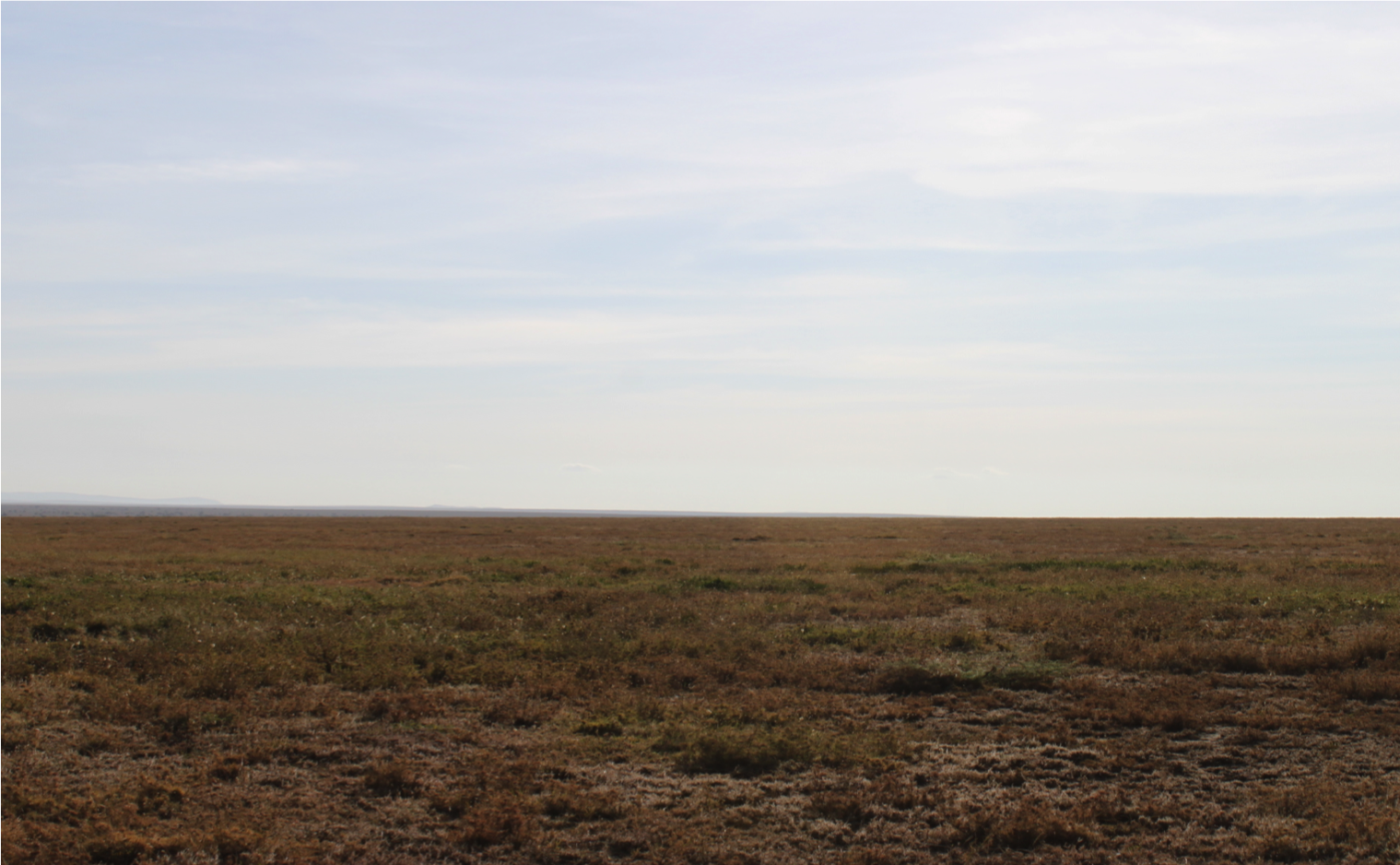
It’s a lot harder to hide from lions here
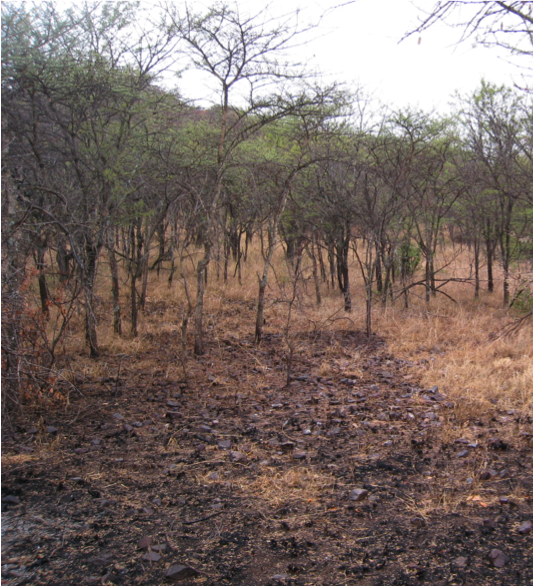
…than here
The problem is that camera traps work better in some habitats than others – at least for certain species. Say you are a huge, muscle-bound lion. Even standing is tiring in the Serengeti heat, and you spend your days breathing heavily even at rest. You like shade. A lot. If you are out in the open plains, a single shade tree will stick out for miles, and you’ll probably work your way to it. Chances are, that tree has a camera. In the woodlands, though, there are lots of trees. And the camera trap could be on any one of them. So even if you’re searching for shade, the chances of you walking past the camera trap in the woodland are far smaller – just because there are so many trees to choose from.
Here’s a map of the study area – green shows more densely wooded areas, whereas yellow marks the plains. Camera traps that have captured lions are shown with circles; the bigger the circle, the more lions were seen at that trap. I know for a fact that there are more lions in the northern half of that map than in the southern half, but the lions out on the plains seem to really like getting their picture taken!
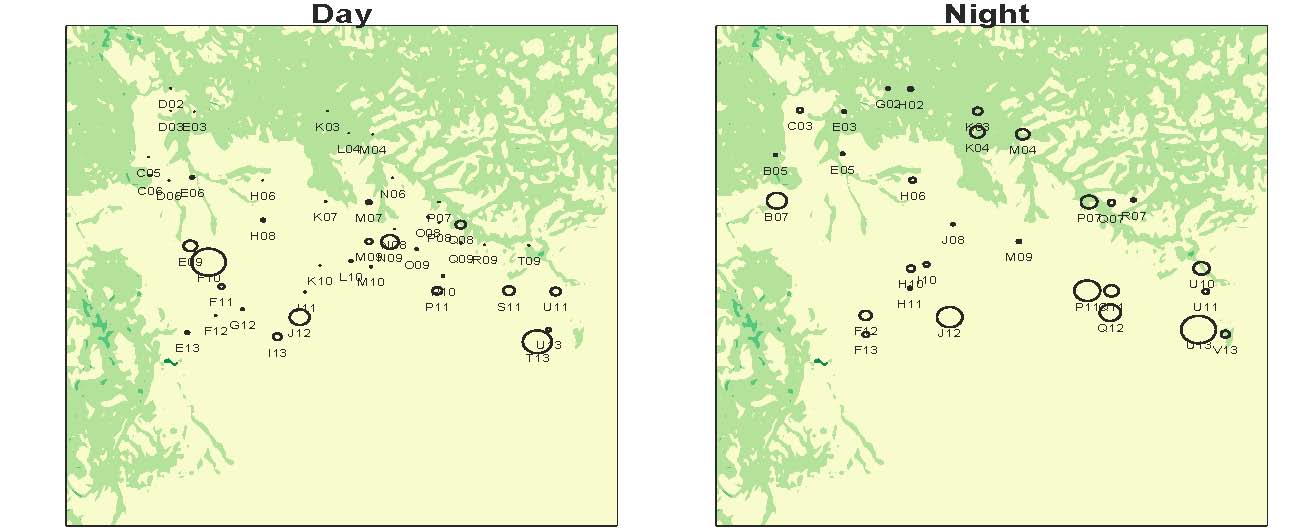
The pattern looks a little better at night than in the day, but it’s not perfect. So perhaps shade isn’t the only thing affecting how these cameras “see” lions in different habitats.
As depressing as this problem seems at first glance, I’m optimistic that we can solve it (enter Kibumbu’s new GPS collar!), but those methods are material for another day. In the meanwhile, what else do you think might be going on that attracts lions, or other animals to trees, besides shade?
Stuck. Part 1.
Stuck. Surrounded by lions. Please come.
This is not a text message that you’d necessarily expect to get on your cell phone…unless you work as a lion researcher in the Serengeti like Ali does. Receiving this text in the early afternoon, she takes the news in stride as a necessary task that needed to be finished before dark. I on the other hand, as a visitor, am charged up and nonplussed with the drama of it all. George, one of the field research assistants on a lion tracking expedition, obviously needs help and pronto, so we are on our way out within a few minutes. In the wild Serengeti, a few minutes can separate success from tragedy — the research team has an exceptional awareness of this and also the discipline to do what it needs to be done in a methodical and prompt manner as Ali is demonstrating to me at this moment.
We track George and his land rover down just like we do lions. Each rover is outfitted with the same tracking unit that is on the collar of each radio-tracked lioness. So we chase the rover’s signature signal deep into the southern range, driving on the dirt roads as fast as we can safely afford. As the day draws towards a close, the animals become restless. Elephants trumpet in the distance. A serval — a beautiful African wild cat one doesn’t see everyday– trots across the road and disappears in the brush. Normally such a sighting would warrant an immediate stop, but not today.
Finally, we go as far as the roads can take us and we must venture in the unmarked grassy plains that are a minefield of axle-breaking holes and mud-traps. Driving off road is risky business in the daytime –as George was just reminded of — and completely a fool’s errand in the nighttime. Ali looks for the tell-tale signs in grass patch coloration that indicate a possible hole as she swerves deftly through the treacherous terrain in a labored crawl.
Finally on the horizon, we sight George and his rover axle deep in a seemingly stable area. The dry cracked surface, however, masks a vast mud hole created by the recent rains. This is the worst kind of environmental trap that even a seasoned veteran like George can fall prey too. With a lighthearted smile that belies any frustration, George explains how he tracked a pride of lions into this area and was surprised by the sudden drop into the mud. Luckily, our rover remains in the solid area just short of George’s rover. We check the area and see that the lions have moved off to a series of small mesas to the north. It’s safe enough to exit the vehicles as long as one of us keeps a 360 degree lookout.
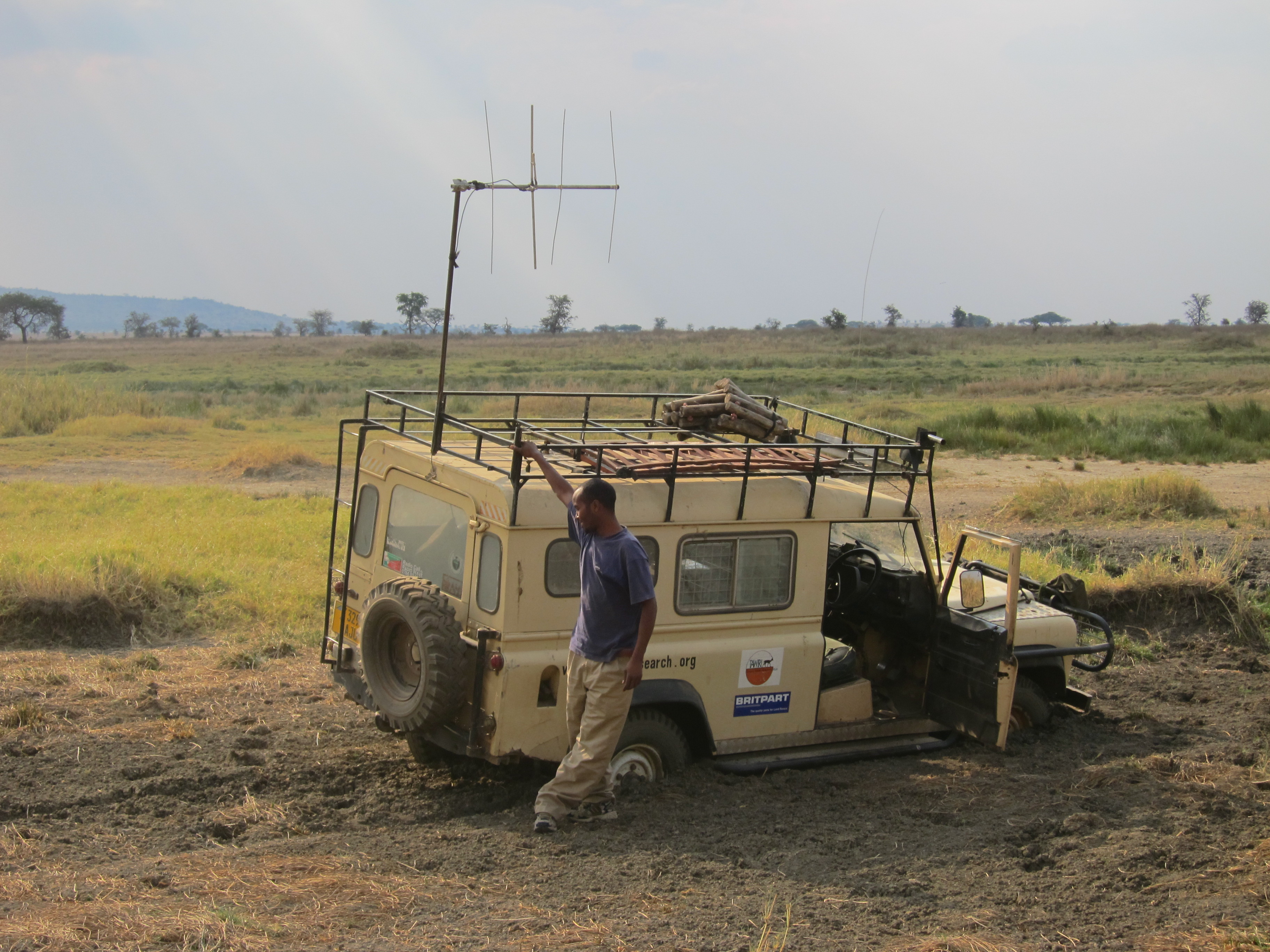
How we found George.
Our cellphones at that point record no bars, so as Ali readies a tow line, she inquires how George was able to get a message out.
The calm exterior and wry banter of every lion researcher I’ve met is always the counterpoint to the fierce passion and iron discipline at their core. George is all smiles and laughs a bit as he recounts the sinking feeling he had when he saw that he had no bars on his cellphone and lions surrounding three sides of the vehicle. A thickly maned adult male lion stood watch right outside the drivers side as if he sensed George’s desperation.
A good scientist, when faced with a problem, puts together an experiment to test its boundaries. Perhaps the cell phone could be made to transmit somehow? As George raised his hand up and out of the vehicle he noticed to a single bar flicker on and off. This observation made him hatch a plan that he reflected on as he eyed the attentive dark-maned sentinel waiting outside along with the multiple groups of lionesses and cubs surrounding him.
The day was not going to get any longer so George, did exactly what he contemplated: he composed his terse message on his phone, climbed out the window onto the roof rack, and jumped up several times pressing the send key until the signal caught and the phone indicated the message was sent. Then he waited for the animals realize that he was still out of their range and relax back down to their lazy poses and before slipping back into the car to await rescue.
By the end of the story, the tow cable is fastened and mud traction ladders are in position under the rear wheels of the rover. Ali is ready to begin the first effort to pull the car. The gears lock in, the engine strains, the wheels spin, and…Georges car slips off of the ladders and deeper into the mud.

Step 1. Let’s see if we can tow George out…
To be continued…
Monday.
Apparently I am no longer invincible. I hear this is what happens when you turn 30 (next week!) but I didn’t believe it. Nonetheless, reality cares not for what I do and don’t believe, and my backcountry vacation in the Yellowstone and Tetons (with bears! and marmots! and moose!) left me with a cold that has knocked me flat on my back.
So, instead of trying to blog, in between bites of chicken & stars soup and through the fog on NyQuil, about why shade skews our perception of where animals are hanging out, I am instead suggesting you read this gorgeous blog post by one of the students with the Masaai Mara Hyena Project. Masaai Mara is part of the larger Serengeti-Mara ecosystem, which spans Kenya and Tanzania. Masaai Mara falls on the Kenyan side of the border, and Serengeti on the Tanzanian side.
The hyena project is overseen by Kay Holekamp’s lab at the University of Michigan. I had the privilege of spending a week or so with these guys in the Mara in 2012, trying to fool their hyenas with our lifesized lion dummies. They are an amazing, fun, and productive group doing really cool research about the intersection of hyena physiology and behavior. It’s sort of the flip side of what I’m interested in – whereas I’m interested in how animal behaviors translate upwards into larger scale dynamics of populations, Holekamp’s group is trying to understand the physiological drivers of, and implications of, these behaviors. For example, hyenas live in incredibly hierarchical societies. What makes a hyena “top dog”, if you will, in a clan? And in turn, how does that dominance status affect that individual’s health? Their reproduction? Why do lower-ranking individuals help higher ranking individuals acquire food, when they don’t actually get to eat it? Stuff like that. It’s pretty cool. So check them out!
We (or at least the lions) miss the migration
Hi everyone —
It’s Friday and we’re short a guest post! Since I’ve just returned from a backcountry holiday in Yellowstone, and Margaret is at a scientific conference, I thought I’d fill this space with a quick video of last year’s migration. I recruited Jason Adams, a Serengeti-based hot-air balloon pilot (and Canada’s reigning hot-air ballooning champion), to help me capture the scene on his Go-Pro.
Space and time
If you are a nerd like me, the sheer magnitude of questions that can be addressed with Snapshot Serengeti data is pretty much the coolest thing in the world. Though, admittedly, the jucy lucy is a close second.
The problem with these really cool questions, however, is that they take some rather complicated analyses to answer. And there are a lot of steps along the way. For example, ultimately we hope to understand things like how predator species coexist, how the migration affects resident herbivores, and how complex patterns of predator territoriality coupled with migratory and resident prey drive the stability of the ecosystem… But we first have to be able to turn these snapshots into real information about where different animals are and when they’re there.
That might sound easy. You guys have already done the work of telling us which species are in each picture – and, as Margaret’s data validation analysis shows, you guys are really good at that. So, since we have date, time, and GPS information for each picture, it should be pretty easy to use that, right?
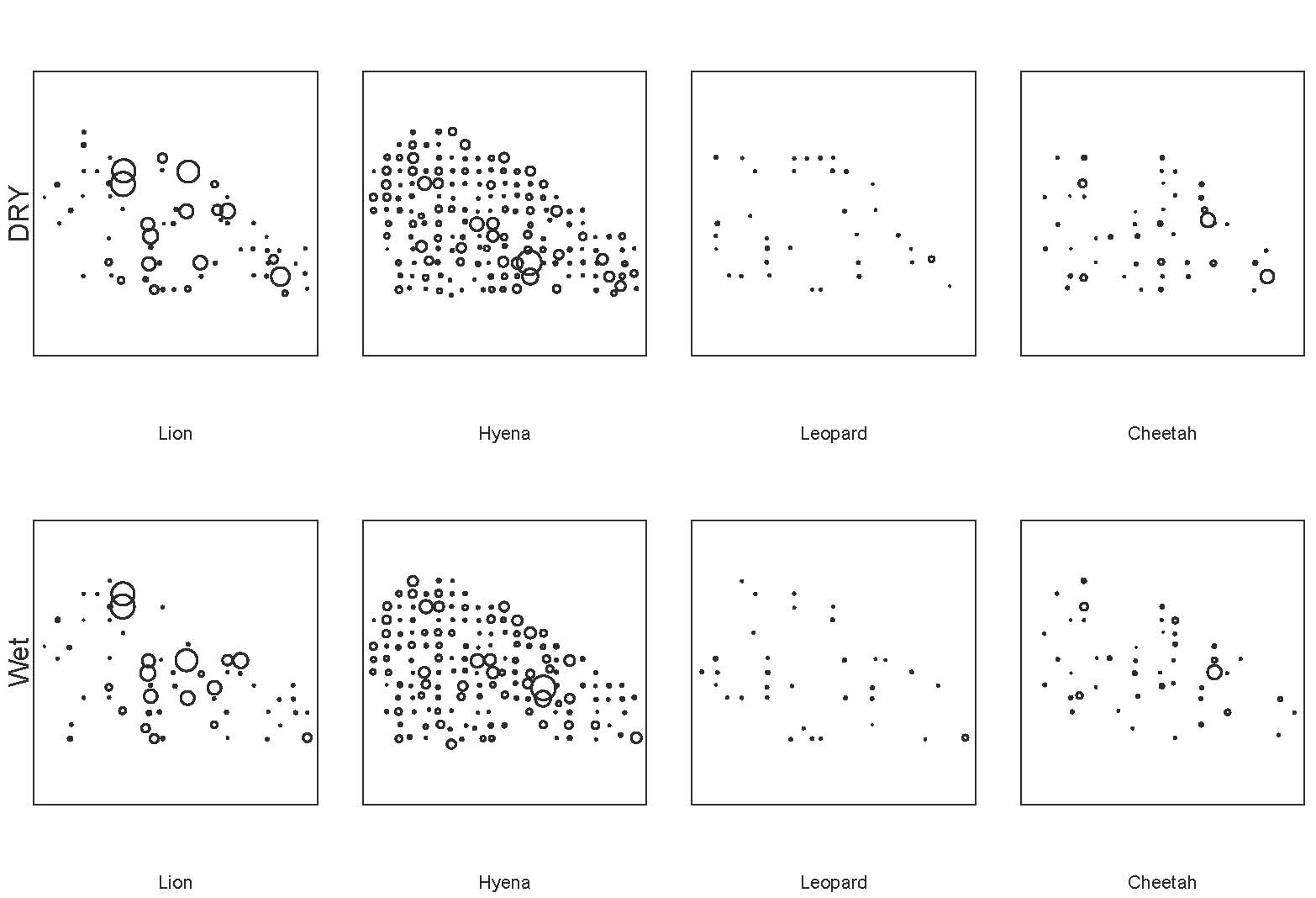
Sort of. On one hand, it’s really easy to create preliminary maps from the raw data. For example, this map shows all the sightings of lions, hyenas, leopards, and cheetahs in the wet and dry seasons. Larger circles mean that more animals were seen there; blank spaces mean that none were.
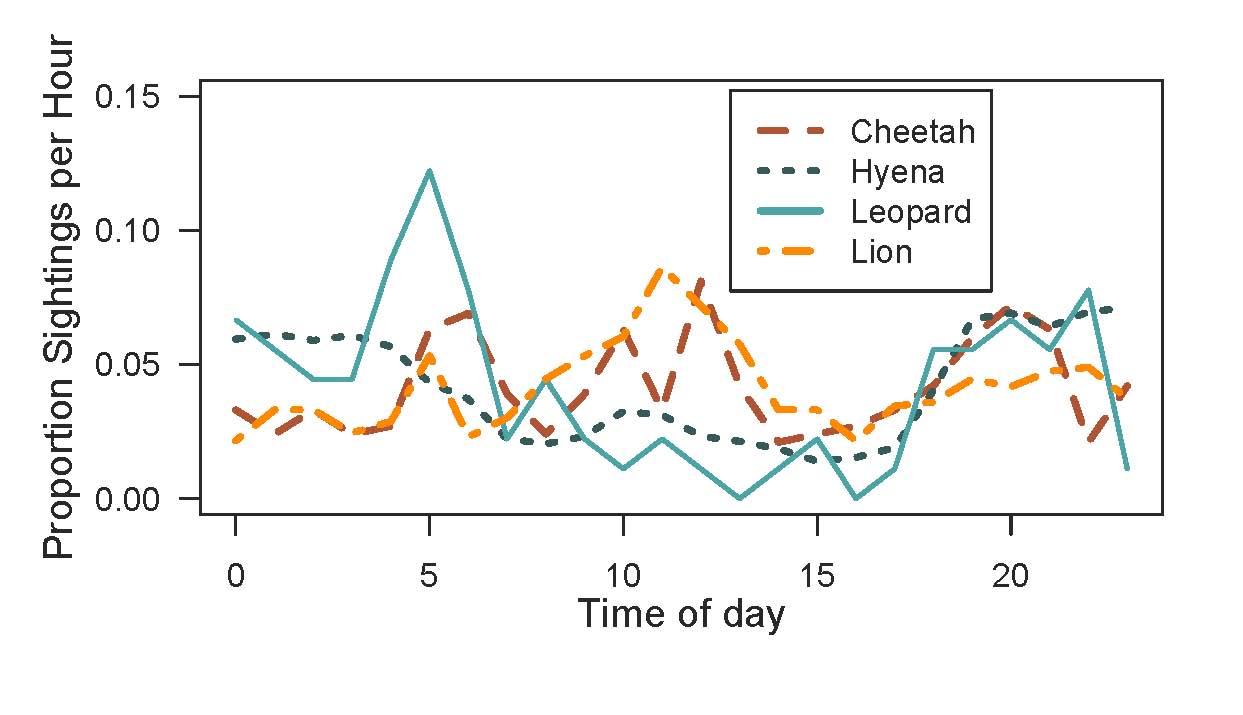
And it’s pretty easy to map when we’re seeing animals. This graph shows the number of sightings for each hour of the day. On the X-axis, 0 is midnight, 12 is noon, 23 is 11pm.
So we’ve got a good start. But then the question becomes “How well do the cameras reflect actual activity patterns?” And, more importantly, “How do we interpret the camera trap data to understand actual activity patterns?”
For example, take the activity chart above. Let’s look at lions. We know from years and years of watching lions, day and night, that they are a lot more active at night. They hunt, they fight, they play much more at night than during the day. But when we look at this graph, we see a huge number of lion photos taken between hours 10:00 to 12:00. If we didn’t know anything about lions, we might think that lions were really active during that time, when in reality, they’ve simply moved 15 meters over to the nearest tree for shade, and then stayed there. Because we have outside understanding of how these animals move, we’re able to identify sources of bias in the camera trapping data, and account for them so we can get to the answers we’re really looking for.
So far, shade seems to be our biggest obstacle in reconciling how the cameras see the world vs. what is actually going on. I’ve just shown you a bit about how shade affects camera data on when animals are active – next week I’ll talk more about how it affects camera data on where animals are.

Hard to find a better place to nap…
Drumroll, please
If you’ve been following Margaret’s blogs, you’ve known this moment was coming. So stop what you’re doing, put down your pens and pencils, and open up your internet browsers, folks, because Season 5 is here!
It’s been an admittedly long wait. Season 5 represents photos from June – December 2012. During those six months I was back here in Minnesota, working with Margaret and the amazing team at Zooniverse to launch Snapshot Serengeti; meanwhile, in Serengeti, Stanslaus Mwampeta was working hard to keep the camera trap survey going. I mailed the Season 5 photos back as soon as possible after returning to Serengeti – but the vagaries of cross-continental postal service were against us, and it took nearly 5 months to get these images from Serengeti to Minnesota, where they could be prepped for the Snapshot interface.
So now that you’ve finally kicked the habit, get ready to dive back in. As with Season 4, the photos in Season 5 have never been seen before. Your eyes are the first. And you might see some really exciting things.
For starters, you won’t see as many wildebeest. By now, they’ve moved back to the north – northern Serengeti as well as Kenya’s Masaai Mara – where more frequent rains keep the grass long and lush year-round. Here, June marks the onslaught of the dry season. From June through October, if not later, everything is covered in a relentless layer of dust. After three months without a drop of rain, we start to wonder if the water in our six 3,000 liter tanks will last us another two months. We ration laundry to one dusty load a week, and showers to every few field days. We’ve always made it through so far, but sometimes barely…and often rather smelly.
You might see Stan

Norbert

And occasionally Daniel

Or me
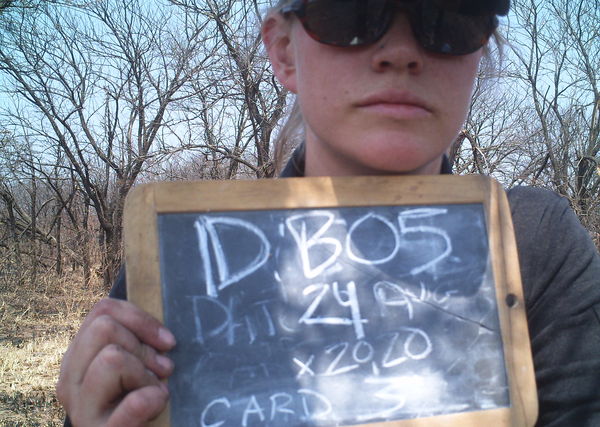
Checking the camera traps.
But most excitingly, you might see African wild dogs.

photo nabbed from: http://en.wikipedia.org/wiki/File:LycaonPictus.jpg
Also known as the Cape hunting dog or painted hunting dog, these canines disappeared from Serengeti in the early 1990’s. While various factors may have contributed to their decline, wild dog populations have lurked just outside the Serengeti, in multi-use protected areas (e.g. with people, cows, and few lions) for at least 10 years. Many researchers suspect that wild dogs have failed to recolonize their previous home-ranges inside the park because lion populations have nearly tripled – and as you saw in “Big, Mean, & Nasty”, lions do not make living easy for African wild dogs.
Nonetheless, the Tanzanian government has initiated a wild dog relocation program that hopes to bring wild dogs back to Serengeti, where they thrived several decades ago. In August 2012, and again in December, the Serengeti National Park authorities released a total of 29 wild dogs in the western corridor of the park. While the release area is well outside of the camera survey area, rumor has it that the dogs booked it across the park, through the camera survey, on their journey to the hills of Loliondo. Only a handful of people have seen these newly released dogs in person, but it’s possible they’ve been caught on camera. So keep your eyes peeled! And if you see something that might be a wild dog, please tag it with #wild-dog!! Happy hunting!
Living with lions
A few weeks ago, I wrote about how awful lions are to other large carnivores. Basically, lions harass, steal food from, and even kill hyenas, cheetahs, leopards, and wild dogs. Their aggression usually has no visible justification (e.g. they don’t eat the cheetahs they kill), but can have devastating effects. One of my main research goals is to understand how hyenas, leopards, cheetahs, and wild dogs survive with lions. As I mentioned the other week, I think the secret may lie in how these smaller carnivores use the landscape to avoid interacting with lions.
Top predators (the big ones doing the chasing and killing) can create what we call a “landscape of fear” that essentially reduces the amount of land available to smaller predators. Smaller predators are so afraid of encountering the big guys that they avoid using large chunks of the landscape altogether. One of my favorite illustrations of this pattern is the map below, which shows how swift foxes restrict their territories to the no-man’s land between coyote territories.
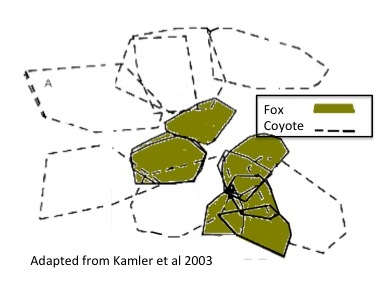
A map of coyote and swift fox territories in Texas. Foxes are so afraid of encountering coyotes that they restrict their territories into the spaces between coyote ranges.
The habitat inside the coyote territories is just as good, if not better, for the foxes, but the risk of encountering a coyote is too great. By restricting their habitat use to the areas outside coyote territories, swift foxes have essentially suffered from habitat loss, meaning that they have less land and fewer resources to support their population. There’s growing evidence that this effective habitat loss may be the mechanism driving suppression in smaller predators. In fact, this habitat loss may have larger consequences on a population than direct killing by the top predator!
While some animals are displaced from large areas, others may be able to avoid top predators at a much finer scale. They may still use the same general areas, but use scent or noise to avoid actually running into a lion (or coyote). This is called fine-scale avoidance, and I think animals that can achieve fine-scale avoidance, instead of suffering from large-scale displacement, manage to coexist.
The camera traps are, fingers crossed, going to help me understand at what scale hyenas, leopards, cheetahs, and wild dogs avoid lions. My general hypothesis is that if these species are generally displaced from lion territories, and suffer effective habitat loss, their populations should decline as lion populations grow. If instead they are able to use the land within lion territories, avoiding lions by shifting their patterns of habitat use or changing the time of day they are active, then I expect them to coexist with lions pretty well.
So what have we seen so far? Stay tuned – I’ll share some preliminary results next week!
#####
Map adapted from: Kamler, J.F., Ballard, W.B., Gilliland, R.L., and Mote, K. (2003b). Spatial relationships between swift foxes and coyotes in northwestern Texas. Canadian Journal of Zoology 81, 168–172.
“Home” — the one without the wildlife
It’s hard to believe that I’m really and truly done with the Serengeti. It’s strange to not have a veranda to sit on, and watch the elles or giraffes munch on our trees; see the eyeshine of hyenas lurking in the shadows, hoping for a bite of our dinner. The only wildlife I’ve seen in the last week is squirrels. As entertaining as they are, it’s just not quite the same.
Nonetheless, it’s good to be “home.” It’s funny the things you take for granted when you live here. As an idea, I’ve made a list of just some of the things I’ve done in the past week that I hadn’t done in at least 5 months:
- gone to a farmer’s market
- run (oh the pain)
- gone to the kickboxing gym (even more pain)
- brushed my teeth with tap water (!)
- drunk tap water (The strangest thing to get used to)
- had a shower. With hot, running water.
- eaten fresh, water packed mozzarella (I really do love food)
- drunk an IPA (and beer. There’s no such thing as good beer in Serengeti.)
- bought clothes
- put clothes in a washing machine
- driven on the right side of the road (This is surprisingly hard to get used to.)
- put dishes in a dishwasher
- had hot water come out of the tap
- sat on a leather sofa
- eaten baby spinach
- eaten ice cream
- watched something on YouTube (I still can’t believe how fast the internet is!)
- driven a car with power steering
- used a microwave
- used a toaster
- listened to the radio
- checked my mail (that is NOT a pretty sight after 5 months…)
The list could go on, especially when it comes to food. But perhaps the most significant thing about this trip home is that, well, I’m here for good. Or as good as “for good” gets in grad school. I’m here, in Minnesota, until I finish my dissertation. What that means is that the next 12 months will be spent furiously analyzing the Snapshot Serengeti data to understand lion/hyena/cheetah/leopard/wild dog interactions, presenting at conferences, writing papers, searching for post-doc positions, and ultimately defending the last 5 (soon to be 6) years of research to a committee of UMN faculty members. It’s terrifying! Way scarier than spitting cobras, getting stuck in the mud, or having lions roaring right outside the car window…at least in my opinion.
 Snapshot Serengeti
