
Motivation
Happy New Year! 2014 is here and as Snapshotters around the world know it brings the eagerly awaited season 7 with it (coming soon). A season that may never have happened if it weren’t for the generosity of many who helped the Save Snapshot Serengeti campaign.
Recently I filled out a questionnaire for a local nature group who were hoping to launch a citizen science project. They asked the following question.
What would motivate you to take part in a citizen science project?
• To help scientists
• To enrich personal knowledge
• To gain awareness of preserving biodiversity
• To have contact with nature
As someone who has taken part in various citizen science projects both online and in the field this got me thinking. What does motivate us? I am sure there are as many answers out there as there are people taking part. For me all of the above options play their part in the motivation but it’s more than that. There is of course just pure personal enjoyment. Let’s face it: it’s fun, being involved, interacting on the forums with like minded people, getting a glimpse of what the scientists are up to. It connects us to science. I think without this aspect citizen science wouldn’t be the success that it is.
The other motivation for me is the sense of being able to do something that helps. The news is full of doom and gloom these days; climate change, vanishing biodiversity, habitat loss. This can leave us feeling depressed and the scale of the issues can make us feel helpless to do anything. Citizen science offers us the opportunity to feel positive and provides us with a way to really help and make a difference.
Modern technology has not only lead to huge advances in data capture capabilities for scientists but to organisations such as Zooniverse to involve the worldwide public in analysing that data. The ability to join in from the comfort of your own home is really a revolution in science.There are also loads of projects that get you out and about and tap into the rich source of amateur naturalists. Bird counts, butterfly counts, phenology projects to mention just a few.
What is it that motivates you? We would really like to hear your thoughts, why do you participate in Snapshot Serengeti? Do you work on other Zooniverse projects? What about field projects?
Happy 2014, Snapshot Serengeti!
It’s a new year. Of course, I am in blatant denial about this, since this means time is passing and I haven’t finished all of the things I planned to do in 2013, but the calendar has turned despite my protests.
So happy 2014 everyone! Here’s a few of the awesome photos we’ve collected over the last year. I’m looking forward to collecting newer and better ones in the year to come!

these guys will always be my favorite animals.

well hello.

heehee.

baby!

hi.

As pretty as they are, maybe fewer of these fire photos. The cameras don’t usually do so well…
Happy 2014!
The joys of poster presentation
As Meredith mentioned last week, she, Craig, and I are counting down the days until we head out to sunny California for an academic conference. I am really looking forward to above-zero temperatures. I am rather less enthused about the prospect of presenting a poster. Yes, it is good networking. Yes, I get to personally advertise results from a study that are currently in review at a journal (and hopefully will be published “soon”). Yes, I get to engage with brilliant minds whose research I have read forward, backwards, and sideways. Despite all of that, I’m still not excited.
Poster-ing is perhaps the most awkward component of an academic conference. Academics are not known for their mingling skills. Add to that the inherent awkwardness of having to lurk like an ambush predator by your poster while fellow ever-so-socially-savvy scientists trudge through the narrow aisle ways, trying to sneak non-committal glances at figures and headings without pausing long enough for the poster-presenter to pounce with their “poster spiel.” For the browsers who do stop and study your poster, you have stand there pretending that you aren’t just standing there breathing down their necks while they try to read your poster until they decide that a) this is really interesting and they want to talk to you, or b) phew that was close, they almost got roped into having to talk to you about something they know/care nothing about. Most conferences have figure out that poster sessions are a lot less painful if beer is served.
Working with big, fuzzy animals means that I usually get a pretty decent sized crowd at my posters. About half of those people want to ask me about job opportunities or to tell me about the time that they worked in a wildlife sanctuary and got to hug a lion and do I get to hug lions when I’m working? I once had a pleistocene re-wilding advocate approach me for advice on – no joke – introducing African lions into suburban America. But they aren’t all bad. I’ve met a number of people in poster sessions who have gone on to become respected colleagues and casual friends. I’ve met faculty members whose labs I am now applying to for post-doctoral research positions. And I’ve learned how to condense a 20-page paper into a 2 minute monologue — which is a remarkably handy skill to have.
As much as I gripe and grumble about poster sessions, I know they’re good for me. At least with this one, I’ll be close to the beach!!
Below is a copy of my (draft) poster for the upcoming Gordon Research Conference that a chunk of the Snapshot Serengeti team will be at. It’s mostly on data outside of Snapshot Serengeti, but you might find it interesting nonetheless! (Minor suggestions and typo corrections welcome! I know I still have to add a legend or two…)

At 4 feet by 4 feet, this thing is a beast!
More accidental video
In processing Seasons 5 and 6, I recently stumbled upon a bunch of video files amongst the stills. You may recall that while we have our cameras set to take still images, every once in a while a camera gets accidentally switched to video mode. Then it takes 10-second (silent) clips. Most of these are “blanks” triggered by grass waving in the wind. But every once in a while, we get ten seconds of animal footage. Here are some from Season 5.
Zebras
Giraffe (peek-a-boo!)
Warthog
And, what do you think this is?
Honey badger:1 chicken:0

Honey badger don’t care
Have you ever seen the look on a dogs face when confronted with a cat that fights back? There is utter confusion about his role in life, “hang on a minute that cat is way smaller than me, I could stomp her in a second, but now she’s scaring me?” our imaginary dog says. Well that’s about my reaction the first time I came face to face with a honey badger.
Honey badgers are small, reaching somewhere between your ankle and your knee and no more than 1 meter long. They weigh around 10kg but don’t let these dimensions fool you; a honey badger is full to the brim with confidence.
Most small animals will run when they find themselves face to face with a human; a sensible option given our species general nature. A honey badger on the other hand probably won’t and this can be very disconcerting.
One night I was sat round a fire in what classed as my garden, though in reality there was nothing to distinguish it from the rest of the bush surrounding us as home was in a nature reserve and there were no fences. It was a crisp, for the lowveld in South Africa, winters night and the stars were shining brilliantly as we sat in the sand by the fire waiting for the chicken to finish cooking. From the other side of the river the hyena started their whooping and the hippo disputed the rights of some patch of dry grass. Winter is the dry season here and things get difficult especially for bulk grazers. The African night sounds had as captivated as usual. The chicken smelt good. My husband was just about to rouse himself to check it one last time when we both heard something moving behind us in the dark. As it got closer we saw it was a honey badger moving at a lopping determined gait that they have straight towards us. It was a wonderful treat to see one of these guys close up and for a few seconds we were rapt. But it didn’t stop. It trotted straight to the grill, a small pause to give us a low growling warning and chomp, there went half our chicken. We couldn’t believe our eyes, this wasn’t a hand reared animal or an animal in a public campsite in a national park that gets used to people, this was a real live wild animal. It had no fear of us, it totally wrong footed us as we were not expecting it to just bull doze its way in. Needless to say we grabbed the rest of our meal and took it into the safety of the house to finish in peace.
Honey badgers really are remarkable creatures. Whilst in search of food they can cover up to 30km in a night. They eat a varied diet of mammals, birds, reptiles and some roots and berries and of course honey when they can get it. They climb well and can swim; they will dig furiously to follow a rodent down a hole and just don’t seem to give up in their pursuit of prey.
Honey badgers are tough and there are many stories about them killing buffalo, fighting lions, being bitten by cobras and surviving. One of the tricks they use to help evade predators is by having very loose skin around the back of their necks. A lion or leopard will grab for this area, coming up with a mouthful of skin but leaving the vital bones and muscles untouched. The honey badger can then twist round and start biting and scratching with it all its might often inducing the dog/cat scenario from the start of this blog i.e. predator dropping honey badger in utter surprise.
So next time you classify a honey badger on Snapshot Serengeti remember it’s not always size that counts.
Fear
I have successfully survived the trials and tribulations of my first semester of graduate school! Huzzah! That being said, a student’s work is never done – you can still find me sitting in my office, plugging away at data and up to my eyeballs in pdfs and textbooks. Although it certainly helps when I know that, in a few short weeks, I’ll be showing off my preliminary data on a nice warm beach in California. Well, the Gordon Research Conference that Ali and I will both be attending will probably not be held directly ON the beach, but it’s a nice fantasy to have when your fingers are freezing off in Minnesota.
The theme of the conference is predator-prey interactions, but approached from a very interdisciplinary standpoint. Topics range from genes and the causes of childhood anxiety up through ecosystems, evolution, and Craig’s presentation on man-eating lions. It’s been over a year since I last attended a conference, and it’s going to be intimidating and inspiring to meet the Who’s Who in our field. All the papers piled up around my desk, underlined and annotated and thoroughly mulled over? Hopefully I’ll have a chance to chat with their authors in person and get these scientists’ input on the direction of my current research ideas.
My particular focus, predator intimidation (“fear”), is delightfully billed in the conference descriptions as “the persistent threat of immediate violent death.” The blurb continues on to state that “most wild animals are in peril every moment of every day of being torn limb from limb by any number of predators.” Language far more colorful that I can get away with in most of my proposals, but certainly right on point! There will be talks on fear’s impacts on evolutionary ecology and population- and ecosystem-level processes as well as about the effect of predators as stressors that I’m am particularly keen to attend.
As excited as I am, I’m honestly a bit frantic trying to synthesize our Snapshot data to produce distribution graphs and other basic preliminary results. A few months ago, I couldn’t have programmed my own name into “R” – the bread and butter statistical program of beloved (well, it’s a bittersweet relationship) by biologists. With long evenings in front of the computer and by the generous grace and goodwill of Ali, I’ve been making progress. Ideally, I would like to show up to this conference with not only an outline of my research to be picked apart by the aforementioned greatest minds in the field, but also with maps of the monthly distributions of several herbivore species in relation the changing vegetative landscape and predator movements. No breakthroughs so far; I foresee a great deal of coffee in my future between now and January…
P.S. Congrats to Margaret for defending her PhD!!!
A Massive Lion Poster For You
In the final instalment of our mosaic poster series for the 2013 Zooniverse Advent Calendar, we bring you a lion of lions! This magnificent beast is constructed of more than 4,000 individual lion images from Snapshot Serengeti, as tagged by the volunteers.

Download Full Size [70 MB] or Half-size [22MB]
Things are looking up!
I’ve got to echo Margaret’s apology for our sporadic blog posts lately. Things have been a bit hectic for all of us — Dr (!!!) Margaret Kosmala is finishing up her dissertation revisions and moving on to an exciting post-doctoral position at Harvard, our latest addition, Meredith, is finishing up her first semester (finals! ah!), and I’m knee deep in analyses (and snow!).
So,\ please bear with us through the craziness and rest assured that we’ll pick up the blog posts again after the holidays. In the meanwhile, I’ll show you something that got me really excited last week. (Warning: this involves graphs, not cute pictures.)
Last week, I was summarizing some of the Snapshot Serengeti data to present to my committee members. (My committee is the group of faculty members that eventually decide whether my research warrants a PhD, so holding these meetings is always a little nerve-wracking.) As a quick summary, I made this graph of the total number of photographs of the top carnivores. Note that I’m currently only working with data from Seasons 1-3, since we’re having trouble with the timestamps from Seasons 4-6, so the numbers below are about half of what I’ll eventually be able to analyze.
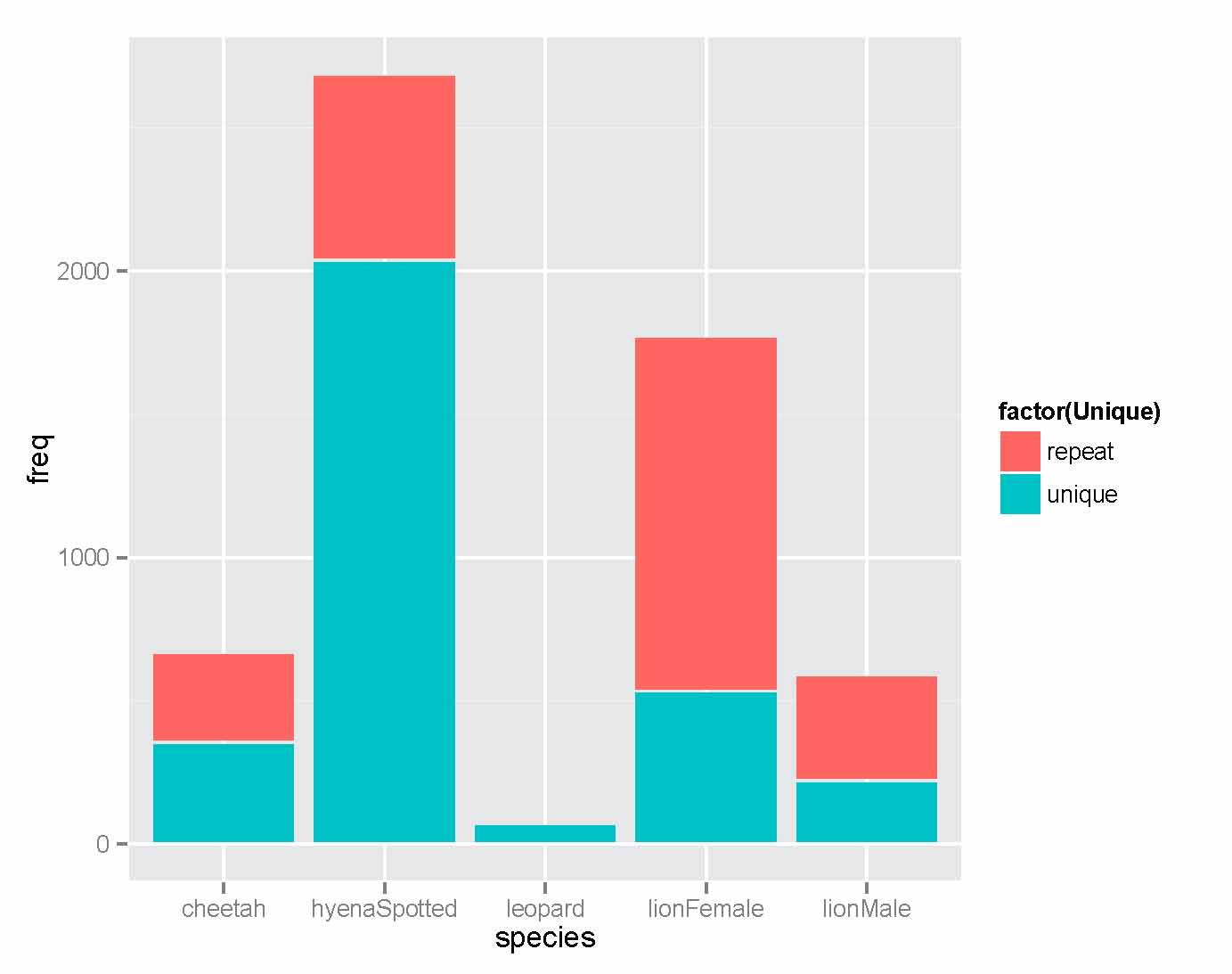
The height of each bar represents the total number of pictures for each species. The color of the bar reflects whether or not a sighting is “unique” or “repeat.” Repeated sightings happen when an animal plops down in front of the camera for a period of time, and we get lots and lots of photos of it. This most likely happens when animals seek out shade to lie in. Notice that lions have wayyyy more repeated sightings percentage-wise than other species. This makes sense — while we do occasionally see cheetahs and hyenas conked out in front of a well-shaded camera, this is a much bigger issue for lions.
I also dived a little deeper into the temporal patterns of activity for each species. The next graph shows the number of unique camera trap captures of each species for every hour of the day. See the huge spike in lion photos from 10am-2pm? It’s weird, right? Lions, like the other carnivores, are mostly nocturnal….so why are there so many photos of them at midday? Well, these photos are almost always lions who have wandered over for a well-shaded naptime snoozing spot. While there are a fair number of cheetahs who seem to do this too, it doesn’t seem to be as big of a deal for hyenas or leopards.
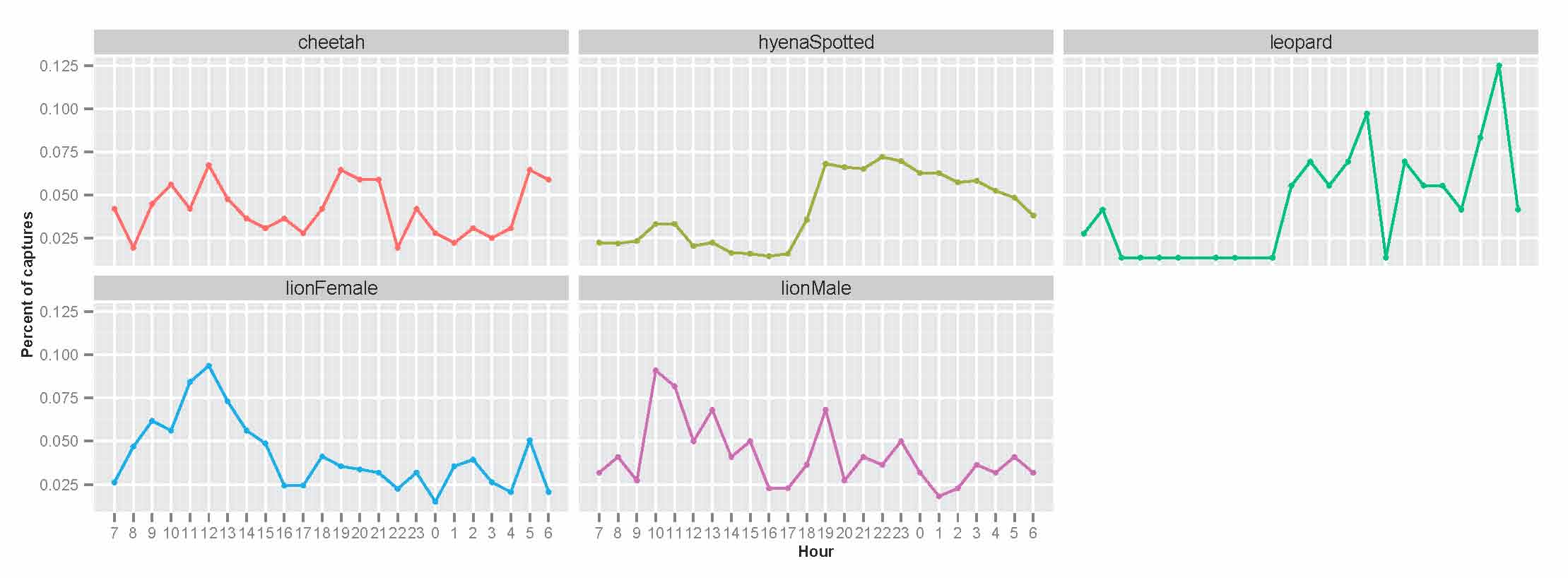
Why is this so exciting? Well, recall how I’ve repeatedly lamented about the way shade biases camera trap captures of lions? Because lions are so drawn to nice, shady trees, we get these camera trap hotspots that don’t match up with our lion radio-collar data. The map below shows lion densities, with highest densities in green, and camera traps in circles. The bigger the circle, the more lions were seen there.

The “lion hotspots” in relatively low density lion areas have been driving me mad all year. These are nice, shady trees that lions are drawn to from up to several kilometers away, and I’ve been struggling to reconcile the lion radio-collar data with the camera trapping data.
What the graphs above suggest, though, is that there likely to be much less bias for hyenas and leopards. Lions are drawn to shade, because they are big and bulky and easily overheated. We see this in the data in the form of many repeated sightings (indicating that lions like to lie down in one spot for hours) and in the “naptime spike” in the timing of camera trap captures that suggest lions seeking out shade trees to go to. Although this remains a bit of an issue for cheetahs, what the graphs above suggest is that using camera traps to understand hyena and leopard activity will be much less biased and much more straightforward — ultimately, much easier than it is for lions. And this is really good news for me.
Snapshot Team Update
Apologies for such sporadic blog posts recently. We’ve all been quite busy. I successfully defended my dissertation last week. And then I enjoyed the true spirit of Minnesota for the next couple of snowy days, getting to catch up with friends and colleagues whom I haven’t seen in quite some time. But I’m not quite done! I need to make some minor revisions to the dissertation text before submitting it, and this has been occupying much of my time this week, as I need to get it all done before the end of the month – and preferably earlier if I want to enjoy the holidays.
Ali, meanwhile, is deep in analyses of the Snapshot Serengeti data gathered to date. We’re still working on the time issues. If you’ve got crazy Python and/or SQL skills and some free time in the next few weeks, drop us a note. A little help would accelerate Ali’s research while I’m busy finishing up my dissertation work.
And Craig’s diving into the next round of National Science Foundation proposals. The preliminary proposals are due in mid-January and an accepted proposal would restart long-term funding for Snapshot Serengeti starting in 2015. The preliminary proposals are relatively short, but in some ways that makes them harder than the longer ones – we not only have to concisely describe the research, but also convince the reviewers that citizen science yields high-quality data.
While some ecologists are still skeptical of citizen science, more and more are coming to accept it as a valid and valuable way to gather and analyze science data. The astronomy field may be a bit ahead of ecology in this respect, but we’re glad they’re paving the way. And did you hear? The Zooniverse was awarded a $1.8 million Global Impact Award by Google that’s going to allow them to scale up their citizen science platform to host many more projects. I only wonder what citizen scientists will do in the (perhaps not too distant) future, when they have hundreds of citizen science projects to select among. How will you choose which ones to try?
Elephant of Elephants

Continuing the meta-animal theme of our Zooniverse Advent, we present the Elephant of Elephants! This magnificent creature is made from 5,000 images of elephants from Snapshot Serengeti, as classified by our amazing volunteers.

You can download the full poster here (warning: it’s 70 MB).
 Snapshot Serengeti
![Half-size [22MB]](http://zooniverse-resources.s3.amazonaws.com/bigblogfiles/Snapshot_Serengeti_Lion_Poster_Small.jpeg)
