
Season 4
Dear devoted Snapshot Serengeti ID-ers: I know the last couple weeks have been tough, especially with the appearance of those two words that strike fear into the heart of every Serengeti addict (I mean ID-er): “We’re done.”
Well, we’ve got good news for you: we’re not really done. Like Margaret wrote the other day, we expected to have several weeks (or more!) to prepare Season 4 for posting. We hadn’t really expected to you guys to process three seasons of images in one week. Clearly. So, it’s been a bit of a scramble…but we’re finally ready to give you Season 4. Even cooler? Yours will be the first eyes to really take a look at these photos.
Prior to launching Snapshot Serengeti, Seasons 1-3 had been looked at by a small group of volunteers on a prototype application called “Serengeti Live.” We’ve been able to use the preliminary data to start answering research questions, refine our analytical methods, and show funding agencies that this project is really cool and worth continuing. However, each image had only been looked at once, so there were a lot of mistakes, which is why we still needed your help with those Seasons.
But Season 4 has never been seen before. It contains all the photographs collected during my last field season in Serengeti – February through July 2012. The rains were pretty bad that season – I can’t tell you how many times I got stuck in the mud trying to get to those cameras. Oh, yeah, and the neighbor’s outdoor toilet (choo in Swahili) sunk. But with the rains came the wildebeest, who honked/mooed (I don’t think there is a word for the sounds they make) outside our homes at night. And in July I lugged back a huge, dust-covered hard drive full of photos.

Choo down!
With every SD card I collect, I do some basic error-checking – so I’ve taken a very cursory flip through the photos and tried to trim down the number of “broken camera” shots of the dirt, grass, or sky, as well as some of the “lawn-mowing” images. But other than that, this is unexplored territory. These photos are new, unseen, unexplored…you’re the first!
I’m excited to see what you find.

Imagine this layer of mud on *everything.*
Three Million
Dear Snapshot Serengeti Community: As of yesterday, you all have made over three million classifications. That’s 3,000,000. That’s unbelievable! (For those of you new to the Zooniverse, a classification represents one person looking at one image. Or, to think of it another way, every time the “Finish” button is clicked, another classification is made.)
And, I have to admit, we really weren’t quite ready for your enthusiasm. I’m sure you’ve noticed those progress bars on the Snapshot Serengeti title page. You know, the ones that show Season 1 being done, Season 3 being almost done, and Season 2 two-thirds of the way done. Snapshot Serengeti hasn’t even been up for a week yet! The bad news is that there’s not much classifying left to do in Seasons 1, 2, and 3. The good news is there’s a Season 4 that we’re working on getting ready.
So what are these “Seasons”? They’re roughly 6-month stretches of images, based on Ali’s field seasons. Season 1 ran from June to November, 2010, and involved a lot of experimentation and damaged cameras, as Ali figured out what camera set-up would survive the animals’ curiosity.
Season 2 ran from January to June 2011. During this time, Ali gradually swapped out cameras with infrared flashes to incandescent flashes for nighttime shots. She found that the infrared night images were just too blurry too much of the time. The incandescent flashes give clearer (and color) images, with the downside that we just get one night image instead of a series of three. Also during Season 2, you can see the famed Serengeti migration in many of the images. Every year, over a million wildebeest, zebra, and Thomson’s gazelles move through the ecosystem, following the rains and new (and presumably yummy) grass. They’re in our study area from about December to April.
Season 3 ran from July 2011 to January 2012. By Season 3, Ali had mastered the camera-trap logistics. (However, we did have some trouble with a hard drive carrying lots of camera trap images that crashed. More on that some other time.)
Season 4, which will be showing up soon, covers February to July, 2012. And Season 5 goes from July to December, 2012. Yes, that’s right: the cameras are snapping away right this minute. Ali will be heading out the Serengeti in early January and will send us back the hard drive with Season 5’s images. We hope to have Season 5 ready for you all by the end of January.
So what now? Well, your amazing speed at classifying means we have the opportunity to refine our algorithm for combining classifications from multiple people. We’ve been making some assumptions about how many people need to see each image to be sure that we get the animals identified correctly. These assumptions are based on some beta testing we did, and I feel good about them. But right now, while you’re waiting for Season 4, we’re going to put some of the Season 1 and Season 3 images back in circulation for more classifications. That way, we can get an even better estimate of how many times we really need to show each image – and, in particular, how these estimates vary for easy, medium, hard, and impossible images.
So thank you for all your classifications these past six days. Please keep classifying images even when the progress bars fill up; we will be using your classifications. And we’ll have Season 4 ready for you soon.
From lions to everything…
The Serengeti lion project was established by George Schaller in 1966; his book, The Serengeti Lion, is a classic. When I arrived in 1978, it was hard to imagine there was much left to discover about lions, and I only expected to stay in the Serengeti for a few years. I just planned to answer a few specific questions about lion behavior before moving on to the next species. My prior research had been on baboons and Japanese macaques, animals that move around a lot and interact with each other throughout the day. Lions sleep in tall grass and are mostly active at night. Watching lions is a test of patience.
I took it for granted that lions live in complex social groups (“prides” consisting of about six related females, their dependent offspring, and a coalition of 2-3 males that have joined the females from elsewhere). I wanted to know why pride females raised their cubs together in a creche; how coalition partners competed with each other for mating opportunities; how the whole crowd managed to feed together at kills.
But whereas a lot of the Serengeti lions were mating and feeding those first few years, there were very few cubs in the population, so I decided to continue the study a bit longer. But as time went by, I became ever more intrigued about the fundamental ecology of these animals. The Serengeti was changing: trees were spreading in the woodlands, the lion population grew by about 50%, but lions were getting harder to find. The study area contained a dozen prides in a thousand square kilometers; but some of the prides might not be seen for months on end. I would go out into the field for four days at time, sleeping in the Land Rover, listening for roars, hoping to see an upright lion in the early morning light.
It wasn’t until we started using radio collars in 1984 that we could find our study animals on a daily basis. The project then grew in previously unimaginable ways. We could follow lions through the night; we could see where they went when they didn’t want to be seen. And my graduate students and field assistants could hit the ground running, finding lions for themselves their very first day on the job.
We started asking harder questions: Why did lions live in those complex groups? Why did the males have manes? Who fathered the cubs within the pride? What sort of diseases did they catch – and why were some outbreaks more deadly than others?
By then we tracked close to two-dozen prides, and our focus remained primarily on the lions – on their social behavior, their genetics and epidemiology. It has only been in the past few years that I’ve felt comfortable about expanding our research program into a broader perspective. Although there are several other long-term studies in the Serengeti, none of them are able to measure their species’ movements in the same degree of detail as the lions. Cheetah biologists drive around looking for cheetah with patient optimism; hyena biologists watch hyenas at den sites then accept that their nocturnal subjects will wander off to points unknown during the night. And no one keeps track of individual topi, hartebeest, waterbuck, bushbuck, impala or dikdik – let alone knows the daily life of a specific wildebeest, zebra or gazelle… There’s not enough research funding in the world to attach enough radio collars on all those species, and it probably wouldn’t be a good idea to tag any of the herbivores who might then stand out a mile in a lion’s territory.
Then we realized that we didn’t have to touch a thing. We just needed to set up enough camera-traps to get a composite snapshot of the Serengeti. We received generous funding from the National Science Foundation, which allowed us to set out 225 camera-traps in our study area, but then we faced the problem of how to process the resultant flood of over a million photos a year…
Welcome to Snapshot Serengeti
Hi! And welcome to Snapshot Serengeti. We are all incredibly excited to be working with you to turn photographs into scientific discoveries. You might be wondering what this is all about, so let me start with some introductions. This is Ali:
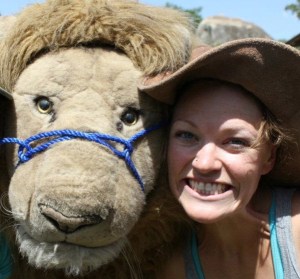
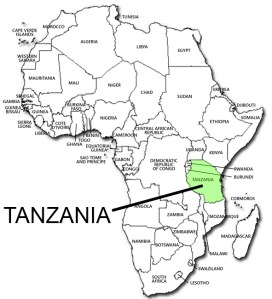
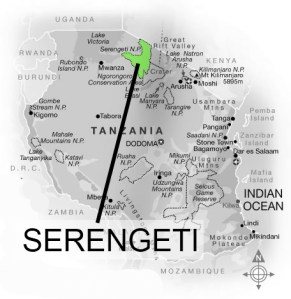
Ali is a researcher at the University of Minnesota. She studies the big carnivores (lions, hyena, cheetahs, and leopards) in the Serengeti. Every year she flies to Tanzania, loads up on supplies in Arusha, and then drives for a day – mostly on dirt roads – out into Serengeti National Park.
This is Craig:

Craig is a professor at the University of Minnesota and Ali’s advisor. He runs the Lion Research Center has been studying lions out in the Serengeti for decades. He has radio collars on lions in many prides, which allows him to keep track of lots individual lions over many years.
This is Daniel:

And this is Stan:

They are field assistants who work for Craig out in the Serengeti. Daniel is responsible for driving around and finding lions, while taking pictures of them and recording lots of information about what he sees. Stan is responsible for going out to the camera traps, making sure they’re still working fine, and changing the cameras’ memory cards when they fill up. Daniel and Stan live in Serengeti year-round at Lion House, where facilities are basic, but the scenery is amazing.
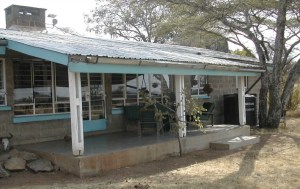
When Ali goes out the Serengeti, she stays at Lion House, too. Once she’s there, she makes observations that help her understand the big carnivores. A couple years ago, she installed a bunch of camera traps so she could see where the carnivores roamed when she wasn’t present. The cameras worked really well and the images were so useful that she installed some more. Now there are 225 of these cameras automatically taking pictures out the Serengeti!

My name is Margaret. This is me:

Like Ali, I’m a researcher at the University of Minnesota, and Craig is my advisor, too. Ali became inundated with the images the camera traps produced – a million per year! I have a reputation around here as a computer fundi – a Swahili word that translates as ‘master’ or ‘expert’ – and Ali asked me if there was a way to automate the process of turning images into data. See, the images by themselves aren’t that useful for research; Ali needs to know what species are in the pictures so she can do her analyses. For example, if she knows which images contain wildebeest and zebra, she can use that data put together a map that shows their density across the landscape. (The size of the circles show how many wildebeest and zebra there are in various places — bigger circles mean more wildebeest and zebra.)
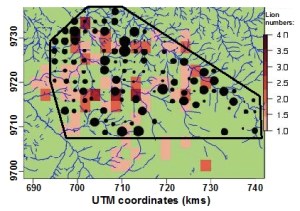 Unfortunately, I had to tell her that computers aren’t that good yet. They can’t yet reliably pick out objects from a picture, except under very controlled situations. But human eyes are remarkable in their ability to find objects in images. As I started looking through Ali’s images, I was blown away by how beautiful many of them are. And I wondered if we could ask for help from people. Lots of people. Hundreds. Thousands. So we started to think about how to do that.
The end result is Snapshot Serengeti, a collaboration with Zooniverse. We’d like to ask you to help us turn all these pictures from the Serengeti into scientific data by identifying what animals are in the images and what they’re doing. And in this blog, we will keep you updated on how the project is progressing, share cool information about the Serengeti and African wildlife, as well as hopefully answer a lot of questions you may have about animal behavior, ecology, and science in general.
So, check out the camera trap images. Tell us what you see in them. And let us know if you have questions. Thanks! You can get started by clicking here.
Coming soon…
…watch this space later today.
 Snapshot Serengeti