
“Fancy Photographs” perk unveiled at Save Snapshot Serengeti
How would you like to hang this on your wall?
You might recall this stunning photograph from National Geographic’s latest feature story on the Serengeti Lions capturing the dramatic and devastating fight between C-boy and three of the Killers. It’s now one of 4 options for our ‘Fancy Photograph’ perk on our Save Snapshot Serengeti campaign.

C-boy being evicted by the killers.
The National Geographic article chronicles the story of C-boy and his coalition partner Hildur, who were evicted from the Jua Kali pride in 2009 by a ruthless group of four males called the Killers. Ingela Jansson took this photo on what was supposed to be a routine day of lion tracking. I was a new graduate student out in Serengeti for the first time, and in the car with Ingela when this happened. It was at that moment that I realized that endless hours of napping that lions did belied a soap opera life that was both dramatic and deadly.
Being a male lion is tough; males live significantly shorter lives than females, and it’s clear why from this picture. But don’t worry, for those of you out there who want a slightly less violent view of nature, Daniel Rosengren, our resident lion-tracker and world-class photographer, has generously donated the following three prints to choose from as well:
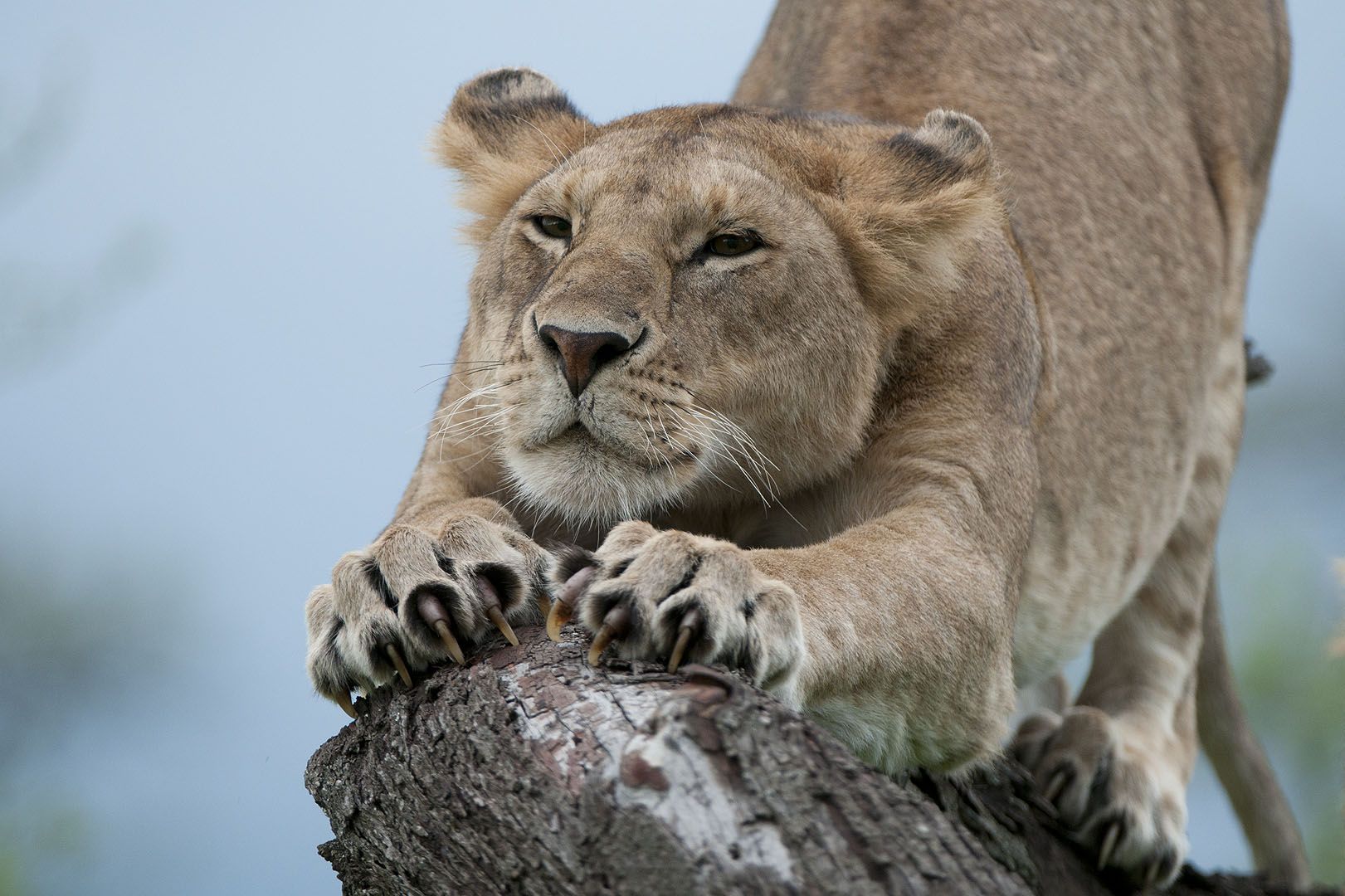
Lioness stretching. Those claws are sharp!
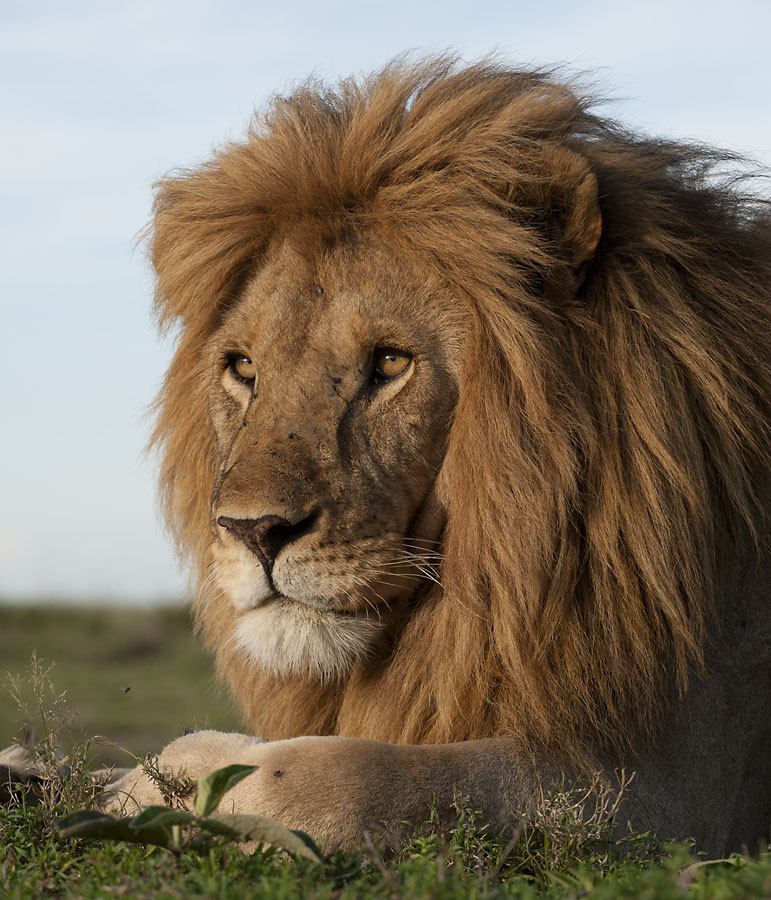
Hildur, C-boys coalition partner.
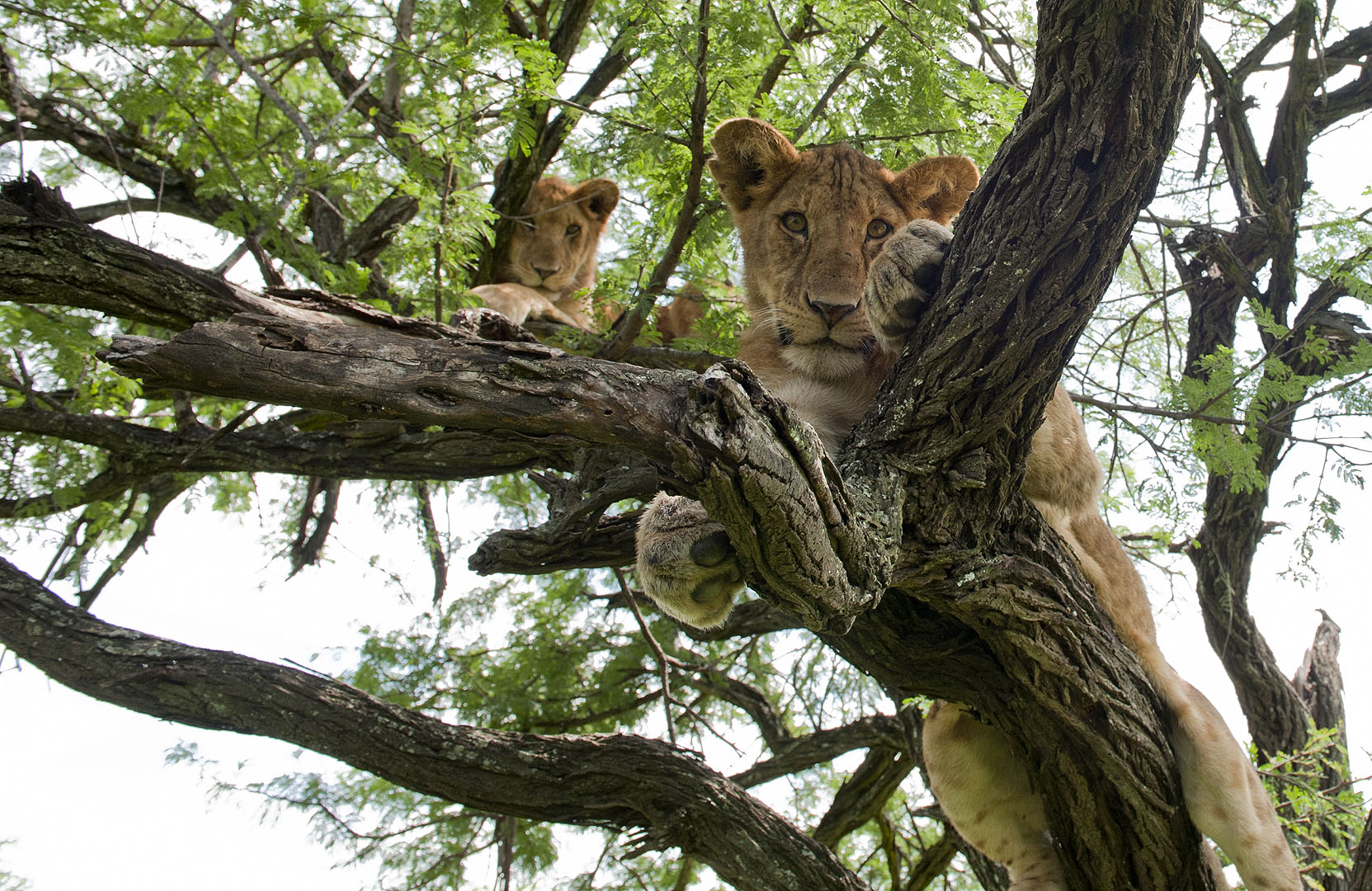
Cubs up in a tree. Who said lions don’t climb?
Please share this news (and the campaign!) with any of your lion-loving friends who might want to hang a piece of Serengeti history on their wall. Thank you all, again, for your dedication and support for Snapshot Serengeti. We on the Snapshot team love doing what we do, and with every picture our camera traps take, we move one small step closer to understanding what makes the Serengeti – and all the animals within it – keep on thriving as one of the world’s most dynamic and iconic ecosystems.
In search of
Hi everyone! We recently discovered that National Geographic, who has just published the big lion feature, might be interested in publishing this Snapshot Serengeti photo:
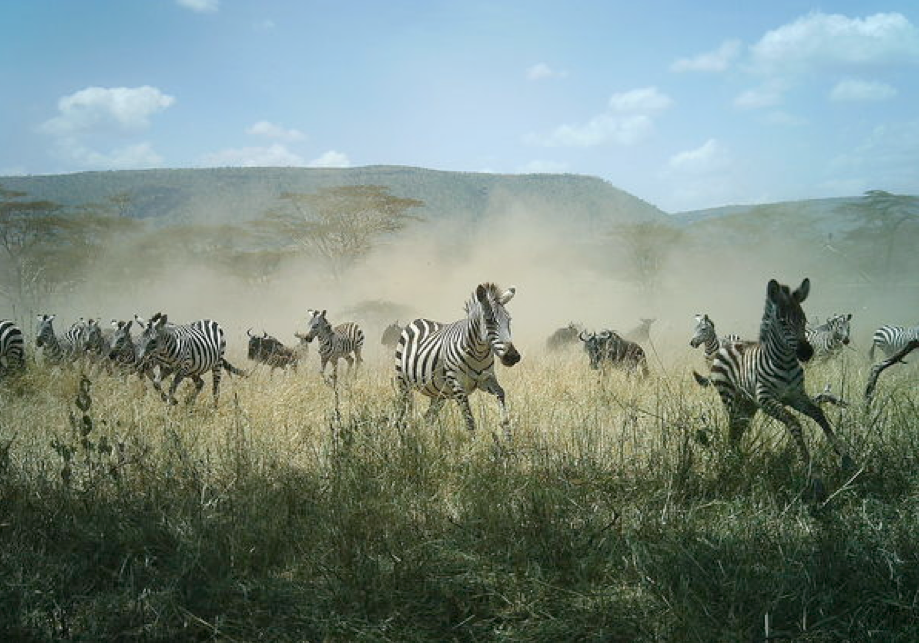
Which would help raise money for the project. Does anyone have it collected on Snapshot Serengeti? We’re trying to track down the url and send NG the full-res version. If so, please let us know!! Thank you!
Photos of the year
Thank you so much to everyone who sent in their favorite photos. We’ve submitted the following 12 to BBC’s photo-of-the-year contest. Of course, there were many, many more we wish we could have used!


and one of my new personal favorites:

In other news, we are *almost* at halfway to our Indiegogo fundraising goal!!!! Thank you all for your support so far! And please don’t forget to check out the meme generator at http://www.SaveTheMemes.org! You can now make a meme directly from the talk pages!
Save the Memes
You have to check this out. Zooniverse has put together a hilarious web site called Save the Memes. It’s a light-hearted way of spreading the story about our Save Snapshot Serengeti campaign. And while it’s good for that… it’s perhaps a little distracting for us scientists, too!
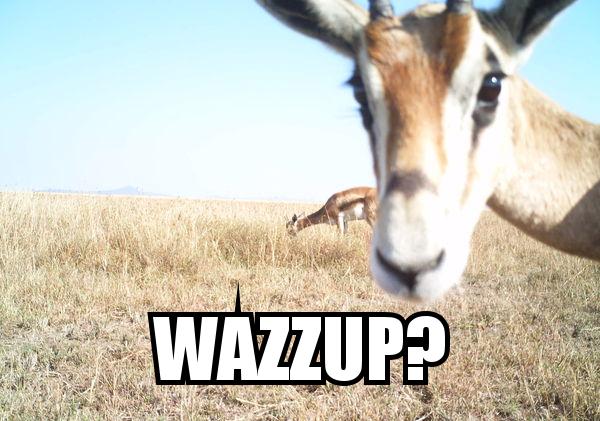


Give it a go with some pre-selected images. Or, you can turn your favorite Snapshot Serengeti image into a meme from the Talk pages now using the “Meme This!” button.
Fave photos?
Calling all camera trap captures!
BBC’s annual camera-trap ‘photo of the year’ contest is drawing a close – and we’re pretty sure Snapshot Serengeti has some winners. So we’re asking for your help to find them!
The contest has three relevant categories:
- Animal Portraits Images taken during the course of research that capture the character or spirit of the animal
- Animal Behaviour Images captured during the course of research that show interesting or unusual behaviour.
- New Discoveries Images that show something new to science, such as a species never before photographed in the wild or outside its known range, or behaviour never before recorded. The caption must make clear what the discovery is.
We can submit up to 12 photos across these three categories. Long-time Snapshot Serengeti moderator lucycawte has already pinpointed a couple of fantastic photos:
…but we’d like your help to find some more!
So send us the subject ID’s or urls of your all-time favorite Snapshot Serengeti pics (via comments here). One of them just might wind up front and center in the next issue of BBC Wildlife or make Snapshot Serengeti the proud winner of a monetary prize to keep the cameras clicking.
And speaking of Snapshot Serengeti funding, I wanted to take a minute to say thank you all who have supported our Save Snapshot Serengeti campaign so far. Yesterday we passed our 20% mark, and we’re marching forward! For everyone out there who loves looking at these incredible photos, please take a look at our campaign — we have some really fun perks that you might enjoy. And whether or not you’re able to make a donation, please help us spread news of the campaign by sharing our link: igg.me/at/serengeti — the more people we reach, the better our chances of bringing you these photos for years to come. Thank you for your support, your effort, and for being as addicted to Snapshot Serengeti as we are!
Season 6: Snapshot Serengeti’s Final Season?
A lot has happened in the Serengeti over the last six months. The wildebeest migration, which appeared towards the end of Season 5, swept down onto the plains in pursuit of nutritious new grass. I improved my hyena-proofing strategies,
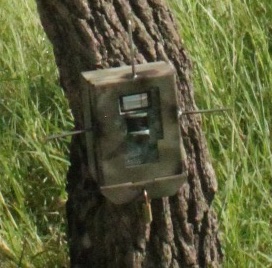
Spikes make the cameras less palatable…I hope….
and Daniel found and collared the long-lost Transect Steady pride.

And, although Season 6 marks my last field season as a graduate student, we on the Snapshot Serengeti team want to keep the cameras running for as long as we can. There is still so much to learn about the Serengeti, and many of its secrets can only be understood by long-term projects that capture both annual variability and unexpected events. The Snapshot Serengeti cameras let us study this incredibly dynamic system in a way that was never possible before – and we’re not ready to stop.
But we need your help. Our NSF funding has run out, and unless we raise enough money to keep the team going, there won’t be a Season 7.
So we’ve launched a crowd funding campaign on Indiegogo to meet our immediate funding needs. And we’re asking for support in any way you can give. We’ve got some fun “perks” in return for your donations, but the biggest perk of all will be having a Season 7 to look forward to.
So, if you too are addicted to pressing ‘play’ on the silly warthog close-ups or collecting images of baboon selfies, please share this campaign with your friends and family.
The more people we reach, the better our chances of meeting our goal and keeping our cameras running…and the better our chances of truly understanding what makes this incredible ecosystem work.

More lions at National Geographic
In addition to the main feature story on the Serengeti lions that I wrote about on Wednesday, there are a number of lion extras at National Geographic Magazine, too.
The article “Living With Lions” talks about the challenges of lion conservation, and brings up some topics I’ve written about before, including fences and trophy hunting.
There’s an interactive map, where you can see the fragmentation of wild lions. The Serengeti (‘C’ on the map) is one of only a handful of strongholds that contain at least 1,000 lions.
There’s a short interview with Michael Nichols, the photographer for the stories, and a fabulous slideshow of images that he took. (Although I have to say that I always think lions look very strange in black and white.)
And there’s a high-resolution download of this image of Serengeti lion cubs you could use for your desktop background if you wanted.

Our lions in National Geographic Magazine
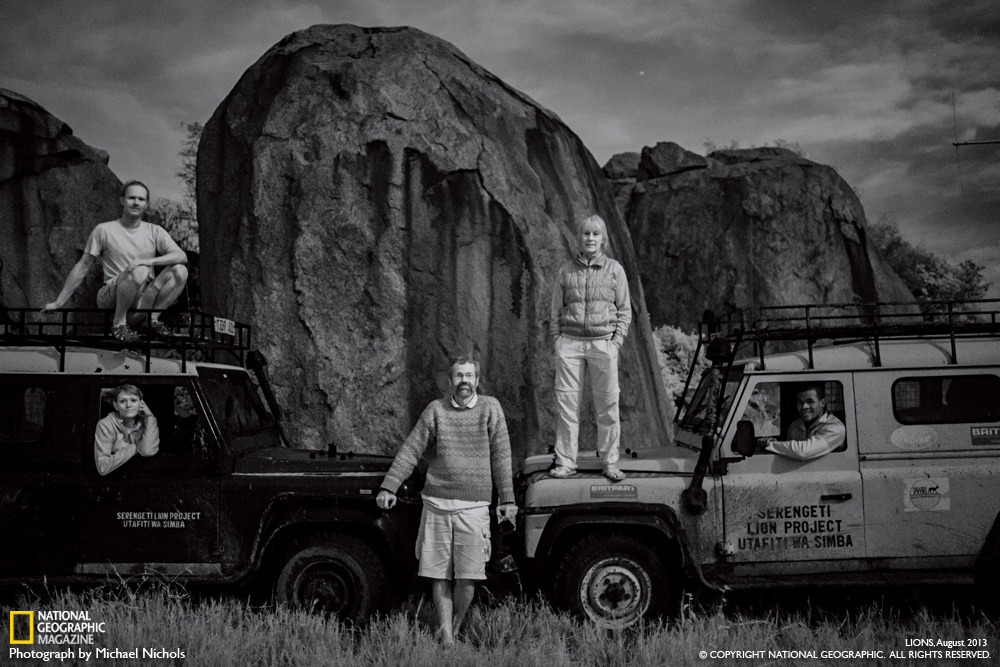
The August edition of National Geographic Magazine has a cover story on the Serengeti lions that Craig has been studying for decades. And because Ali set out the camera trap grid in the same place as Craig’s lion study area, you see the same lions (plus more) on Snapshot Serengeti as those featured in the article. In fact, photographer Michael Nichols was out in the Serengeti during Season 5, so his pictures are contemporaneous with the ones up on Snapshot Serengeti right now.
So if you have a moment, go check out “The Short Happy Life of a Serengeti Lion,” which is entertaining and gives a nice history of the foundational research on which the Snapshot Serengeti science rests. And take a gander at the editor’s note, which accompanies this picture.
Crowdfunding Snapshot Serengeti
I recently returned from Serengeti with all of my limbs intact and hard drives full of camera photos in tow. The images on these drives comprise Season 6 – the season I welded spiky nails to the cases to discourage hungry hyenas from chomping on them, didn’t get stuck every 3 days for a change, and also my last trip as a Ph.D. student. (Now I’m back in Minnesota trying to make sense of all the data and write my dissertation!) The Season 6 images are slowly making their way through the cloud to the Zooniverse team, and we’re expecting to have them online by the end of the month.
Unfortunately, things are not all butterflies and rainbows for us. In fact, Season 6 will mark a rather dire situation for Snapshot Serengeti. As Margaret wrote back in May, our National Science Foundation funding has run out – and our application for renewed funding was rejected. Unless we raise enough money to keep our Land Rovers limping along, our cameras will turn off, and we’ll lose our secret window into this incredible world.
The good news is that we have a plan. Today we launched a crowdfunding campaign on Indiegogo, our first step in keeping the project going. We are asking people around the world to help us raise money to keep the Snapshot Serengeti cameras clicking for another three months after our funding ends in September. That will get us to the end of the year and give us a Season 7.
So, if you love Snapshot Serengeti and are able to contribute something, we’d love your support. And check out our perks. We’ve got some fun ones you might enjoy! If you’re unable to help out financially, please spread the campaign link around to your friends and family. The more people we reach, the more likely we are to make our goal. The link is
http://www.igg.me/at/serengeti
And meanwhile, happy hunting in Season 5. Thanks!

Meanwhile, happy hunting!
The trouble with shade
Who knew that shade could be so problematic? A couple of weeks ago, I wrote about how shade seems to be my biggest obstacle in reconciling how the cameras see the world vs. what is actually going on. My job is to figure out how to make things right.
To start with, the camera traps are up on trees. Mostly. As you know, the cameras are on a rough grid layout – 225 grid cells, each 5km2 (2.236km on each side) — covering a total of 1,125 km2 of Serengeti’s center. This kind of design makes sure that we are covering enough of the landscape to capture the bigger picture of animal distributions and movements. Each camera is roughly at the center of each grid cell – on the closes suitable tree to that center point. Some trees are big and shady; some are small and spindly. In the woodlands, there are trees everywhere; on the plains, the camera-trap tree can be the only tree for miles. And sometimes there are no trees at all, and here the cameras get put up on metal poles.


These different habitats are important to capture. I think that animals might behave very differently in areas with lots of trees than they do in areas with very few trees. When it comes to the aggressive interactions between carnivores, for example, trees, shrubs, and tall grass provide great hiding places for the smaller species. It’s like trying to hide from someone you don’t like in an empty room vs. in a really huge, crowded shopping mall.
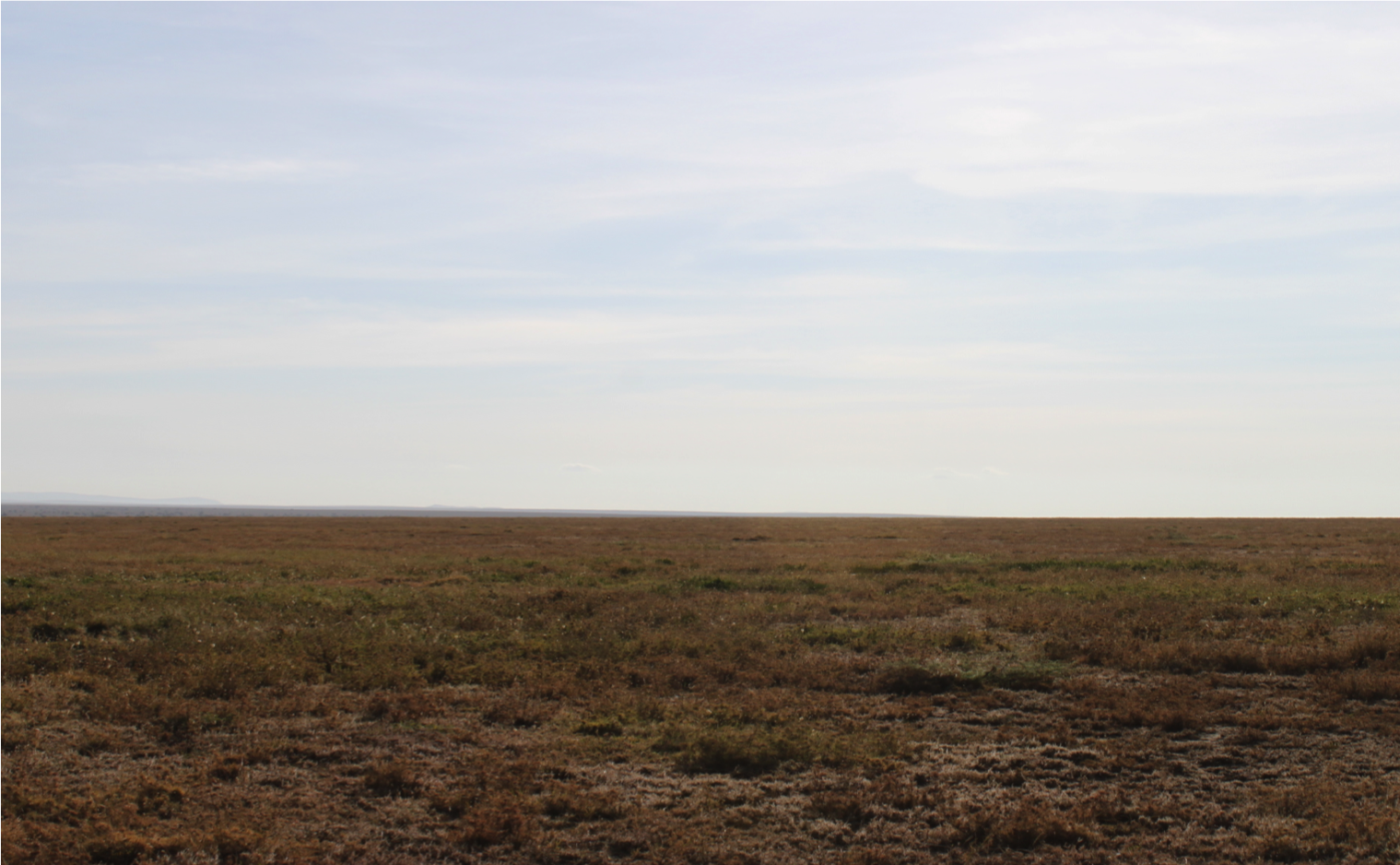
It’s a lot harder to hide from lions here
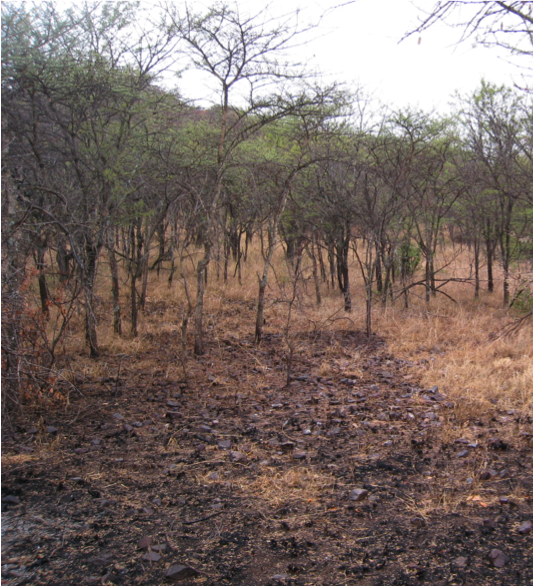
…than here
The problem is that camera traps work better in some habitats than others – at least for certain species. Say you are a huge, muscle-bound lion. Even standing is tiring in the Serengeti heat, and you spend your days breathing heavily even at rest. You like shade. A lot. If you are out in the open plains, a single shade tree will stick out for miles, and you’ll probably work your way to it. Chances are, that tree has a camera. In the woodlands, though, there are lots of trees. And the camera trap could be on any one of them. So even if you’re searching for shade, the chances of you walking past the camera trap in the woodland are far smaller – just because there are so many trees to choose from.
Here’s a map of the study area – green shows more densely wooded areas, whereas yellow marks the plains. Camera traps that have captured lions are shown with circles; the bigger the circle, the more lions were seen at that trap. I know for a fact that there are more lions in the northern half of that map than in the southern half, but the lions out on the plains seem to really like getting their picture taken!
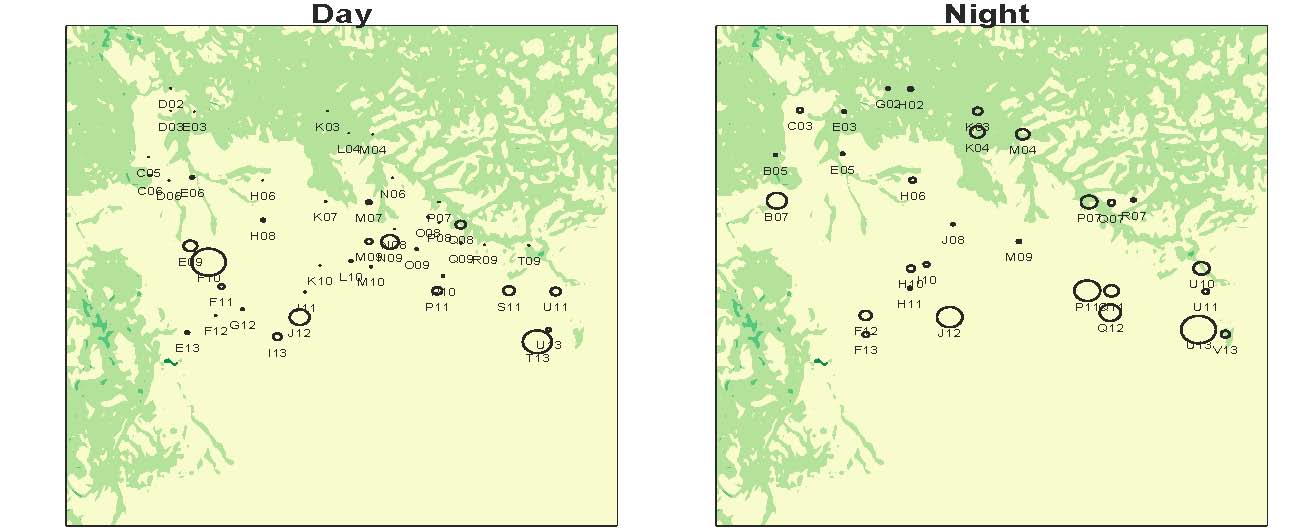
The pattern looks a little better at night than in the day, but it’s not perfect. So perhaps shade isn’t the only thing affecting how these cameras “see” lions in different habitats.
As depressing as this problem seems at first glance, I’m optimistic that we can solve it (enter Kibumbu’s new GPS collar!), but those methods are material for another day. In the meanwhile, what else do you think might be going on that attracts lions, or other animals to trees, besides shade?
 Snapshot Serengeti