
The sound of silence?
Laying in my tent last night listening to nightjars whirring and barn owls screeching I was reminded of the sounds of Africa. As I am away this week with little internet time I thought I would repost this blog I wrote a few years back.

What does silence mean to you? Maybe it’s that moment at the end of the day when the telephones stop ringing and the office hubbub finally stops and you can hear yourself think. Maybe sitting in your garden listening to the insects and aeroplanes pass overhead. Or maybe it’s that first 5 minutes of waking before the baby starts howling. Whatever it means to you the point is silence isn’t really silent. Something is always making a sound even if it’s a leaf rustling in the wind or a cricket singing.
In the African bush night time silence is deafening. Just before sunset there is a rush of activity. The day shift starts looking for a place to spend the night whilst frantically searching out that last mouthful of food. Young banded mongoose are scolded into their burrows by older siblings. Antelope take a drink before heading to thicker cover. Francolins are calling out their staccato calls whilst sandgrouse flock to drink. As the sun sets and darkness looms everything quietens down, the last to make a noise are the guinea fowl who wait till it is just dark to, one by one, barrel up to adorn their favourite roosting trees like giant Christmas baubles. They finally settle down, and the nearby baboons stop squabbling and there is a moment’s peace before the night shift takes over.
The Scops owl is first with its ‘poop poop poop’ call sounding almost like an insect. Then the night-jars join in. A distant rasping bark and the jackal are off calling ownership of their territory. They stop suddenly and a moment later there it is, the slow wo-oop! Woo-ooop! and the hyena clan are declaring they are up for business.
There has been no respite to the constant noise of the African bush during this transition between day and night; a seamless mix between the two sound tracks. As the evening wears on and the night shift are out hunting in earnest it gets quieter. If you are lucky enough to experience this it is unforgettable. The silence is thick, it hurts your ears and you want to shake your head to clear it. You are straining to hear anything out there in the blackness and your senses have you on high alert, never mind that you are in a vehicle your primal instinct knows this is Africa and beasts roam that want to eat you.
The only sound is a cacophony of insects and it is this that gets in your head, it is a relief when a spotted eagle owl calls breaking the pitch and giving you perspective again. Staring into the blackness you see a shape move , you can’t make out what it is, then comes a noise that goes right through you, a guttural, low sawing sound, a leopard is calling broadcasting its presence using the ground as a sounding board. He walks out in front of you, pauses for a moment, then strides off purposefully into the night.
The silence of the African night is palpable. You could slice it with a knife. It is so full of promises of wonderful animal encounters that I never want to sleep. It’s my favourite sound of silence; what’s yours?

World Environment Day

Tree with Landrover
The 5th of June is world environment day. This event was created by the United Nations back in 1974 to promote awareness of our environment and to spur people globally to help protect it. Its celebration has never been more important than in today’s challenging times. All over the world people will be taking part in a host of events that celebrate our environment. Some have formed clean up events of local beaches or city parks. Others will be doing a bioblitz in their gardens or local reserves many will include children who will be inspired by searching out and identifying bugs. There will be events organised on the public scale such as awareness marches or environmental film screenings. Some folks will simply celebrate by stepping out in the open air to take a walk or picnic. Whatever the event you can be sure that a lot of people will be considering the environment this week and that can never be a bad thing.
Each year there is a theme, this year it is ‘connecting people to nature’ I thought this was particularly apt for us citizen scientists at Snapshot Serengeti. Through the millions of images we classify there is a strong connection to the rhythms of animals in the Serengeti. We get to appreciate the wide biodiversity of this immense ecosystem and for those of us unable to visit such a place it is a way to connect to a wild unspoilt place. It is a way to visit, virtually, leaving no carbon foot print as we would by flying there. I feel it is a privilege afforded us thanks to technology that I would not have even dreamed of 15 years ago.
Snapshot Serengeti is the perfect antidote to the doom and gloom decried each day by the newspapers. In a world where wildlife is dwindling and the finger is firmly pointed at us as the major cause of climate change Snapshot Serengeti feels like something positive and good. Something to give us hope that we might not have wrecked everything just yet. From our armchairs we not only experience the wonders of nature but at the same time we are actually benefiting science with our classifications. What can be better than that?
So if you have nothing else planned this #World Environment day why not jump on to Snapshot Serengeti and get classifying, better still see if you can recruit new classifiers, the more the merrier.
If you want to read more about world environment day visit this site.
The Cycle of Life
The waterbuck just stood there, unfocused, staring at nothing. He didn’t move except for the gentle flare of nostrils and rise of ribs as he drew breath. About 8 to 10 minutes went by and still not even a twitch of an ear to dislodge an annoying fly. Then as if released from a spell his drooping head rose a little and he took a step or two towards the stone bird bath where he took a few long draughts of water. After that he slowly walked of through the bushes and out of sight.
I couldn’t quite understand his behaviour thinking perhaps that he was ill. Although he sported a magnificent set of horns his coat looked more than a little out of condition and he looked thin. For a waterbuck to be this close to the house in the middle of the day was unusual. He was less than a meter from me; if the glass window wasn’t there I could have reached out and touched him. I didn’t see him again after that encounter until about 5 days later. Sitting on my stoop I could smell a whiff of something dead, not an unusual smell when you live in the bush, so I went exploring following my nose. It didn’t take long to find him. He was tucked in, sitting down, between the banking and a large boulder. First I thought he had fallen but actually he looked so peaceful I think he lay down in a position that he felt protected in and let his life ebb away.
You see on closer inspection I found his teeth to be worn away to almost nothing. This is common in antelope, if they make it through life without being preyed upon or succumbing to disease then they often die from starvation when the teeth, worn down to nubs, are unable to cope with the tough vegetation it survives on through the dry season. That vacant stare I had seen is something I have witnessed in starving antelope before. So although I couldn’t rule out disease (I am no medical expert) my guess from his behaviour and condition was that he had passed away with old age.
My quandary now was what to do with him. I could leave him be and let nature take its decomposing course (and this is what I would normally do) but that would mean I was going to live with an ever more nauseating death smell for a few weeks which believe me is not good. On the other hand pulling a 200kg animal out from a snug hole was not going to be easy. To cut a long story short I called for backup and with ropes and much holding of noses we got the waterbuck out and dragged him down to the river side. I sat there all day waiting to see if a croc would come and take the waterbuck or perhaps a hyena or vulture. Disappointed that none of natures garbage collectors came I walked off home just before dark.
First light the next day off I went back to the scene. Nothing. Not even a drop of blood. I can only conclude that the crocs did indeed come under the cover of dark and dragged the carcass into the depths where nature’s great cycle of life and death continued to the crocs advantage.
The Square
So you probably know by now that season 10 is up and running and there have been some amazing camera-trap images uncovered already. As well as a few lounging lions and wandering wildebeest there have been some stunning aardvark and wildcat images.
This season has turned up quite a few images with a central square that is brighter than the rest of the frame with a luminous look. These somewhat Warholesque images look as though they have been photo-shopped and I love them. Here are just a few. My favourite is the zebra, its perfect.

Warthog backside
Tree with Landrover
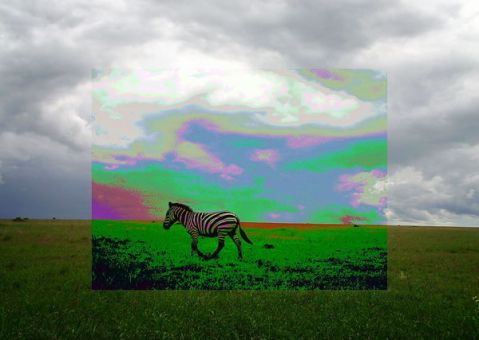
Zebra
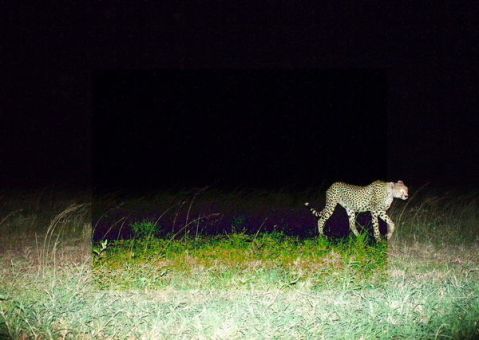
cheetah
Obviously these are not some new form of art but have a more down to earth source; a malfunction with one of the camera trap types. A patch provided by the manufacturer restores the image to normal which for scientific purposes is very good but from the purely aesthetic side its kind of sad, I like “The Square”
Topi versus Hartebeest
Here is another pair of antelope that are often muddled up on Snapshot Serengeti; topi and hartebeest. These two share a similar size and body shape and for those of you not familiar with them they can prove a bit tricky.
Topi and hartebeest belong to the same tribe, Alcelaphini, which also includes wildebeest. These antelope typically have an elongated face, long legs, short necks and stocky bodies. Although these antelope have reasonably large bodies their long legs mean they have retained the ability to run fast, a good adaptation for life on the open plains. It is believed that the long face developed in place of a long neck in order to reach the grasses they consume.
There are several species of both topi and hartebeest in Africa, two are found in the Serengeti. Coke’s hartebeest or kongoni (Alcelaphus cokii) are selective grazers with browse making up less than 4% of their diet. Serengeti topi (Damaliscus jimela) are 100% grazers
In both species males are territorial but topi also form leks from which to display to passing females. Males holding territory close to the lek are more desirable to females. Dominant females will actively prevent subordinate females from mating with these males.
Topi Hartebeest


So side by side we can see that the topi is much darker coloured than the hartebeest with distinct sandy socks up to its knees and conspicuous black patches on the thighs and shoulders. In contrast the hartebeest has pale legs and underbelly with a darker upper body. The paleness forms a patch on the top of the thigh.
Topi Hartebeest


From behind the contrast between leg colour and backside is very obvious with topi sporting dark legs with pale rump and back and hartebeest pale legs and rump with dark back.
Horn shape is also different. A topi’s horns sweep up and back whereas a heartebeest’s sweep out to the side before kinking back. They also sit on a prominent bony ridge on the top of the head.
Hopefully this will help you tackle all the images waiting on season 10.
Grant’s Verses Thomson’s Gazelle
The Zooniverse team are super busy at the moment but hopefully very soon season 10 will be loaded and we can all get cracking with what promises to be a fantastic season full of amazing images.
In the meantime I thought I would post a few notes on those tricky animal pairings that seem to have more than a few people stumped when trying to id them.
To kick it off we will look at Grant’s gazelle and Thomson’s gazelle. If you were treated to perfect photos every time I think you would get the hang of these two pretty quick but with the often blurry or distant images we get on snapshot they can be tricky.
Grant’s gazelle A Thomson’s gazelle A


A; First off there is the overall colouration. Thomson’s has a thick dark stripe across its side, Grant’s usually lacks this but be aware as some Grant’s have a dark stripe too. Not the best distinguishing feature as there can be quite a bit of colour variation.
Grant’s gazelle B Thomson’s gazelle B


B; A better distinction is the facial markings. Grant’s gazelle has a thick black stripe running along the side of the face from the nose passing through the eye to the base of the horns giving a masked look. Thomson’s has the same stripe but it ends at the eye, not passing through. The white band on top of the black stripe is more distinct on Grant’s.
Grant’s gazelle C Thomson’s gazelle C


C; If you get a back-side shot then Grant’s displays a much whiter overall appearance with the white area extending past the root of the tail up onto the back. In Thomson’s the white area stops at the root of the tail. Grant’s tail is white at the root and thin with whispy black end, Thomson’s is dark and fluffy looking. The black vertical bands in Grant’s are also more prominent.
Grant’s and Thomson’s Gazelle
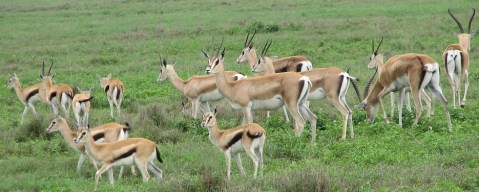
Photo NH53, Flickr (https://creativecommons.org/licenses/by/2.0/)
In a mixed group the smaller size of Thomson’s is evident, although with young animals it is not so obvious. Here you can easily see most of the features discussed above with the Grant’s gazelle comprising the 7 animals to the right back and the Thomson’s gazelle to the left forward. Note the Grant’s gazelle side on at the back, it shows a much darker side stripe than the others more a kin to Thomson’s. Males and females of both antelope have horns with the females usually shorter and thinner. In some females horns are absent. In general Grant’s are more graceful looking than the stocky Thomson’s.
The River
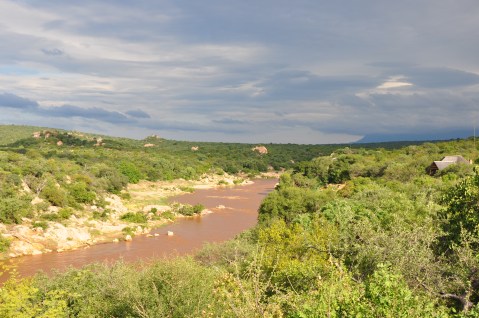
The Oliphants River
Now that we have finished classifying season 9.5 and we have a short break before season 10 is launched I thought I would muse a little on my favourite wildlife setting; Rivers.
I live in South West France next to a river. Its gentle passage demands my attention constantly. That’s because rivers are magnets to wildlife. Everything needs water to drink and in a dry area it means your best chance at seeing wildlife as they come to drink.
In Africa too, I lived by a river and what a special place that was. The Oliphants, sometimes a trickle sometimes a violent torrent, flows into Kruger National Park and I was lucky enough to live on its banks for 4 years. I could watch the daily spectacle of life unfold from my stoop. I watched baboon troops clash viciously, hippo’s endlessly dose, leopards stroll the beaches, fish eagles catching supper. I once watched a four meter long rock python ascend the cliffs opposite effortlessly and I followed the progress of a family of spotted eagle owls on a nest in a crevice, worrying absurdly when the river began to turn chocolaty and rise. They survived but I was ready to brave crocs and hippos and swim over to rescue them.
You can watch for hours and see nothing then turn your back for a second and suddenly 5 kudu have appeared out of nowhere. One early evening I sat watching, all was quiet except the birds calling in the bushes. It was approaching the hour that nightjars start to sing. All of a sudden the shrill nasal alarm snort of a Klipspringer rang out quickly followed by the outraged screaming of vervet monkeys. Grabbing binoculars I focused on a blur on the rocks opposite in time to see a klipspringer launch itself off landing with an almighty splash in the river. A leopard came to a screeching halt on the rocks not wishing for a swim. The river meanwhile was flowing pretty fast and I thought the klipspringer, more suited to rocky precipices than water, would drown. Amazingly the stout little antelope managed to swim to the shore and clamber out, shaken no doubt but alive. I often wondered if he ever made it back to his side of the river.
A stroll down the beach was always an education. The damp morning sand would show who had passed previously and was great for practicing tracking skills. On one such stroll I noted an absence of leopard tracks on my outward walk only to discover on my return journey that a leopard had left its mark on top of my foot prints; a little disconcerting.
The river, for most of the year, retreated to the deeper channels leaving a boulder strewn sandy beach lined with large trees such as sycamore figs and marulas. During the driest part of the year we really felt our connection to the great Kruger Park. Our reserve was quite small by African standards and did not have elephant or lion resident but during the dry period elephant would take to wandering the river course right out of the park and would spend a few weeks looking for food on our reserve before wandering back to the park. Lion too followed this same route and it was always a thrill to double take on a seemingly large leopard print only to realise it was in fact a lion.
The other end of the scale came with the rains. The river could rise meters in minutes turning a deep chocolate brown. The force of its passage was astonishing, great trees would be swept down, I have seen cars and sofas swirl by. Most of the animals that live in the water seem to get out whist the storm passes but I watched a hippo once in the full force of the raging river and I suspect that it wasn’t by choice that he was in there that somehow he couldn’t get out.
So benign or raging, highway or refuge the river is like an anchor to wildlife. The chance of seeing wildlife there is strong but even if you don’t they are intrinsically beautiful places.


Black and White
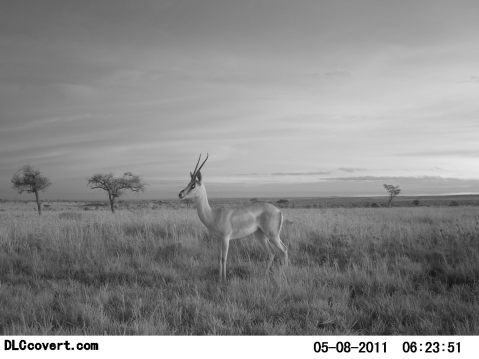
Grants Gazell
This past week I have been trudging up and down boggy slopes with armfuls of tree protection tubes, posts, tools and finally trees as part of a reforestation project in the Lake District National park, UK. With storm Doris fast approaching it has been a miserable week and my mind has often wandered over to snapshot Serengeti for some light relief.
The job I am doing, trying to help mitigate the over grazing of sheep and deer made me think of Michael Andersons work that has provided us with the images for season 9.5. He has written here about the project to study how herbivores affect vegetation patterns and you will have seen the enclosures around his experimental plots.
Some people have found that the images from this season are not quite as good as in previous seasons, they seem to be a bit fuzzy in places and there are a few less lions. On reflection though it does seem to be producing a lot of my favourite images, those taken during dusk and dawn when the camera is not quite sure if it is day or night and ends up taking a black and white daytime shot. These pictures can be quite exquisite and have the feel of being completely composed by a top photographer rather than just a random event.
Here are some of my favourites.
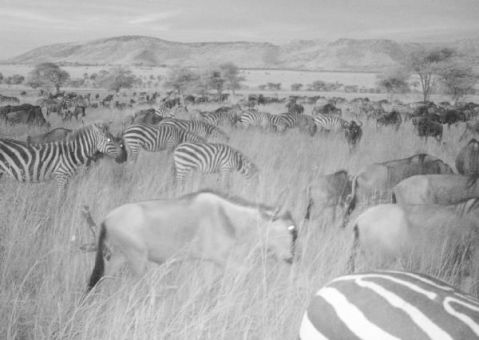
Zebra/Wildebeest
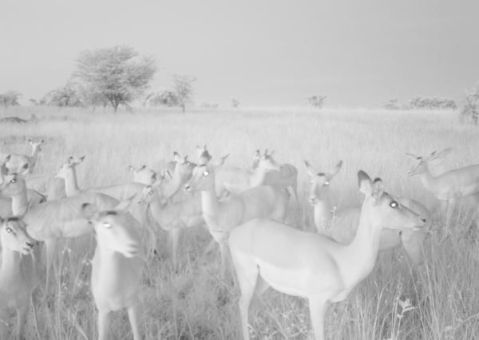
Impala
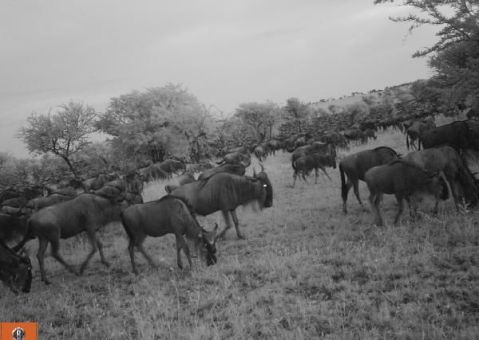
Wildebeest
It is a good reminder to us all that although we are all waiting to discover that one truly great animal capture and it is gratifying to classify the more unusual beasts the aim of the whole project is science. Back in the old days of Serengetilive the classifying was done one camera roll at a time. Sometimes I would sit and classify 2000 capture events of….. grass. Seriously, you would be luck to maybe get a passing bird but it had to be gone through just in case the last couple of shots were of lion. At least with Snapshot Serengeti the pictures are randomised so you get shots from a mixture of cameras rather than being stuck on a tedious one.
Pre-Dawn in Serengeti
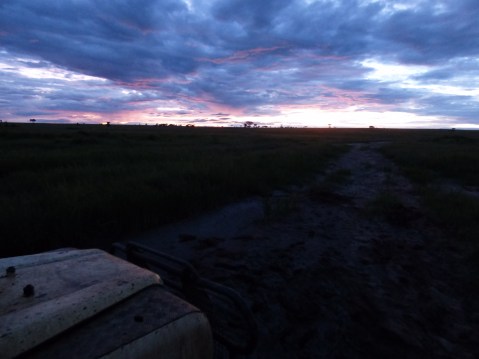
There are definitely pros to early-morning fieldwork! Heading out to do camera trap experiments often required hitting the road before sun-up, and with the right composition of clouds, you often got to experience beautiful sunrises. Here, you can see the front of my LandRover as we’re about to tackle this swampy stretch of road!
Field Decor

My favorite part of Africa has to be the decorating.
 Snapshot Serengeti