
Male lion takeovers

This series of photographs documents a stand-off between two male lions — a younger male attacking? defending against? an older male. Interestingly enough, at the last minute, a pair of lionesses jump in and join the young male in evicting his older competitor.
In lion societies, males leave their birth prides at a young age and join together with other males, forming coalitions. These groups, which vary in size from 2-9 individuals, range across territories and attempt hostile takeover of established female prides from other males. While it may seem that the only obstacle to taking over a pride is the coalition of males who have already set up shop, it isn’t always in the females’ best interest to stand by passively and the males duke it out.
A group of male lions’ first order of business upon gaining tenure of a new pride is to off all the females’ dependent offspring. Loss of cubs brings females back into heat sooner, giving the new males a reproductive incentive to commit infanticide. The female, on the other hand, suffers an immediate loss in fitness — all the reproductive effort invested in her cubs is gone! Females have evolved a number of ways to reduce the risk of infanticide by males, including behavioral strategies such as banding together with their current coalition to stave off intruders. Is that what’s going on here? Perhaps, perhaps not. The female-defended male looks fairly young the be in this type of a situation. Cub loss, however, is an important factor to keep in mind when considering sport-hunting of mature male lions. The effect of removing a resident male is removed may cascade through his social group, leading to additional deaths within his pride when new males move in to his vacated niche.
Grinnell, J. and K. McComb. 1996. Maternal grouping as a defense against infanticide by males: Evidence from field playback experiments on African lions. Behavioral Ecology, 7(1): 55-59.
Packer, C., Scheel, D., and A. Pusey. 1990. Why lions form groups: food is not enough. American Naturalist, 136(1): 1- 19.
If you’ve got the time to sit down for 15 minutes and subject yourself to some truly awe-inspiring photography, check out this TED talk from the documentary film-making couple, Beverly and Dereck Joubert as they recount their adventures in Africa interacting with big cats and their big personalities.

Beverly and Dereck Joubert. (Photo Credit: © Wildlife Films Botswana / Mike Meyers)
https://www.ted.com/talks/beverly_dereck_joubert_life_lessons_from_big_cats
Motivation
Happy New Year! 2014 is here and as Snapshotters around the world know it brings the eagerly awaited season 7 with it (coming soon). A season that may never have happened if it weren’t for the generosity of many who helped the Save Snapshot Serengeti campaign.
Recently I filled out a questionnaire for a local nature group who were hoping to launch a citizen science project. They asked the following question.
What would motivate you to take part in a citizen science project?
• To help scientists
• To enrich personal knowledge
• To gain awareness of preserving biodiversity
• To have contact with nature
As someone who has taken part in various citizen science projects both online and in the field this got me thinking. What does motivate us? I am sure there are as many answers out there as there are people taking part. For me all of the above options play their part in the motivation but it’s more than that. There is of course just pure personal enjoyment. Let’s face it: it’s fun, being involved, interacting on the forums with like minded people, getting a glimpse of what the scientists are up to. It connects us to science. I think without this aspect citizen science wouldn’t be the success that it is.
The other motivation for me is the sense of being able to do something that helps. The news is full of doom and gloom these days; climate change, vanishing biodiversity, habitat loss. This can leave us feeling depressed and the scale of the issues can make us feel helpless to do anything. Citizen science offers us the opportunity to feel positive and provides us with a way to really help and make a difference.
Modern technology has not only lead to huge advances in data capture capabilities for scientists but to organisations such as Zooniverse to involve the worldwide public in analysing that data. The ability to join in from the comfort of your own home is really a revolution in science.There are also loads of projects that get you out and about and tap into the rich source of amateur naturalists. Bird counts, butterfly counts, phenology projects to mention just a few.
What is it that motivates you? We would really like to hear your thoughts, why do you participate in Snapshot Serengeti? Do you work on other Zooniverse projects? What about field projects?
George Schaller and the Serengeti Lion
To bring myself up to speed with the fundamentals of lion research in the Serengeti, I have spent the last week or so reading through the classic work The Serengeti Lion: A Study of Predator-Prey Relations, by the reputable George B. Schaller. For a collection of field notes, the book it quite a page-turner. The work covers everything remotely relating to lion biology, from social systems to predation patterns, and manages to capture both the drama of the dynamic Serengeti system and the dusty, hot, sweaty reality of watching big cats sleep for 18 hours a day.
Although the focus of the book is the life of lions, the life of George B. Schaller himself turns out to be just as intriguing. Digging a little into his background, I discovered that Schaller, dubbed the “Megafauna Man” by National Geographic, has undertaken a 50-year career in field biology studying some of the most iconic systems in the world.
Schaller had moved to the Serengeti with his wife and two sons for two years in 1966 to uncover the intricacies of the lives of big cats and their prey. This, however, was not the start of his field career. Back in 1959, when he was a mere 26 years old, Schaller packed up and headed off to Central Africa to study the mountain gorilla. For two years, amidst dodging poachers and eluding Watusi invaders, he uncovered facts about these great apes which helped to dispel common notions about their brutishness and revealed them to be gentle and intelligent animals. His work paved the way for other naturalists, including the well-known Dian Fossey, and led to the creation of Virunga National Park.
In the ‘70s, Schaller worked in both South Asia and South America, studying large mammals including the blue sheep and snow leopards of Nepal and the jaguars, capybaras, and caimans of Brazil. The American novelist and naturalist Peter Matthiessen accompanied Schaller to Nepal and wrote a travelogue on their exploits (The Snow Leopard) that went on to win the 1979 National Book Award. Matthiessen describes Schaller as “one of the finest field biologists of our time. He pioneered the practice of turning regions of field research into wildlife parks and preserves,” a epithet that held true yet again when five years later, the Nepalese government used Schaller’s research to form Shey-Phoksundo National Park.
Following these adventures, Schaller and his wife were given the distinction of being the first westerners invited by China to enter the remote southwest Asian wilderness and research the Giant Panda in its native habitat. As part of this work, Schaller focused on understanding threats to the diminishing panda population and discovered that the primary culprits in their demise were poaching and logging. In his book, The Last Panda, Schaller writes “The panda has no history, only a past. It has come to us in a fragile moment from another time, its obscure life illuminated through the years we tracked it in the forests.” Despite this foreboding prophesy, since Schaller’s work on panda biology, the number of panda in the wild has increased by 45%.
In the 1990s, Schaller worked in Laos, Vietnam, and Tibet studying antelope and in the process discovering and rediscovering several species of mammals including a bovine, a pig, and a type of deer. More recently, he has been collaborating with agencies in Pakistan, Afghanistan, Tajikistan, and China to develop a 20,000-square mile “Peace Park” for the protection of the world’s largest wild sheep species, the Marco Polo sheep.
Over the span of his career, Schaller has made profound contributions to our knowledge about large mammals, both their biology and ecology, and has greatly furthered species conservation in the creation of over 20 parks and preserves throughout the globe. I can highly recommend his writings on the Serengeti Lion, and if you want to delve further into his life and career, his other authored books (there are over 30) include The Year of the Gorilla, The Last Panda, Tibet Wild, and A Naturalist and Other Beasts.
It’s no Serengeti, but…
Last year, my mom visited me in the Serengeti. We explored the jungle-like Manyara national park, held our breaths as elephants sauntered within reach of the Land Rover, and woke up at 3am to lions roaring next to our campsite in the middle of the Serengeti plains.
This week, I’m visiting my mom in her own little piece of North American grassland. I made a brief escape from the oncoming Minnesota winter to the normally balmy state of Virginia (it’s getting surprisingly cold at night here!) to help my mom with the little piece of paradise she recently purchased. This past spring she sold her home in the DC ‘burbs and moved out to the countryside, somewhere in between fancy horse country and cattle farms. It’s kind of perfect.
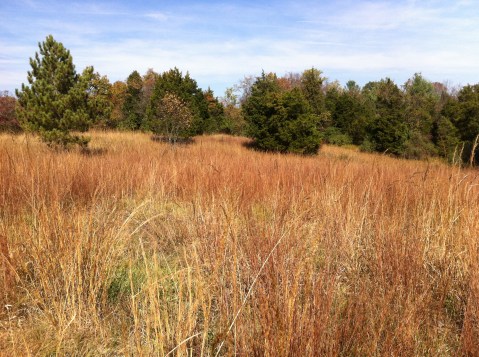
Indian grass, broomsedge bluestem and little bluestem, with autumn olive encroaching in the distance.
It might not be as otherworldly as the Serengeti, and there might not be any giraffes browsing by our deck, but my mom is working hard to maintain a piece of native mid-atlantic grassland on her property. Walking the meadow with the state’s conservation officer, we admired at the Indian grass and bluestem and scowled at the thick carpet of green fescue that made the yard inhabitable for the quail we hoped would recolonize. Grassland restoration is currently a major conservation initiative across the United States. Across the country, most native grasslands have been converted for agriculture; the suppression of natural fires has further allowed trees to grow up in meadows and shade out the sun-hungry grass. Ground nesting prairie birds (such as our bobwhite quail) tend to be the biggest losers in this game, because they need just the right amount of cover to be able to thrive. Fescue grass is too thick for baby quail to waddle through; the relentless olive trees grow fast and thick and threaten to turn our meadow into woods. I had no idea that maintaining native prairie was such a battle.
Spending so much time out in the east African bush, I sometimes forget how amazing our own backyards can be. My mom now has foxes, coyotes, bobcats, and black bears, and a fat, happy family of 8 baby wild turkeys that wobbly by at sunset. As much as I miss the Serengeti, the wildlands here are magical in their own way, and I suspect when I leave, I will feel a little homesick.
Heating up and keeping cool
I’m just returning from a lovely vacation in Maine, where the air was cool and the crowds few and far between. It may not always be that way.
It’s no secret that over the next several decades, the average temperature in the United States (and in many parts of the world) is going to increase. That means warmer summers, both in the hot parts of the country and in the more northerly regions where people typically go in the summer to cool off. As the summer weather get warmer, more people may head north on vacation, or they may go further north than before. We can expect animals to try to compensate for warmer weather, too.
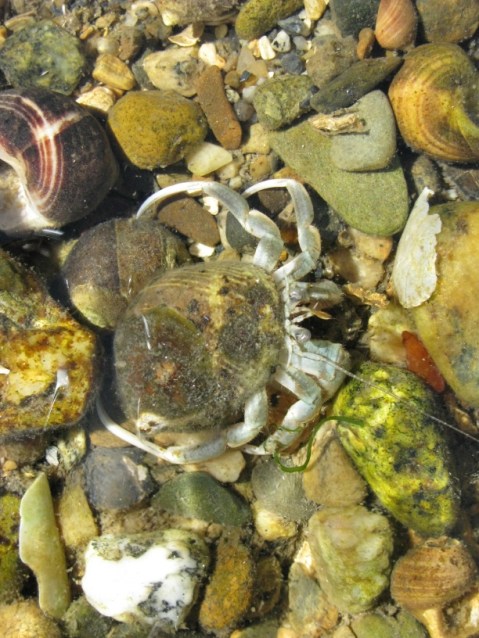
A hermit crab in a Maine tidal pool. Kinda makes you want to cool off with some Seafloor Explorer, doesn’t it?
The first week of August I was in Minneapolis for the annual meeting of the Ecological Society of America, and I spent Thursday sitting in on two symposiums: “Warming Consumers and their Prey: General Principles and Applications for How Temperature Affects Trophic Interactions” in the morning and “Rapid Climate Change and Species Range Shifts: Observations, Predictions, and Management” in the afternoon.
The morning session was about how warming climate may influence interactions between plants and animals and between animal predators and animal prey. It is not an easy topic, as the relationships among species are complex, and scientists are only starting to understand how warming will affect single species directly (that is, if they don’t interact with other species). One speaker pointed out that while some species might normally adapt to warming or move to cooler areas, having other species around might prevent that adaptation or movement. For example, if you overheat easily and your plant food does not move northward as the climate warms, you cannot very easily move northward to adjust to the changing climate. Another speaker showed that we should think about maximum summer temperatures and minimum winter temperatures, rather than average annual temperature (as is typically done); plants and animals are likely to experience the greatest impact of climate change when they experience unusually hot or unusually cold conditions.
The afternoon session was equally interesting. One speaker talked about how over the past few decades, the ranges of plants and animals studied all over the world are moving towards the poles (north in the northern hemisphere, south in the southern hemisphere), up mountains, and down into deeper water (for aquatic organisms). Another talked about using information from botanical gardens and commercial plant nurseries to understand where some plant species can live and reproduce, even if they’re not native to that area to begin with; this is useful information for predicting how plants might change their ranges in the future.
Regional climate models for East Africa do not suggest that the area is going to get much warmer in the next decades. However, the climate will get more variable, with wetter wet seasons and more frequent droughts. That’s one of the reasons we want to run Snapshot Serengeti for many years. By collecting data over a decade or more, we’re likely to catch at least one drought year and at least one very wet rainy season. If the Serengeti’s future holds more of these extreme climate years, the data from Snapshot Serengeti will help us determine what will happen to the various animals that live there — and in other parts of Africa.
More lions at National Geographic
In addition to the main feature story on the Serengeti lions that I wrote about on Wednesday, there are a number of lion extras at National Geographic Magazine, too.
The article “Living With Lions” talks about the challenges of lion conservation, and brings up some topics I’ve written about before, including fences and trophy hunting.
There’s an interactive map, where you can see the fragmentation of wild lions. The Serengeti (‘C’ on the map) is one of only a handful of strongholds that contain at least 1,000 lions.
There’s a short interview with Michael Nichols, the photographer for the stories, and a fabulous slideshow of images that he took. (Although I have to say that I always think lions look very strange in black and white.)
And there’s a high-resolution download of this image of Serengeti lion cubs you could use for your desktop background if you wanted.

Rare Romping Rhinoceros
Thanks to Snapshotters Jihang and parsfan who posted it to Talk, we can all marvel over the best ever picture of a black rhinoceros taken by a Snapshot Serengeti camera.

(And yes, it’s a set of three images, so you can animate them.)
There’s no mistaking this beast!
There are two types of rhinoceroses in Africa: the white rhino and the black rhino. Despite their names, they’re both gray, but you can tell them apart by their lips: white rhinos have broad lips, while black rhinos have a pointed and curved upper lip that is used to grasp vegetation. There are only black rhinos in the Serengeti (and in all of Tanzania), and they can grow to weigh up to 3,000 lbs (1,360 kg).
Despite their size and bulk, these animals can really move — at speeds up to 28 mph (50 kph). Several years ago, I had the chance to see the rhinoceros rehabilitation center at Kruger National Park in South Africa. This gave me a chance to get fairly close to the creatures. At one point I was on the other side of a fence from a rhino and it charged me; the fence was made of wood and very solid, so I was fine and the rhino just bounced off the fence. But I was amazed at how fast it went from standing still to ramming speed — and how quiet it was doing so.
Black rhinos are critically endangered, with fewer than 5,000 alive in the wild (as of the end of 2010, the most recent statistic). Fully 95% of all wild black rhinos live in one of four countries: South Africa, Namibia, Kenya, and Zimbabwe. Tanzania has only about 100 of them, with a quarter of those in the Serengeti.
It’s thought that about 1,000 rhinos originally inhabited the Serengeti. But in the 1970’s and early 1980’s, poaching increased severely. A park survey conducted in 1982 found only two remaining rhinos, both female. Efforts were made to actively protect these remaining two, and plans began to be made to bring in a male. But before those plans came through, a male rhino showed up on his own in 1994. It’s thought that he came from the Ngorongoro population, which contained only about a dozen animals at the time. Moreover, it was quite a hike at 70 miles (113 km). As I said, these animals can move!
It’s something of a mystery how this male rhino found the females in so vast an area — sound? smell? — but he stayed. Within a short time there were four babies, and since then, the population has steadily grown. Now there are twenty or so black rhinoceroses living around Moru Kopjes. These Kopjes are about 20 miles (32 km) south of our camera trap area, so we only rarely catch a glimpse of one (out for a walk?).
While the Moru population is growing, it still faces two major threats. The first is continued poaching. Demand for rhino horn has been rapidly escalating since 2009, with black market prices in Asia skyrocketing, and organized crime getting into the action. In May 2012, two of the Moru rhinos were found dead with their horns missing. The second threat to the Moru population is inbreeding, which over time can cause lower reproduction rates and increased genetic disease. Fortunately, there are ongoing efforts to both protect the existing rhinos and to bring more black rhino genetic diversity to the Serengeti by translocating animals from South Africa.
Perhaps in several decades these massive beasts will once again make regular appearances in central Serengeti; until then, keep your eyes peeled for their rare cameos.
 Snapshot Serengeti