
Winter vacation
In the winter months (northern hemisphere winter, that is), we catch white storks on camera. They’re taking their winter vacation in the Serengeti — and across eastern and southern Africa.
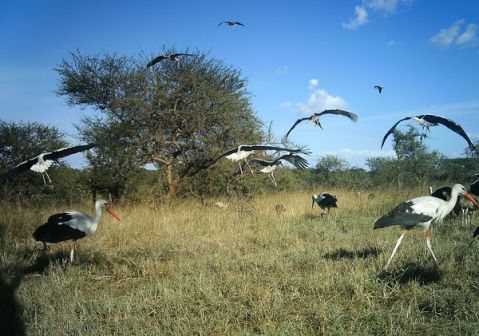
White storks are carnivorous, eating insects, worms, reptiles, and small mammals. A flock of them like this makes me wonder about the diversity of small critters that they eat that we don’t catch on camera. Because they eat small animals, they can sometimes be seen near fires, ready to gobble up those creatures trying to escape flames and smoke.

The white stork has a favorable reputation with people in both Africa and in Europe, because it feeds on crop pests. In the spring, storks leave their wintering grounds and head north to Europe to breed. They build large nests out of sticks and are happy to do so on buildings and other structures with wide, unencumbered supports. And because they are considered useful — and sometime good luck — people allow them to build their nests on buildings. These nests are then frequently re-used year after year.
Several years ago I went to Poland to find my grandmother’s childhood home. This was made a bit challenging because when my grandmother was a child, the area was part of the Austro-Hungarian Empire and the names of everything — towns, streets — were in German. These days, of course, all the names are in Polish. After finding a list of place name translations, I set out to see if I could locate some buildings my grandmother described in her memoirs in a small town in the countryside outside of what is now Wrocław and was then Breslau. One of these was “Grandfather’s [my great-great-grandfather’s] water mill with its stork nest on the roof.” Sure enough, I found a large old building in the middle of town right by the stream. It no longer sported a water wheel, but there on the roof: a stork’s nest, complete with stork.

Pangolin!
A few weeks ago, Snapshot Serengeti volunteers spotted a Pangolin in Season 6. This is the best pangolin shot we’ve ever seen in this project.

Pangolins are rare and nocturnal, so you don’t see them often out in the field. The pangolin species we have in the Serengeti is called the ground pangolin (Manis temmincki), and it ranges from East Africa though much of Southern Africa.
I once went to Kruger National Park in South Africa for a conference and went on a guided tour in my free time; the tour leader asked what we wanted to see, and I shouted out “pangolin!” The tour leader gave me a withering look and we then went out to see the elephants and giraffes and buffalo that the other tourists were eager to see. I really did want to see a pangolin, though. I’ve never seen one in real life.
Pangolins have scales all along their back and curl up into balls like pillbugs when they feel threatened. They hang out in burrows that they either dig themselves or appropriate from other animals. And they have super long tongues that they use to get to ants and termites, their primary food. Pangolins have one baby at a time, and young pangolins travel by clinging to the base of their mother’s tail.
Pangolins don’t have any close living relatives. In fact, they have an order all to themselves (Pholidota). Because of how they look, scientists used to think they were most closely related to anteaters and armadillos. But now with genetic tools they’ve discovered that pangolins are more closely related to the order Carnivora, which includes all cats and dogs. It’s a bit strange to think that pangolins, which are sometimes called “scaly anteaters” have more in common genetically with lions than with actual anteaters, but that’s what the science tells us.
Many thanks to all of you who marked the new pangolin image in the Talk forum. That lets us make sure it gets classified correctly. ‘Pangolin’ was just one of those rare animals that didn’t make it onto the list of animals you can choose from, so our algorithm will classify it as something else, which we will fix by hand.
Who knew?
Just wanted to brighten your morning with a pretty unbelievable video that has nothing to with the Serengeti. Frogs freeze. That’s right. They don’t hibernate, they freeze. I couldn’t embed this video from NOVA’s Science Now site, but just click here to watch!
I hope that rocks your morning as much as it rocked mine.
Closer look: civets and genets
Civets
The African civet Civettictis civetta is the sole terrestrial civet found in Africa, the rest being found in Indian subcontinent. It is a heavy set cat-like animal and is still referred to as a civet-cat by some though it is not a member of the felids. Civets have a white body with black blotchy spots. They have a black face mask and black legs; the tail appears ringed with a thick black line running down the top. They have an erectile dorsal crest which they raise when alarmed or in aggression. This can be seen on a few of our camera-trap images.

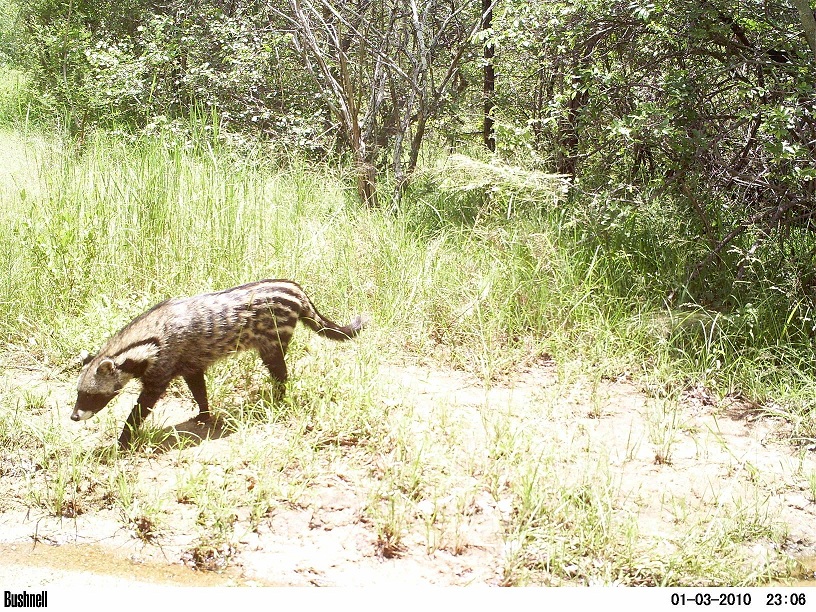
The African civet is most famous for its musk that is used in the perfume trade. Don’t get the wrong impression, it smells terrible, but helps fix scent. Its use has mostly been replaced with synthetic fixers these days which is good news for civets. Civet farms are not regulated and animals are usually kept in small cages from which they are ‘milked’ daily. The real use of their perineal gland which is situated near the anus is to paste an object such as a tree to act as territorial sign post.
African civets are omnivorous, eating a wide range of vertebrate and invertebrate prey as well as taking advantage of fallen fruit. They are clumsy killers and often employ a bite and retreat or bite and throw tactic, where prey is bitten and thrown before quickly running away. The prey is hopefully immobilised so the civet can return to inflict the killing bite. Scent and sound are the predominant senses used by civets. They are classified as Least Concern on the IUNC Red List (International Union for Conservation of Nature)
Genets
The Genet family has 15 subspecies in Africa and these are all still hotly debated. The Serengeti is home to at least two of these, the Common Genet Genetta genetta and the Rusty Spotted or Central African Large Spotted Genet Genetta maculate. It is very hard to tell them apart, especially in a fleeting camera-trap picture but the Common Genet usually has a white tipped tail and the Rusty Spotted Genet has a black tipped tail.
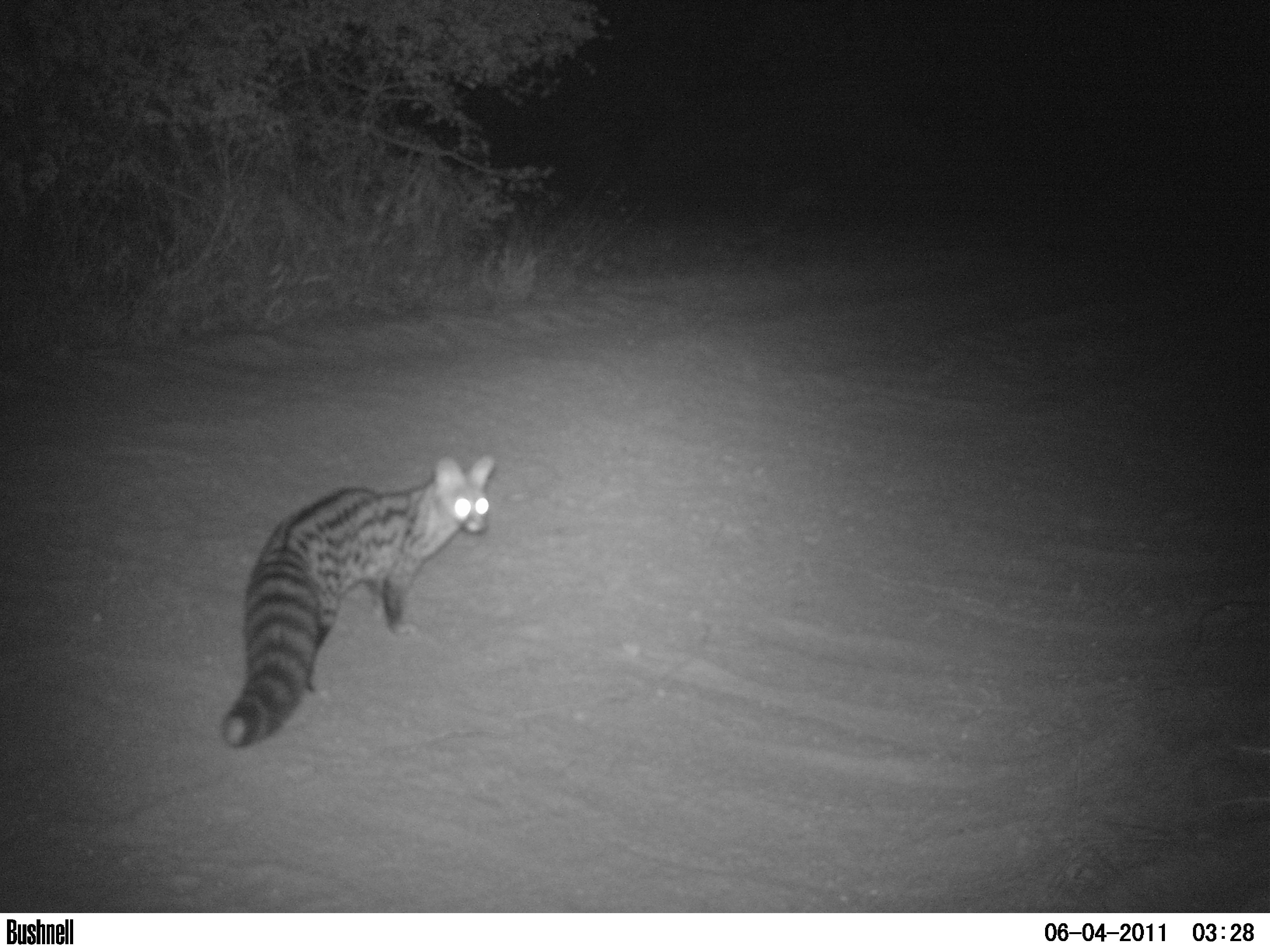
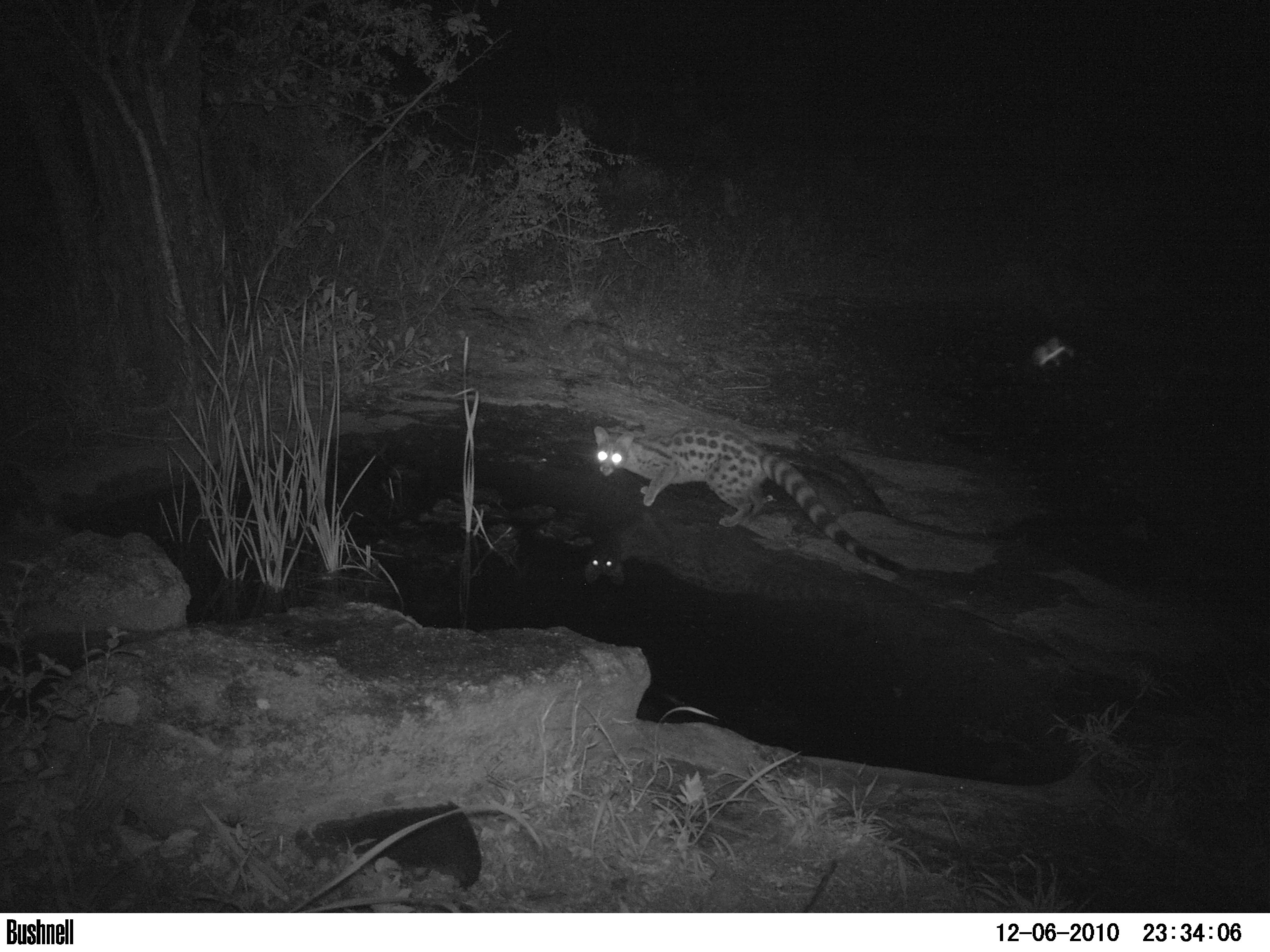
They are small agile mammals that resemble a cat with short legs. Their silvery grey coat is marked with black spots in the Common Genet and black to brown spots in the Rusty Spotted Genet. They have dark marks either side of the muzzle below the eyes giving them a slightly racoon-like look. The tail which is banded is almost as long as the body and can appear quite bushy when alarmed.
The Genets are mainly carnivorous and they will eat mammals, birds, insects and reptiles. They hunt in trees and on the ground and are extremely dextrous. They spend their days in holes in trees, thick bushes, rocky crevices and sometimes in ground holes. Like civets they also have a perineal gland that they use for scent marking. To do this they will stand on their forefeet in a handstand posture and rub the raised gland on a tree or bush. Both Common Genet and Rusty Spotted Genet are classed as Least Concern on the IUNC Red List.
Night of the Lion
Most of you have probably seen this picture:

Kill in action
As well as the ones after it:

Joined by a pridemate.

staring out of view of the camera…

Three minutes later…

Trade-off again…

Where are the leftovers?
This series of photos was taken at site H11 along the Loyangalani river and remains, to me, one of the most amazing accomplishments of our camera trap survey to date.
First, seeing a kill is rare. In the 47 years that the Lion Project has been watching Serengeti’s lions, we’ve only seen lions with about 4,000 carcasses; of those, we’ve only actually seen them in the act of killing 1,100 animals. That might sound like a lot, but with one or two people on the ground, almost every day of the year, racking up nearly 50,000 sightings, that’s not that often.
I don’t love this series simply because this random, stationary, complacently-stuck-to-a-tree camera trap caught this rather rare event – but because it goes on to document the story that follows: A single lioness takes down a zebra much bigger than herself. Within minutes, her sister joins her (free meal!). Note how big their bellies already are though, when they begin to eat. These aren’t particularly hungry lions to begin with. About 45 minutes later, they are staring out of view of the camera, and then comes a group of hyenas. The carcass goes back and forth between them throughout the night, with a jackal darting in to sneak a nibble.
Food stealing, or kleptoparasitism, is a major part of life for Serengeti carnivores. Contrary to long-standing popular belief (reinforced by the Lion King), hyenas are not skulking scavengers living only off others’ leftovers. Hyenas are quite adept predators and scavenge only about 40% of their diet; lions scavenge at least 30% of theirs. And, in fact, lions steal a lot more food from hyenas than is apparent at first glance. More often than not, when we see hyenas lurking anxiously around a pride of lions demolishing a carcass, it’s because hyenas made the kill, and lions stole it away. Research from Kenya suggests lions might actually suppress hyena populations simply by stealing their food.
On the flip side, work from Botswana suggests that hyenas are able to steal food from lions if and only if hyenas outnumber lions by at least 4 to one, and there are no adult male lions present. (Remember, males are half again as big as females: hyenas don’t stand a chance.) But observations that Craig and a former graduate student made from the Ngorongoro Crater further revealed that even when lions do give up a kill, they are so full they can barely move – it’s simply not worth the effort to fend off hyenas any more.
So, kleptoparasitism is a part of life if you are a Serengeti carnivore, but it’s not always as simple as the movies make it out to be. It’s a pretty cool mechanism that might be driving predator dynamics though – I just wish it weren’t so hard to test!!
The lost lions of the Transect Steady pride
### Today we’ve got a guest post by our very own Daniel Rosengren, lion tracker (& photographer) extraordinaire. ###
It started with some mysterious footprints around the Loliondo Kopjes. There were a lot of fresh paw marks in the mud following the road. I could tell it was a big pride but the only big pride with a territory nearby was the Young Transects. But I could not hear their collar. Neither could I hear any of our other prides. I drove around for a while looking for lions, especially on the rocks and under trees. I didn’t find any and guessed it could have been the Young Transect lions anyway, only without the collared female.
A couple of weeks later I was headed out east when I soon caught eye on a big group of lions. As I drove closer I realized they weren’t any lions I knew. I tried to get photos of all of them but it wasn’t easy knowing who you’d already got in a group of 17 lions. Luckily they all started walking along the track. All I had to do was park ahead of them and take photos as they passed one by one. Once I had photos of all their left sides I went home to try to figure out who they were.

I concentrated on the older females as the youngster probably never had been seen before by the Lion Project. After a while I found a couple of matches. It was TR86 and TSF from the Transect Steady pride, not seen since December 2009, almost three and a half years earlier. But the last time they were seen regularly in our study area was in 2008.
Now I contacted TANAPA and the vets to organize a collaring of one of the females. They were coming. I drove back to the place where I’d seen the lions and hoped they hadn’t walked too far. I found them in the shade of a tree. Then a long wait started for the vets to organize themselves and drive all the way from Fort Ikoma. Once they came, the collaring went smoothly, the rest of the pride watching from a distance.
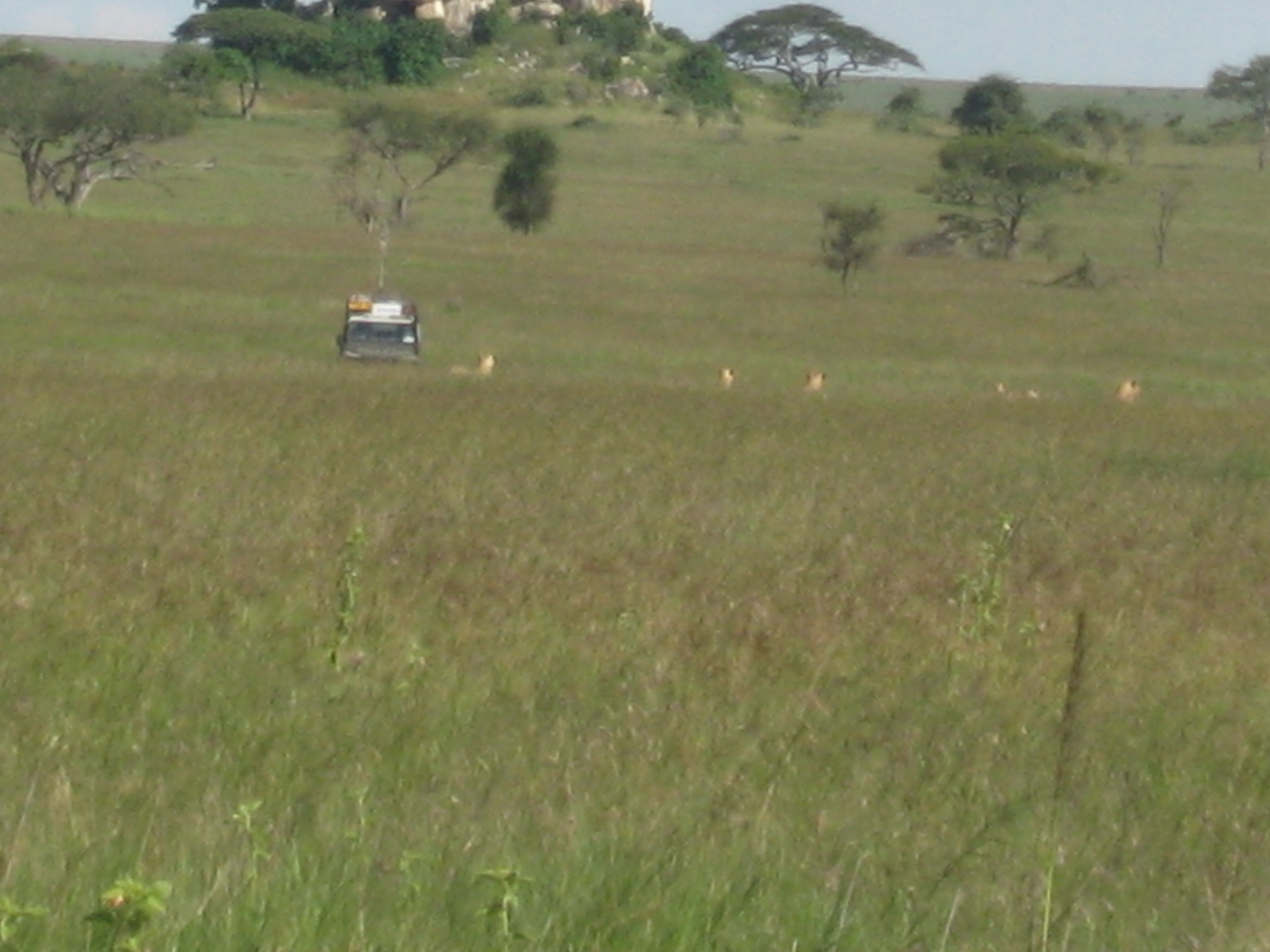
All of the lions of the TS pride, watching us warily as we try and create enough space to safely collar our lion.

Daniel fitting the collar.

TANAPA vet preparing to take samples.
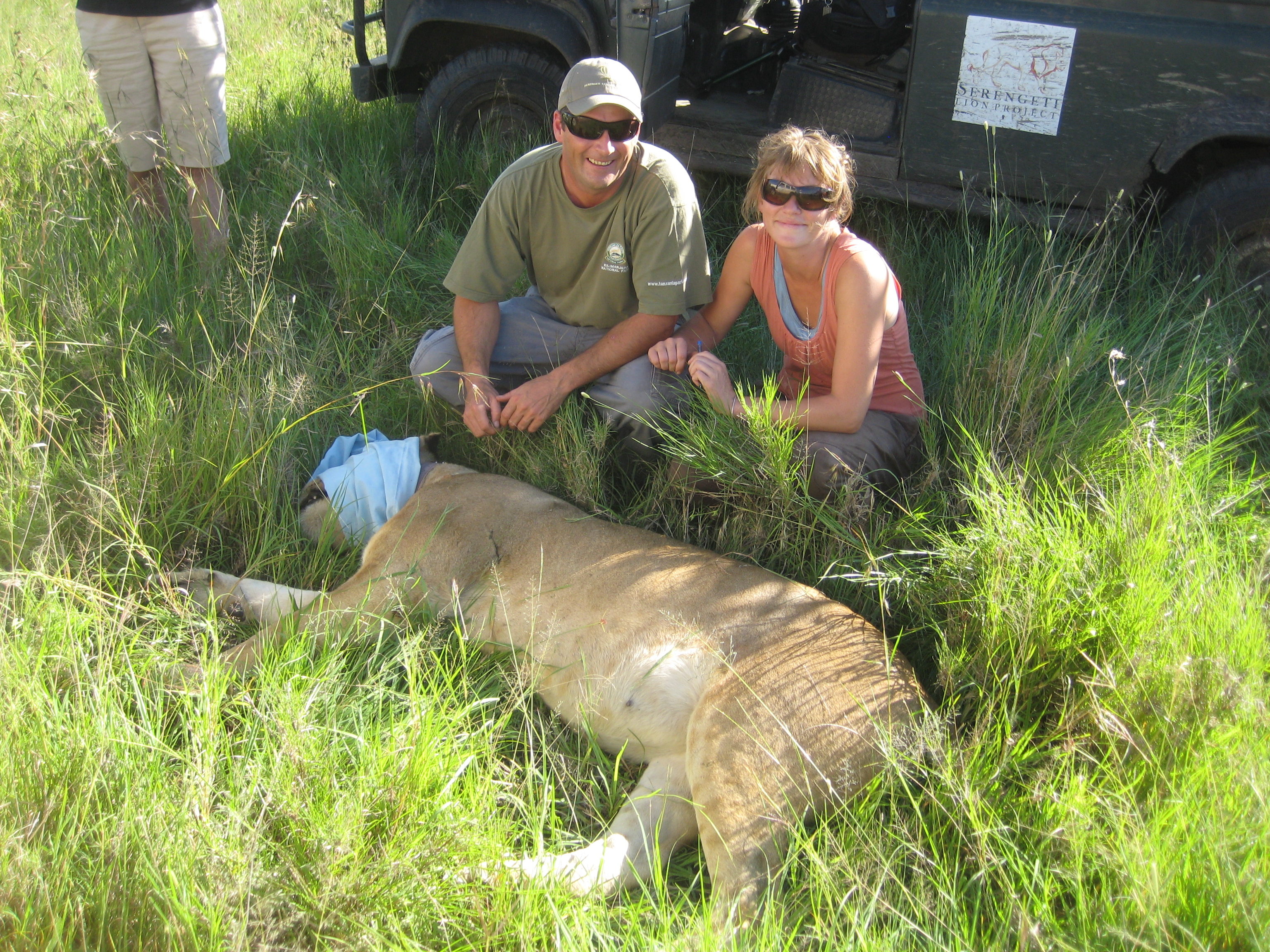
It’s pretty exciting to to be this close to a lion. Their paws are BIG.
About a week later I found the pride just outside the northern edge of our study area along the Pipeline track. Two more old females known since before had joined them, TR93 and TR106. Then they disappeared. So two weeks later I decided to search for them and drove along the Pipeline track north. But instead of driving on the actual track, which in many places was disappearing because of little use, I drove parallel to it, hitting all hilltops to be able to pick up the radio signal from a greater distance. The drive was terrible as the hills in the area are specked with large rocks and I had to drive dead slow. I held on the the steering wheel as little as possible. Having no power steering means that every time I hit a rock I risk breaking thumbs or worse.
I picked up the signal after a while but I still had to pass several hills before finally finding them, right by the track at a river confluence. That was quite far north of our study area and too far to go and see them on a weekly basis. The future will have to show where they finally settle.
A cheetah made from galaxies
This is what happens when astronomers haven’t gotten enough sleep. From Kyle Willett: a cheetah made out of many, many small galaxy images from Galaxy Zoo. Click it for the awesome full-sized image.

Why does the zebra have stripes?
While procrastinating on this lovely Sunday afternoon, I stumbled across this incredible video of a octopus camouflage in action:
Now, we don’t have anything quite that camouflaged in the Serengeti, but in watching that video my thoughts turned to one of our more strikingly colored species: the zebra. Their starkly contrasting black and white stripes have puzzled researchers and naturalists for a long time.
For starters, the stripes seem like they would be terrible camouflage. I mean, how much more could you stand out from the open plains of waving gold grass? But at dawn and dusk, especially from a distance, the stripes seem to bleed into gray, making them look a surprising lot like elephants (no joke), or rocks, or even nothing at all. Still, up close they still look like bright black-on-white zebras, and it’s hard to imagine that any lion lurking in the thickets nearby would be fooled.
Some researchers have mused that the bold patterns disrupt the perception of predators, and that when the zebras run en masse from an attacking lion, they become a confusing jumble of stripes into which the initial target disappears. Others have pointed out that every zebra has a unique set of stripes, and that these stocky equids might use these patterns to identify herd members, mates, or even mothers (if you’re a hungry foal).
One of the my favorite explanations has always been that the stripes protect against the savanna’s most fearsome creature: the tsetse fly. These blood-sucking insects are not only vectors for some nasty diseases (such as sleeping sickness), but also hurt. A lot. (Having spent more time than I care to remember in the woodlands where these terrible, terrible creatures thrive, just the thought of tsetses makes me shudder. I have spent many hours hurling expletives (fruitlessly) at the tiny terrors.) Tsetse flies suck. A lot. And if wearing stripes were a way to fend them off, I’d have gone out in a zebra suit every day. There are in fact stories of one intrepid researcher back in the day dressing up in a stripey suit and attempting to test whether zebra stripes deter tsetses. But there’s only so much that one man in a zebra outfit can do, and field experiments are notoriously difficult…and so this remained a buried rumor until last year.
Last year, Swedish researchers discovered that horseflies (a close cousin to the terrible tsetse) don’t like stripes. And they tested this on an experiment useing number of fake, plastic zebras painted solid black, solid white, and various things in between. Turns out that the flies really like dark colors over light colors, but still like solid light colors over stripes. And while in the real world, there are things (such as smells) that may attract tsetses to stripey animals despite their off-putting pattern, this study is pretty exciting. And next time I have to venture into the savannah woodlands? You can bet I’m wearing that zebra-striped shirt.
Human, 1, dancing
Seriously, this was too good not to share!

Elles in the night
## I’m currently on a mini-holiday in the Minnesota wilderness (Boundary Waters Canoe Area). As I’ve lately been missing long mornings on the porch watching Serengeti wildlife, and Margaret wrote a recent post on one of the all-time most-watchable animals out there, I thought I’d share a story of a late-night elephant encounter from my first year in the field. I was in the car with Candida, a Lion Project Field assistant, and Philipp Henschel, a lion researcher for Panthera who has spent years working in west Africa, and the man who taught me how to camera trap, when we came across this…#
As we hurtled along the gutted road, we came face to face with a herd of elephants paying their respects to a fallen buffalo. At first, in the murk of night, we thought they huddled around one of their own, and concerned silence fell upon us. Ellies, for as aggressive as they can sometimes be, have earned our admiration and careful respect. They seem to me intelligent and emotional creatures; where they are not persecuted, they tolerate the roar of our passing engine with a casual glance. But they are supposedly nearsighted to the point of legal blindness*. In heavily hunted areas we are sometimes charged by a protective female, but as we hold our breaths and brace for impact, they stop their charge short and listen…but give up and turn away. If we remain downwind in silence we are invisible…or so we hope.
The elephants tonight are agitated as they mill around the buffalo. Philipp tells us that ellies often investigate death in the forests where he’s worked. In an eerie display of some sort of cognizance, they seem to recognize that something is not right and come to look at fallen creatures. When they come across the bones of one of their own, he says, they pick them up and carry them away. It is sad and scary and moving and beyond my comprehension, what must be going on in the heads of these big, gray, lumbering beasts.
The two tour vehicles that are blocking the watering hole eventually pull away, and the ellies step forward to drink. They cluster close, pressing together side by side. Hesitant lions slowly creep back to reclaim their half-eaten kill, and the matriarch whirls around, her ears flaring, watching the lions in a silent stand-off. The air is still. It is thick with tension and heavy with the severity of the moment. One ill-timed thud against the car window or a frightened squeal from any of us, and we could incited a rampage. Silence is imperative and we hold our breaths as the ellies file past within inches of our landrover.We can almost feel their fear and my heart twists as I wonder what it must be like to stumble blindly through a blurry world, sensing death and its bearers all around you lurking in the hazy shadows and around every corner. As they disappear into the acacias, we hear a long, lumpy-sounding elephant fart and giggle nervously. We can breathe again.
We drive closer to the buffalo carcass and watch the lions return. In the faint starlight, we see that an adult female has already resumed her demolition; her whole head disappears inside the opened belly to rip solid tracts of muscle from the ribcage. We fumble for our headlamps and cameras; I look around optimitistically for an onslaught of hyenas. I have yet to see them challenge a lion kill, and begin to question the feasibility of my research plans. The subadult males pad around our car, their massive paws falling silently in the sandy soil. They are full, and are now studying us. Our windows are open, as always, and we glance around with slight unease – where did the two subadult males go? Suddenly we hear a loud chomp from the back of our vehicle. Fearing that they’ve gone of one of our tires, and hardly in any position to fix a flat, we frantically turn the car ignition and pull a few meters forward. In the sideview mirror, we see a lion trot into the darkness with our plastic tire cover dangling from his teeth. Candida’s jaw drops. We are not quite sure what inspired them to steal such an inedible adornment, but it is late and we have company coming that night. So we chalk the loss up to a casualty of the field…and as we drive home along the corrugated dirt road, we remind ourselves that at least we are better off than the buffalo.

*Elephants do have pretty bad vision, but it’s not as bad as I believed it was on this ominous night at the buffalo kill.
 Snapshot Serengeti