
A change of scene; jungles
I have just got back from a short (too short!) trip to Costa Rica. I wasn’t sure what to expect from this world famous eco destination but I decided to bring my camera trap with me on the off chance I would be given permission to set it up and capture something new, for me anyway.
My time was split between two distinct ecosystems, lowland rainforest of the Caribbean slope and dry forest of the Guanacaste/Nicoya peninsular. I stayed in protected areas and reserves so the chances of mammal activity was there, unfortunately I had only two or three days in each place which limited the chances of capturing anything somewhat. Hardly scientific I know but I was curious to see what might be out and about after I was tucked up in bed.
Now I am used to the African bushveld, a dry-ish, semi wooded, semi open grassland environment with a sandy substrate. It is easy to see where animals are frequently passing from trampled vegetation and tracks. Placing camera traps and getting results was not too hard. Costa Rica’s rainforests on the other hand was a challenge. The vegetation was thick, lush and resilient to animal passage and finding tracks in the dense leaf litter was impossible. Costa Rica’s dry forests where just as bad. It was the dry season and the trees had lost all their leaves…big leaves that made a thick carpet on the ground covering any tracks and trails.
Needless to say I did not get too many results but taking my time frame and lack of local knowledge into account it is amazing that I got anything. All the animals were at least new to me so gave me a great buzz.
Of the animals I captured peccaries, a type of pig where the most common in the rainforest followed by crab eating raccoons in the dry coastal forests. I captured 1 agouti, 1 paca, 1 probable grison devouring my camera and the most exciting of all an ocelot. Typically the ocelot was the very first capture on the first night. Staying at the Selva Verde lodge I had the help of the resident guide, Ivan and we placed the camera near to the river. I think he was just as thrilled as I was to get an ocelot despite their being the most common of the neo tropical cats.
I hope you enjoy this short video clip, you can see if you look closely that the ocelot is carrying something in its mouth, prey?
Big Cat Wars
I’m in the process of writing up some *really* cool camera trap results from Seasons 1-6, and plan to share them here next week (as soon as I make them pretty). It would never have been possible without your guys’ help. But in the meanwhile, this just aired again on TV, and thought you might enjoy a bit of a break! They talk about the camera traps a bit ~33 minutes in.
The curious case of the giraffe and the oxpecker
As you all ready know Snapshot Serengeti’s thousands of camera-trap images are part of an ongoing study into predator interactions by Ali. There are few projects that use camera-traps as extensively as Snapshot Serengeti and of course Ali has her hands full analysing the bits relevant to her. The cameras work around the clock recording details of daily and nightly life in the Serengeti and do not discern between the stuff Ali does and doesn’t want. That’s why, Ali’s sanity aside, they are such perfect tools. Those same cameras providing Ali’s data could also be the basis of a future ecologist’s research.
One of the most striking asides for me is the case of the giraffe and the oxpeckers.
Oxpeckers are small birds that feed on ticks and other parasites that they glean from the bodies of large mammals. Most usually they are seen riding along on large mammals such as buffalo, wildebeest and giraffe whilst they search their hosts for ticks or open wounds. This in itself is not an unusual occurrence and most of you will have hit the bird /other button with these guys. Much more unusual are the shots of giraffe at night time with these birds using them as roosting spots. There are two species of oxpecker, the red-billed (Buphagus erythrorhynchus) and the yellow-billed (Buphagus africanus) both of which are found in the Serengeti.
According to research carried out by M. Stutterheim and K. Panagis that looked at the roosting habits of both species the red-billed oxpecker roosts in trees but the yellow-billed was often found roosting on their preferred host species. Apparently red-billed oxpeckers feed on a wide range of host species where as yellow-billed oxpeckers are much more picky preferring buffalo and giraffe. It is thought that the habit of roosting at night on their favourite host species is an adaptation to save the birds time looking for the right animal the following day. Given that buffalo and giraffe are prone to walking large distances this is probably very sensible.
From most of the images we have of oxpeckers on giraffe at night it is hard to tell which species they are but there are one or two where you can see the tell-tell yellow bill confirming that they are indeed yellow-billed oxpeckers. The images also show that the birds seem to prefer settling between the hind legs of the giraffe. This must be a nice warm spot in winter and keeps them safe from any nocturnal predators.

Perhaps the behaviour is not so unusual after all but rather little documented. Getting photographic evidence of birds at night on mobile roosts is obviously not easy. Looks like our camera-traps have excelled themselves again.
More accidental video
In processing Seasons 5 and 6, I recently stumbled upon a bunch of video files amongst the stills. You may recall that while we have our cameras set to take still images, every once in a while a camera gets accidentally switched to video mode. Then it takes 10-second (silent) clips. Most of these are “blanks” triggered by grass waving in the wind. But every once in a while, we get ten seconds of animal footage. Here are some from Season 5.
Zebras
Giraffe (peek-a-boo!)
Warthog
And, what do you think this is?
Honey badger:1 chicken:0

Honey badger don’t care
Have you ever seen the look on a dogs face when confronted with a cat that fights back? There is utter confusion about his role in life, “hang on a minute that cat is way smaller than me, I could stomp her in a second, but now she’s scaring me?” our imaginary dog says. Well that’s about my reaction the first time I came face to face with a honey badger.
Honey badgers are small, reaching somewhere between your ankle and your knee and no more than 1 meter long. They weigh around 10kg but don’t let these dimensions fool you; a honey badger is full to the brim with confidence.
Most small animals will run when they find themselves face to face with a human; a sensible option given our species general nature. A honey badger on the other hand probably won’t and this can be very disconcerting.
One night I was sat round a fire in what classed as my garden, though in reality there was nothing to distinguish it from the rest of the bush surrounding us as home was in a nature reserve and there were no fences. It was a crisp, for the lowveld in South Africa, winters night and the stars were shining brilliantly as we sat in the sand by the fire waiting for the chicken to finish cooking. From the other side of the river the hyena started their whooping and the hippo disputed the rights of some patch of dry grass. Winter is the dry season here and things get difficult especially for bulk grazers. The African night sounds had as captivated as usual. The chicken smelt good. My husband was just about to rouse himself to check it one last time when we both heard something moving behind us in the dark. As it got closer we saw it was a honey badger moving at a lopping determined gait that they have straight towards us. It was a wonderful treat to see one of these guys close up and for a few seconds we were rapt. But it didn’t stop. It trotted straight to the grill, a small pause to give us a low growling warning and chomp, there went half our chicken. We couldn’t believe our eyes, this wasn’t a hand reared animal or an animal in a public campsite in a national park that gets used to people, this was a real live wild animal. It had no fear of us, it totally wrong footed us as we were not expecting it to just bull doze its way in. Needless to say we grabbed the rest of our meal and took it into the safety of the house to finish in peace.
Honey badgers really are remarkable creatures. Whilst in search of food they can cover up to 30km in a night. They eat a varied diet of mammals, birds, reptiles and some roots and berries and of course honey when they can get it. They climb well and can swim; they will dig furiously to follow a rodent down a hole and just don’t seem to give up in their pursuit of prey.
Honey badgers are tough and there are many stories about them killing buffalo, fighting lions, being bitten by cobras and surviving. One of the tricks they use to help evade predators is by having very loose skin around the back of their necks. A lion or leopard will grab for this area, coming up with a mouthful of skin but leaving the vital bones and muscles untouched. The honey badger can then twist round and start biting and scratching with it all its might often inducing the dog/cat scenario from the start of this blog i.e. predator dropping honey badger in utter surprise.
So next time you classify a honey badger on Snapshot Serengeti remember it’s not always size that counts.
A Massive Lion Poster For You
In the final instalment of our mosaic poster series for the 2013 Zooniverse Advent Calendar, we bring you a lion of lions! This magnificent beast is constructed of more than 4,000 individual lion images from Snapshot Serengeti, as tagged by the volunteers.

Download Full Size [70 MB] or Half-size [22MB]
Meet the Meta-Zebra
It’s advent, and that means it’s time for the Zooniverse Advent Calendar. Last year Snapshot Serengeti itself was hiding behind one the doors of the calendar – that means we’re nearly a year old! Today we appear on the 2013 calendar with this post, and the meta-zebra. It’s a thank you to everyone that’s been supporting us for the last year: a zebra made from zebra. Naturally.

This poster was created using a pool of more than 16,000 zebra identified by the Snapshot Serengeti community. We then take a nice, simple capture of a Zebra and use a wonderful piece of software (called Andreamosaic) to generate this poster for you all. It is extremely high resolution (and 70 MB big!) so if you want to, you can print it out to be several feet across! Below is the zebra’s nose.

It’s just a small token of our thanks for a great year. In 2014 we’ll be back with season 7. We also plan to have more fun to share before December is over. Stay tuned!
[Download the full poster here – warning this file is 70 MB big]
What does the fox say?
By now, you have probably heard of this silly (but hilarious) video that’s been making the rounds of the interwebs lately:
It’s pretty catchy, not just because it’s ridiculous, but because it’s a pretty good question. I mean, how many of you out there have actually ever heard a fox?
The sounds of the bush are one of the many, many things I miss being back here in civilization. From my slightly sketchy corner of Saint Paul, I hear fire crackers and unmuffled engines roaring. Occasionally I get chattered at by an angry squirrel in the back yard. But that’s about it. Nothing like the otherworldly chorus of the Serengeti savanna that Lucy so beautifully described.
The sounds really are incredible and often unbelievable, and I thought I’d share some of them with you. I couldn’t actually figure out how to upload audio files, so I scoured Youtube for the best audio clips I could find and embedded them as videos here.
Zebras: Nothing like horses, these stripy equids sound something like a braying donkey crossed with a barking dog.
Wildebeest: I believe that somewhere in the annals of Zooniverse blogs, there is an audio or video clip of me doing a wildebeest impression. This is better.
Hyenas: Despite being hell-bent on devouring all of my camera traps, these guys are pretty cool. They have a rather large repertoire of very…unusual…vocalizations that are used to communicate in a number of situations. The whoop, which you hear at 0:05 and 0:55, is a long-distance call often used to rally scattered clan members. The laugh at 2:33 is a sign of nervousness or submission. Similar to human voices, hyena vocalizations are individually recognizable to clan-mates. To learn more about hyena vocalizations, check out this blog by hyena expert and director of Masai Mara’s long-term hyena project, Kay Holekamp.
Lions: And finally, for the best, non-hollywood lion roar, scroll about halfway down through our lion research center’s page. This is what they really sound like.
I’ll take any of these noises over the sounds of the city any day.
George Schaller and the Serengeti Lion
To bring myself up to speed with the fundamentals of lion research in the Serengeti, I have spent the last week or so reading through the classic work The Serengeti Lion: A Study of Predator-Prey Relations, by the reputable George B. Schaller. For a collection of field notes, the book it quite a page-turner. The work covers everything remotely relating to lion biology, from social systems to predation patterns, and manages to capture both the drama of the dynamic Serengeti system and the dusty, hot, sweaty reality of watching big cats sleep for 18 hours a day.
Although the focus of the book is the life of lions, the life of George B. Schaller himself turns out to be just as intriguing. Digging a little into his background, I discovered that Schaller, dubbed the “Megafauna Man” by National Geographic, has undertaken a 50-year career in field biology studying some of the most iconic systems in the world.
Schaller had moved to the Serengeti with his wife and two sons for two years in 1966 to uncover the intricacies of the lives of big cats and their prey. This, however, was not the start of his field career. Back in 1959, when he was a mere 26 years old, Schaller packed up and headed off to Central Africa to study the mountain gorilla. For two years, amidst dodging poachers and eluding Watusi invaders, he uncovered facts about these great apes which helped to dispel common notions about their brutishness and revealed them to be gentle and intelligent animals. His work paved the way for other naturalists, including the well-known Dian Fossey, and led to the creation of Virunga National Park.
In the ‘70s, Schaller worked in both South Asia and South America, studying large mammals including the blue sheep and snow leopards of Nepal and the jaguars, capybaras, and caimans of Brazil. The American novelist and naturalist Peter Matthiessen accompanied Schaller to Nepal and wrote a travelogue on their exploits (The Snow Leopard) that went on to win the 1979 National Book Award. Matthiessen describes Schaller as “one of the finest field biologists of our time. He pioneered the practice of turning regions of field research into wildlife parks and preserves,” a epithet that held true yet again when five years later, the Nepalese government used Schaller’s research to form Shey-Phoksundo National Park.
Following these adventures, Schaller and his wife were given the distinction of being the first westerners invited by China to enter the remote southwest Asian wilderness and research the Giant Panda in its native habitat. As part of this work, Schaller focused on understanding threats to the diminishing panda population and discovered that the primary culprits in their demise were poaching and logging. In his book, The Last Panda, Schaller writes “The panda has no history, only a past. It has come to us in a fragile moment from another time, its obscure life illuminated through the years we tracked it in the forests.” Despite this foreboding prophesy, since Schaller’s work on panda biology, the number of panda in the wild has increased by 45%.
In the 1990s, Schaller worked in Laos, Vietnam, and Tibet studying antelope and in the process discovering and rediscovering several species of mammals including a bovine, a pig, and a type of deer. More recently, he has been collaborating with agencies in Pakistan, Afghanistan, Tajikistan, and China to develop a 20,000-square mile “Peace Park” for the protection of the world’s largest wild sheep species, the Marco Polo sheep.
Over the span of his career, Schaller has made profound contributions to our knowledge about large mammals, both their biology and ecology, and has greatly furthered species conservation in the creation of over 20 parks and preserves throughout the globe. I can highly recommend his writings on the Serengeti Lion, and if you want to delve further into his life and career, his other authored books (there are over 30) include The Year of the Gorilla, The Last Panda, Tibet Wild, and A Naturalist and Other Beasts.
The Little Guys
##### Today’s blog is a guest post from our own Lucy Hughes. ####
We all love the cats don’t we, the majestic lions, the graceful cheetahs and the elusive leopards. There is something about getting one of these cats to ID on Snapshot Serengeti that makes you feel you hit the jackpot. Then there are the elephants, buffalo and giraffe ‘the big guys’. Lions for instance always get the most ‘likes’ on our facebook page. Let’s not even talk about wildlife documentaries; they always manage to star ‘the big guys’, the crowd pleasers, elephants, tigers, lions, whales.
So what about ‘the little guys’? When was the last time you saw a documentary on aardvark or civets?
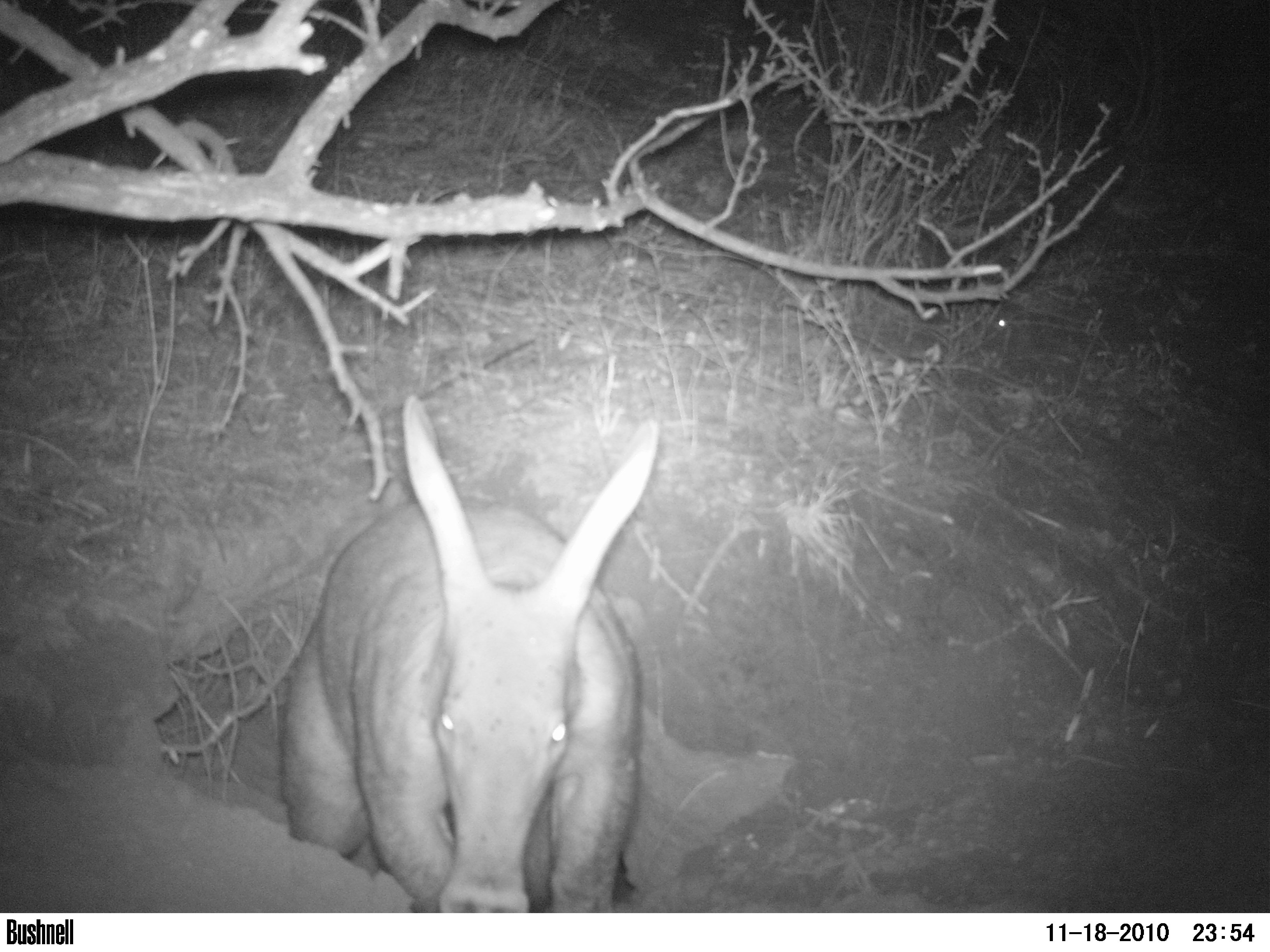
Aardvark!
It seems that the documentary makers don’t think we want to see a whole hour on these little guys. Most people know that lions live in prides and that when a new comer ousts the dominant male he will kill any young cubs. They also know that thousands of wildebeest migrate through the Serengeti, preyed upon by lions, hyena and crocodiles. Who knows how many offspring aardvark have at one time? Or who knows how far a honey badger will walk in one nights foraging.
They are fascinating to say the least these smaller mammals and they are totally deserving of their own starring roles in documentaries and the media. Luckily for us they do appear regularly on Snapshot Serengeti’s camera-traps. Next time you get a porcupine, serval or aardvark stop and think what you know about them.
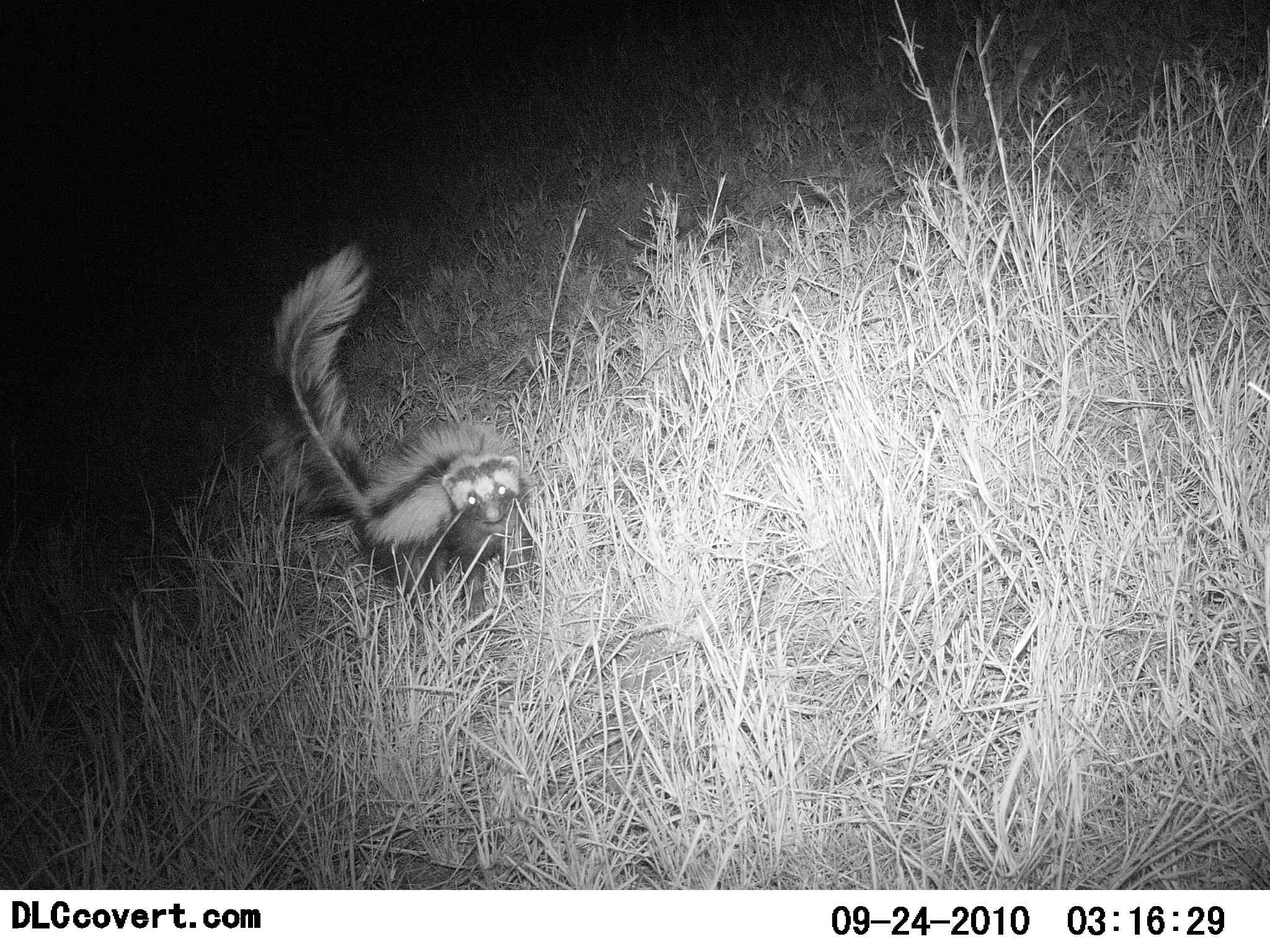
Zorrilla — a rare find!
For me one of the most fascinating small mammals is the sociable mongoose. On the camera-traps they are usually banded mongoose or dwarf mongoose. These guys bustle around all day risking ground based and winged predators. They have complex social lives that find them forever challenging each other of reaffirming bonds. To put it simply they are busy animals.

Dwarf mongoose! One of the cutest critters out there…
I once had the pleasure of a very close encounter with a group of wild dwarf mongoose. One super hot day I was ambling in the bush checking out camera trap spots, following game tracks, looking for likely spots when I came across a beautiful shaded clearing, not very big, a few meters in diameter. I decided to sit awhile and cool down so propping my back against a boulder and stretching my legs out I sat quietly listening to the sounds of the African bush. A sudden black flash and a drongo had flown into the opposite side of my refuge. Now these birds are adept at following mammals and catching any insects scared up by them so I was curious to see if anything else would arrive. Sure enough a rustle in the dry grass and here popped a dwarf mongoose into the clearing. The diminutive creature was followed rather noisily by about 10 or so more of its group. They fanned out each their own direction and immediately started searching for anything edible. I kept very still and tried not to breathe too much until one of the younger mongooses was sniffing my boot. A second scrambled right over my leg and I was entranced. Then the wind must have changed or an adult must have realised the strange rock might just be alive because a squeal was uttered and the whole group scarpered in one direction their drongo with them. The whole episode lasted about 6 or 7 minutes but it has endeared me to these ‘little guys’ for ever more.
 Snapshot Serengeti
![Half-size [22MB]](http://zooniverse-resources.s3.amazonaws.com/bigblogfiles/Snapshot_Serengeti_Lion_Poster_Small.jpeg)
