
Good News Bad News
So there’s good news and there’s bad news. Which would you like first? Good news?
The good news is that the pictures from Season 5 are being processed at the Minnesota Supercomputer Institute right this minute. There are about 900,000 images total, so it will take a few days to process them all. (What are we doing? We’re resizing them, extracting the place and time they were taken, and grouping those that need it into groups of 3.) Then we’ll need to upload them to Zooniverse’s servers. That might take another day or so. If everything goes without a hitch (fingers crossed), we’ll be ready to unleash Season 5 by the end of next week! (So for those of you who wanted some warning, this is your warning. Clear you schedules. Get your work done early. Set up an ‘away’ message on your email…)

Sneak Preview of Season 5 (July to December 2012)
The other news is bad, I’m afraid. We just found out that the grant proposal we wrote to the National Science Foundation back in January got turned down. Our grant would have funded Snapshot Serengeti and the Serengeti Lion Project for another five years, and included money for scientists to continue to analyze all the data you’ve been generating by identifying animals in the Snapshot Serengeti images.
Our proposal was reviewed by three other scientists independently and then talked about by a group of scientists who had our proposal and the three reviews to look at. Our three reviews varied. One person thought that our proposal was the most exciting project s/he had read yet this year. But the others were a bit concerned about exactly how we would analyze the data. This proposal was a “pre-proposal,” meaning that we only had a few pages to explain what we wanted to do, how we would do it, why it’s important, and the broader impact we would have. I guess we didn’t manage to get in enough of the “how” for these reviewers.
We were all taken by surprise by the rejection. The Lion Research Center has been reliably funded by the National Science Foundation for decades. But things are changing. Firstly, this “pre-proposal” system is new; it’s only in its second year. And everyone — both proposal writers and proposal reviewers — are still figuring out what exactly should go in the new shorter pre-proposals. And secondly, the Sequester is still in place, so the National Science Foundation has less money to give out this coming year than usual.
In any case, we’re now regrouping to come up with a new funding plan. We’ll be able to apply again to the National Science Foundation in January 2014 to fund camera trapping starting in 2015. And we’ve got several papers that we plan to write in the next six months using Snapshot Serengeti data that we’ll be able to point to to show reviewers that we can properly analyze the data. Meanwhile, we’re going to try to keep the cameras rolling by looking for other funding sources to cover our year-long funding gap. Suggestions welcome.
Detecting the right number of animals
This past spring, four seniors in the University of Minnesota’s Department of Fisheries, Wildlife, and Conservation Biology took a class called “Analysis of Populations,” taught by Professor Todd Arnold. Layne Warner, Samantha Helle, Rachel Leuthard, and Jessica Bass decided to use Snapshot Serengeti data for their major project in the course.
Their main question was to ask whether the Snapshot Serengeti images are giving us good information about the number of animals in each picture. If you’ve been reading the blog for a while, you know that I’ve been exploring whether it’s possible to correctly identify the species in each picture, but I haven’t yet looked at how well we do with the actual number of animals. So I’m really excited about their project and their results.
Since the semester is winding up, I thought we’d try something that some other Zooniverse projects have done: a video chat*. So here I am talking with Layne, Samantha, and Rachel (Jessica couldn’t make it) about their project. And Ali just got back to Minnesota from Serengeti, so she joined in, too.
Here are examples of the four types of covariates (i.e. potential problems) that the team looked at: Herd, Distance, Period, Vegetation
Herd: animals are hard to count because they are in groups

Herd
Distance: animals are hard to count because they are very close to or very far from the camera

Distance
Period: animals are hard to count because of the time of day

Period
Vegetation: animals are hard to count because of surrounding vegetation

Vegetation
* This was our first foray into video, so please excuse the wobbly camera and audio problems. We’ll try to do better next time…
All in the name of science
Today’s guest blogger is Lucy Hughes. Lucy lived and worked on a private nature reserve in South Africa for four years, carrying out field research that included a camera-trap study into the reserve’s leopard population and twice monthly bird surveys for Cape Town University’s Birds in Reserves Project (BIRP).
Arrhhh, that really hurts! A three inch thorn had just penetrated my, admittedly inadequate, footwear and was stuck deep in the sole of my foot. Thorns are a serious hazard of camera trap placement in the South African bushveld where plants with thorns or hooks seem to make up about 90% of species.
My colleague Michelle ran back to the landy to get a first aid kit whilst I set about extracting the thorn, there seemed to be an awful lot of blood. I watched the path eagerly for Michelle’s return but as she got near she seemed to slow down and as she opened her mouth to speak I knew exactly what she was going to say. “Luce, if it’s not too painful, what about spreading your blood around a bit?”
Callous as it may seem it wasn’t a bad idea. We had been having trouble with capturing clear night shots of leopards. They always seem to be in a hurry and the shots we had were often blurry making it impossible to id the individuals. We needed a way to get the leopards to pause for a second or two in shot of the camera trap.
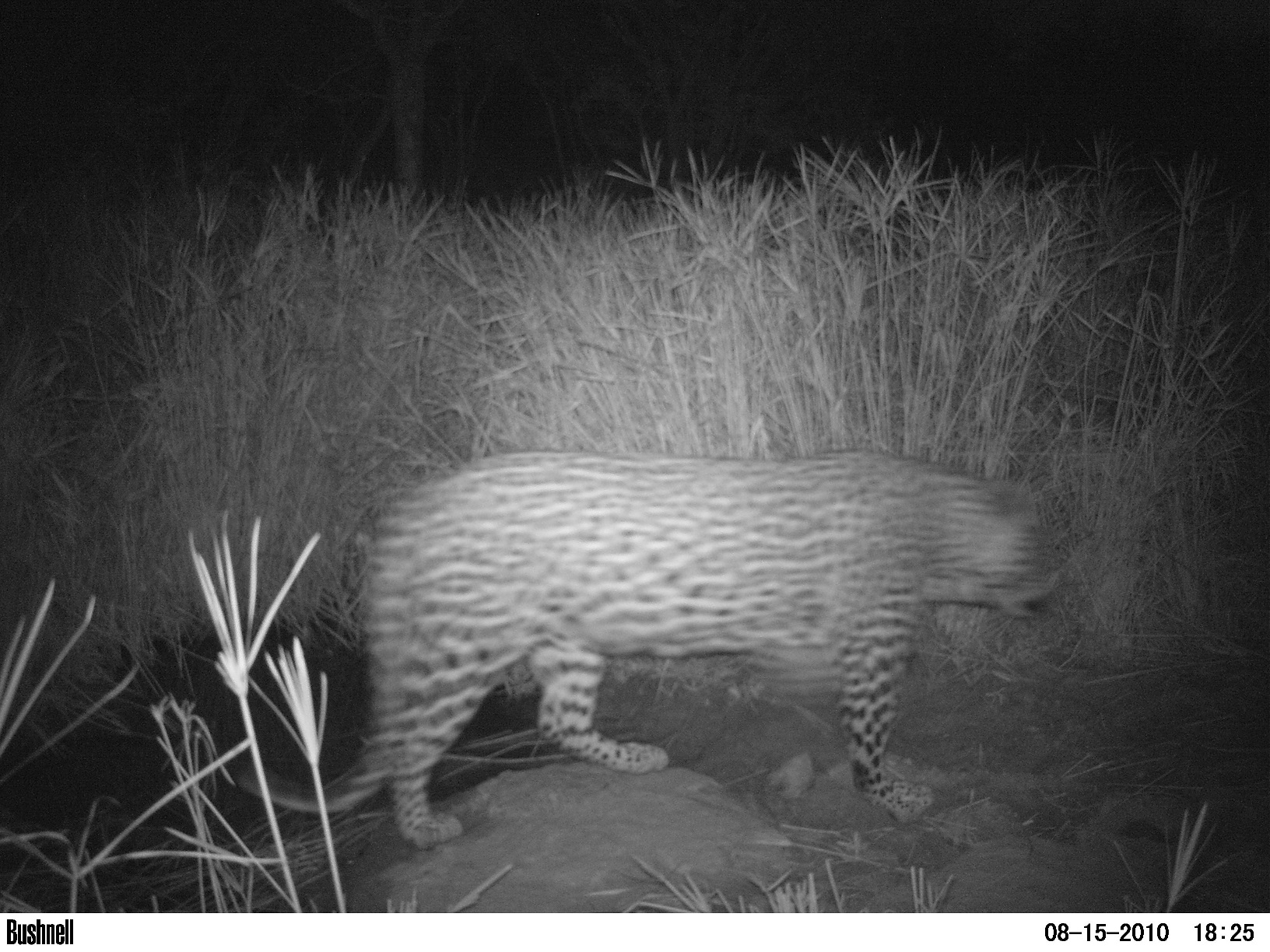
We had been advised that scent was the answer and were experimenting with various different ones and now it seemed human blood was to be the next test. I dutifully hobbled out in front of the camera and scraped my bleeding foot around on a nice flat rock Michelle had procured, wondering about the sensibleness of using human blood as bait for a predator. My slight discomfort was all in the name of science.
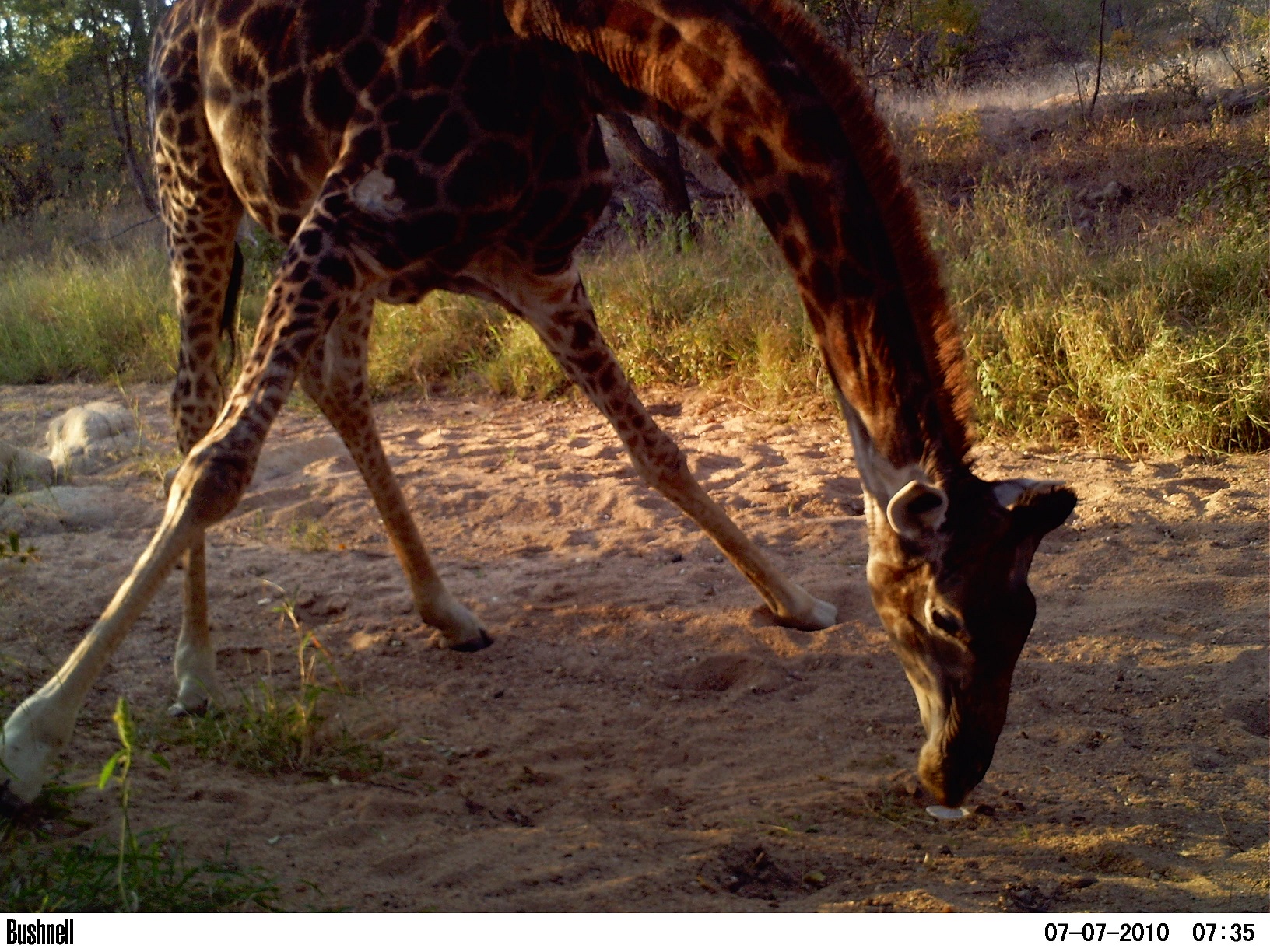
In the end it didn’t work, It rained a couple of nights later and my efforts where washed away. We never did find the perfect scent. We were told that tinned sardines worked wonders as well as catnip and perfume. We tried them all. It seems our cats where immune to these. The only thing that stopped them in their tracks was the scent of other leopards. I did learn however that the scent of tinned sardines was particularly interesting to giraffe of all animals. My method was to bury a plastic cup up to its rim in sand and put a blob of sardines in the cup. Now you would have thought that giraffe would have walked on by but as the picture below testifies, giraffe just have to take a closer look. You always learn something new!
Complex Landscapes
This past week I’ve been reworking a paper about a study with Anna Mosser and Craig. The study asks the question: How did lions come to live in groups? It doesn’t seem like group-living in lions would be something you would spend much time thinking about – until you realize that lions are the only cat that regularly lives in groups. What’s special about lions?
Craig’s work over the past decades has shown that seemingly intuitive ideas about why lions form groups are wrong. Lions don’t form groups in order to hunt more efficiently. Lions don’t form groups to cooperatively nurse their young. Lions don’t form groups to protect young against aggressive outsiders. Instead, it appears that the primary purpose of lion groups is to defend territories against other groups of lions.
So territorial defense appears to be the key to group living in lions. But is territorial defense the only thing that matters? That’s what we set out to investigate. We created a computer model that simulates a bunch of lions living on a landscape. The model is a simplification of what happens in real life, but it contains some essential aspects of lion living.
First, we have complex landscapes. Previous research suggests that group territoriality is more likely in complex landscapes because there are highly desirable areas that are worth defending. If you had a landscape where everything was more or less the same, then you wouldn’t need to fight your neighbor over some small patch of it; you could just wander off and find your own patch that would be more-or-less the same quality as your neighbor’s.
Second, we have various behaviors that we can turn on or off in our simulated lions. For example, we can tell them that they can live together in a territory, but they can’t cooperate to defend it. We can also tell them whether or not they can live in a territory with their parents when they grow up. And we can tell them whether they’re allowed to make their territory bigger if they recruit more lions into their group.
By manipulating the types of landscapes and the various behaviors, we explored how often our simulated lions formed groups. Our results suggest that while territorial defense is important, it’s also important to have complex landscapes with high-value real estate. If the landscape isn’t very complex, then it’s easy enough to find an area to set up a territory without fighting for it. And if the landscape is complex, but doesn’t have any areas with high value, then there’s nothing worth fighting for or defending. It’s also important that lions be able to pass their valuable territories on to their offspring, for without inheritance, the benefits of all that fighting and defending are gone in a generation.
Lions evolved on the savannas of East Africa, where the landscape is complex with patchy areas of high value (near where rivers come together, for example). Humans did too. It’s possible that the same sorts of savanna landscapes that shaped group living and territorial defense for lions did so for people, as well.
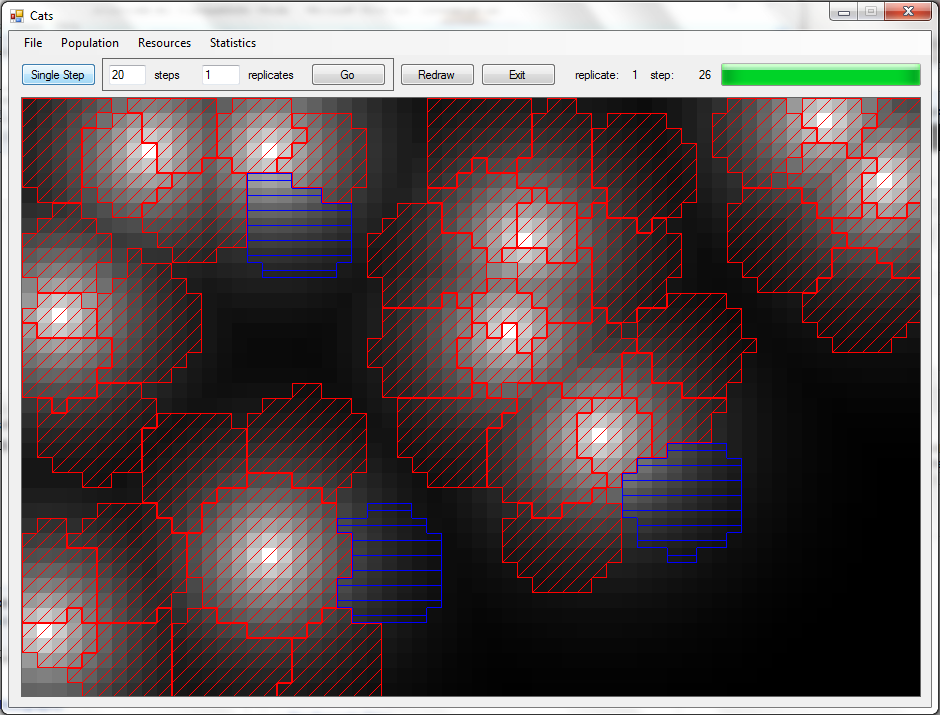
The simulation model. White areas are high-value real-estate, while black areas are low-value. Red shapes show where lions have formed a group territory, while blue shapes show where there’s a territory defended by just a single lion.
Volunteer Visualizations
At the Zooniverse workshop last week, Philip Brohan (of Old Weather fame) showed me how to produce a cool graphic of volunteer participation. So I put together a couple graphics – one for Season 1 and one for Season 4 – to see if patterns of who does what changed over time.
In these graphics, each square represents one volunteer. And the size of the square shows how many classifications that volunteer did.
Here’s Season 1:

The big blue square is all the volunteers who didn’t create a user account; since I can’t track them without an ID, they all get lumped together. Probably most of the people in this blue square did just a few classifications at most. All together there are just over 15,000 people who created an account represented here. Those that did fewer than 50 classifications each are lumped together under the big blue square. You can see that the majority of the work was done by people who between 50 and 1,000 classifications each. There were another 100 or so volunteers who did over 1,000 classifications in Season 1.
Now here’s Season 4:
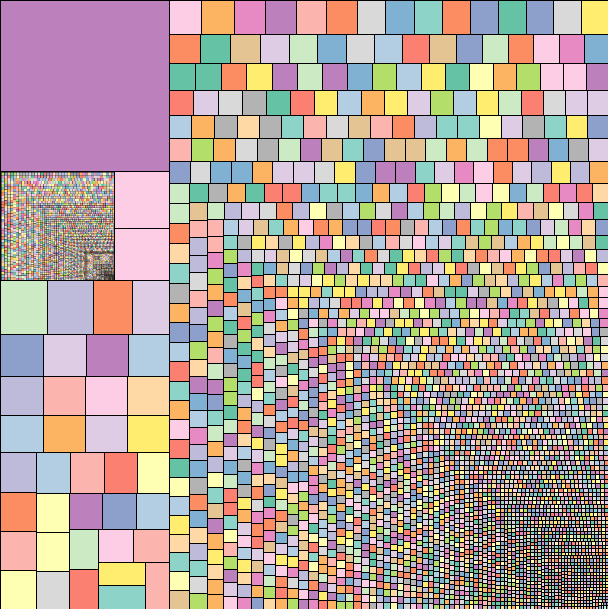
This time, it’s the big purple square that represents all the volunteers who didn’t create an account; the square is smaller than in Season 1, which isn’t very surprising. Those folks that don’t log in are generally looking at the site for the first time and we expect more of them when Snapshot Serengeti first started than later on. All together, there are about 7,500 people who created an account and who worked on Season 4 – about half the number of Season 1. The square below the purple square shows all the volunteers who did fewer than 50 classifications. You can see that the majority of the work is being done by our thousands of dedicated fans; about half of all people who worked on Season 4 did more than 50 classifications, and these volunteers accounted for the vast majority of all classifications.
PS. The Zooniverse is launching a new project today: SpaceWarps. Go check it out, while we work on getting Season 5 ready for you.
Zooniverse Workshop
It’s been an exciting and exhausting past couple days. I’ve been at Chicago’s Adler Planetarium, chatting with Zooniverse developers, scientists from other Zooniverse projects, educators and social scientists, and citizen science volunteers. There have been presentations on the history of the Zooniverse, starting with the original Galaxy Zoo, and on why people say they participate in citizen science projects. We’ve talked about ways to process the huge amount of data that comes out of the projects, and how to make translations of projects into other languages easier. We’ve seen that for some projects, many people do few classifications, and for others, few people do many classifications. And we’ve consumed coffee and food, and just gotten to know one another. (I discovered a scientist on another project went to my alma mater, graduated a year after me, and that we know many of the same people!)
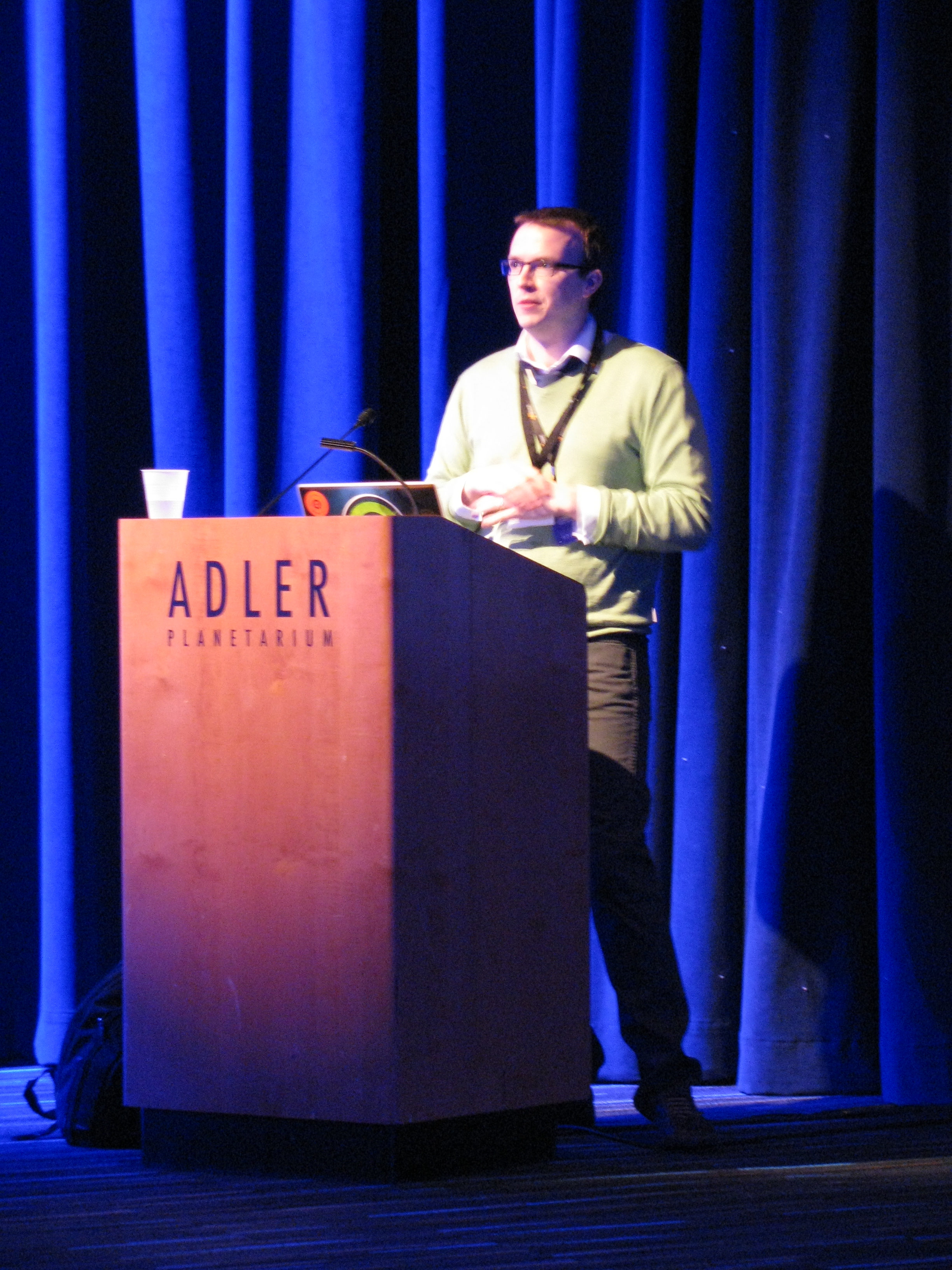
Arfon talks about how the Zooniverse creates citizen science projects
One of the things I’m most excited about for Snapshot Serengeti is a set of visualization and analysis tools that the Zooniverse team is developing. They’ve started on a nice set of tools for Galaxy Zoo already, and Snapshot Serengeti is well-positioned to have tools added next. The tools will allow you to do things like map where images were taken, look at trends over time of species, and make some simple graphs. Is there anything you’d like to do easily with Snapshot Serengeti data? Now is the time to let us know. Feel free to leave ideas in the comments.
This workshop has also been fun because we’ve gotten a sneak peak at what lies down the Zooniverse road… a project called SpaceWarps is coming soon… further down the road, we have plankton, condors, kelp, sunspots… plus more data for Andromeda Project, Notes from Nature, and… Snapshot Serengeti!
It turns out to be true: there IS a new hard drive in Minnesota and it has all the Season 5 images on it. On Friday, Lora Orme and I started loading those images onto the supercomputers so we can start processing them. You’ll have to forgive the Zooniverse for stealing me away these past couple days and keeping me from working on the Season 5 images. But it’s just a small delay; I think we’ll have Season 5 online within the month.
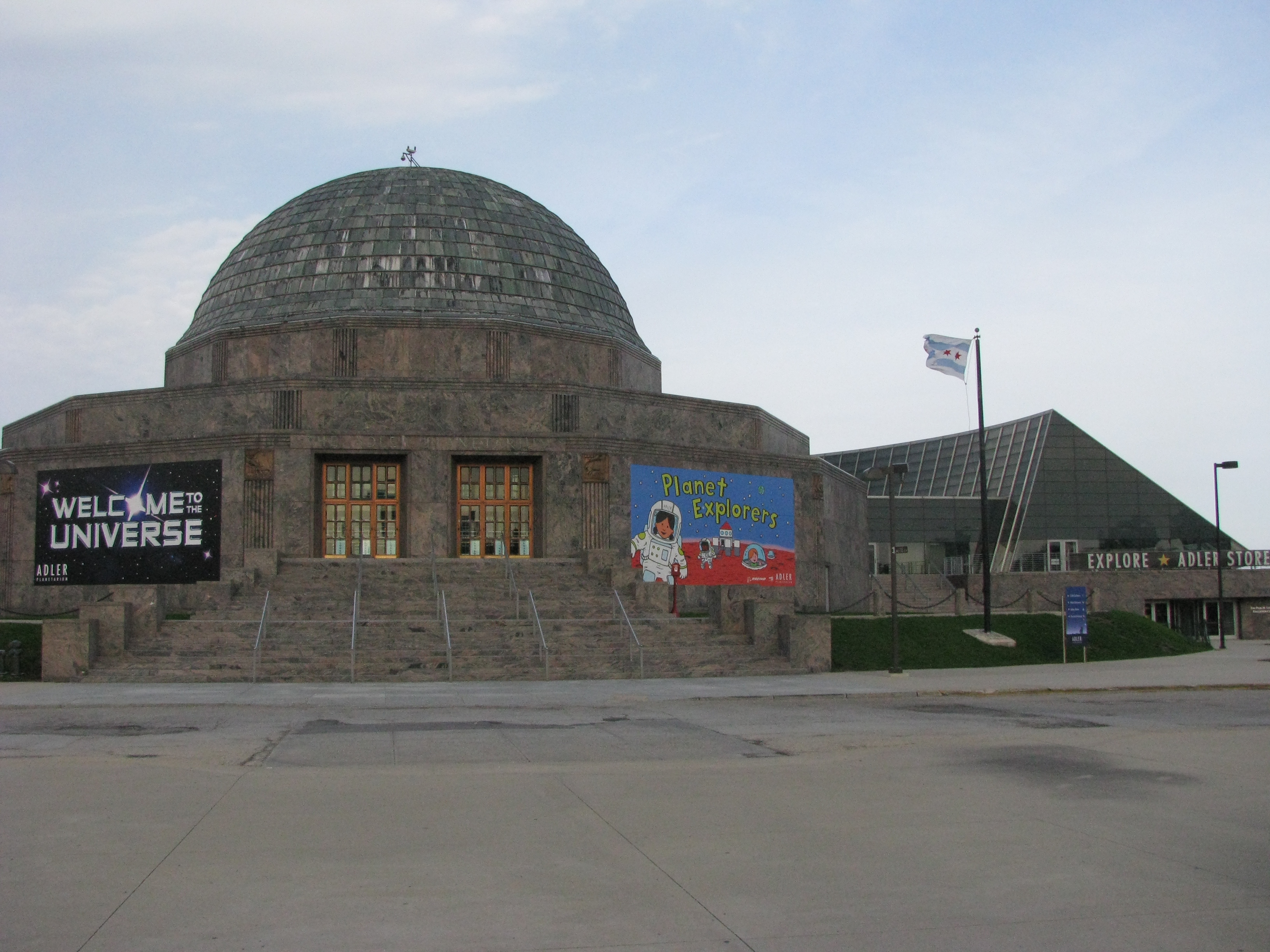
The Adler Planetarium
Notes from Nature
Next week, Zooniverse is holding their annual meeting of project science teams. Since Ali and Craig are both still in Tanzania, I’m going to be the only Snapshot Serengeti representative there, but I’m super excited to go. I went to this meeting last year, while we were still developing Snapshot Serengeti, and it was both really fun (the Zooniverse team in Chicago are awesome) and really useful. Since Zooniverse already had a dozen other projects live, I got a lot of advice from their science team members about what to expect when the Snapshot Serengeti went live, and also tips on analyzing the large data set that results from the project. This year, I’ll be one of the people giving tips to the scientists of developing projects.
Speaking of which, if you haven’t already, you should go check out Notes from Nature, which launched this week. It’s a bit different from Snapshot Serengeti in that the species in the picture is already known, but what they don’t have is the meta-data (the date the specimen was collected, where it was collected, etc.) You help out by entering this information off of labels, many of which are hand-written and so hard to use OCR on. They have both a botany collection and an insect collection that they need help with. And there’s a Notes from Nature blog.

On fencing wildlife reserves
Craig wrote an op-ed in the Los Angeles Times today. He argues that fencing wildlife reserves in Africa is a cost-effective and necessary step to conserving Africa’s big mammals. The reasons that reserves need fencing now have to do with demographic changes over the half-century since they were established. He points out that fences won’t work for some reserves, especially those that depend on wildlife migration over reserve boundaries, but that for many, it may be an important step towards conservation sustainability. (For what it’s worth, those reserves like Tarangire with in-out migration may be doomed anyway, as human population and agriculture increase around the reserve and effectively block the migration anyway.)
Craig’s opinion piece derives from a study he and many others did comparing the success of Africa’s reserves based on various attributes of those reserves *. The effectiveness of conservation efforts is not usually measured; mostly, people would rather their money to go conservation actions rather than conservation monitoring programs. Lacking specific monitoring data, the approach of Craig’s study is one way to look at what works and what doesn’t when it comes to conservation. And the data say that fences work in (most) African wildlife reserves.
Your gut reaction to fencing wildlife areas might be aversion, or even horror. I know I wince when I consider the idea. Fences are unattractive. But they’re especially unattractive, I want to point out, for those of us with the luxury of living far from major human-wildlife conflict. If there were reasonable chances that a lion or leopard might carry off my child – or kill my livestock – or that elephants would trample my carefully tended crops – I would welcome a fence. North Americans and Europeans have historically come into conflict with wild animals when human needs for land, food, and fuel have increased. They have largely solved this human-wildlife conflict by eliminating the wildlife. Africans have done a better job of retaining their wildlife, but their needs for land, food, and fuel are also increasing. As unaesthetic as they might seem, maybe fences around wildlife reserves can help both Africa’s wildlife and its people.

* “Conserving large carnivores: dollars and fence” in Ecology Letters, 2013 Volume 16, pages 635-641. DOI: 10.1111/ele.12091
Authors: C. Packer A. Loveridge S. Canney T. Caro S.T. Garnett M. Pfeifer K.K. Zander A. Swanson D. MacNulty G. Balme H. Bauer C.M. Begg K.S. Begg S. Bhalla C. Bissett T. Bodasing H. Brink A. Burger A.C. Burton B. Clegg S. Dell A. Delsink T. Dickerson S.M. Dloniak D. Druce L. Frank P. Funston N. Gichohi R. Groom C. Hanekom B. Heath L. Hunter H.H. DeIongh C.J. Joubert S.M. Kasiki B. Kissui W. Knocker B. Leathem P.A. Lindsey S.D. Maclennan J.W. McNutt S.M. Miller S. Naylor P. Nel C. Ng’weno K. Nicholls J.O. Ogutu E. Okot‐Omoya B.D. Patterson A. Plumptre J. Salerno K. Skinner R. Slotow E.A. Sogbohossou K.J. Stratford C. Winterbach H. Winterbach S. Polasky.
Open source and multilingual
In keeping with Zooniverse’s philosophy of openness, the code for Snapshot Serengeti was released back in February. (And the code for several other Zooniverse projects has been released, as well). What this means is that you — or anyone else — can contribute directly to the development of Snapshot Serengeti!
In particular, we’d love to internationalize the site so non-English speakers can participate. If you go and classify images in Snapshot Serengeti right now, you can see a beta version of a Polish translation of the site. Look for the word “English” in the upper left, pull down the arrow, and select “Polski (beta)”. You can now develop your Polish vocabulary, if you don’t happen to be a native Polish speaker. (Seriously. I studied for my high school AP French exam by installing Civilization in French on my computer and playing it endlessly. I’ll admit it was tricky to work the words caserne (barracks) and galère (galley) into my exam essay, but playing Civilization was so much more fun than flash cards…)
All the text you see on Snapshot Serengeti is in what is called a “localization file.” If you look at Snapshot Serengeti’s English localization file, you’ll see all the English text that you could possibly encounter on the site, starting like this:

And if you wanted to, say, create a Swahili version of Snapshot Serengeti (which would be awesome), you would change the text that reads ‘Welcome to Snapshot Serengeti!’ to ‘Karibu Snapshot Serengeti!’. And you would continue doing that for all the English.
So, want to do some translating? If you’re tech-savvy, follow these instructions for translating Galaxy Zoo, but use the Snapshot Serengeti code instead of Galaxy Zoo’s. If those directions leave your head spinning, leave a comment below and we’ll help get you started.


 Snapshot Serengeti