
The sound of silence?
Laying in my tent last night listening to nightjars whirring and barn owls screeching I was reminded of the sounds of Africa. As I am away this week with little internet time I thought I would repost this blog I wrote a few years back.

What does silence mean to you? Maybe it’s that moment at the end of the day when the telephones stop ringing and the office hubbub finally stops and you can hear yourself think. Maybe sitting in your garden listening to the insects and aeroplanes pass overhead. Or maybe it’s that first 5 minutes of waking before the baby starts howling. Whatever it means to you the point is silence isn’t really silent. Something is always making a sound even if it’s a leaf rustling in the wind or a cricket singing.
In the African bush night time silence is deafening. Just before sunset there is a rush of activity. The day shift starts looking for a place to spend the night whilst frantically searching out that last mouthful of food. Young banded mongoose are scolded into their burrows by older siblings. Antelope take a drink before heading to thicker cover. Francolins are calling out their staccato calls whilst sandgrouse flock to drink. As the sun sets and darkness looms everything quietens down, the last to make a noise are the guinea fowl who wait till it is just dark to, one by one, barrel up to adorn their favourite roosting trees like giant Christmas baubles. They finally settle down, and the nearby baboons stop squabbling and there is a moment’s peace before the night shift takes over.
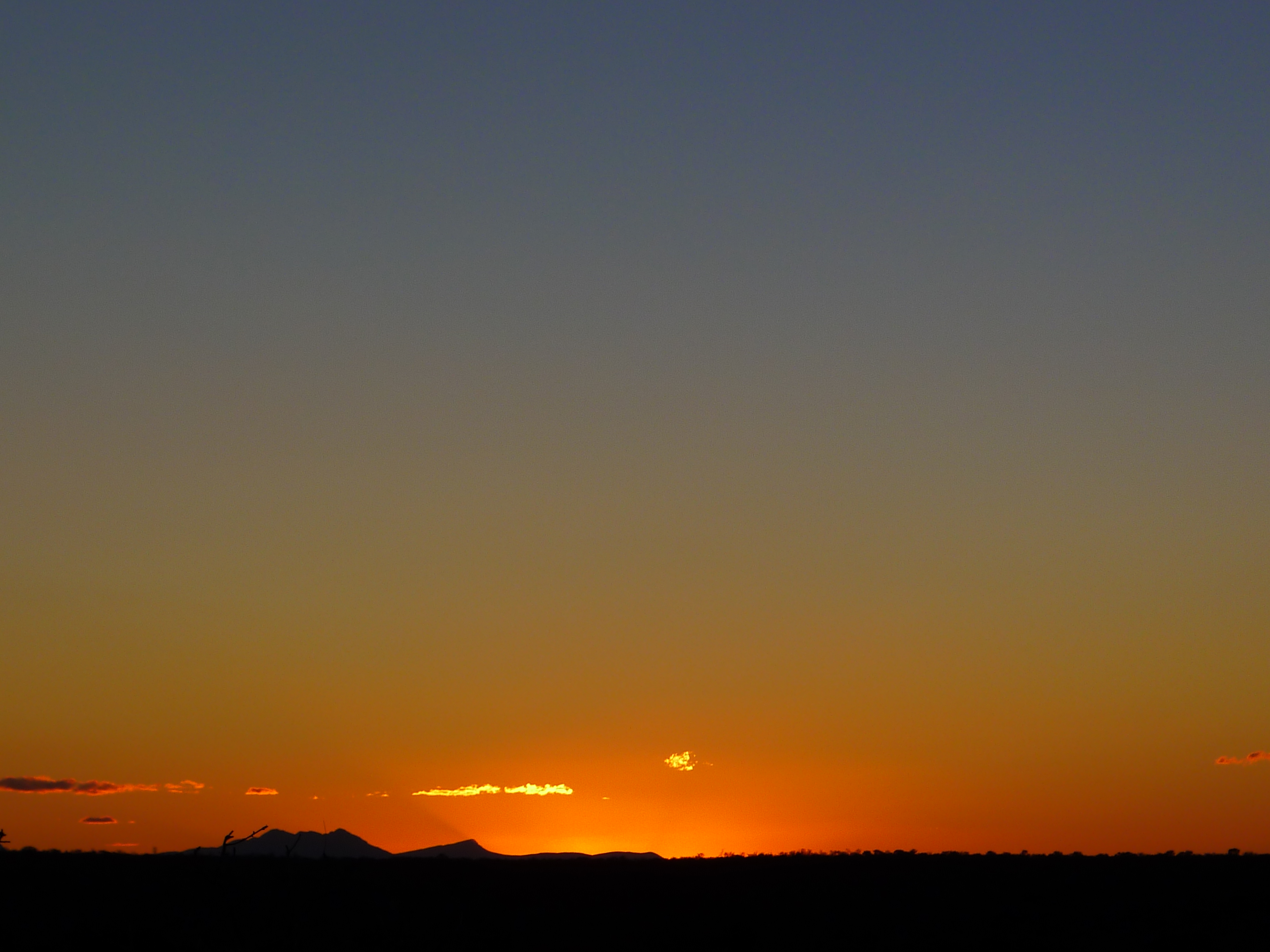
The Scops owl is first with its ‘poop poop poop’ call sounding almost like an insect. Then the night-jars join in. A distant rasping bark and the jackal are off calling ownership of their territory. They stop suddenly and a moment later there it is, the slow wo-oop! Woo-ooop! and the hyena clan are declaring they are up for business.
There has been no respite to the constant noise of the African bush during this transition between day and night; a seamless mix between the two sound tracks. As the evening wears on and the night shift are out hunting in earnest it gets quieter. If you are lucky enough to experience this it is unforgettable. The silence is thick, it hurts your ears and you want to shake your head to clear it. You are straining to hear anything out there in the blackness and your senses have you on high alert, never mind that you are in a vehicle your primal instinct knows this is Africa and beasts roam that want to eat you.
The only sound is a cacophony of insects and it is this that gets in your head, it is a relief when a spotted eagle owl calls breaking the pitch and giving you perspective again. Staring into the blackness you see a shape move , you can’t make out what it is, then comes a noise that goes right through you, a guttural, low sawing sound, a leopard is calling broadcasting its presence using the ground as a sounding board. He walks out in front of you, pauses for a moment, then strides off purposefully into the night.
The silence of the African night is palpable. You could slice it with a knife. It is so full of promises of wonderful animal encounters that I never want to sleep. It’s my favourite sound of silence; what’s yours?

Antelope Versus Oxen- The Case of the Eland

Of all the antelope that we classify on snapshot Serengeti the eland is one of the most distinct. Its massive size, heavy set horns and swinging dewlap lends it a bovine appearance yet it is an antelope – all be it Africa’s largest. A member of the Tragelaphini family or spiral horned antelope the eland is closely related to kudu, nyala and bushbucks.
There are two species, the common eland (Taurotragus oryx) we are familiar with in the Serengeti and the giant eland (Taurotragus derbianus) found sporadically in woodland savannah across Central and West Africa. One thing to get straight is that giant eland are on average less bulky than their common cousins, the ‘giant’ refers to their horns.
At close to a thousand kilograms in weight a fully grown male eland equipped with a fortified neck and viscous hefty horns could prove a lethal adversary. Perhaps it is unsurprising then that most male interactions are highly ritualised and the real fighting only really occurs between males of near equal stature. It is an unusual trait in male eland that the neck, shoulders and dewlap continue to enlarge as the animal ages. They develop tufts of wiry hair on their foreheads and noses and a strange clicking in their knees develops that is audible quite some distance away. I remember once sitting in a clearing in the bush and hearing what sounded like multiple people cracking their knuckles whilst moving closer towards me. I could not even begin to imagine what was fast approaching me and began to get a little nervous, looking around for a tree to climb. I heard nothing else but the odd branch moving until out from the edge of the bush appeared a small group of eland. Much to my relief it was precisely these knee clicks that I had heard.
Although not a particularly fast running antelope eland are noted to be extreme jumpers. They are capable of leaping over three meters high from a standstill which to me puts to bed any lingering doubts that they are antelope not oxen.
As many of our snapshot images attest to they are often found in quite large herds, congregations 100’s strong are not unheard of. But all the same there is no real structure to the group. Herds can comprise all males, all females or mixed sexes and ages. They are highly interchangeable and very few bonds are formed. Even the sacred mother and calf bond is tenuous in eland society. Calves form crèches when they are a few days old and prefer to hang out away from the adults. They only suckle once or so a day and that can be the only time spent with mum. Female eland will band together in defence of their young but as they are often out of sight of the youngsters this doesn’t happen too often. Instead young eland grow fast attaining 450kg in their first year.

Although life seems good in these juvenile gangs and generally eland are long lived, mortality can be high in youngsters. Whilst studying leopard in South Africa we found eland was a common prey item, in fact we discovered three kills within a month of eland less than six months old and those were just the ones we found. Lion and hyena are also known to take their toll. There is no real synchronised birthing in eland herds with young born at anytime. I guess this means there is always a slightly younger, less savvy, youngster in the crèche that is easy prey for predators.

Leopard with eland kill
Next time you find an image of an eland herd have a close look to see if you can work out if they are females (smaller with more slender horns), males or if perhaps it is a crèche.
The Bird That Packs A Punch

Across the African Savannahs many different birds can be seen strutting around on long legs, a perfect adaptation, often coupled with long necks, to give them a higher vantage point to see over the long grasses. We are talking about ostrich, korhaan, ground hornbill and storks to name a few. All these birds use the same method of steadily walking through the grass picking of preferred prey items; grass itself in the case of the ostrich.
One of the most fascinating to me is the secretarybird (Sagittarius serpentarius). Reportedly named for its resemblance to a medieval scribe with a quill behind his ear other sources suggest the name is a Francophile corruption of the Arab word saqr et-tair which translates to hunter-bird. Whatever the origins of its name the frond of spatulate nape feathers and the elongated central tail feathers easily distinguish this bird.
It is something of an enigma taxonomically speaking, making up its own unique family, Sagittariidae. It seems secretarybirds are related to eagles sharing skull structure and a type of feather lice. Currently aligned to diurnal birds of prey it has previously been thought of as a relative of storks and cranes. Indeed its breeding behaviour is very similar to that of storks, which to make things more complicated are also share a close affinity to birds of prey.
Taxonomic complexities aside secretarybirds do look like elongated hawks, they share that hooked bill and yellow cere common in birds of prey, they also possess a large gape which allows them to open the bill wide enough to swallow large prey whole. But it’s their feet that do all the work.
The modus operandi for a secretary bird is to stalk along quietly and stomp its prey with a torrent of fast powerful kicks to dispatch it. This method is used for a number of prey items such as arthropods, rodents, amphibians, game birds even mongooses. In fact anything, really, that can be subdued and killed by its deadly kicks is fair game. That said it is the secretarybird’s ability to despatch snakes that has endeared it to most Africans.
To sneak up on a snake and then kill it quickly takes a lot of skill and you best not make a mistake otherwise in the African bush you may end up the one dying.
A study led by Dr. Steven Portugal, from Royal Holloway, University of London found that although other birds of prey strike their prey with far more force this is enhanced by the momentum of their entire bodies plunging down from flight. The secretarybird is able to exert a force 5 times greater than its own body weight from standstill and can repeat this accurately with multiple kicks being delivered at a speed of 15 milliseconds each. Fast and furious, that’s how this bird tackles deadly snakes and biting mongoose.
If you are interested you can read the paper here. http://www.sciencedirect.com/science/article/pii/S0960982215014839
Serengeti Field Update
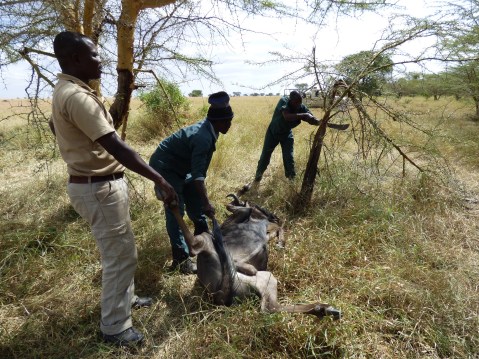
Snared wildebeest being released
June through August is a busy time for scientific researchers. They get to leave their desks and all that computer stuff and go visit their study area. Snapshot Serengeti’s resident researcher Meredith is lucky enough to be in the Serengeti as I write and she has shared a few recent experiences with me.
She is currently setting up a new camera-trap array in Grumeti Reserve which borders the Serengeti National Park in the north west. This area was created as a buffer zone to the Serengeti National Park to help protect the western corridors of the famous wildebeest migration of the Serengeti/Mara ecosystem. Grumeti in turn is bordered by villages and has one of the fastest growing human populations around the Serengeti Park. Traditionally these communities hunted for bushmeat to supplement their diets but with the rise in population it is doubtful if this is still sustainable.
Meredith has been out this week following the migration as it moves along Grumeti’s northern border. As well as setting camera-traps and marvelling at the numbers of wildebeest she has also seen the darker side of conservation that almost anyone working in protected wildlife areas in Africa is familiar with; poaching. She reports that they have been removing snares daily and that distressingly they found 4 snared wildebeest within a half hour, two were dead, one had a broken leg and had to be killed but miraculously they were able to release one. Whilst trying to select camera-trap spots Meredith and her team encountered poachers butchering a fresh caught wildebeest, they were able to give chase, alas to no avail.
In areas like this the locals know well the movements of the animals and they will seed the area with thousands of wire snares. Anti poaching teams are kept even busier during migration time knowing this too. The anti poaching team, well trained as they are, have had more luck than Meredith and her team. This week they set up an ambush and took out a biltong (dried meat) camp. Their efforts on the front line destroying snares and apprehending poachers as well as the community liaison work that goes on at Grumeti has reaped rewards. Animal numbers are on the rise, the elephant population has quadrupled in the last 11 years and giraffe and topi numbers have tripled.
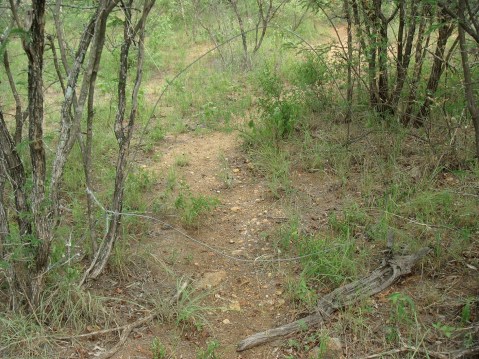
Wire snare set along a game trail
Still Dr Craig Packer and his colleagues have estimated that tens of thousands of wildebeest are poached each year…and this is not a problem that will go away. You can read more about the issue in this Africa Geographic article.
Poaching goes on all around the world, I have even found wire snares set in my own garden her in France (probably for badger). It is a senseless, lazy but effective way to catch animals. There are many reasons why people poach, when I lived in South Africa the local community would poach our animals not because they were poor and couldn’t afford meat but because warthog and impala meat could fetch higher prices than chicken, goat or pig. Christmas was a particularly bad time for poaching as local chiefs put in their orders. Bushmeat was a delicacy and poaching made good money. In Central African Republic the systematic stripping of wildlife by the Sudanese cattle herders has been stimulated by draught and poverty in Sudan, they dry most of the meat to take back and sell in the Darfur region. Utilising the natural world is deeply rooted in many cultures around the world and always has been. Opportunity is what fuels the practice but it is the rapidly rising human population that is causing this age old practice to become unsustainable in our shrinking world.
I hope Meredith doesn’t have to witness too much more wildlife destruction but all the same it is good for a scientist to get firsthand experience of one of the biggest issues facing wildlife today and for us to recognise it.
Southern Ground Hornbill

As some of you know, Snapshot Serengeti is not just about mammals. Their avian cousins also like to get in on the act especially the larger ones. Amongst the more common captures are kori bustards, secretary birds, korhaans, and storks. The one I like best though is the ground hornbill.
I fell in love with these birds many years ago when I helped hand raise southern ground hornbill chicks. Although wide spread and fairly common over most of southern and eastern Africa the southern ground hornbill has lost around 70% of its home range in South Africa. They are large birds and don’t do well outside of protected areas especially where human density is high.
Ground hornbills lay two eggs in, believe it or not, a cavity in a tree. The first chick to hatch will kill the second, which is really just an insurance policy in case the first egg doesn’t hatch or should die in the first few days. We were given permission to take the second egg once the first had hatched in order to hand rear then release the birds. The newly hatched chick has to be one of the ugliest babies I have seen. It is a charcoal grey naked greasy looking blob with a head so large it cannot lift it up. For the first day or so it just flops around barely able to raise its bill for food. When its feathers start growing it looks like a diminutive dinosaur. Eventually they do blossom into the splendid giants that strut across the savannahs in small family groups eating a range of food stuffs from insects, rodents and reptiles. They can kill efficiently with that heavy bill and will take anything up to the size of a hare.
Considering their size it is hard to believe that they can fly but fly they do and spend time perched in trees. In fact the loss of large trees is another reason behind their decline, as I said earlier they need trees to nest in. Ground hornbills are cooperative breeders with several family members helping to rear the single chick. This joint effort seems strange until you realise that although they breed once every three years the groups only manage to raise one chick to maturity every 8 to ten years. Once a chick has fledged it is dependent on its parents for two years, which is the longest span of any bird and makes reintroduction programs very hard. It only reaches maturity at 6 years old.
There are two species of ground hornbill, found only in Africa. The southern ground hornbill (Bucorvus leadbeateri) the species found in the Serengeti and the northern ground hornbill (Bucorvus abyssinicus) found across sub-Sahara from Mauritania to Uganda in suitable savannah habitat. The later is slightly smaller than the former and has some blue facial patches which distinguish it from the red of southern ground hornbills.
Such a large bird living mostly on the ground the ground hornbills have not escaped the attention of man. Although many tribes hold totemic beliefs about the birds that afford them some protection others are not so lucky. The Zulus and Xhosa of South Africa believe that to break a drought a dead ground hornbill must be tied down in a streambed to attract rainwater. In a more modern twist ground hornbills, ever territorial will smash windows and car windscreens with their powerful bills in a misguided attempt to evict intruders (namely their reflections) This has not endeared them to humans.
All in all the ground hornbills are magnificent birds, next time you spot one on Snapshot Serengeti take a moment to have a closer look.
World Environment Day

Tree with Landrover
The 5th of June is world environment day. This event was created by the United Nations back in 1974 to promote awareness of our environment and to spur people globally to help protect it. Its celebration has never been more important than in today’s challenging times. All over the world people will be taking part in a host of events that celebrate our environment. Some have formed clean up events of local beaches or city parks. Others will be doing a bioblitz in their gardens or local reserves many will include children who will be inspired by searching out and identifying bugs. There will be events organised on the public scale such as awareness marches or environmental film screenings. Some folks will simply celebrate by stepping out in the open air to take a walk or picnic. Whatever the event you can be sure that a lot of people will be considering the environment this week and that can never be a bad thing.
Each year there is a theme, this year it is ‘connecting people to nature’ I thought this was particularly apt for us citizen scientists at Snapshot Serengeti. Through the millions of images we classify there is a strong connection to the rhythms of animals in the Serengeti. We get to appreciate the wide biodiversity of this immense ecosystem and for those of us unable to visit such a place it is a way to connect to a wild unspoilt place. It is a way to visit, virtually, leaving no carbon foot print as we would by flying there. I feel it is a privilege afforded us thanks to technology that I would not have even dreamed of 15 years ago.
Snapshot Serengeti is the perfect antidote to the doom and gloom decried each day by the newspapers. In a world where wildlife is dwindling and the finger is firmly pointed at us as the major cause of climate change Snapshot Serengeti feels like something positive and good. Something to give us hope that we might not have wrecked everything just yet. From our armchairs we not only experience the wonders of nature but at the same time we are actually benefiting science with our classifications. What can be better than that?
So if you have nothing else planned this #World Environment day why not jump on to Snapshot Serengeti and get classifying, better still see if you can recruit new classifiers, the more the merrier.
If you want to read more about world environment day visit this site.
The Cycle of Life
The waterbuck just stood there, unfocused, staring at nothing. He didn’t move except for the gentle flare of nostrils and rise of ribs as he drew breath. About 8 to 10 minutes went by and still not even a twitch of an ear to dislodge an annoying fly. Then as if released from a spell his drooping head rose a little and he took a step or two towards the stone bird bath where he took a few long draughts of water. After that he slowly walked of through the bushes and out of sight.
I couldn’t quite understand his behaviour thinking perhaps that he was ill. Although he sported a magnificent set of horns his coat looked more than a little out of condition and he looked thin. For a waterbuck to be this close to the house in the middle of the day was unusual. He was less than a meter from me; if the glass window wasn’t there I could have reached out and touched him. I didn’t see him again after that encounter until about 5 days later. Sitting on my stoop I could smell a whiff of something dead, not an unusual smell when you live in the bush, so I went exploring following my nose. It didn’t take long to find him. He was tucked in, sitting down, between the banking and a large boulder. First I thought he had fallen but actually he looked so peaceful I think he lay down in a position that he felt protected in and let his life ebb away.
You see on closer inspection I found his teeth to be worn away to almost nothing. This is common in antelope, if they make it through life without being preyed upon or succumbing to disease then they often die from starvation when the teeth, worn down to nubs, are unable to cope with the tough vegetation it survives on through the dry season. That vacant stare I had seen is something I have witnessed in starving antelope before. So although I couldn’t rule out disease (I am no medical expert) my guess from his behaviour and condition was that he had passed away with old age.
My quandary now was what to do with him. I could leave him be and let nature take its decomposing course (and this is what I would normally do) but that would mean I was going to live with an ever more nauseating death smell for a few weeks which believe me is not good. On the other hand pulling a 200kg animal out from a snug hole was not going to be easy. To cut a long story short I called for backup and with ropes and much holding of noses we got the waterbuck out and dragged him down to the river side. I sat there all day waiting to see if a croc would come and take the waterbuck or perhaps a hyena or vulture. Disappointed that none of natures garbage collectors came I walked off home just before dark.
First light the next day off I went back to the scene. Nothing. Not even a drop of blood. I can only conclude that the crocs did indeed come under the cover of dark and dragged the carcass into the depths where nature’s great cycle of life and death continued to the crocs advantage.
Citizen Science Conference
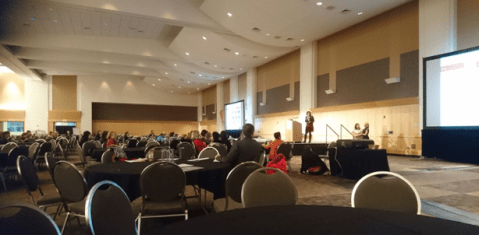
Meredith giving a project slam Photo: Avi Baruch
Meredith has been busy this past week attending the Citizen Science conference in St Paul, Minnesota. She reports back that it was a fantastically stimulating conference that confirms the high esteem that citizen science has grown within the science community.
The yearly conference sees a diverse group of people from researchers, educators and universities to the likes of NGO’s and museums get together to discuss the use and promotion of citizen science. Although we at Snapshot Serengeti have been aware of its great impact for some time citizen science is now emerging and is recognised as a powerful tool in the advancement of research by many.
Those attending the four day event collaborated by sharing their varied experience and ideas on a variety of topics. The collection and sharing of data and how to impact policy was discussed. There was focus on how to use citizen science as an engaging teaching tool, how to bring citizen science to a wider audience and how to involve citizens more in research. Those attending brought their joint experience and expertise together to discuss how citizen science impact on science could be measured and evaluated. If you want to find out more about the conference then visit this link.
http://citizenscience.org/association/conferences/citsci2017/
We sometimes forget when working away at classifying our stunning images on Snapshot Serengeti that there is a lot of tech going on that enables us citizen scientists to be of use to the scientists. Meredith gave what’s known as a ‘project slam’ essentially a 5 minute presentation about our work on Snapshot Serengeti and how it has paved the way for helping other cameratrap citizen science projects. A quick look around Zooniverse will show just how many there are now.
The massive amount of data produced over several seasons through Snapshot Serengeti have allowed the development of a robust, tried and tested methodology that smaller projects would have taken years longer to develop. Just contemplate the work that went into developing interfaces, protocols, pipelines and algorithms for taking millions of classifications of untrained volunteers and turning them into a dataset which has been verified to be >97% accurate.
It is awesome to see that something we all find so truly engaging can translate into such serious stuff in the field of science. I think we, the citizen scientists, and the Snapshot team can be rightly proud of our work on this brand new branch of science
A Green Desert
I have to admit that I actually quite like insects, they fascinate me, they are often brilliantly coloured and despite being so small seem to send most humans into a frenzy of panic. It astonishes me that these tiny creatures can come in such an array of beauty; something about the miniature form is beguiling. How can so much colour and pattern fit on such a small form.
However there are insects that do not elicit these feelings of wonder. Mosquitoes for one and ticks; both are annoying and can have you in your sick bed. If you have ever been hounded by sweat bees that want to crawl into every corner of your scalp, eyes, nose, ears and mouth you will know what I am talking about when I say they are enough to make you want to dive into a shark infested pool.
But… there is one creature that for me is worse than any of these, one that I cannot tolerate either mentally or physically. The tsetse fly.
My first encounter with tsetse in Central Africa has left me somewhat traumatised. I set off from base camp on a 2hr drive to an old abandoned camp to scavenge some equipment. The car had seen better days and although it had a windscreen it did not have windows. Lovely I thought, it’s hot and it will be nice and airy. The roads were in a bad state, necessitating a top speed of around 30km/hr. The first few km’s were fine then something sharp bit my ankle. Following that the same burning sensation came from my neck then there it was again from my shin instantaneously reappearing, most painfully of all on my temple. I looked around the dash board and it was swarming with about 50 tsetses all of which were clamouring to get to my bare skin and feast on me. They had been sucked through the nonexistent windows and there was nothing I could do to keep them out. All I could do was hold my collar closed whilst driving one handed the rest of the way. By the time I arrived I had welts all over my hands, neck, legs and feet. Yes they had actually crawled into my socks to get at my nice hot blood filled feet. Aarrrrrhhh.
Discomfort aside there is a very real risk to tsetse. They are vectors for a debilitating disease, sleeping sickness medically known as trypanosomosis. The disease effects both wild and domestic animals and humans. Whilst wild animals have a tolerance to the disease cattle do not. 3 million are thought to die a year across sub-Saharan Africa. Sleeping sickness in humans is often fatal if not treated although the death rate has been vastly reduced with modern medicines.
Historically areas of intense tsetse fly activity were not cultivated by humans leaving large fertile areas of the African continent as so called green deserts. Although a terrible burden for the human population it was good news for wild animals. The area of Central African Republic where I worked was one such place. It should have been teaming with wildlife but it wasn’t. In fact it was full of cattle during the dry season. The cattle herders are arriving in ever increasing numbers from Sudan trying to find respite from the desertification of their own lands. So how can this be? How can they survive the obvious tsetse infestation? It is all down drugs and motivation. The cattle must be shot full of drugs in order to survive the tsetse. A lot of these drugs are supplied by aid agencies trying to stop the human crisis developing but this inadvertently turns into a wildlife crisis. Not only do the herders now spend 4 months a year with their cattle competing alongside wildlife for resources but the herders are decimating the wildlife through poaching. They kill as much as they can, drying it to take back to Sudan and sell. It has become a major trade route and next to the armed gangs who extort protection from the families of herders the next richest guys working the route are the medicine sellers. Without the medicine the cattle die and the whole thing collapses.
Depressing I know but it does put the tsetse in context. Perhaps they played a very important role limiting the use of fertile land by over consumptive mammals. Once I learned their role in keeping humans out of wilderness areas I was a little more forgiving of their painful bites. Though when you have hundreds of bites all over you there is always that niggling worry of illness. Thankfully I escaped with nothing more than some ugly, very itchy swellings and a new understanding of the complexities involved with wildlife conservation.

Found amongst poached animal meat and skins, medicine for cattle.
Snapshots From The Past
This weeks guest blog is from our moderator David Bygott who has been guiding us through Snapshot Serengeti images since the beginning.
I’ve been lurking here for years as a moderator, but Lucy Hughes invited me to come out of the shadows and tell you how I got my Serengeti creds.
As a country boy in England I was obsessed with nature and yearned to see more of the world’s wildlife. Reading “Serengeti Shall Not Die” by Bernard Grzimek, inspired me to go there. The dream took some years to achieve. First, I worked hard to get a zoology degree. Then, I wrote to anybody doing field research in Africa who might need a research student, assistant, or slave. I got lucky. A scientist, studying hyenas and wild dogs in Ngorongoro Conservation area, wanted me to work on her better-known chimpanzee project, which I had been following in the pages of ‘National Geographic’. Sounded good.
Thus in 1969 I pitched up at the camp of my new bosses, on the floor of Ngorongoro Crater. Ten days of getting to know Jane Goodall and her photographer husband Hugo van Lawick, and total immersion in African wildlife. Incredible nights of watching hyena packs run down wildebeest and tear them apart. Even a road trip into the heart of Serengeti.
A seed sown, my mind blown, I continued across Tanzania to the remote chimp camp at Gombe National Park on the beautiful forested shore of Lake Tanganyika. Here I spent 2 amazing years with a small team of young people, following the famous chimps through the forest and recording their behavior. Experiencing at first hand our closest kin was a life-changing experience for me.

David with a chimp group at Gombe, 1970
While at Gombe, I met more of my scientific heroes. Bernard Grzimek visited, so did Dian Fossey, and I travelled to Rwanda to see her gorillas. Jane’s doctoral advisor Robert Hinde came, and encouraged me to write up my fieldwork for a Cambridge PhD.
Two unexpected things happened at Cambridge. I met my wife, primatologist Jeannette Hanby. And we got to know Brian Bertram who had studied Serengeti lions for 4 years, following George Schaller’s pioneering work. Brian persuaded us that social carnivores were just as interesting as primates, and that there was still more to learn about lions. It was a change of direction, but we were tempted!
So in 1974 we joined the Serengeti Research Institute as lion biologists, thanks to support from the U of Cambridge. Our main mission was to census the lion population, as National Parks feared that lions were decreasing (they weren’t!). We also compared the lives of lions in different habitats (Serengeti Plains where prey abundance is seasonal, and Ngorongoro Crater where prey is always abundant). And we investigated lion pride dynamics – why do some individuals leave, and others stay?
Imagine being part of a community of scientists studying every aspect of the ecosystem. We had a house in the centre of Serengeti and a Land-rover to go wherever we wanted, and we spent our days and nights with the great tawny cats.

Sometimes humans and lions are attracted to the same campsites
It was remote, but fortunately we were both used to that. Every month we made a supply run – either to Arusha or Nairobi, each at least 200 miles away, mostly on dirt roads. This took 2 days each way, plus several days of shopping and socializing. We learnt a lot about fixing cars, often in beautiful remote settings with primitive tools.


There was much less technology then. We had basic maps but no GPS, radio or mobile phones or internet. There were no computers, though we had cutting-edge hand-calculators. Radio-telemetry was in its infancy; we built our own radio-collars and darted and collared a few lions, but for most of our study we had no air support and ground-to-ground range was poor, so we had to rely on careful searching to find the lions – scanning with binoculars, driving, staying out at night to listen for roars. We identified the lions from natural markings and close-up photographs, on film of course. We developed a symbiosis with cheetah biologists, George and Lory Frame, photographing each others’ study animals whenever we saw them and trading ID photos to increase our sightings. We learnt as much as we could about what all our colleagues were doing, and often participated in ecosystem-wide aerial animal censuses.
We tried various methods of counting lions, including aerial and ground transects and individual recognition. The latter proved the most successful, but it was hard work to identify all the lions in our 1000 square study area. In addition, every second month we’d spend a week in Ngorongoro Crater. After finding as many lions as we could there, we would follow one pride for 4 days and nights, to observe their activity, range and hunting success. We did the same with a comparable pride living at Sametu on the Serengeti Plain. The story of the Sametu pride unrolled like a soap opera, and we couldn’t resist writing a book about them. “Lions Share” tells their story, but also incorporates much of what we knew about lion behavior and about the ecology of Serengeti. (Out of print, but look on Amazon).
Eventually we had to leave, and our friends Craig Packer and Anne Pusey took over the Serengeti Lion Project. Craig amazingly kept it going from 1978 to 2014, and Snapshot Serengeti is an offshoot of what has become one of the world’s longest running wildlife studies.
After writing up our 4 years of lion data, we returned to Tanzania in 1982 to work in conservation education; university teaching, producing guidebooks and interpretive displays, and guiding safaris. We built our home near Lake Eyasi, and experienced years of village life and culture clash, but that’s another story (in preparation). In 2003 we moved to Tucson, Arizona, but I still get back to Tanzania every year, mostly leading National Geographic Expeditions.
I’m organizing my own safari to visit Serengeti and other parks in February 2018. If you seriously want to see these wonderful animals in the flesh, send me a message!
 Snapshot Serengeti