
Black and White
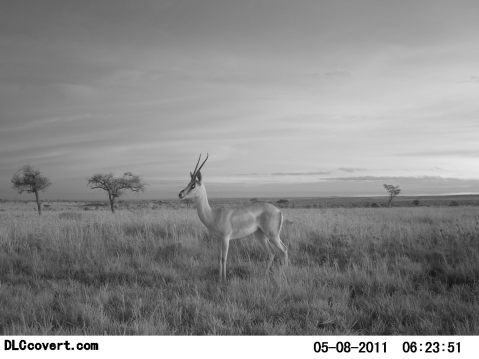
Grants Gazell
This past week I have been trudging up and down boggy slopes with armfuls of tree protection tubes, posts, tools and finally trees as part of a reforestation project in the Lake District National park, UK. With storm Doris fast approaching it has been a miserable week and my mind has often wandered over to snapshot Serengeti for some light relief.
The job I am doing, trying to help mitigate the over grazing of sheep and deer made me think of Michael Andersons work that has provided us with the images for season 9.5. He has written here about the project to study how herbivores affect vegetation patterns and you will have seen the enclosures around his experimental plots.
Some people have found that the images from this season are not quite as good as in previous seasons, they seem to be a bit fuzzy in places and there are a few less lions. On reflection though it does seem to be producing a lot of my favourite images, those taken during dusk and dawn when the camera is not quite sure if it is day or night and ends up taking a black and white daytime shot. These pictures can be quite exquisite and have the feel of being completely composed by a top photographer rather than just a random event.
Here are some of my favourites.
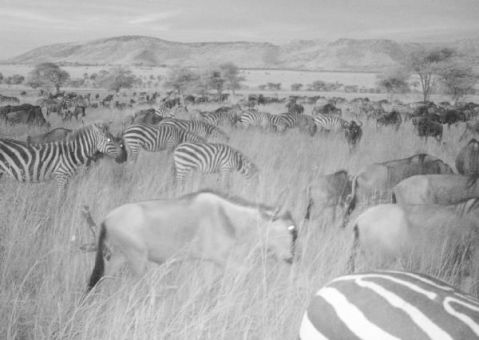
Zebra/Wildebeest
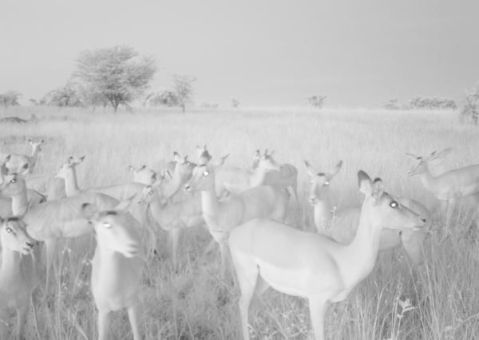
Impala
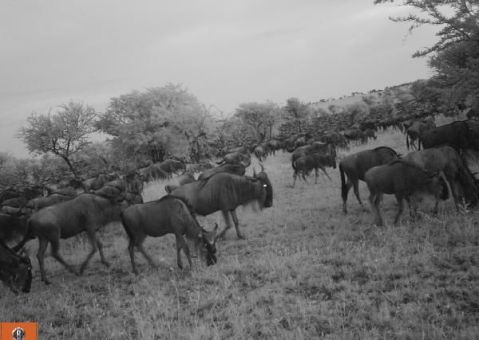
Wildebeest
It is a good reminder to us all that although we are all waiting to discover that one truly great animal capture and it is gratifying to classify the more unusual beasts the aim of the whole project is science. Back in the old days of Serengetilive the classifying was done one camera roll at a time. Sometimes I would sit and classify 2000 capture events of….. grass. Seriously, you would be luck to maybe get a passing bird but it had to be gone through just in case the last couple of shots were of lion. At least with Snapshot Serengeti the pictures are randomised so you get shots from a mixture of cameras rather than being stuck on a tedious one.
Snapshot Rhinos
One of the animals that continue to be a rarity on snapshot Serengeti is the rhino. We have had a handful of capture events over the years.
There are two species of rhino found in Africa; the white or square lipped and the black or hook lipped. The Serengeti is home to the latter. It is a large bulky mammal and as such many a hopeful #Rhino has turned out to be a blurry image of an elephant or buffalo. Things can get confusing with some of the images but isn’t that half the challenge trying to guess those indescribable blobs? Surely it wouldn’t be the same if everything was easy to id?
Anyway back to Serengeti rhinos.
Just 50 years ago between 500 and 700 Eastern Black Rhino (Diceros bicornis michaeli) roamed the Serengeti-Mara ecosystem but during the seventies the population was decimated by poaching to around 10 or so individuals.
A huge effort is being made by various conservation and government bodies with enormous donations by private individuals to save the population from total extinction. Notably a remnant population in the park was highly protected and slowly, over the next few decades the population made some recovery. In 2010 it was decided that the Serengeti area was being protected well enough to try and bolster the resident rhinos with new genetic stock. It just so happened that a private owner in South Africa had a breeding herd of Eastern black rhino that had been part of the attempt to safe guard the subspecies back in the 60’s, these animals had originated from Kenya. With strict controls by IUCN officials it was deemed these animals were of the right genetic stock to be reintroduced to the Serengeti.
The plan was to translocate 32 rhinos over the next few years and release them in a new site close enough to allow some overlap with the resident 30 or so rhino. Unfortunately the project has been affected by the recent escalation in rhino poaching and it is difficult to find how many rhino have been successfully translocated to date let alone the current Serengeti total population but you can bet it is still small. The IUCN red data list states Tanzania as having 88 Eastern Black Rhino in 2011.
If you are lucky enough to stumble across a rhino capture on Snapshot Serengeti you should definitely celebrate … and don’t forget to # it.
The Challenges of Field Work
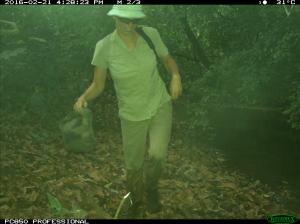
Hazard of the job; catching myself on camera-trap
If you have clicked through the seemingly endless captures on Snapshot Serengeti then you must have realized just how many cameras are snapping away out there in the Serengeti. Have you ever wondered who looks after those cameras?
Researchers sometimes go to extreme lengths to collect their data and not much deters them from their goal.
On a recent assignment working in Central African Republic I was tasked by our biologist to collect in an array of 40 camera-traps. The park was very large, the size of Wales and very remote, the nearest village was a 12 hours 4×4 drive away. It was also newly proclaimed and had little in the way of infrastructure like roads. Of course, Thierry wanted to survey the areas we didn’t yet know so obviously the cameras were nowhere near any of the smatterings of roads.
He presented me with a mobile phone resplendent with a mapping app which showed the camera trap locations overlaid with our rudimentary road network. I should really say temporal track system as these so called roads consisted of two tire tracks driven through the elephant grass and mud soon to grow over again in the coming wet season. The park consists of a mosaic of wooded savannah and tropical lowland rainforest so you are either struggling through 2 meter high elephant grass or deeply tangled riverine forest growth. Added to the physical challenges of working in the park was the fact of it harboring armed Sudanese cattle herders, poachers and Lord’s Resistance Army militia.
So equipped with the mobile phone, two trackers and 5 armed rangers off we went to collect the cameras. After three hours bumpy ride plagued with biting tsetse fly we got as close to the first camera as any road was going to take us. Using the phone to navigate I pointed us in the general direction praying that the battery would last. If it failed we would be completely lost with no landmarks. Two kilometers later we had narrowed down the camera location to about 20 meters and under the vigilant eye of the rangers myself and the two trackers began searching for the camera in the thick jungle tangle.

Rangers caught on camera-trap whilst on patrol
Once the camera was reclaimed it was bagged up and we set out for the walk to the next camera another kilometer or so away. The whole day was spent battling foliage and insects in the 40o c temperatures for a total of 8 cameras. We made camp for the night; the journey back to base was just too far with so many cameras still to collect. It took 4 days to collect half the array and it was with some relief that we trundled back into base camp having had no encounter with armed men. A hot shower, something other than sardines to eat and the excitement of examining the camera-trap pictures was a just reward for all our foot work
The cameras were being used to assess what species were present in the park and as such were left up for short periods in small arrays. In the Serengeti however, there are 225 camera traps permanently running in an area of 1125 km2. Just think of the logistics involved with changing batteries, keeping vegetation trimmed back and changing SD cards. Our researchers work tirelessly to keep the project on its toes and over the next few months I will try to bring you their stories about the work we support from the comfort of our homes. We each have our part to play but together we are a team dedicated to furthering a scientific cause.


Why we do it
Congratulations, your time classifying images on Snapshot Serengeti has resulted in yet another scientific paper. Over 70,000 of you have contributed to analysing the millions of images produced by the 225 Snapshot Serengeti cameras over the last few years. Thanks to all your effort the cameras are still rolling, creating one of the longest running cameratrap studies going. This data set is so important to scientists because of the size of the area it covers as well as the length of time it has been recording for. It allows them to ask many and varied questions about a naturally functioning healthy ecosystem and in today’s changing world it has never been so important to figure out what makes this planet tick.
The paper ‘The spatial distribution of African Savannah herbivores: species associations and habitat occupancy in a landscape context’ was published last year in Philosophical Transactions B. Visit here to read the article.
http://rstb.royalsocietypublishing.org/content/371/1703/20150314
The Snapshot Serengeti team argue that if we want to predict the impact of changes/ losses of large mammals in the future we need to have a quantitative understanding of a currently functioning ecosystem. It just so happens that the Snapshot data set is perfect for this. The Serengeti National Park is representative of the grass dominated Savannahs of East Africa which are home to the world’s greatest diversity of ungulate (hoofed animals) grazers.
The team present a neat graphic that shows how the various elements interact to affect herbivore habitat occupancy.

Predators, herbivores, termites, fire, grasses and trees all play a role in determining where different herbivores choose to roam.
It seems that herbivore body size is also important to habitat selection. For example large herbivores survive by bulk grazing whereas small herbivores concentrate on grazing quality over quantity. Recently burned ground results in new vegetation growth. This growth is relatively high in nutrients compared with unburned patches and the same can be found on and around termite mounds. Small herbivores were found to occupy these areas but the sparse coverage does not favour large herbivores that must eat more volume.
The paper highlights the complex relationship between predators, herbivores, vegetation and disturbance and is well worth a read. Next time you are classifying images see if you agree. Do you see many herds of zebra or wildebeest on burnt areas or is it mostly Thompson’s gazelle? It’s another way to look at the images you classify.
Caught in the act
I am sure you were all enthralled by the recent shots of a male lion with a hyena clamped in his jaw. A truly awesome capture. The reality is that action shots like that are few and far between. Snapshot Serengeti has had only a handful in the millions of images that have been classified to date.
So when Karen and Deon Scheepers caught the following action on camera trap on the nature reserve in South Africa where I used to live I just had to share it with you;

Wildebeest
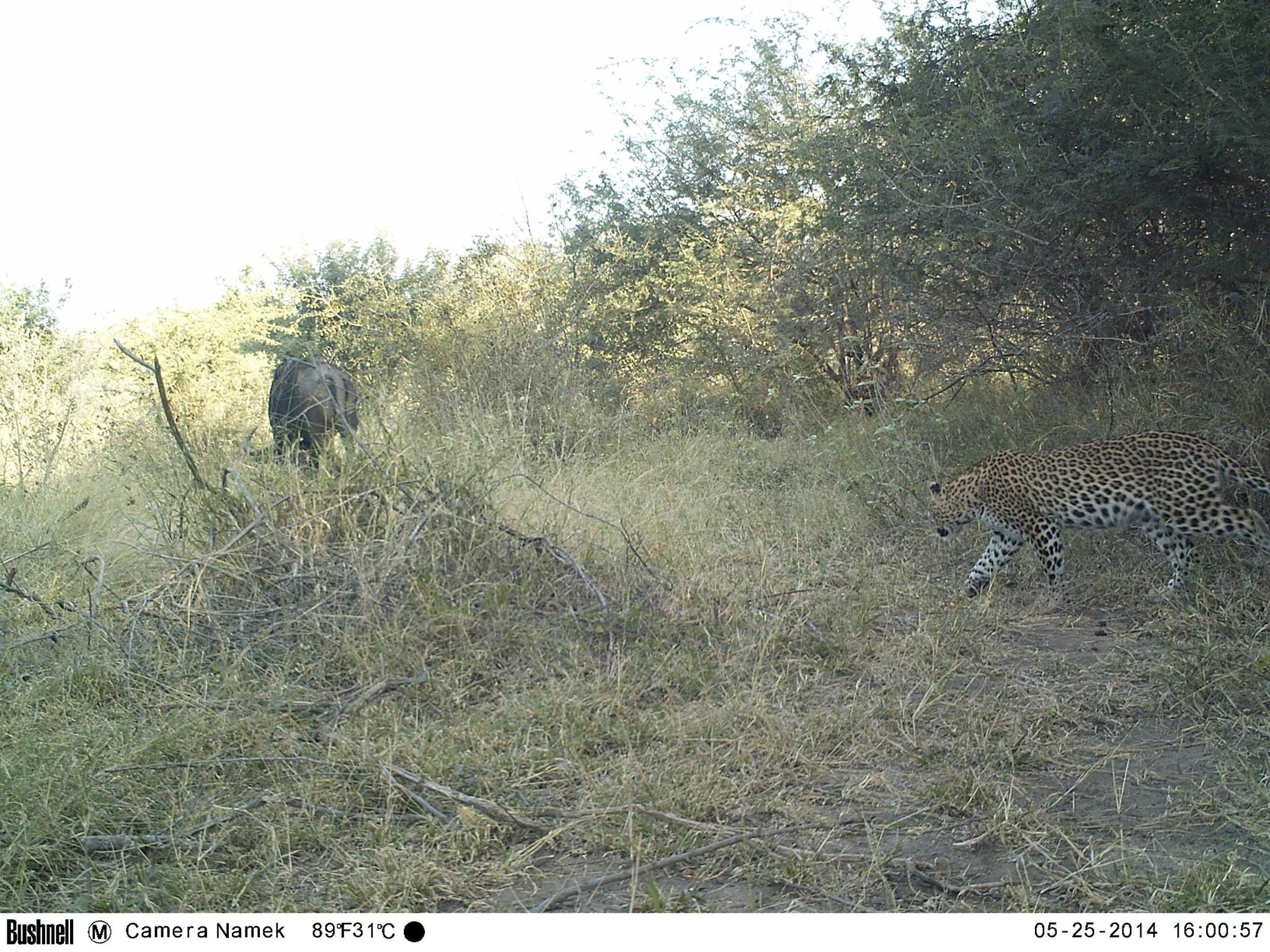
uh oh.. look behind you!

leopard on the hunt
What a capture… a leopard on the hunt. The out come was unknown, reserve staff looked for a carcass but didn’t find anything. To think I used to walk those trails every day, I wonder how many times a leopard walked out behind me!
Thanks Karen and Deon Scheepers for sharing these shots.
Africa on my door step
So those of you who have read my blogs are probably used to hearing me bemoaning the fact that I am no longer in Africa but am back in France whilst I am studying towards a degree. I can’t really complain, life is still good, but the European wildlife feels a bit lacking when you have been used to the mega fauna of Africa.
I have however continued to put out my camera traps in order to survey my property and the surrounding countryside and it’s busier than you would think. Badgers, foxes, hares, otters, roe deer, squirrels, stone martens and wild boar make regular contact with my paltry two cameras. Not really enough camera power to base a study on but interesting all the same.
The highlight has been the discovery that one little favourite of mine from Africa has followed me to France; the genet. Yes the common genet (Genetta genetta) lives in France and I am ecstatic to say right by my house too.
It seems no-one really knows how they got here but it was probably something to do with the Romans centuries ago being brought over from the Magreb region of North Africa. They are now naturalised animals in Spain, Portugal and France. Refreshingly for an introduced animal they are not invasive and have little impact if any on the native wildlife, so I can go on loving them with a clear conscience.
Here are a couple of shots of genets in France for your enjoyment!


The no armed monkey
I am being consumed by envy. Ali is in South Africa and Meredith is in Tanzania. I am stuck in front of my computer working away on assignments with the prospect of an exam looming fast, in fact days away. I want to be finished with my degree and get back out there where the wild things are.
So to distract myself I have been reminiscing about my life in the African bush, it’s been a good exercise as it has reminded me what all the studying is for. Whilst we are waiting for Ali and Meredith’s blogs I thought I would share with you the story of the no armed monkey….
This is actually a true story involving a troop of vervet monkeys whose territory included my house. I would see them at least once a day as they moved from the tall sycamore fig trees along the river, their nightly refuge spot, into the bush to feed. Vervets are fascinating to watch, they are always up to something and that often involved trying to get into my house to steel fruit. I remember one cold winter morning watching a heavily pregnant female on the stoop reclining with her back propped up on a chair leg, her arms and legs spread out warming her swollen belly in the sun. She looked so at home there I thought I may just get to witness a birth, no such luck. So when the troop moved through I would always stop and watch.
It was on one such vervet induced pause that I noticed one sub adult monkey run across the garden on its back legs, almost lemur like. Grabbing the binoculars I got a better look only to discover it was missing both its arms. There didn’t appear to be any sign of trauma nor scarring. The next thing I knew it had run, on its back legs, straight up a smallish tree through its branches and leaped up on to the thatched roof of my house. My eyes could not believe what they had just clearly seen. Obviously having no arms was no impediment for this little monkey.
On subsequent occasions I watched various other members of the group help the no armed monkey by giving it food or just simply waiting for it to catch up. It was able to use its feet to feed itself quite effectively and seemed to get on just fine. My feeling was that it was born this way, I just can’t think of a scenario where it would lose both arms in an accident and recover enough with no scarring. Whatever the truth of the matter, this little monkey was an inspiration.
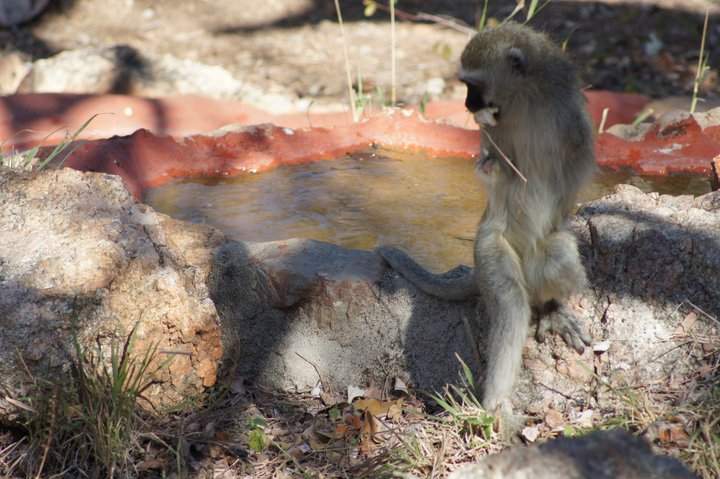
Photo courtesy of Tammy Keizer
Giraffe battle
I thought I would share these video clips from my camera trap with you. During my research using camera traps in South Africa I mostly used the picture mode but in the early days when I was trying to figure out what the camera trap was capable of and what was most valuable from my research point of view I messed around with the video option.
From my research perspective it wasn’t that great, I found that the camera was slower to trigger in video mode and so particularly at night I was left with lots of footage of nothing. But from pure interest value it sometimes proved very interesting.
On this occasion I had set up the camera on a sand road hoping to capture the leopard who frequently passed that way leaving its pug marks for all to see. I was pretty sure of capturing the leopard. What I didn’t bank on was getting a full 17 minutes of footage of two giraffe battling it out. Nor was I expecting the unique perspective from which the camera shot the footage. Oh and the leopard never showed. Typical!
I hope you enjoy the following three short clips.
[youtube http://youtu.be/dUsrGxtQcp0%5D
[youtube http://youtu.be/_PJgoQAus3U%5D
A change of scene; jungles
I have just got back from a short (too short!) trip to Costa Rica. I wasn’t sure what to expect from this world famous eco destination but I decided to bring my camera trap with me on the off chance I would be given permission to set it up and capture something new, for me anyway.
My time was split between two distinct ecosystems, lowland rainforest of the Caribbean slope and dry forest of the Guanacaste/Nicoya peninsular. I stayed in protected areas and reserves so the chances of mammal activity was there, unfortunately I had only two or three days in each place which limited the chances of capturing anything somewhat. Hardly scientific I know but I was curious to see what might be out and about after I was tucked up in bed.
Now I am used to the African bushveld, a dry-ish, semi wooded, semi open grassland environment with a sandy substrate. It is easy to see where animals are frequently passing from trampled vegetation and tracks. Placing camera traps and getting results was not too hard. Costa Rica’s rainforests on the other hand was a challenge. The vegetation was thick, lush and resilient to animal passage and finding tracks in the dense leaf litter was impossible. Costa Rica’s dry forests where just as bad. It was the dry season and the trees had lost all their leaves…big leaves that made a thick carpet on the ground covering any tracks and trails.
Needless to say I did not get too many results but taking my time frame and lack of local knowledge into account it is amazing that I got anything. All the animals were at least new to me so gave me a great buzz.
Of the animals I captured peccaries, a type of pig where the most common in the rainforest followed by crab eating raccoons in the dry coastal forests. I captured 1 agouti, 1 paca, 1 probable grison devouring my camera and the most exciting of all an ocelot. Typically the ocelot was the very first capture on the first night. Staying at the Selva Verde lodge I had the help of the resident guide, Ivan and we placed the camera near to the river. I think he was just as thrilled as I was to get an ocelot despite their being the most common of the neo tropical cats.
I hope you enjoy this short video clip, you can see if you look closely that the ocelot is carrying something in its mouth, prey?
The curious case of the giraffe and the oxpecker
As you all ready know Snapshot Serengeti’s thousands of camera-trap images are part of an ongoing study into predator interactions by Ali. There are few projects that use camera-traps as extensively as Snapshot Serengeti and of course Ali has her hands full analysing the bits relevant to her. The cameras work around the clock recording details of daily and nightly life in the Serengeti and do not discern between the stuff Ali does and doesn’t want. That’s why, Ali’s sanity aside, they are such perfect tools. Those same cameras providing Ali’s data could also be the basis of a future ecologist’s research.
One of the most striking asides for me is the case of the giraffe and the oxpeckers.
Oxpeckers are small birds that feed on ticks and other parasites that they glean from the bodies of large mammals. Most usually they are seen riding along on large mammals such as buffalo, wildebeest and giraffe whilst they search their hosts for ticks or open wounds. This in itself is not an unusual occurrence and most of you will have hit the bird /other button with these guys. Much more unusual are the shots of giraffe at night time with these birds using them as roosting spots. There are two species of oxpecker, the red-billed (Buphagus erythrorhynchus) and the yellow-billed (Buphagus africanus) both of which are found in the Serengeti.
According to research carried out by M. Stutterheim and K. Panagis that looked at the roosting habits of both species the red-billed oxpecker roosts in trees but the yellow-billed was often found roosting on their preferred host species. Apparently red-billed oxpeckers feed on a wide range of host species where as yellow-billed oxpeckers are much more picky preferring buffalo and giraffe. It is thought that the habit of roosting at night on their favourite host species is an adaptation to save the birds time looking for the right animal the following day. Given that buffalo and giraffe are prone to walking large distances this is probably very sensible.
From most of the images we have of oxpeckers on giraffe at night it is hard to tell which species they are but there are one or two where you can see the tell-tell yellow bill confirming that they are indeed yellow-billed oxpeckers. The images also show that the birds seem to prefer settling between the hind legs of the giraffe. This must be a nice warm spot in winter and keeps them safe from any nocturnal predators.

Perhaps the behaviour is not so unusual after all but rather little documented. Getting photographic evidence of birds at night on mobile roosts is obviously not easy. Looks like our camera-traps have excelled themselves again.
 Snapshot Serengeti